
Pulp Fiction, 1883 · page 104 of 142
Stories with a Vengeance — page 104: what you’re looking at
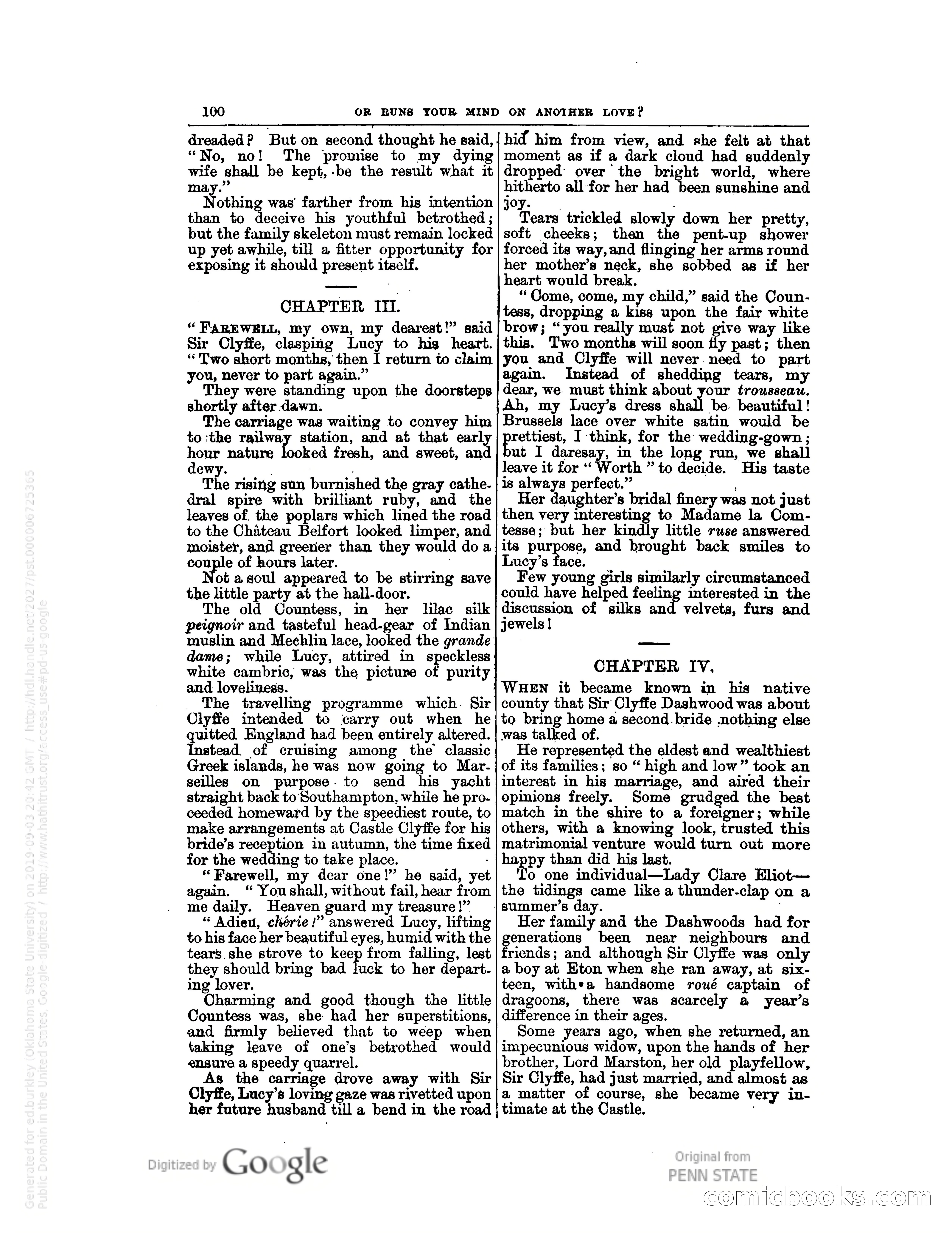
A restored page from Pulp Fiction, 1883. Page through the whole issue in the reader above.
📄 Transcribed text from this page (OCR, searchable)
Machine-transcribed from the original scan — historical spelling and the odd misread are preserved.
100 OR RUNS YOUR. MIND ON ANOTHER LOVE? dreaded? But on second thought he said, “No, no! The promise to my dying wife shall be kept, -be the result what it may.” N othing was farther from his intention than to deceive his youthful betrothed ; but the family skeleton must remain locked up yet awhile, till a fitter opportunity for exposing it should present itself. CHAPTER III. “ FAREWELL, my own, my dearest!” said Sir Clyffe, clasping Lucy to hig heart. “Two short months, then I return to claim you, never to part again.” They were standing upon the doorsteps shortly after dawn. The carriage was waiting to convey him to:the railway station, and at that early hour nature looked fresh, and sweet, and dewy. . . ; The rising sun burnished the gray cathe- dral spire with brilliant ruby, and the leaves of. the poplars which lined the road to the Chateau Belfort looked limper, and moister, and greerier than they would do a couple of hours later. : Not asoul appeared to be stirring save the little party at the hall-door. The old Countess, in her lilac silk peignoir and tasteful head-gear of Indian muslin and Mechlin lace, looked the grande: dame; while Lucy, attired in speckless white cambric, was the picture of purity and loveliness. _ The travellimg programme which. Sir Clyffe intended to carry out when he gutted England had been entirely altered. nstead. of cruising among the classic Greek islands, he was now going to Mar. sellles on purpose. to send his yacht straight back to Southampton, while he pro- ceeded homeward by the speediest route, to make arrangements at Castle Clyffe for his bride’s reception in autumn, the time fixed for the wedding to take place. “Farewell, my dear one!” he said, yet again. “ Youshall, without fail, hear from me daily. Heaven guard my treasure!” “ Adieu, chérie!” answered Lucy, lifting to his face her beautiful eyes, humid with the tears she strove to keep from falling, lest they should bring bad luck to her depart- ing lover. Oharming and good though the little Countess was, she had her superstitions, and firmly believed that to weep when taking leave of one’s betrothed would ensure a speedy quarrel. As the carriage drove away with Sir Clyffe, Lucy’s loving gaze was rivetted upon her future husband till a bend in the road (Go gle hid him from view, and she felt at that moment as if a dark cloud had suddenly dropped’ over the bright world, where hitherto all for her had been sunshine and joy. . Tears trickled slowly down her pretty, soft cheeks; then the pent-up shower forced its way,and flinging her arms round her mother’s neck, she sobbed as if her heart would break. “Come, come, my child,” said the Coun- tess, dropping a kiss upon the fair white brow; “you really must not give way like this. Two months will soon ily past; then you and Clyffe will never. need to part again. Instead of shedding tears, my dear, we must think about your trousseaw. Ah, my Lucy’s dress shall be beautiful! Brussels lace over white satin would be prettiest, I think, for the wedding-gown ; ut I daresay, in the long run, we s leave it for ‘‘ Worth ” to decide. His taste is always perfect.” ; Her daughter’s bridal finery was not just then very interesting to Madame la Com- tesse; but her kindly little ruse answered its purpose, and brought back smiles to Lucy’s face. | Few young girls similarly circumstanced could have helped feeling interested in the discussion of silks and velvets, furs and jewels ! CHAPTER IV. WHEN it became known in his native county that Sir Clyffe Dashwood was about to bring home a second bride .nothing else was talked of. He represented the eldest and wealthiest of its families; so “ high and low” took an interest in his marriage, and aired their opinions freely. Some grudged the best match in the shire to a foreigner; while others, with a knowing look, trusted this matrimonial venture would turn out more happy than did his last. ‘'o one individual—Lady Clare Eliot— the tidings came like a thunder-clap on a |summer’s day. Her family and the Dashwoods had for generations been near neighbours and friends; and although Sir Clyffe was only a boy at Eton when she ran away, at six- teen, with*ea handsome roué captain of dragoons, there was scarcely a year’s difference in their ages. Some years ago, when she returned, an impecunious widow, upon the hands of her brother, Lord Marston, her old playfellow, Sir Clyffe, had just married, and almost as a matter of course, she became very in- timate at the Castle. : JOO @ © = a S CO)