
Pulp Fiction, 1883 · page 134 of 142
Stories with a Vengeance — page 134: what you’re looking at
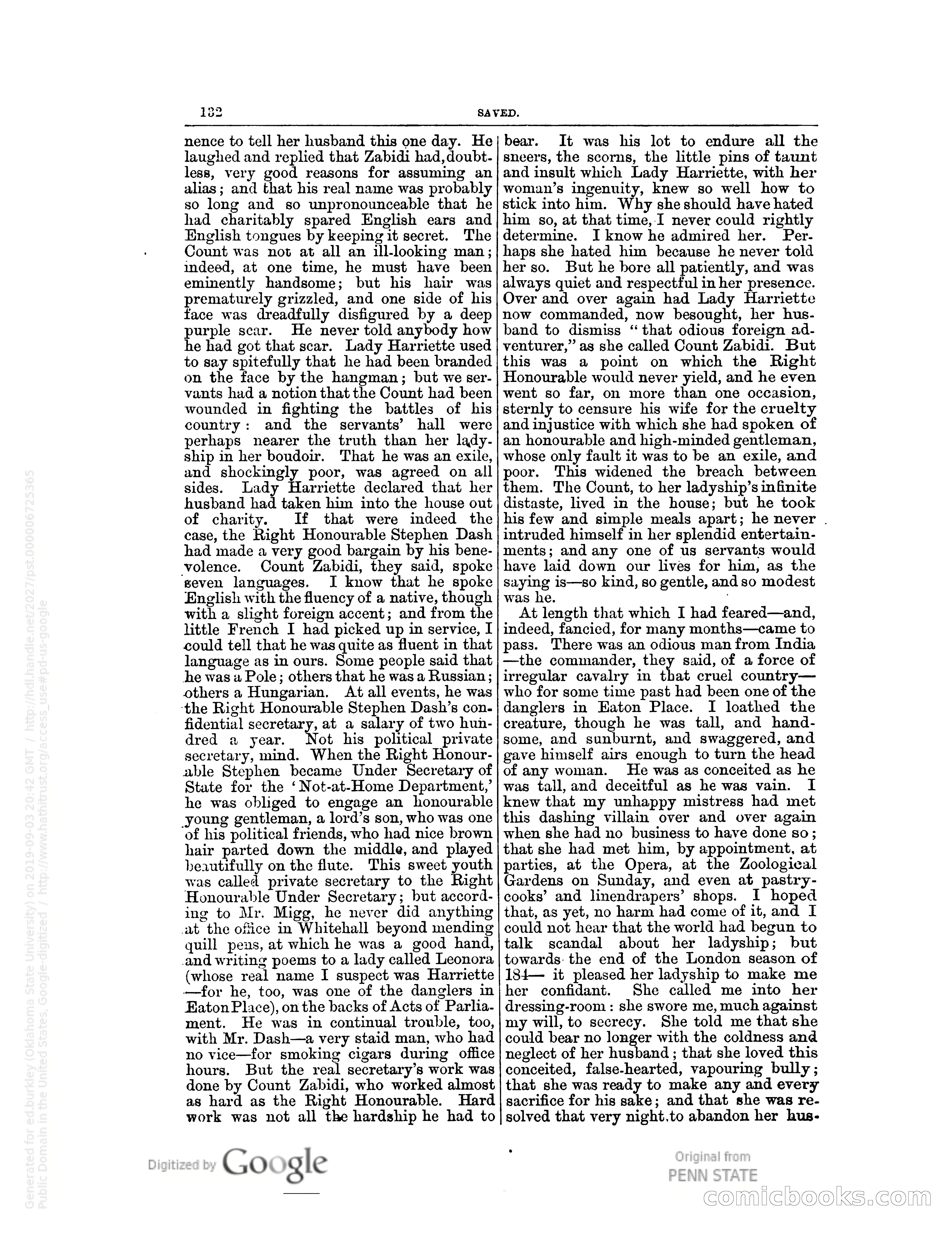
A restored page from Pulp Fiction, 1883. Page through the whole issue in the reader above.
📄 Transcribed text from this page (OCR, searchable)
Machine-transcribed from the original scan — historical spelling and the odd misread are preserved.
182 SAVED. nence to tell her husband this one day. He laughed and replied that Zabidi had,doubt- less, very good reasons for assuming an alias; and that his real name was probably so long and so unpronounceable that he had charitably spared English ears and English tongues by keeping it secret. The Count was not at all an ill-looking man ; indeed, at one time, he must have been eminently handsome; but his hair was prematurely grizzled, and one side of his face was dreadfully disfigured by a deep purple scar. He never told anybody how he had got that scar. Lady Harriette used to say spitefully that he had been branded on the face by the hangman; but we ser- vants had a notion that the Count had been wounded in fighting the battles of his country: and the servants’ hall were perhaps nearer the truth than her lady- ship in her boudoir. That he was an exile, and shockingly poor, was agreed on all sides. Lady Harriette declared that her husband had taken him into the house out of charity. If that were indeed the case, the Right Honourable Stephen Dash had made a very good bargain by his bene- volence. Count Zabidi, they said, spoke seven languages. I know that he spoke English with the fluency of a native, though with a slight foreign accent; and from the little French I had picked up in service, I could tell that he was quite as fluent in that language as in ours. Some people said that he was a Pole; others that he was a Russian ; others a Hungarian. At all events, he was the Right Honourable Stephen Dash’s con. fidential secretary, at a salary of two hun- dred a year. Not his political private secretary, mind. When the Right Honour- able Stephen became Under Secretary of State for the ‘Not-at-Home Department,’ he was obliged to engage an honourable young gentleman, a lord’s son, who was one of his political friends, who had nice brown hair parted down the middle, and played beautifully on the flute. This sweet youth was called private secretary to the Right Honourable Under Secretary; but accord- ing to Mr. Migg, he never did anything at the office in Whitehall beyond mending quill pens, at which he was a good hand, and writing poems to a lady called Leonora (whose real name I suspect was Harriette —for he, too, was one of the danglers in Eaton Place), on the backs of Acts of Parlia- ment. He was in continual trouble, too, with Mr. Dash—a very staid man, who had no vice—for smoking cigars during office hours. But the real secretary’s work was done by Count Zabidi, who worked almost as hard as the Right Honourable. Hard work was not all the hardship he had to Google bear. It was his lot to endure all the sneers, the scorns, the little pins of taunt and insult which Lady Harriette, with her woman’s ingenuity, knew so well how to stick into him. Why she should have hated him so, at that time, I never could rightly determine. I know he admired her. Per- haps she hated him because he never told her so. But he bore all patiently, and was always quiet and respectful in her presence. Over and over again had Lady Harriette now commanded, now besought, her hus- band to dismiss “that odious foreign ad- venturer,” as she called Count Zabidi. But this was a point on which the Right Honourable would never yield, and he even went so far, on more than one occasion, sternly to censure his wife for the cruelty and injustice with which she had spoken of an honourable and high-minded gentleman, whose only fault it was to be an exile, and poor. This widened the breach between them. The Count, to her ladyship’s infinite distaste, lived in the house; but he took his few and simple meals apart; he never . intruded himself in her splendid entertain- ments; and any one of us servants would have laid down our lives for him, as the saying is—so kind, so gentle, andso modest was he. At length that which I had feared—and, indeed, fancied, for many months—came to pass. There was an odious man from India —the commander, they said, of a force of irregular cavalry in that cruel country— who for some time past had been one of the danglers in Haton Place. I loathed the creature, though he was tall, and hand- some, and sunburnt, and swaggered, and gave himself airs enough to turn the head of any woman. He was as conceited as he was tall, and deceitful as he was vain. I knew that my unhappy mistress had met this dashing villain over and over again when she had no business to have done so; that she had met him, by appointment, at parties, at the Opera, at the Zoological Gardens on Sunday, and even at pastry- cooks’ and linendrapers’ shops. I hoped that, as yet, no harm had come of it, and I could not hear that the world had begun to talk scandal about her ladyship; but towards: the end of the London season of 184— it pleased her ladyship to make me her confidant. She called me into her dressing-room : she swore me, much against my will, to secrecy. She told me that she could bear no longer with the coldness and neglect of her husband ; that she loved this conceited, false-hearted, vapouring bully; that she was ready to make any and every sacrifice for his sake; and that she was re- solved that very night.to abandon her hus- @ © = a JOO S CO)