
Pulp Fiction, 1883 · page 133 of 142
Stories with a Vengeance — page 133: what you’re looking at
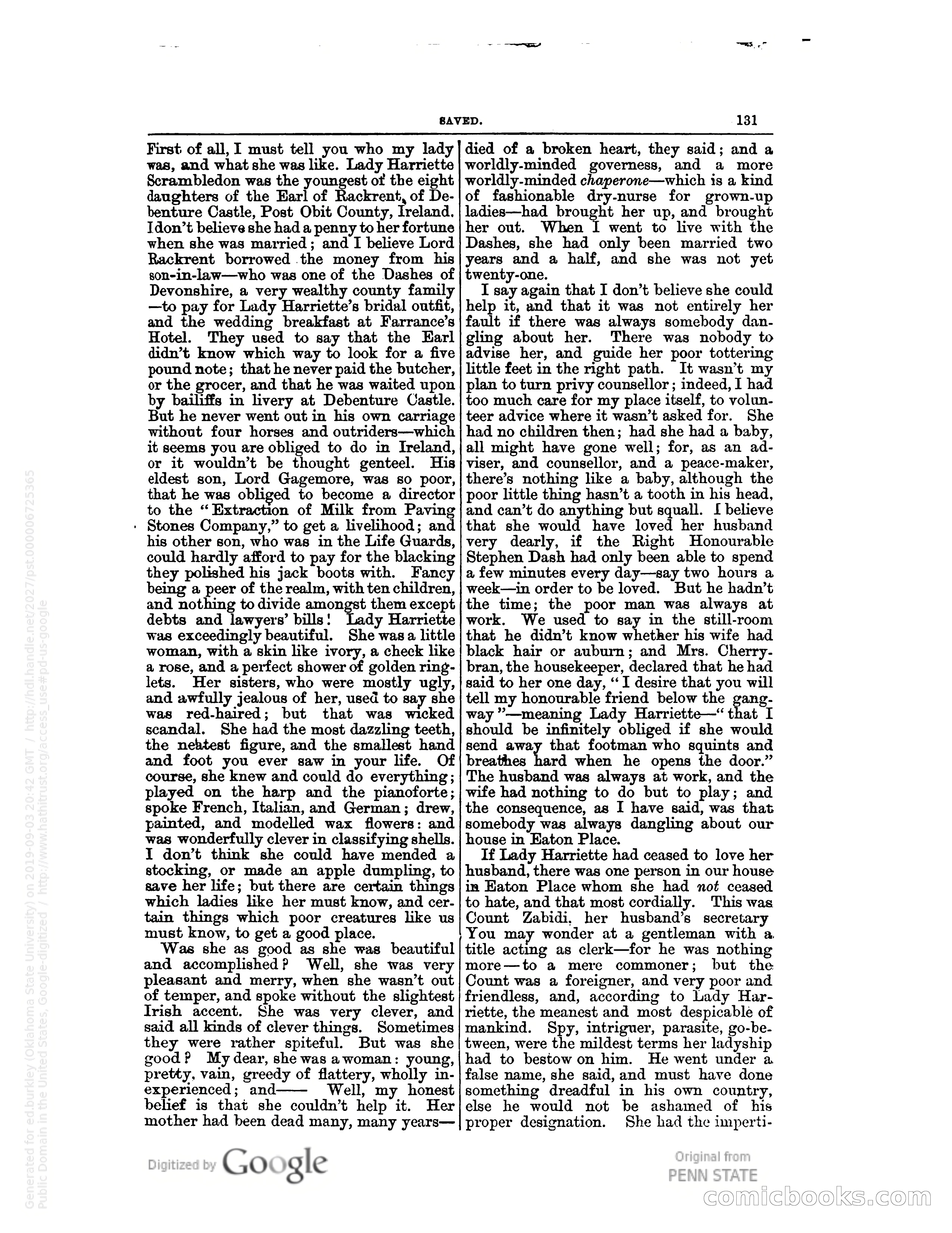
A restored page from Pulp Fiction, 1883. Page through the whole issue in the reader above.
📄 Transcribed text from this page (OCR, searchable)
Machine-transcribed from the original scan — historical spelling and the odd misread are preserved.
SAVED. (131 First of all, I must tell you who my lady was, and what she was like. Lady Harriette Scrambledon was the youngest of the eight daughters of the Earl of Rackrent, of De- benture Castle, Post Obit County, Ireland. Idon’t believe she had a penny to her fortune when she was married; and I believe Lord Rackrent borrowed the money from his son-in-law—who was one of the Dashes of Devonshire, a very wealthy county family —to pay for Lady Harriette’s bridal outfit, and the wedding breakfast at Farrance’s Hotel. They used to say that the Karl didn’t know which way to look for a five pound note; that he never paid the butcher, or the grocer, and that he was waited upon by bailiffs in livery at Debenture Castle. But he never went out in his own carriage without four horses and outriders—which it seems you are obliged to do in Ireland, or it wouldn’t be thought genteel. His eldest son, Lord Gagemore, was so poor, that he was obliged to become a director to the “ Extraction of Milk from Paving - Stones Company,” to get a livelihood; and his other son, who was in the Life Guards, could hardly afford to pay for the blacking they polished his jack boots with. Fancy being a peer of the realm, with ten children, and nothing to divide amongst them except debts and lawyers’ bills! Lady Harriette was exceedingly beautiful. She wasa little woman, with a skin like ivory, a check like a rose, and a perfect shower of golden ring- lets. Her sisters, who were mostly ugly, and awfully jealous of her, used to say she was red-haired; but that was wicked scandal. She had the most dazzling teeth, the nektest figure, and the smallest hand and foot you ever saw in your life. Of course, she knew and could do everything; played on the harp and the pianoforte; spoke French, Italian, and German; drew, painted, and modelled wax flowers: and was wonderfully clever in classifying shells. Y don’t think she could have mended a stocking, or made an apple dumpling, to save her life; but there are certain things which ladies like her must know, and cer- tain things which poor creatures like us must know, to get a good place. Was she as good as she was beautiful and accomplished? Well, she was very pleasant and merry, when she wasn’t out of temper, and spoke without the slightest Irish accent. She was very clever, and said all kinds of clever things. Sometimes they were rather spiteful. But was she good ? My dear, she was a woman: young, pretty, vain, greedy of flattery, wholly in- experienced; and—— Well, my honest behef is that she couldn’t help it. Her mother had been dead many, many years— Google died of a broken heart, they said; and a worldly-minded governess, and a more worldly-minded chaperone—which 1s a kind of fashionable dry-nurse for grown-up ladies—had brought her up, and brought her out. When I went to live with the Dashes, she had only been married two years and a half, and she was not yet twenty-one. I say again that I don’t believe she could help it, and that it was not entirely her fault if there was always somebody dan- gling about her. There was nobody to advise her, and guide her poor tottermg little feet in the right path. It wasn’t my plan to turn privy counsellor ; indeed, I had too much care for my place itself, to volun- teer advice where it wasn’t asked for. She had no children then; had she had a baby, all might have gone well; for, as an ad- viser, and counsellor, and a peace-maker, there’s nothing like a baby, although the poor little thing hasn’t a tooth in his head, and can’t do anything but squall. I believe that she would have loved her husband very dearly, if the Right Honourable Stephen Dash had only been able to spend a few minutes every day—say two hours a week—in order to be loved. But he hadn’t the time; the poor man was always at work. We used to say in the still-room that he didn’t know whether his wife had black hair or auburn; and Mrs. Cherry- bran, the housekeeper, declared that he had said to her one day, “I desire that you will tell my honourable friend below the gang. way ”’—meaning Lady Harriette—“ that I should be infinitely obliged if she would send away that footman who squints and breathes hard when he opens the door.” The husband was always at work, and the wife had nothing to do but to play; and the consequence, as I have said, was that somebody was always dangling about our house in Eaton Place. If Lady Harriette had ceased to love her husband, there was one person in our house in Haton Place whom she had not ceased to hate, and that most cordially. This was Count Zabidi, her husband’s secretary You may wonder at a gentleman with a. title acting as clerk—for he was nothing more—to a mere commoner; but the Count was a foreigner, and very poor and friendless, and, according to Lady Har- riette, the meanest and most despicable of mankind. Spy, intriguer, parasite, go-be- tween, were the mildest terms her ladyship had to bestow on him. He went under a false name, she said, and must have done something dreadful in his own country, else he would not be ashamed of his proper designation. She had the imperti- 5} JOO S CO)