
Pulp Fiction, 1883 · page 89 of 142
Stories with a Vengeance — page 89: what you’re looking at
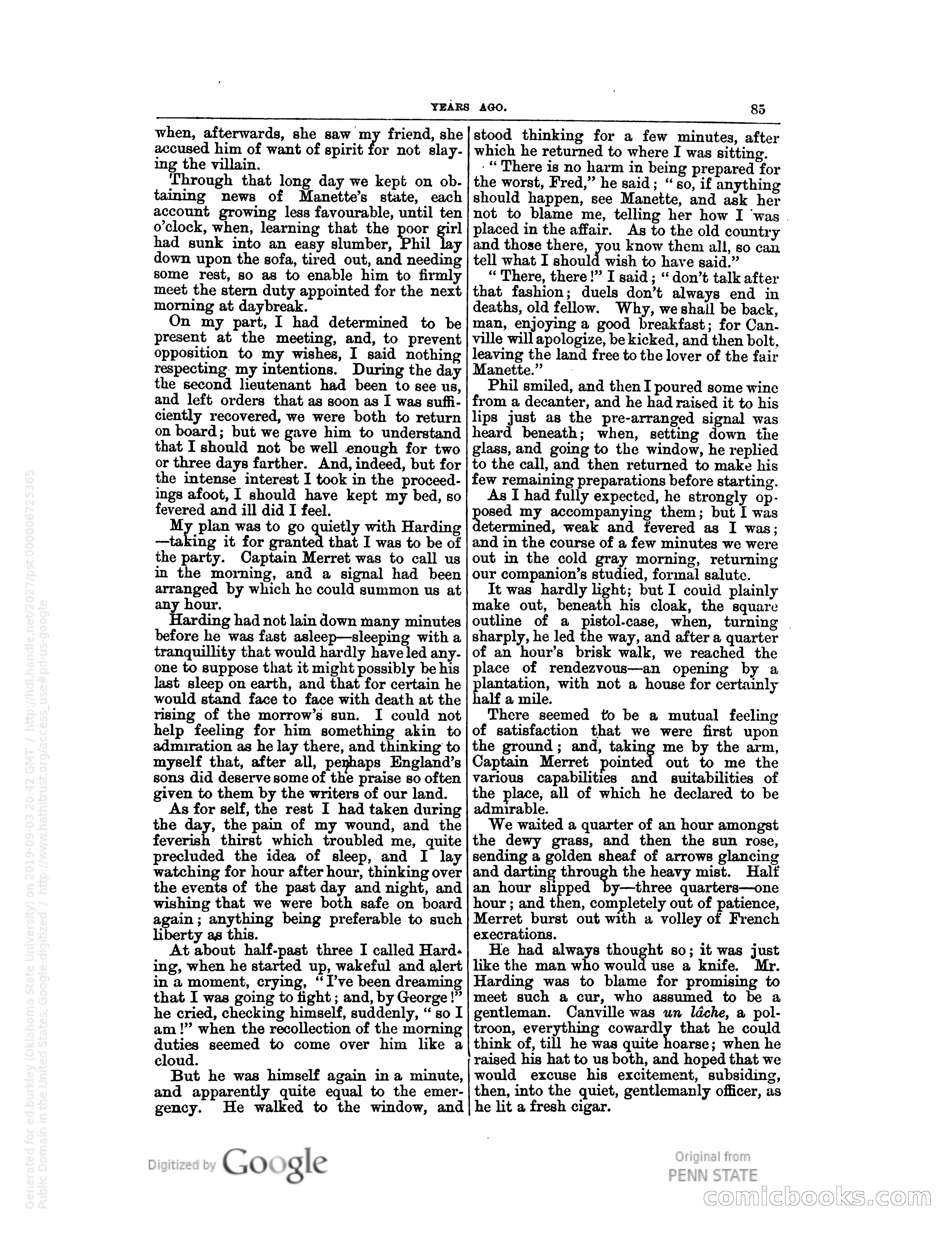
A restored page from Pulp Fiction, 1883. Page through the whole issue in the reader above.
📄 Transcribed text from this page (OCR, searchable)
Machine-transcribed from the original scan — historical spelling and the odd misread are preserved.
YEARS AGO. when, afterwards, she saw my friend, she accused him of want of spirit for not slay- ing the villain. Through that long day we kept on ob- taining news of Manette’s state, each account growing less favourable, until ten o’clock, when, learning that the poor girl had sunk into an easy slumber, phil y down upon the sofa, tired out, and needing some rest, so as to enable him to firmly meet the stern duty appointed for the next morning at daybreak. On my part, I had determined to be present at the meeting, and, to prevent opposition to my wishes, I said nothing respecting. my intentions. During the day the second lieutenant had been to see us, and left orders that as soon as I was suffi- ciently recovered, we were both to return on board; but we gave him to understand that I should not be well enough for two or three days farther. And, indeed, but for the intense interest I took in the proceed- ings afoot, I should have kept my bed, so fevered and ill did I feel. iy plan was to go quietly with Harding —taking it for granted that I was to be of the party. Captain Merret was to call us in the morning, and a signal had been arranged by which he could summon us at any hour. Harding had not lain down many minutes before he was fast asleep—sleeping with a tranquillity that would hardly have led any- one to suppose that it might possibly be his last sleep on earth, and that for certain he would stand face to face with death at the rising of the morrow’s sun. I could not help feeling for him something akin to admiration as he lay there, and thinking to myself that, after all, peyhaps England’s sons did deserve some of the praise so often given to them by the writers of our land. As for self, the rest I had taken during the day, the pain of my wound, and the feverish thirst which troubled me, quite precluded the idea of sleep, and I lay watching for hour after hour, thinking over the events of the past day and night, and wishing that we were both safe on board again; anything being preferable to such liberty as this. At about half-past three I called Hard- ing, when he started up, wakeful and alert in a2 moment, crying, “I’ve been dreaming that I was going to fight ; and, by George !” he cried, checking himself, suddenly, “ so I am !”? when the recollection of the morning duties seemed to come over him like a cloud. But he was himself again in a minute, 85 stood thinking for a few minutes, after which he returned to where I was sitting. - “ There is no harm in being prepared for the worst, Fred,” he said ; “so, if anything should happen, see Manette, and ask her not to blame me, telling her how I ‘was . placed in the affair. As to the old country and those there, you know them all, so can tell what I should. wish to have said.” “ There, there!” I said ; “ don’t talk after that fashion; duels don’t always end in deaths, old fellow. Why, we shall be back, man, enjoying a good breakfast; for Can- ville will apologize, be kicked, and then bolt, leaving the land free to the lover of the fair Manette.” Phil smiled, and thenI poured some wine from a decanter, and he had raised it to his lips just as the pre-arranged signal was heard beneath; when, setting down the glass, and going to the window, he replied to the call, and then returned to make his few remaining preparations before starting. As I had fully expected, he strongly op- posed my accompanying them; but I was etermined, weak and fevered as I was; and in the course of a few minutes we were out in the cold gray morning, returning our companion’s studied, formal salute. It was hardly light; but I couid plainly make out, beneath his cloak, the square outline of a pistol-case, when, turning - sharply, he led the way, and after a quarter of an hour’s brisk walk, we reached the place of rendezvous—an opening by a plantation, with not a house for certainly half a mile. There seemed to be a mutual feeling of satisfaction that we were first upon the ground ; and, taking me by the arm, Captain Merret pointed out to me the various capabilities and suitabilities of the place, all of which he declared to be admirable. We waited a quarter of an hour amongst the dewy grass, and then the sun rose, sending a golden sheaf of arrows glancing and darting through the heavy mist. Half an hour slipped by—three quarters—one hour ; and then, completely out of patience, Merret burst out with a volley of French execrations. He had always thought so; it was just like the man who would use a knife. Mr. Harding was to blame for promising to meet such a cur, who assumed to be a gentleman. Canville was un ldche, a pol- troon, everything cowardly that he could think of, till he was quite hoarse; when he raised his hat to us both, and hoped that we would excuse his excitement, subsiding, and apparently quite equal to the emer-| then, into the quiet, gentlemanly officer, as gency. He walked to the window, and/|he lit a fresh cigar. Google > a JOO S CO)