
Pulp Fiction, 1883 · page 135 of 142
Stories with a Vengeance — page 135: what you’re looking at
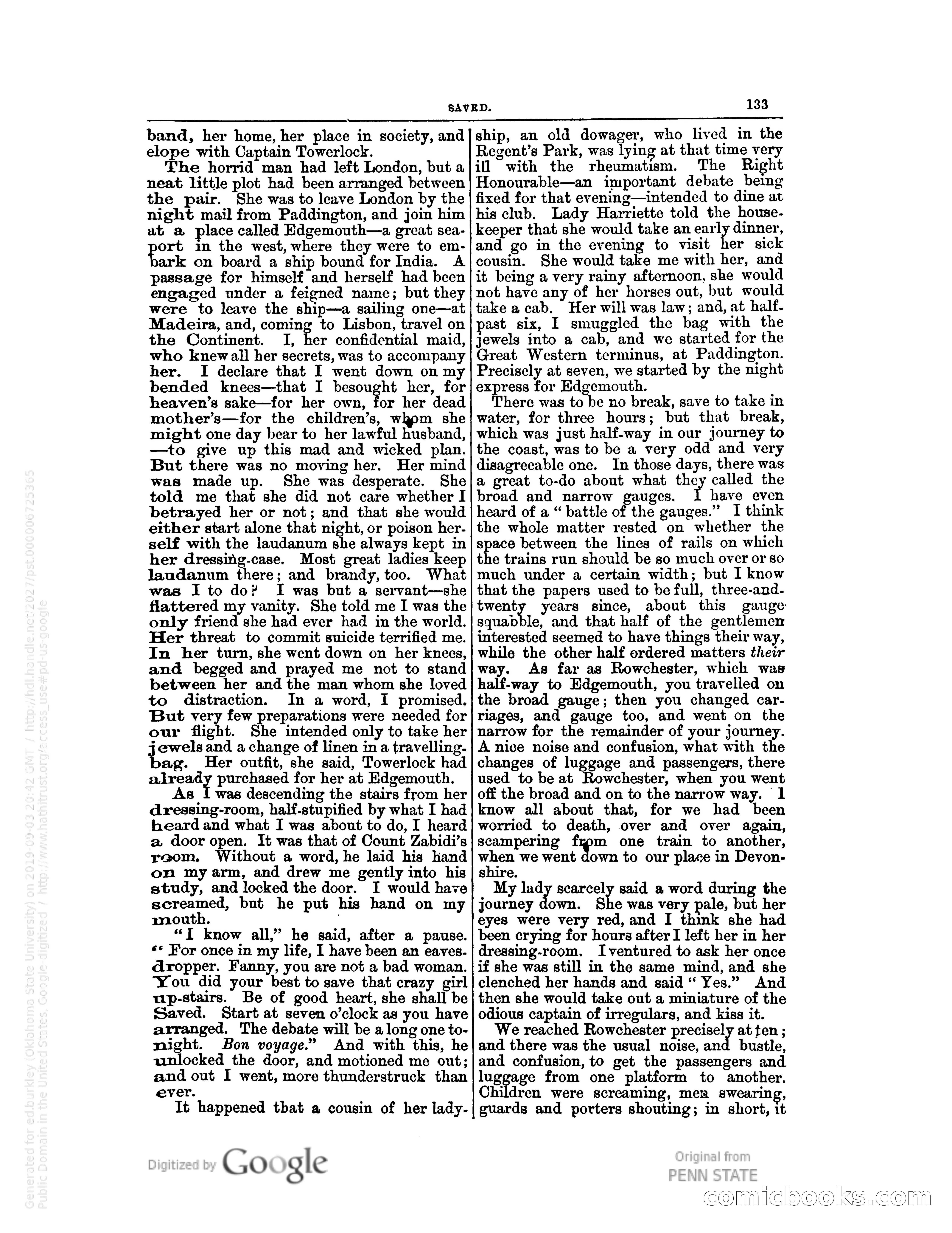
A restored page from Pulp Fiction, 1883. Page through the whole issue in the reader above.
📄 Transcribed text from this page (OCR, searchable)
Machine-transcribed from the original scan — historical spelling and the odd misread are preserved.
SAVED. 133 band, her home, her place in society, and elope with Captain Towerlock. The horrid man had left London, but a neat little plot had been arranged between the pair. She was to leave London by the night mail from Paddington, and join him at a place called Edgemouth—a great sea- ort in the west, where they were to em- hark on board a ship bound for India. A passage for himsclf and herself had been engaged under a feigned name; but they were to leave the ship—a sailing one—at Madeira, and, coming to Lisbon, travel on the Continent. I, her confidential maid, who knew all her secrets, was to accompany her. I declare that I went down on my bended knees—that I besought her, for heaven’s sake—for her own, for her dead mother’s—for the children’s, whom she might one day bear to her lawful husband, —to give up this mad and wicked plan. But there was no moving her. Her mind was made up. She was desperate. She told me that she did not care whether I betrayed her or not; and that she would either start alone that night, or poison her- self with the laudanum she always kept in her dressing-case. Most great ladies keep laudanum there; and brandy, too. What was Ito do? I was but a servant—she flattered my vanity. She told me I was the only friend she had ever had in the world. Her threat to commit suicide terrified me. In her turn, she went down on her knees, and begged and prayed me not to stand between her and the man whom she loved to distraction. In a word, I promised. But very few aig were needed for our flight. She intended only to take her jewels and a change of linen in a travelline- ag. Her outfit, she said, Towerlock had alreaey purchased for her at Edgemouth. As I was descending the stairs from her dressing-room, half-stupified by what I had heard and what I was about to do, I heard a door open. It was that of Count Zabidi’s reom, Without a word, he laid his hand on my arm, and drew me gently into his study, and locked the door. I would have screamed, but he put his hand on my mouth. “I know all,” he said, after a pause. «© For once in my life, I have been an eaves- dropper. Fanny, you are not a bad woman. You did your best to save that crazy girl up-stairs. Be of good heart, she shall be Saved. Start at seven o’clock as you have arranged. The debate will be a long one to- night. Bon voyage.” And with this, he unlocked the door, and motioned me out; and out I went, more thunderstruck than ever. It happened tbat a cousin of her lady- Google ship, an old dowager, who lived in the Regent’s Park, was lying at that time very ill with the rheumatism. The Right Honourable—an important debate being fixed for that evening—intended to dine at his club. Lady Harriette told the house- keeper that she would take an early dinner, and go in the evening to visit her sick cousin. She would take me with her, and it being a very rainy afternoon, she would not have any of her horses out, but would take a cab. Her will was law; and, at half. past six, I smuggled the bag with the jewels into a cab, and we started for the Great Western terminus, at Paddington. Precisely at seven, we started by the night express for Edgemouth. here was to be no break, save to take in water, for three hours; but that break, which was just half-way in our journey to the coast, was to be a very odd and very disagreeable one. In those days, there was a great to-do about what they called the broad and narrow gauges. have even heard of a “ battle of the gauges.” I think the whole matter rested on whether the space between the lines of rails on which the trains run should be so much over or so much under a certain width; but I know that the papers used to be full, three-and- twenty years since, about this squabble, and that half of the gentlemen interested seemed to have things their way, while the other half ordered matters their way. As far as Rowchester, which was half-way to Edgemouth, you travelled on the broad gauge; then you changed car- riages, and gauge too, and went on the narrow for the remainder of your journey. A nice noise and confusion, what with the changes of luggage and passengers, there used to be at Rowchester, when you went off the broad and on to the narrow way. 1 know all about that, for we had been worried to death, over and over again, scampering fyom one train to another, when we went down to our place in Devon- shire. My lady scarcely said a word during the journey down. She was very pale, but her eyes were very red, and I think she had been crying for hours after I left her in her dressing-room. Iventured to ask her once if she was still in the same mind, and she clenched her hands and said “ Yes.” And then she would take out a miniature of the odious captain of irregulars, and kiss it. We reached Rowchester precisely at ten ; and there was the usual noise, and bustle, and confusion, to get the passengers and luggage from one platform to another. Children were screaming, mem swearing, guards and porters shouting; in short, it gauge: CY, JOO S CO)