
Pulp Fiction, 1883 · page 124 of 142
Stories with a Vengeance — page 124: what you’re looking at
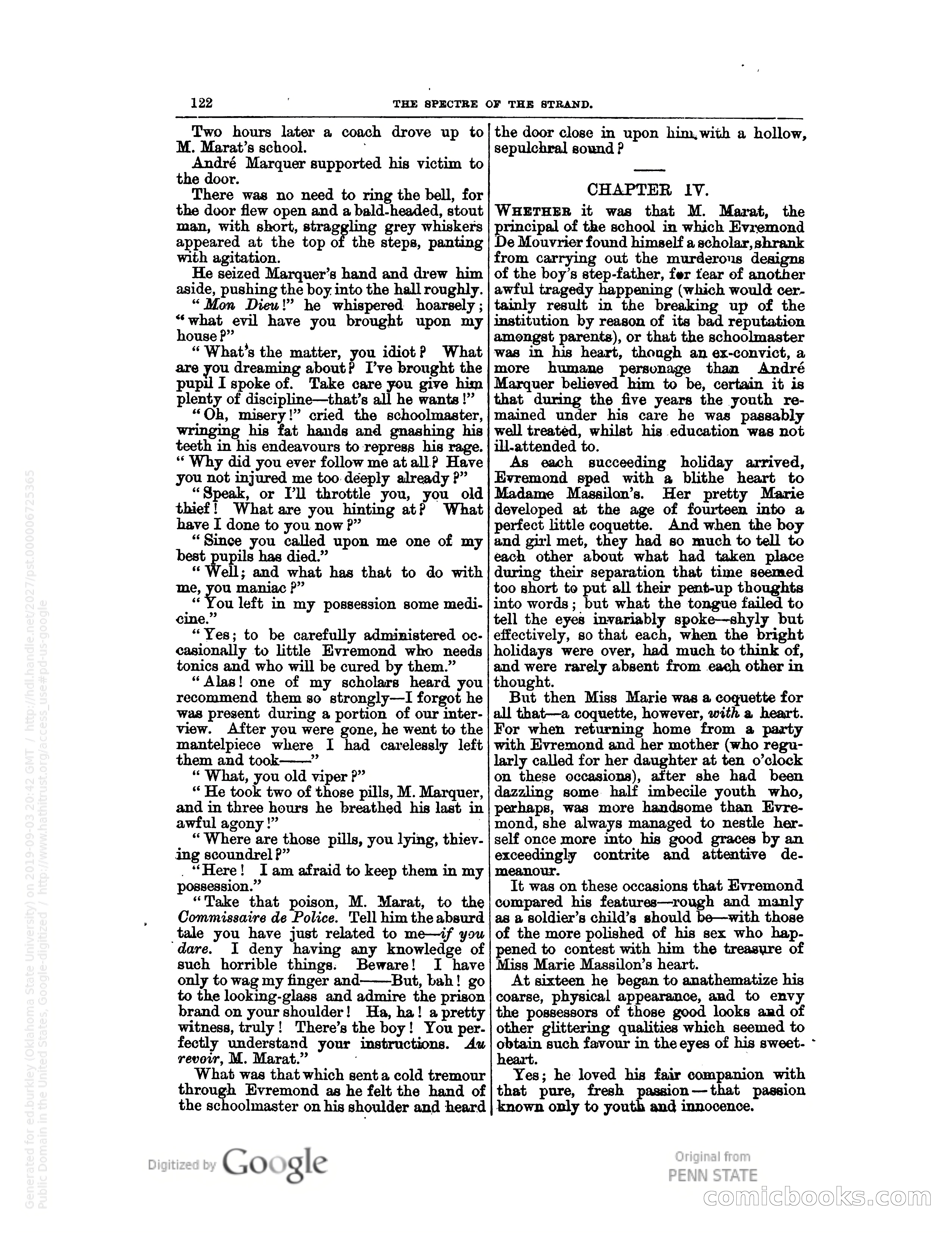
A restored page from Pulp Fiction, 1883. Page through the whole issue in the reader above.
📄 Transcribed text from this page (OCR, searchable)
Machine-transcribed from the original scan — historical spelling and the odd misread are preserved.
122 THE SPECTRE OF THE STRAND. Two hours later a coach drove up to M. Marat’s school. André Marquer supported his victim to the door. There was no need to ring the bell, for the door flew open and a bald-headed, stout man, with short, straggling grey whiskers appeared at the top of the steps, panting with agitation. He seized Marquer’s hand and drew him aside, pushing the boy. into the hall roughly. “ Mon Diew!” he whispered hoarsely ; “what evil have you brought upon my house P” “ What's the matter, you idiot? What are you dreaming about? I’ve brought the pupul I spoke of. Take care you give him plenty of discipline—that’s all he wants!” “Oh, misery!” cried the schoolmaster, inging his fat hands and gnashing his teeth in his endeavours to repress his rage. ‘Why did you ever follow me at all? Have you not injured me too deeply already ?” “Speak, or Pll throttle you, you old thief! What are you hinting at? What have I done to you now P” “Since you called upon me one of my best pupils has died.” * Well; and what has that to do with me, you maniac P” _“ You left in my possession some medi- cine.” “Yes; to be carefully administered oc- casionally to little Evremond who needs tonics and who will be cured by them.” “ Alas! one of my scholars heard you recommend them so strongly—lI forgot he was present during a portion of our inter- view. After you were gone, he went to the mantelpiece where I had carelessly left them and took 7 * What, you old viper P” “He took two of those pills, M. Marquer, and in three hours he breathed his last in awful agony !” | “Where are those pills, you lying, thiev- ing scoundrel P” . “Here! Iam afraid to keep them in my possession.” “Take that poison, M. Marat, to the Commissaire de Police. Tell him the absurd tale you have just related to me—if you dare. I deny having any knowledge of such horrible things: Beware! I have only to wag my finger and——-But, bah! go to the looking-glass and admire the prison brand on your shoulder! Ha, ha! a pretty witness, truly! There’s the boy! You per- fectly understand your instructions. Aw revoir, M. Marat.” What was that which sent a cold tremour through Evremond as he felt the hand of the schoolmaster on his shoulder and heard Google the door close in upon him,with a hollow, sepulchral sound ? ED CHAPTER IV. WHETHER it was that M. Marat, the principal of the school in which Evremond De Mouvnier found himself a scholar, shrank from carrying out the murderous designs of the boy’s step-father, fer tear of another awful tragedy happening (which would cer- tainly result in the breaking up of the institution by reason of its bad reputation amongst parents), or that the schoolmaster was in his heart, though an ex-convict, a more humane persunage than André Marquer believed him to be, certain it is that during the five years the youth re- mained under his care he was passably well treated, whilst his education was not ill.attended to. As each succeeding holiday arrived, Evremond sped with a blithe heart to Madame Massilon’s. Her pretty Marie developed at the age of fourteen into a perfect httle coquette. And when the boy and girl met, they had so much to tell to each other about what had taken place during their separation that time seemed too short to put all their pent-up thoughts into words; but what the tongue failed to tell the eyes invariably spoke—shyly but effectively, so that each, when the bright holidays were over, had much to think of, and were rarely absent from each other in thought. But then Miss Marie was a coquette for all that—a coquette, however, with a heart. For when returning home from a party with Evremond and her mother (who regu- larly called for her daughter at ten o’clock on these occasions), aiter she had been dazzling some half imbecile youth who, perhaps, was more handsome than Evre- mond, she always managed to nestle her- self once more into his good graces by an exceedingly contrite and attentive de- meanour. It was on these occasions that Hvremond compared his features—rough and manly as a soldier’s child’s should be—with those of the more polished of his sex who hap- pened to contest with him the treasure of Miss Marie Massilon’s heart. At sixteen he began to anathematize his coarse, physical appearance, and to envy the possessors of those good looks and of other glittering qualities which seemed to obtain such favour in the eyes of his sweet- - eart. | Yes; he loved his fair companion with that pure, fresh passion—that passion known only to youth and innocence. JOO @ © = a S CO)