
Pulp Fiction, 1883 · page 130 of 142
Stories with a Vengeance — page 130: what you’re looking at
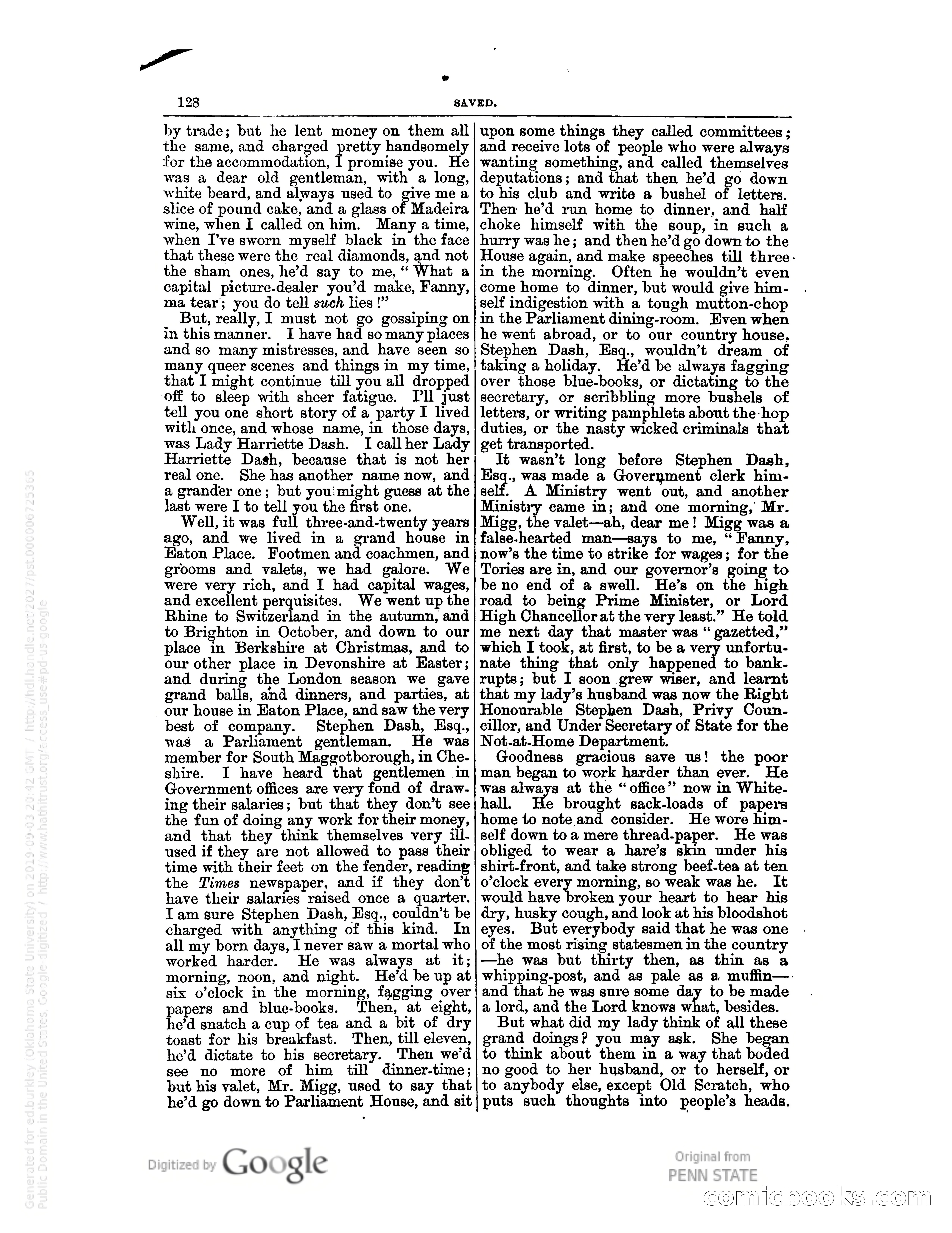
A restored page from Pulp Fiction, 1883. Page through the whole issue in the reader above.
📄 Transcribed text from this page (OCR, searchable)
Machine-transcribed from the original scan — historical spelling and the odd misread are preserved.
128 by trade; but he lent money on them all the same, and charged pretty handsomely for the accommodation, I promise you. He was a dear old gentleman, with a long, white beard, and always used to give me a shee of pound cake, and a glass of Madeira wine, when I called on him. Many a time, when Pve sworn myself black in the face that these were the real diamonds, and not the sham ones, he’d say to me, “ What a capital picture-dealer you’d make, Fanny, ma tear; you do tell such lies !” But, really, I must not go gossiping on in thismanner. I have had so many places and so many mistresses, and have seen so many queer scenes and things in my time, that I might continue till you all dropped off to sleep with sheer fatigue. Tl just tell you one short story of a party I lived with once, and whose name, in those days, was Lady Harriette Dash. I call her Lady Harriette Dash, because that is not her real one. She has another name now, and a grander one; but you!might guess at the Jast were I to tell you the first one. Well, it was full three-and-twenty years ago, and we lived in a grand house in Eaton Place. Footmen and coachmen, and grooms and valets, we had galore. We were very rich, and I had capital wages, and excellent perquisites. We went up the Rhine to Switzerland in the autumn, and to Brighton in October, and down to our place in Berkshire at Christmas, and to our other place in Devonshire at Easter ; and during the London season we gave grand balls, and dinners, and parties, at our house in Eaton Place, and saw the very best of company. Stephen Dash, Hsq., was a Parliament gentleman. He was member for South Maggotborough, in Che- shire. I have heard that gentlemen in Government offices are very fond of draw- ing their salaries; but that they don’t see the fun of doing any work for their money, and that they think themselves very ill- used if they are not allowed to pass their time with their feet on the fender, reading the Times newspaper, and if they don’t have their salaries raised once a quarter. Tam sure Stephen Dash, Esq., couldn’t be charged with anything of this kind. In all my born days, I never saw a mortal who worked harder. He was always at it; morning, noon, and night. He’d be up at six o’clock in the morning, fagging over papers and blue-books. ‘Then, at eight, he’d snatch a cup of tea and a bit of dry toast for his breakfast. Then, till eleven, he’d dictate to his secretary. Then we'd see no more of him till dinner-time; but his valet, Mr. Migg, used to say that he’d go down to Parliament House, and sit Google SAVED. upon some things they called committees ; and receive lots of people who were always wanting something, and called themselves deputations; and that then he’d go down to his club and write a bushel of letters. Then he’d run home to dinner, and half choke himself with the soup, in such a hurry was he; and then he’d go down to the House again, and make speeches till three. in the morning. Often he wouldn’t even come home to dinner, but would give him- self indigestion with a tough mutton-chop in the Parliament dining-room. Even when he went abroad, or to our country house, Stephen Dash, Esq., wouldn’t dream of taking a holiday. He’d be always fagging over those blue-books, or dictating to the secretary, or scribbling more bushels of letters, or writing pamphlets about the -hop duties, or the nasty wicked criminals that get transported. It wasn’t long before Stephen Dash, Hsq.. was made a Government clerk him- self. A Ministry went out, and another Ministry came in; and one morning, Mr. Migg, the valet—ah, dear me! Migg was a false-hearted man—says to me, “ Fanny, now’s the time to strike for wages; for the Tories are in, and our governor’s going to be no end of a swell. He’s on the high road to being Prime Minister, or Lord High Chancellor at the very least.” He told me next day that master was “ gazetted,” which I took, at first, to be a very unfortu- nate thing that only happened to bank- rupts; but I soon grew wiser, and learnt that my lady’s husband was now the Right Honourable Stephen Dash, Privy Coun- cillor, and Under Secretary of State for the Not-at-Home Department. Goodness gracious save us! the poor man began to work harder than ever. He was always at the “office” now in White- hall. He brought sack-loads of papers home to note and consider. He wore him- se]f down to a mere thread-paper. He was obliged to wear a hare’s skin under his shirt-front, and take strong beef-tea at ten o’clock every morning, so weak was he. It would have broken your heart to hear his dry, husky cough, and look at his bloodshot eyes. But everybody said that he was one of the most rising statesmen in the country —he was but thirty then, as thin as a whipping-post, and as pale as a muffin—-. and that he was sure some day to be made a lord, and the Lord knows what, besides. But what did my lady think of all these grand doingsP you may ask. She began to think about them in a way that boded no good to her husband, or to herself, or to anybody else, except Old Scratch, who puts such thoughts into people’s heads. @ © = a JOO S CO)