
Pulp Fiction, 1883 · page 121 of 142
Stories with a Vengeance — page 121: what you’re looking at
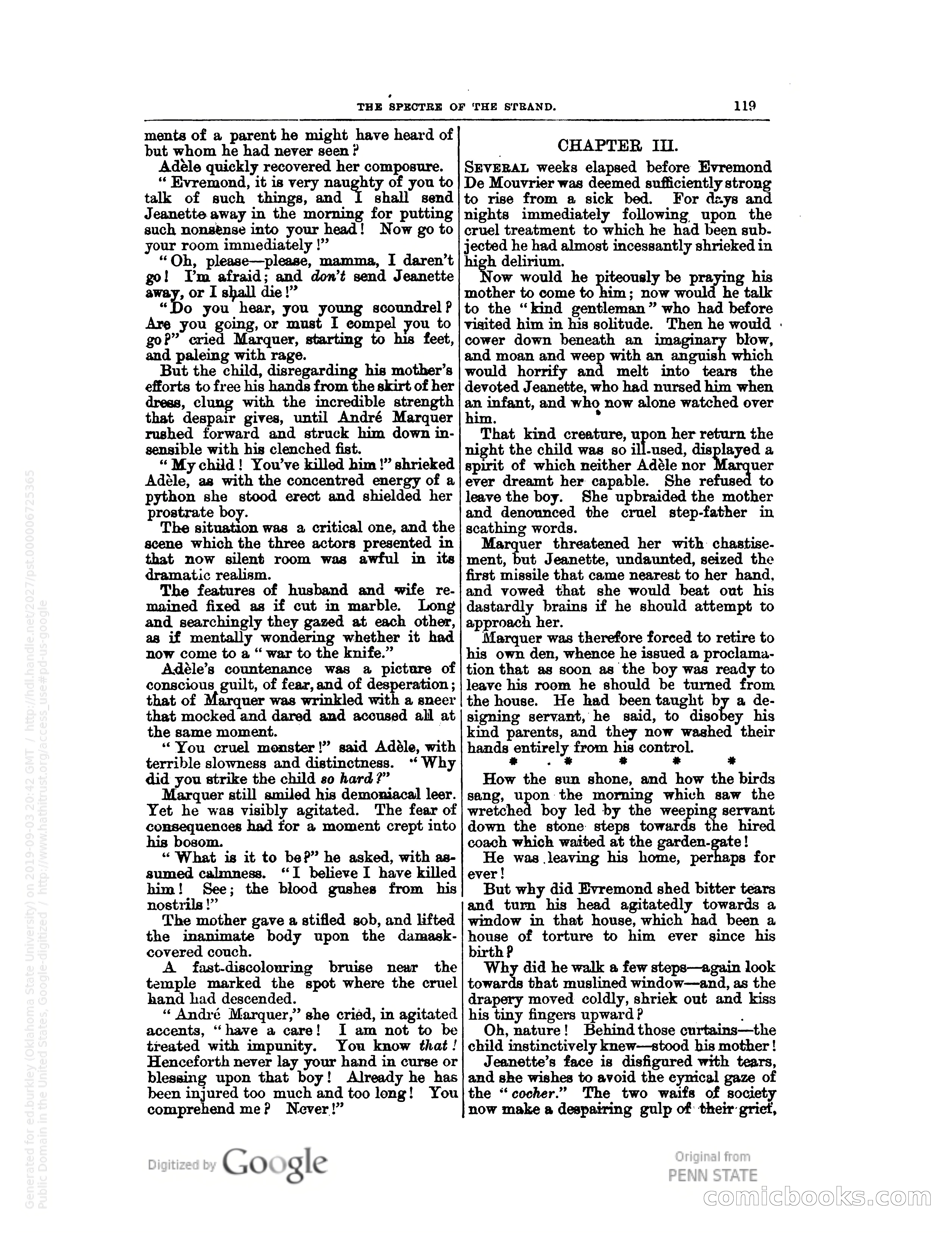
A restored page from Pulp Fiction, 1883. Page through the whole issue in the reader above.
📄 Transcribed text from this page (OCR, searchable)
Machine-transcribed from the original scan — historical spelling and the odd misread are preserved.
THE SPECTRE OF ‘THE STRAND. ments of a parent he might have heard of but whom he had never seen ? Adéle quickly recovered her composure. “ Evremond, it is very naughty of you to talk of such things, and si shall send Jeanette away in the morning for putting such nonsense into your head! Now go to your room immediately !” “Oh, please—please, mamma, I daren’t Tm afraid; and don’t send Jeanette or I shall die!” o you hear, you young scoundrel P Are you going, or must I eompel you to goP” cried Marquer, starting to his feet, and paleing with rage. But the child, disregarding his mother’s efforts to free his hands from the skirt of her dress, clung with the incredible strength that despair gives, until André Marquer rushed forward and struck him down in- sensible with his clenched fist. “ My child! You've killed him !” shrieked Adele, as with the concentred energy of a python she stood erect and shielded her prostrate boy. The situation was a critical one, and the scene which the three actors presented in that now silent room was awful in its dramatic realism. The features of husband and wife re- mained fixed as if cut in marble. Long and searchingly they gazed at each other, as if mentally wondering whether it had now come to a “ war to the knife.” Adéle’s countenance was a picture of conscious guilt, of fear, and of desperation ; that of Marquer was wrinkled with a sneer that mocked and dared and accused all at the same moment. | “You cruel monster!” said Adéle, with terrible slowness and distinctness. ‘“‘ Why did you strike the child so hard ?” Marquer still smiled his demoniacal leer. Yet he was visibly agitated. The fear of consequences had for a moment crept into his bosom. “What is it to be?” he asked, with as- sumed calmness. “I believe I have killed him! See; the blood gushes from his nostrils!” The mother gave a stifled sob, and lifted the inanimate body upon the damask- covered couch. A fast-discolourmg bruise near the temple marked the spot where the cruel hand had descended. “ André Marquer,” she criéd, in agitated accents, “have a care! I am not to be treated with impunity. You know that! Henceforth never lay your hand in curse or blessing upon that boy! Already he has been injured too much and too long! You comprehend me? Never!” go! away Google CHAPTER IT. SEVERAL weeks elapsed before Hvremond De Mouvrier was deemed sufficiently strong to rise from a sick bed. For days and nights immediately following upon the cruel treatment to which he had been sub- jected he had almost incessantly shrieked in high delirium. ow would he piteously be praying his mother to come to him ; now wo he talk to the “kind gentleman” who had before visited him in his solitude. cower down beneath an imaginary blow, and moan and weep with an anguish which would horrify and melt into tears the devoted Jeanette, who had nursed him when = infant, and who now alone watched over im. That kind creature, upon her return the night the child was so ill-used, displayed a spirit of which neither Adéle nor uer ever dreamt her capable. She refused to leave the boy. She upbraided the mother and denounced the cruel step-father in scathing words. Marquer threatened her with chastise- ment, but Jeanette, undaunted, seized the first missile that came nearest to her hand, and vowed that she would beat out his dastardly brains if he should attempt to approach her. Marquer was therefore forced to retire to his own den, whence he issued a proclama- tion that as soon as the boy was ready to leave his room he should be turned from the house. He had been taught by a de- signing servant, he said, to disobey his kind parents, and they now washed their hands entirely from his control. * . # % % #* How the sun shone, and how the birds sang, upon the morning which saw the wretched boy led by the weeping servant down the stone steps towards the hired coach which waited at the garden-gate! He was leaving his home, perhaps for ever! But why did Evremond shed bitter tears and turn his head agitatedly towards a window in that house, which had been a house of torture to him ever since his birth P Why did he walk a few steps—again look towards that muslined window—and, as the drapery moved coldly, shriek out and kiss his tiny fingers upward ? | Oh, nature! Behind those curtains—the child instinctively knew—stood his mother! Jeanette’s face is disfigured wrth tears, and she wishes to avoid the eynical gaze of the “cocher.” The two waifs of society now make a despairing gulp of their grief, Then he would ; > a JOO S CO)