
Pulp Fiction, 1883 · page 32 of 142
Stories with a Vengeance — page 32: what you’re looking at
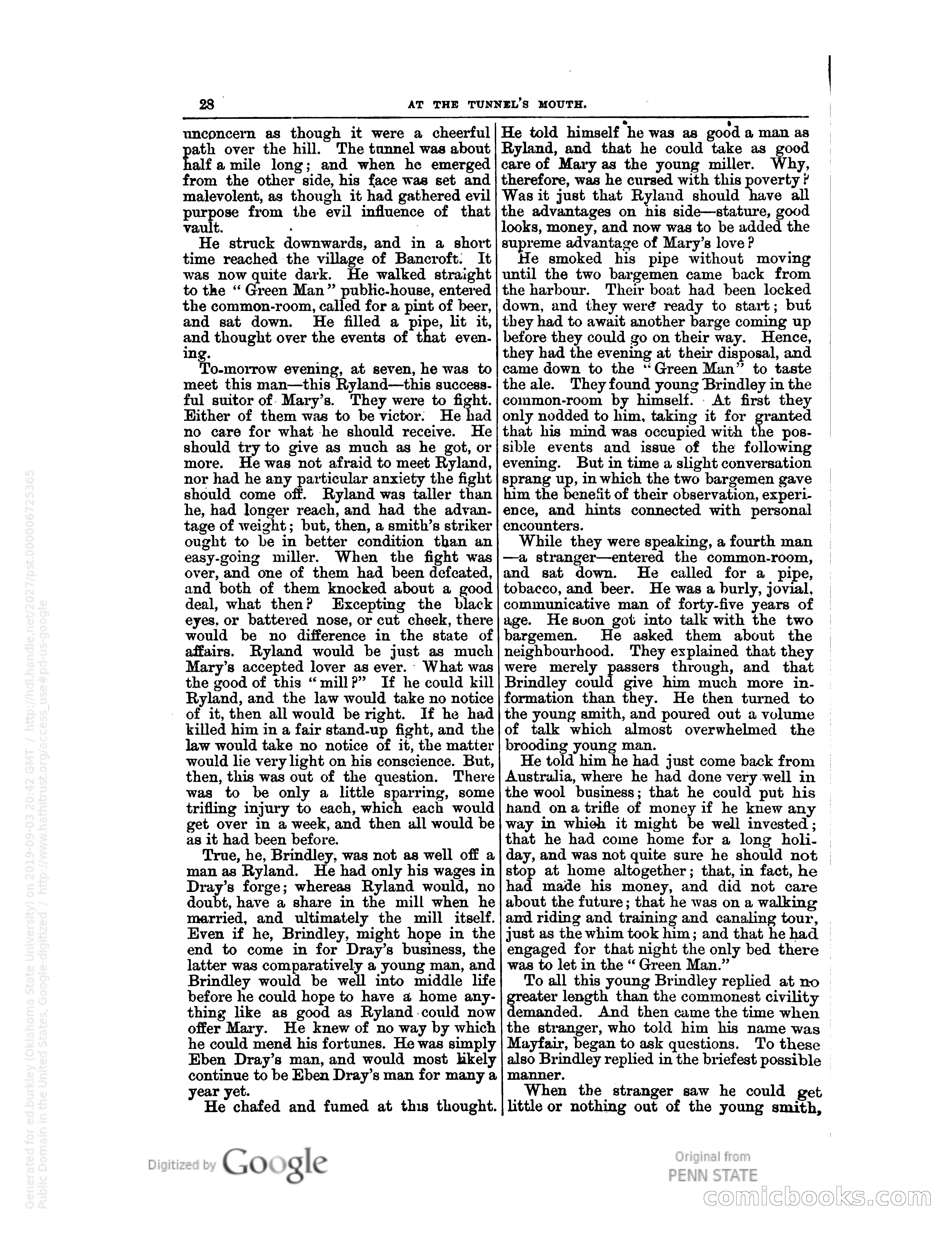
A restored page from Pulp Fiction, 1883. Page through the whole issue in the reader above.
📄 Transcribed text from this page (OCR, searchable)
Machine-transcribed from the original scan — historical spelling and the odd misread are preserved.
28 | unconcern as though it were a cheerful ath over the hill. The tunnel was about half a mile long; and when he emerged from the other side, his face was set and malevolent, as though it had gathered evil purpose from the evil influence of that. vault. He struck downwards, and in a short time reached the village of Bancroft. It was now quite dark. He walked straight to the “ Green Man” pubhc-house, entered the common-room, called for a pint of beer, and sat down. He filled a pipe, lit it, and thought over the events of that even- ing. To-morrow evening, at seven, he was to meet this man—this Ryland—this success- ful suitor of. Mary’s. They were to fight. Hither of them was to be victor. He had no care for what he should receive. He should try to give as much as he got, or more. He was not afraid to meet Ryland, nor had he any particular anxiety the fight should come off. Ryland was taller than he, had longer reach, and had the advan. tage of weight; but, then, a smith’s striker ought to be in better condition than an easy-going miller. When the fight was over, and one of them had been defeated, and both of them knocked about a good deal, what then? Excepting the black eyes. or battered nose, or cut cheek, there would be no difference in the state of affairs. Ryland would be just as much Mary’s accepted lover as ever. What was the good of this “mill?” If he could kill Ryland, and the law would take no notice - of it, then all would be right. If he had killed him in a fair stand-up fight, and the law would take no notice of it, the matter would lie very light on his conscience. But, then, this was out of the question. There was to be only a little sparring, some triflmg injury to each, which each would get over in a week, and then all would be as it had been before. True, he, Brindley, was not as well off a man as Ryland. He had only his wages in Dray’s forge; whereas Ryland would, no doubt, have a share in the mill when he married, and ultimately the mill itself. Even if he, Brindley, might hope in the end to come in for Dray’s business, the latter was comparatively a young man, and Brindley would be well into middle life before he could hope to have a home any- thing like as good as Ryland -could now offer Mary. He knew of no way by which he could mend his fortunes. He was simply Eben Dray’s man, and would most hkely continue to be Eben Dray’s man for many a year yet. He chafed and fumed at this thought. Google AT THE TUNNEL’S MOUTH. He told himself he was as good a& man as Ryland, and that he could take as good care of Mary as the young miller. Why, therefore, was he cursed with this poverty ? Was it just that Ryland should ee all the advantages on his side—stature, good looks, money, and now was to be added the supreme advantage of Mary’s love? He smoked his pipe without moving until the two bargemen came back from the harbour. Their boat had been locked down, and they werd ready to start; but they had to await another barge coming up before they could go on their way. Hence, they had the evening at their disposal, and came down to the ‘Green Man” to taste the ale. They found young Brindley in the common-room by himself. At first they only nodded to him, taking it for granted that his mind was occupied with the pos- sible events and issue of the following evening. But in time a slight conversation sprang up, in which the two bargemen gave him the beneit of their observation, experi- ence, and hints connected with personal encounters. While they were speaking, a fourth man —a stranger—entered the common-room, and sat down. He called for a pipe, tobacco, and beer. He was a burly, jovial, communicative man of forty-five years of age. Hesvon got into talk with the two bargemen. He asked them about the neighbourhood. They explained that they were merely passers through, and that Brindley could give him much more in- formation than they. He then turned to the young smith, and poured out a volume of talk which almost overwhelmed the brooding young man. He told him he had just come back from Australia, where he had done very well in the wool business; that he could put his hand ona trifle of money if he knew any way in whieh it might be well invested ; that he had come home for a long holi- day, and was not quite sure he should not stop at home altogether; that, in fact, he had made his money, and did not care about the future; that he was on a walking and riding and training and canaling tour, | just as the whim took him; and that he had | engaged for that night the only bed there © was to let in the “ Green Man.” To all this young Brindley replied at no | greater length than the commonest civility | demanded. And then came the time when | the stranger, who told him his name was | To these | also Brindley replied in the briefest possible | Mayfair, began to ask questions. manner. | When the stranger saw he could get little or nothing out of the young smith, > a JOO S CO)