
Pulp Fiction, 1883 · page 72 of 142
Stories with a Vengeance — page 72: what you’re looking at
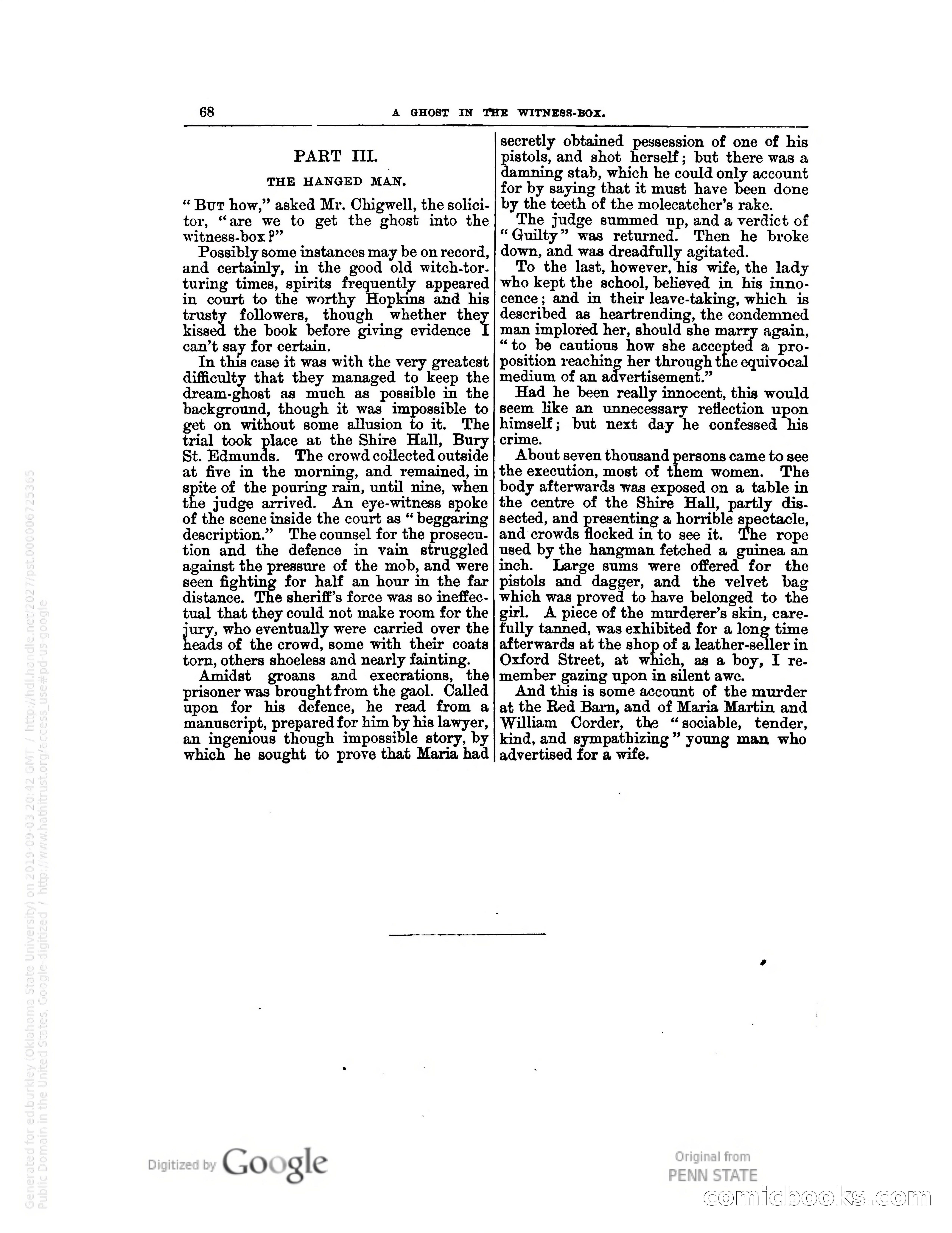
A restored page from Pulp Fiction, 1883. Page through the whole issue in the reader above.
📄 Transcribed text from this page (OCR, searchable)
Machine-transcribed from the original scan — historical spelling and the odd misread are preserved.
68 A GHOST IN THE WITNESS-BOX. PART III. THE HANGED MAN. “ But how,” asked Mr. Chigwell, the solici- tor, “are we to get the ghost into the witness-box P”’ Possibly some instances may be on record, and certainly, in the good old witch-tor- turing times, spirits puequenly appeared in court to the worthy Hopkins and his trusty followers, though whether they kissed the book before giving evidence I can’t say for certain. In this case it was with the very greatest difficulty that they managed to keep the dream-ghost as much as possible in the background, though it was impossible to get on without some allusion to it. The trial took place at the Shire Hall, Bury St. Edmunds. The crowd collected outside at five in the morning, and remained, in spite of the pouring rain, until nine, when shite judge arrived. An eye-witness spoke of the scene inside the court as “ beggaring description.” The counsel for the prosecu- tion and the defence in vain struggled against the pressure of the mob, and were seen fighting for half an hour in the far distance. The sheriff’s force was so ineffec- tual that they could not make room for the jury, who eventually were carried over the heads of the crowd, some with their coats torn, others shoeless and nearly fainting. Amidst groans and execrations, the prisoner was brought from the gaol. Called upon for his defence, he read from a manuscript, prepared for him by his lawyer, an ingenious though impossible story, by which he sought to prove that Maria had Google — secretly obtained pessession of one of his pistols, and shot herself; but there was a damning stab, which he could only account for by saying that it must have been done by the teeth of the molecatcher’s rake. The judge summed up, and a verdict of “Guilty” was returned. Then he broke down, and was dreadfully agitated. To the last, however, his wife, the lady who kept the school, believed in his inno- cence; and in their leave-taking, which is described as heartrending, the condemned man implored her, should she marry again, “to be cautious how she accepted a pro- position reaching her through the equivocal medium of an advertisement.” Had he been really innocent, this would seem like an unnecessary reflection upon himself; but next day he confessed his crime. About seven thousand persons came to see the execution, most of them women. The body afterwards was exposed on a table in the centre of the Shire Hall, partly dis- sected, and presenting a horrible spectacle, and crowds flocked in to see it. The rope used by the hangman fetched a guinea an inch. Large sums were offered for the pistols and dagger, and the velvet bag which was proved to have belonged to the girl. A piece of the murderer’s skin, care- fully tanned, was exhibited for a long time afterwards at the shop of a leather-seller in Oxford Street, at which, as a boy, I re- member gazing upon in silent awe. And this is some account of the murder at the Red Barn, and of Maria Martin and Wilham Corder, the “sociable, tender, kind, and sympathizing” young man who advertised for a wife. JOO a Ss > a S CO)