
Pulp Fiction, 1883 · page 60 of 142
Stories with a Vengeance — page 60: what you’re looking at
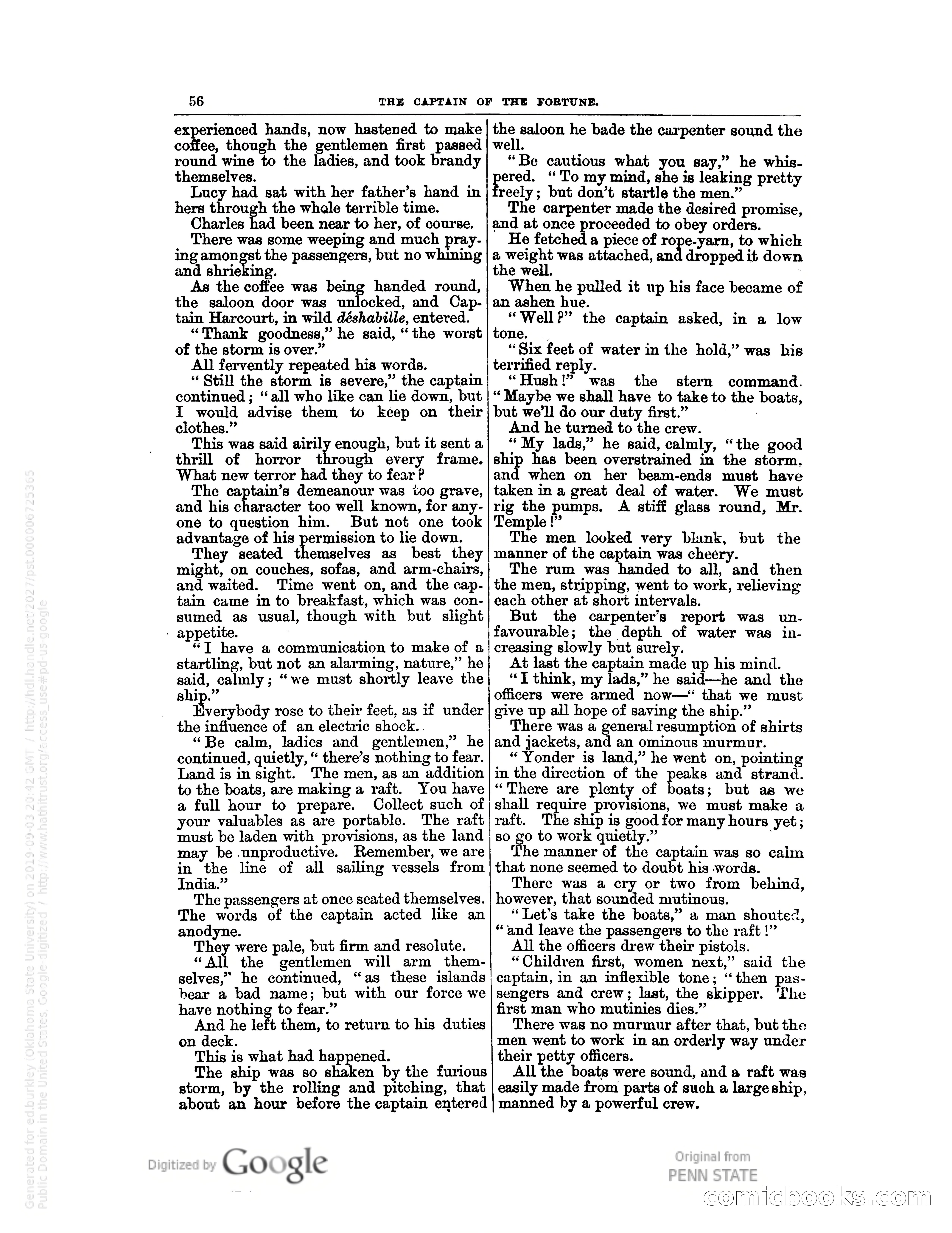
A restored page from Pulp Fiction, 1883. Page through the whole issue in the reader above.
📄 Transcribed text from this page (OCR, searchable)
Machine-transcribed from the original scan — historical spelling and the odd misread are preserved.
56 experienced hands, now hastened to make coffee, though the gentlemen first passed round wine to the ladies, and took brandy themselves. Lucy had sat with her father’s hand in hers through the whale terrible time. Charles had been near to her, of course. There was some weeping and much pray- ing amongst the passengers, but no whining and shrieking. As the coffee was being handed round, the saloon door was unlocked, and Cap- tain Harcourt, in wild déshabille, entered. “Thank goodness,” he said, “the worst of the storm is over.” All fervently repeated his words. “Still the storm is severe,” the captain continued ; “all who like can lie down, but I would advise them to keep on their clothes.” This was said airily enough, but it sent a thrill of horror through every frame. What new terror had they to fear ? The captain’s demeanour was too grave, and his character too well known, for any- one to question him. But not one took advantage of his permission to lie down. They seated themselves as best they might, on couches, sofas, and arm-chairs, and waited. Time went on, and the cap- tain came in to breakfast, which was con- sumed as usual, though with but slight ' appetite. “T have a communication to make of a startling, but not an alarming, nature,” he said, calmly ; “we must shortly leave the ship.” Everybody rose to their feet, as if under the influence of an electric shock.. “Be calm, ladies and gentlemen,” he continued, quietly, “ there’s nothing to fear. Land is in sight. The men, as an addition to the boats, are making a raft. You have a full hour to prepare. Collect such of your valuables as are portable. The raft must be laden with provisions, as the land may be unproductive. Remember, we are in the line of all sailing vessels from India.” The passengers at once seated themselves. The words of the captain acted lke an anodyne. They were pale, but firm and resolute. “All the gentlemen will arm them- selves,” he continued, “as these islands hear a bad name; but with our force we have nothing to fear.” And he left them, to return to his duties on deck. This is what had happened. The ship was so shaken by the furious storm, by the rolling and pitching, that about an hour before the captain entered Google THE CAPTAIN OF THE FORTUNE. ee eeoon he bade the carpenter sound the well. “Be cautious what you say,” he whis- ered. “ ‘T'o my mind, she is leaking pretty reely; but don’t startle the men.” The carpenter made the desired promise, and at once proceeded to obey orders. He fetched a piece of rope-yarn, to which a weight was attached, and dropped it down the well. : When he pulled it up his face became of an ashen hue. “Well?” the captain asked, in a low tone. . “Six feet of water in the hold,” was his terrified reply. “Hush!” was the stern command. ‘“‘ Maybe we shall have to take to the boats, but we'll do our duty first.” . And he turned to the crew. ““ My lads,” he said, calmly, “the good ship has been overstrained in the storm, and when on her beam-ends must have taken in a great deal of water. We must rig the pumps. A stiff glass round, Mr. Temple!” The men lovked very blank, but the manner of the captain was cheery. The rum was handed to all, and then the men, stripping, went to work, relieving each other at short intervals. But the carpenter's report was un- favourable; the depth of water was in- creasing slowly but surely. At last the captain made up his mind. “I think, my lads,” he said—he and the officers were armed now—“ that we must give up all hope of saving the ship.” There was a general resumption of shirts and jackets, and an ominous murmur. “ Yonder is land,” he went on, pointing in the direction of the peaks and strand. “There are plenty of boats; but as we shall require provisions, we must make a raft. The ship is good for many hours yet; so go to work quietly.” The manner of the captain was so calm that none seemed to doubt his words. There was a cry or two from behind, however, that sounded mutinous. ‘‘Let’s take the boats,” a man shouted, “and leave the passengers to the raft !” All the officers diew their pistols. “Children first, women next,” said the captain, in an inflexible tone; “then pas- sengers and crew; last, the skipper. ‘The first man who mutinies dies.” There was no murmur after that, but the men went to work in an orderly way under their petty officers. All the boats were sound, and a raft was easily made from parts of such a large ship, manned by a powerful crew. > a JOO S CO)