
Pulp Fiction, 1883 · page 27 of 142
Stories with a Vengeance — page 27: what you’re looking at
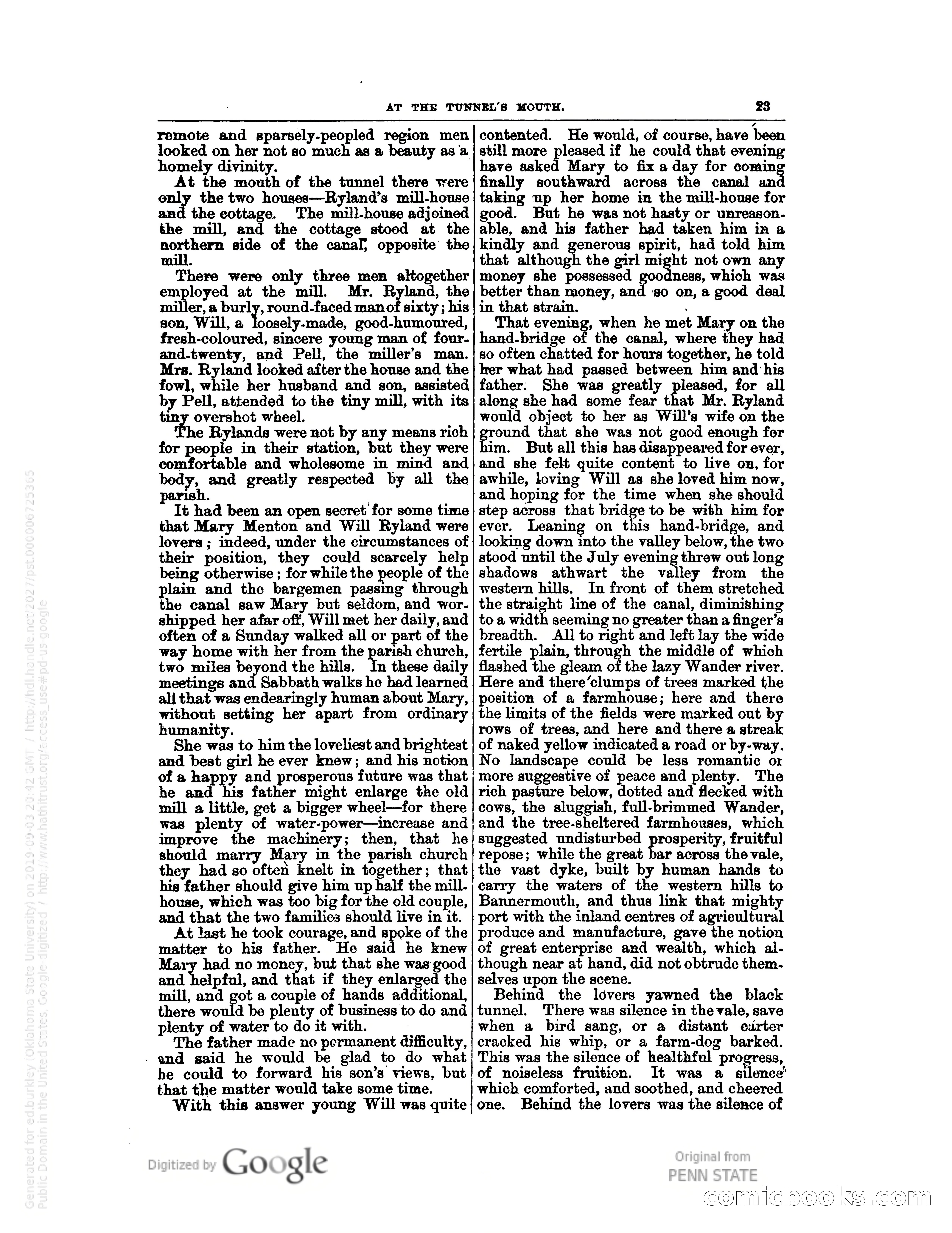
A restored page from Pulp Fiction, 1883. Page through the whole issue in the reader above.
📄 Transcribed text from this page (OCR, searchable)
Machine-transcribed from the original scan — historical spelling and the odd misread are preserved.
AT THE TUNNEL’S MOUTH. remote and sparsely-peopled region men looked on her not ao niaek as a beauty asa homely divinity. At the mouth of the tunnel there were enly the two houses—RKyland’s mill-house ae the cottage. The mill-house adjoined the mill, and the cottage stoed at the a le side of the canal; opposite the There were only three men altogether employed at the mill. Mr. Ryland, the miller a burly, round-faced man of sixty ; his son, Will, a loosely-made, good-humoured, fresh-coloured, sincere young man of four- and.twenty, and Pell, the muiller’s man. Mrs. Ryland looked after the house and the fow], while her husband and son, assisted by Pell, attended to the tiny mill, with its tiny overshot wheel. he Rylands were not by any means rich for people in their station, but they were comfortable and wholesome in mind and bedy, and greatly respected by all the parish. It had been an open secret for some time that Mary Menton and Will Ryland were lovers ; indeed, under the circumstances of their position, they could scarcely help being otherwise ; for while the people of the plain and the bargemen passmg through the canal saw Mary but seldom, and wor. shipped her afar off, Will met her daily, and often of a Sunday walked all or part of the way home with her from the parish church, two miles beyond the hills. In these daily meetings and Sabbath walks he had learned all that was endearingly human about Mary, without setting her apart from ordinary humanity. She was to him the loveliest and brightest and best girl he ever knew; and his notion of a happy and prosperous future was that he and his father might enlarge the old mill a little, get a bigger wheel—for there was plenty of water-power—aincrease and improve the machinery; then, that he should marry Mary in the parish church they had so often knelt in together; that his father should give him up half the mill- house, which was too big for the old couple, and that the two families should live in it. At last he took courage, and spoke of the matter to his father. He said he knew Mary had no money, but that she was good and helpful, and that if they enlarged the mill, and got a couple of hands additional, there would be plenty of business to do and plenty of water to do it with. , The father made no permanent difficulty, . and said he would be glad to do what he could to forward his son’s views, but that the matter would take some time. With this answer young Will was quite Google 23 contented. He would, of course, have been still more pleased if he could that evening have asked Mary to fix a day for comin finally southward across the canal an taking up her home in the mill-house for good. But he was not hasty or unreason- able, and his father had taken him in a kindly and generous spirit, had told him that although the girl might not own any money she possessed goodness, which was better than money, and 80 on, a good deal in that strain. ; That evening, when he met Mary on the hand-bridge of the canal, where they had so often chatted for hours together, he told rer what had passed between him and his father. She was greatly pleased, for all along she had some fear that Mr. Ryland would object to her as Will's wife on the ground that she was not gaod enough for him. But all this has disappeared for ever, and she felt quite content to live on, for awhile, loving Will as she loved him now, and hoping for the time when she should step across that bridge to be with him for ever. Leaning on this hand-bridge, and looking down into the valley below, the two stood until the July evening threw out long shadows athwart the valley from the western hills. In front of them stretched the straight line of the canal, diminishing to a width seeming no greater than a finger’s breadth. All to right and left lay the wide fertile plain, through the middle of which flashed the gleam of the lazy Wander river. Here and there’clumps of trees marked the position of a farmhouse; here and there the limits of the fields were marked out by rows of trees, and here and there a streak of naked yellow indicated a road or by-way. No landscape could be less romantic or more suggestive of peace and plenty. The rich pasture below, dotted and flecked with cows, the sluggish, full-brimmed Wander, and the tree-sheltered farmhouses, which suggested undisturbed prosperity, fruitful repose; while the great bar across the vale, the vast dyke, built by human hands to carry the waters of the western hills to Bannermouth, and thus link that mighty port with the inland centres of agrieultural produce and manufacture, gave the notion of great enterprise and wealth, which al- though near at hand, did not obtrude them- selves upon the scene. Behind the ldvers yawned the black tunnel. There was silence in the vale, save when a bird sang, or a distant eurter cracked his whip, or a farm-dog barked. This was the silence of healthful progress, of noiseless fruition. which comforted, and soothed, and cheered one. Behind the lovers was the silence of It was a silence’ CY, S CO) JOO