
Pulp Fiction, 1883 · page 91 of 142
Stories with a Vengeance — page 91: what you’re looking at
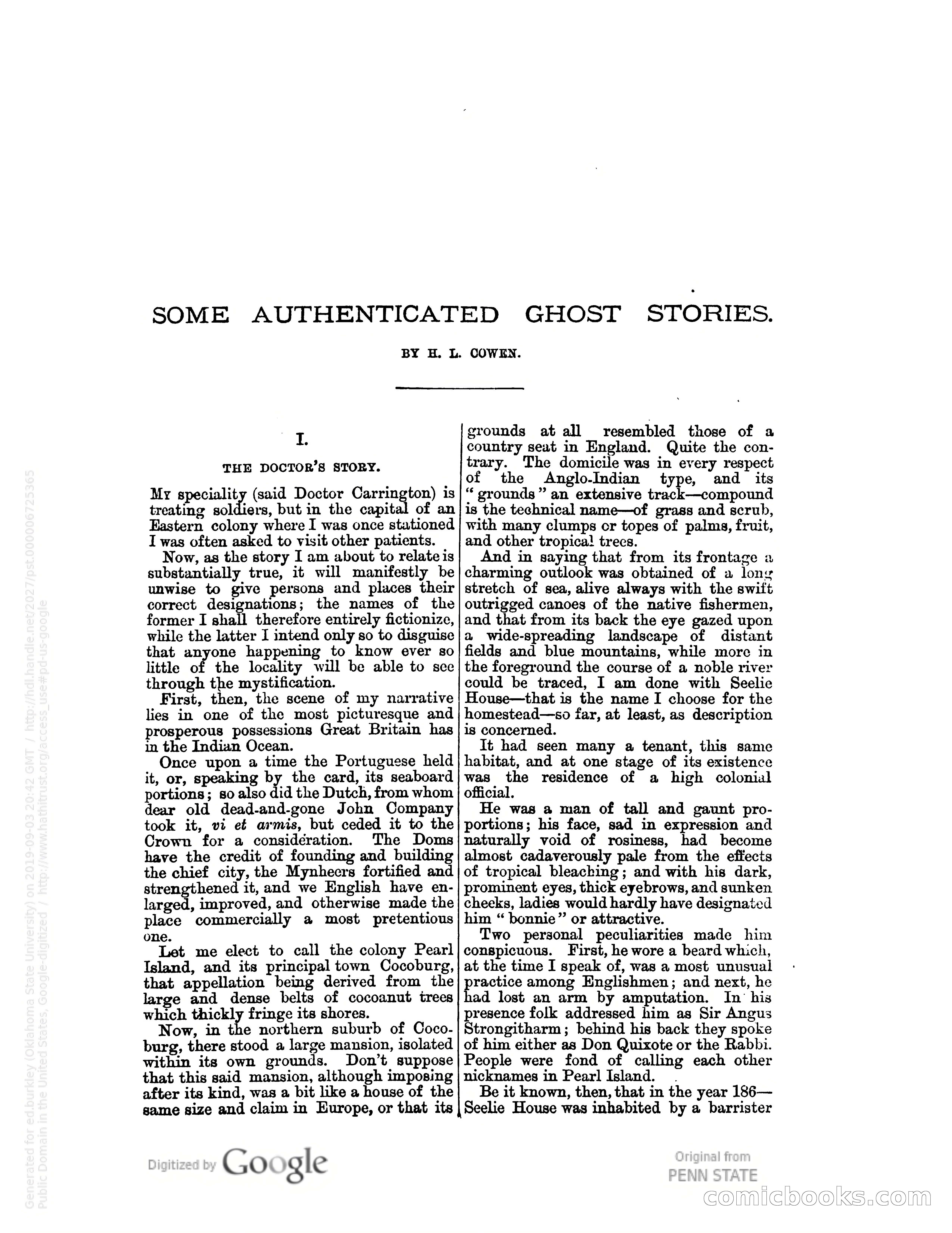
A restored page from Pulp Fiction, 1883. Page through the whole issue in the reader above.
📄 Transcribed text from this page (OCR, searchable)
Machine-transcribed from the original scan — historical spelling and the odd misread are preserved.
SOME AUTHENTICATED GHOST STORIES. BY H. L. ano THE DOCTOR’S STORY. My speciality (said Doctor Carrington) 1s treating soldiers, but in the capital of an Eastern colony where I was once stationed I was often asked to visit other patients. Now, as the story I am about to relate is substantially true, it will manifestly be unwise to give persons and places their correct designations; the names of the former I shall therefore entirely fictionize, while the latter I intend only so to disguise that anyone happening to know ever so little of the locality will be able to see through the mystification. First, then, the scene of my narrative lies in one of the most picturesque and prosperous possessions Great Britain has in the Indian Ocean. Once upon a time the Portuguese held it, or, speaking by the card, its seaboard portions; so also did the Dutch, from whom dear old dead-and-gone John Company took it, vi et armis, but ceded it to the Crown for a consideration. The Doms have the credit of founding and building the chief city, the Mynhecrs fortified and strengthened it, and we English have en- larged, improved, and otherwise made the place commercially a most pretentious one. Let me elect to call the colony Pearl Island, and its principal town Cocoburg, that appellation bemg derived from the large and dense belts of cocoanut trees which thickly fringe its shores. Now, in the northern suburb of Coco- burg, there stood a large mansion, isolated within its own grounds. Don’t suppose that this said mansion, although imposing after its kind, was a bit like a house of the game size and claim in Europe, or that its Google COWEN. grounds at all resembled those of a country seat in England. Quite the con- trary. The domicile was in every respect of the Anglo-Indian type, and _ its “ grounds” an extensive track—compound is the technical name—of grass and scrub, with many clumps cr topes of palms, fruit, and other tropica! trees. And in saying that from its frontage a charming outlook was obtained of a long stretch of sea, alive always with the swift outrigged canoes of the native fishermen, and that from its back the eye gazed upon a wide-spreading landscape of distant fields and blue mountains, while more in the foreground the course of a noble river could be traced, I am done with Seelie House—that is the name I choose for the homestead—so far, at least, as description is concerned. lt had seen many a tenant, this same habitat, and at one stage of its existence was the residence of a high colonial official. He was a man of tall and gaunt pro- portions; his face, sad in expression and naturally void of rosiness, had become almost cadaverously pale from the effects of tropical bleaching; and with his dark, prominent eyes, thick eyebrows, and sunken cheeks, ladies would hardly have designated him “ bonnie” or attractive. Two personal peculiarities made him conspicuous. First, he wore a beard which, at the time I speak of, was a most unusual practice among Englishmen; and next, he had lost an arm by amputation. In‘ his presence folk addressed him as Sir Angus Strongitharm; behind his back they spoke of him either as Don Quixote or the Rabbi. People were fond of calling each other nicknames in Pearl Island. . Be it known, then, that in the year 186— Seelie House was inhabited by a barrister CY, JOO S CO)