
Pulp Fiction, 1883 · page 109 of 142
Stories with a Vengeance — page 109: what you’re looking at
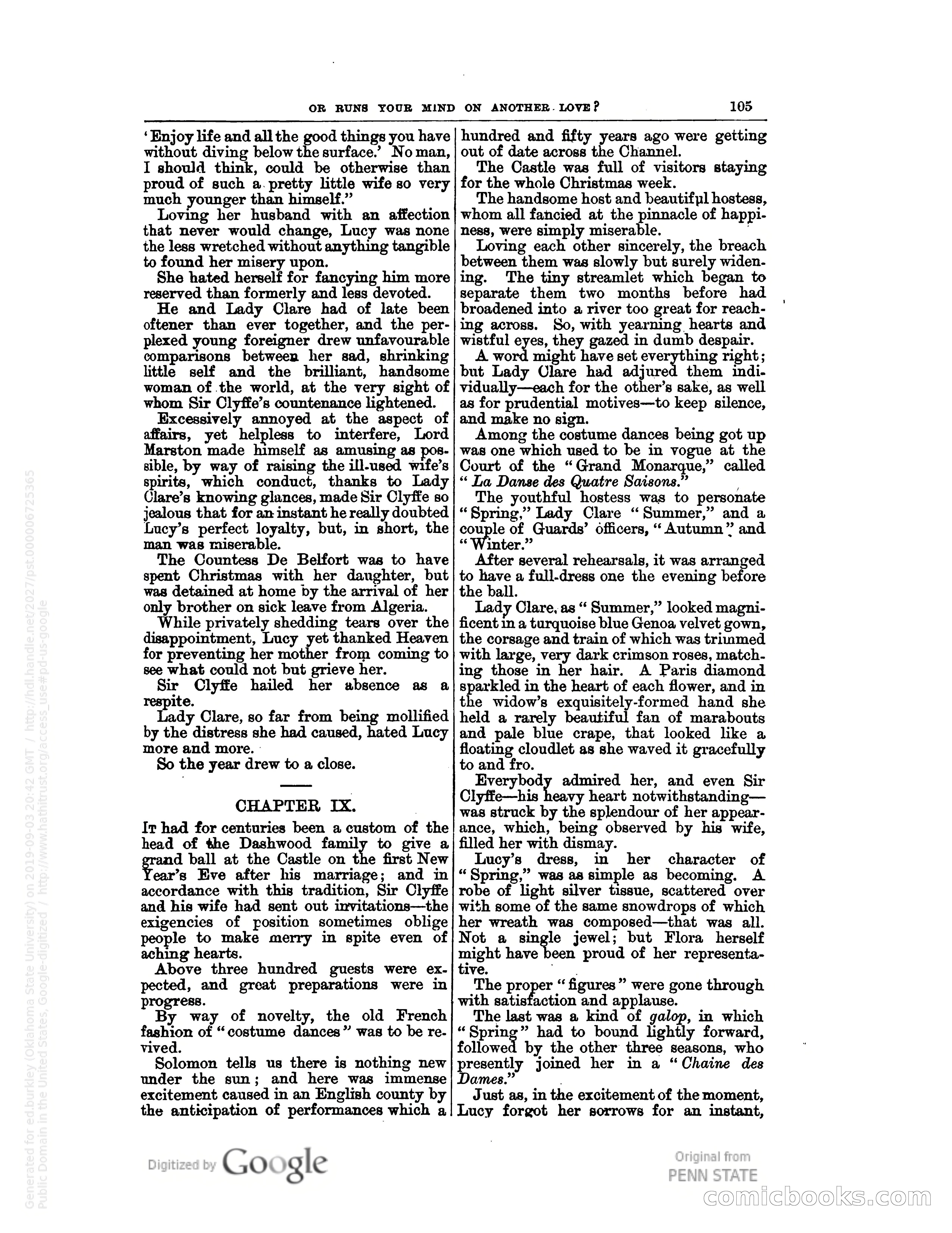
A restored page from Pulp Fiction, 1883. Page through the whole issue in the reader above.
📄 Transcribed text from this page (OCR, searchable)
Machine-transcribed from the original scan — historical spelling and the odd misread are preserved.
OR RUNS YOUR MIND ‘Enjoy life and all the good things you have without diving below the surface.’ No man, I should think, could be otherwise than proud of such a. pretty little wife so very much younger than himself.” Loving her husband with an affection that never would change, Lucy was none the less wretched without anything tangible to found her misery upon. She hated herself for fancying him more reserved than formerly and less devoted. He and Lady Clare had of late been oftener than ever together, and the per- plexed young foreigner drew unfavourable comparisons between her sad, shrinking little self and the brilliant, handsome woman of the world, at the very sight of whom Sir Clyffe’s countenance lightened. Excessively annoyed at the aspect of affairs, yet helpless to interfere, Lord Marston made himself as amusing as pos- sible, by way of raising the ill-used wife’s spirits, which conduct, thanks to Lady Clare’s knowing glances, made Sir Clyfie so jealous that for an instant he really doubted Lucy’s perfect loyalty, but, in short, the man was miserable. The Countess De Belfort was to have spent Christmas with her daughter, but was detained at home by the arrival of her only brother on sick leave from Algeria. While privately shedding tears over the disappointment, Lucy yet thanked Heaven for preventing her mother from coming to see what could not but grieve her. Sir Clyffe hailed her absence as a respite. Lady Clare, so far from being mollified by the distress she had caused, hated Lucy more and more. ' So the year drew to a close. CHAPTER IX. It had for centuries been a custom of the head of the Dashwood family to give a and ball at the Castle on the first New ear’s Eve after his marriage; and in accordance with this tradition, Sir Clyffe and his wife had sent out imvitations—the exigencies of position sometimes oblige people to make merry in spite even of aching hearts. Above three hundred guests were ex- pected, and great preparations were in progress. By way of novelty, the old French fashion of “costume dances” was to be re- vived. Solomon tells us there is nothing new under the sun; and here was immense excitement caused in an English county by the anticipation of performances which a Google ON ANOTHER. LOVE? 105 hundred and fifty years ago were getting out of date across the Channel. The Castle was full of visitors staying for the whole Christmas week. The handsome host and beautifyl hostess, whom all fancied at the pinnacle of happi- ness, were simply miserable. | Loving each other sincerely, the breach between them was slowly but surely widen- ing. The tiny streamlet which began to separate them two months before had broadened into a river too great for reach- ing across. So, with yearning hearts and wistful eyes, they gazed in dumb despair. A word might have set everything right; but Lady Olare had adjured them indi- vidually—each for the other’s sake, as well as for prudential motives—to keep silence, and make no sign. Among the costume dances being got up was one which used to be in vogue at the Court of the “Grand Monarque,” called “‘ La Danse des Quatre Saisons.” The youthful hostess was to personate “Spring,” Lady Clare “Summer,” and a couple of Guards’ officers, ‘“‘ Autumn” and 66 inter.” After several rehearsals, it was arranged to have a full-dress one the evening before the ball. Lady Clare, as “ Summer,” looked magni- ficent 1n a turquoise blue Genoa velvet gown, the corsage and train of which was trinmed with large, very dark crimson roses, match- ing those in her hair. A Paris diamond sparkled in the heart of each flower, and in the widow’s exquisitely-formed hand she held a rarely beautiful fan of marabouts and pale blue crape, that looked like a floating cloudlet as she waved it gracefully {| to and fro. Hverypody admired her, and even Sir Clyffe—his heavy heart notwithstanding— was struck by the splendour of her appear- ance, which, being observed by his wife, filled her with dismay. Lucy’s dress, in her character of “Spring,” was as simple as becoming. A robe of light silver tissue, scattered over with some of the same snowdrops of which her wreath was composed—that was all. Not a single jewel; but Flora herself might have been proud of her representa- tive. oO The proper “ figures” were gone through with satisfaction and applause. The last was a kind of galop, in which “Spring” had to bound lightly forward, followed by the other three seasons, who presently joined her in a “Chaine des Dames. Just as, in the excitement of the moment, Lucy forgot her sorrows for an instant, CY, JOO S CO)