
Pulp Fiction, 1883 · page 105 of 142
Stories with a Vengeance — page 105: what you’re looking at
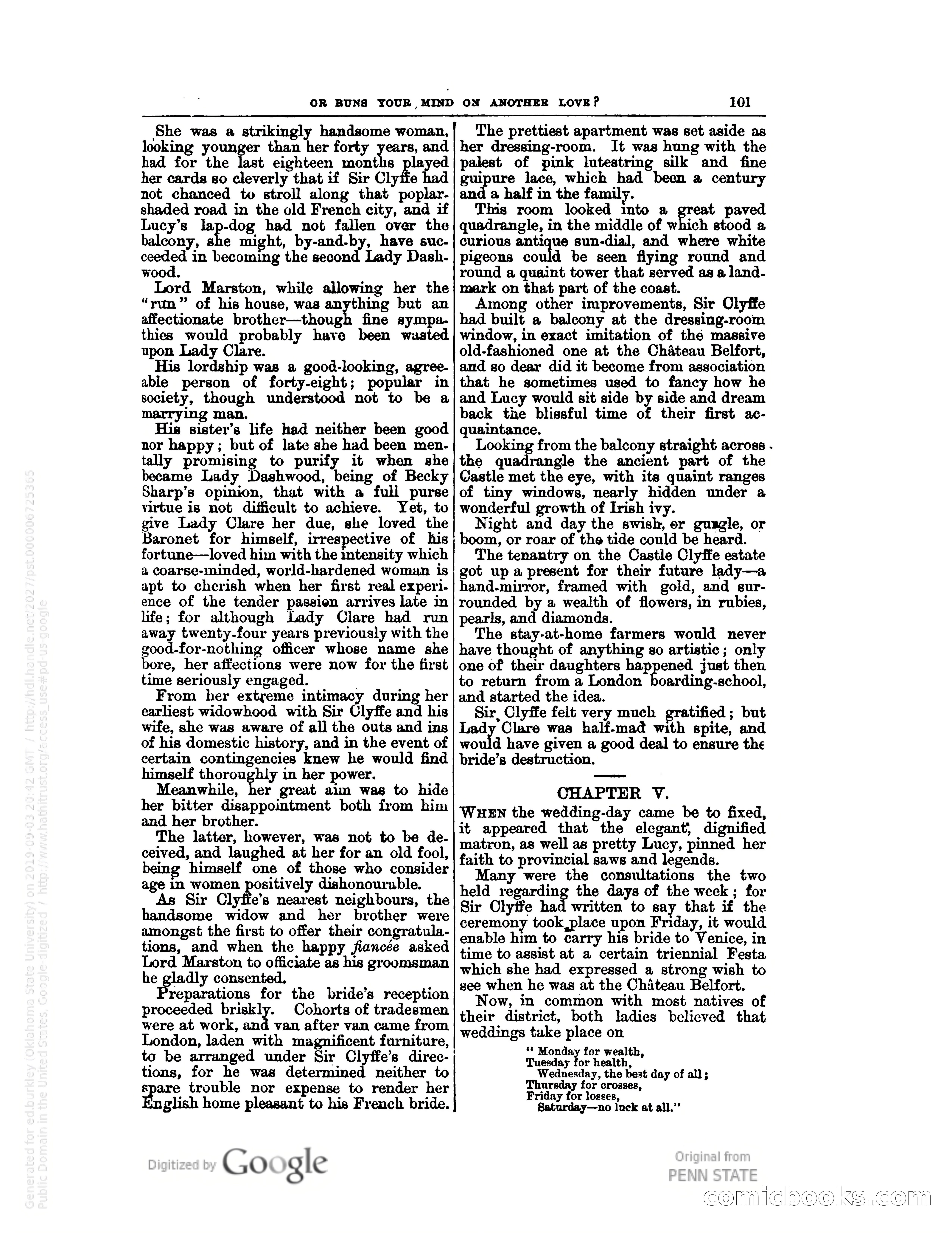
A restored page from Pulp Fiction, 1883. Page through the whole issue in the reader above.
📄 Transcribed text from this page (OCR, searchable)
Machine-transcribed from the original scan — historical spelling and the odd misread are preserved.
OR BUNS YOUR MIND She was a strikimgly handsome woman, looking younger than her forty years, and had for the last eighteen months pe ed her cards so cleverly that if Sir Clyife had not chanced to stroll along that poplar- shaded road in the old French city, and if Lucy’s lap-dog had not fallen over the balcony, she might, by-and-by, have suc- ceeded in becoming the second Lady Dash- wood. Lord Marston, while allowing her the “rum” of his house, was anything but an affectionate brother—though fine sympa- thies would probably have been wasted upon Lady Clare. His lordship was a good-looking, agree- able person of forty-eight; popular in society, though understood not to be a marrying man. His scier'a life had neither been good nor happy; but of late she had been men- tally promising to purify it when she became Lady Dashwood, being of Becky Sharp’s opinion, thut with a full purse virtue is not difficult to achieve. Yet, to give Lady Clare her due, she loved the Baronet for himself, irrespective of his fortune—loved him with the intensity which a coarse-minded, world-hardened womun is apt to cherish when her first real experi- ence of the tender passien arrives late in life; for although Lady Clare had run away twenty-four years previously with the good-for-nothing officer whose name she bore, her affections were now for the first time seriously engaged. | From her extyeme intimacy during her earliest widowhood with Sir Clyffe and his wife, she was aware of all the outs and ins of his domestic history, and in the event of certain contingencies knew he would find himself thoroughly in her power. Meanwhile, her great aim was to hide her bitter disappointment both from him and her brother. The latter, however, was not to be de- ceived, and laughed at her for an old fool, being himself one of those who consider age In women positively dishonouruble. As Sir Clyffe’s nearest neighbours, the handsome widow and her brother were amongst the first to offer their congratula- tions, and when the happy fiancée asked Lord Marston to officiate as his groomsman he gladly consented. Preparations for the bride’s reception proceeded briskly. Cohorts of tradesmen were at work, and van after van came from London, laden with magnificent furniture, to be arranged under Sir Clyffe’s direc- | tions, for he was determined neither to spare trouble nor expense to render her glish home pleasant to his French bride. Google ON ANOTHER LOVE? 101 The prettiest apartment was set aside as her dressing-room. It was hung with the palest of pink lutestring silk and fine guipure lace, which had been a century and a half in the family. This room looked into a great paved quadrangle, in the middle of which stood a curious antique sun-dial, and where white pigeons could be seen flying round and round a quaint tower that served as a land- mark on that part of the coast. Among other improvements, Sir Olyffe had built a balcony at the dressing-room window, in exact imitation of the massive old-fashioned one at the Chateau Belfort, and so dear did it become from association that he sometimes used to fancy how he and Lucy would sit side by side and dream back the blissful time of their first ac- quaintance. Looking from the balcony straight across . the quadrangle the ancient part of the Castle met the eye, with its quaint ranges of tiny windows, nearly hidden under a wonderful growth of Irish ivy. Night and day the swish, er guxgle, or boom, or roar of the tide could be heard. The tenantry on the Castle Clyffe estate got up a present for their future lady—a hand-murror, framed with gold, and sur- rounded by a wealth of flowers, in rubies, pearls, and diamonds. The stay-at-home farmers would never have thought of anything so artistic; only one of their daughters happened just then to return from a London boarding-school, and started the idea. Sir, Clyffe felt very much gratified; but Lady Clare was half-mad with spite, and would have given a good deal to ensure the bride’s destruction. CHAPTER V. WHEN the wedding-day came be to fixed, it appeared that the elegant, dignified matron, as well as pretty Lucy, pinned her faith to provincial saws and legends. Many were the consultations the two held regarding the days of the week; for Sir Clyffe had written to say that if the ceremony took,place upon Friday, it would enable him to carry his bride to Venice, in time to assist at a certain triennial Festa which she had expressed a strong wish to see when he was at the Chiteau Belfort. Now, in common with most natives of their district, both ladies believed that weddings take place on ‘* Monday for wealth, Tuesday for health, Wednesday, the best day of all; Thursday for crosses, Friday for losses, Saturday—no luck at all.” CY, JOO S CO)