
Pulp Fiction, 1883 · page 67 of 142
Stories with a Vengeance — page 67: what you’re looking at
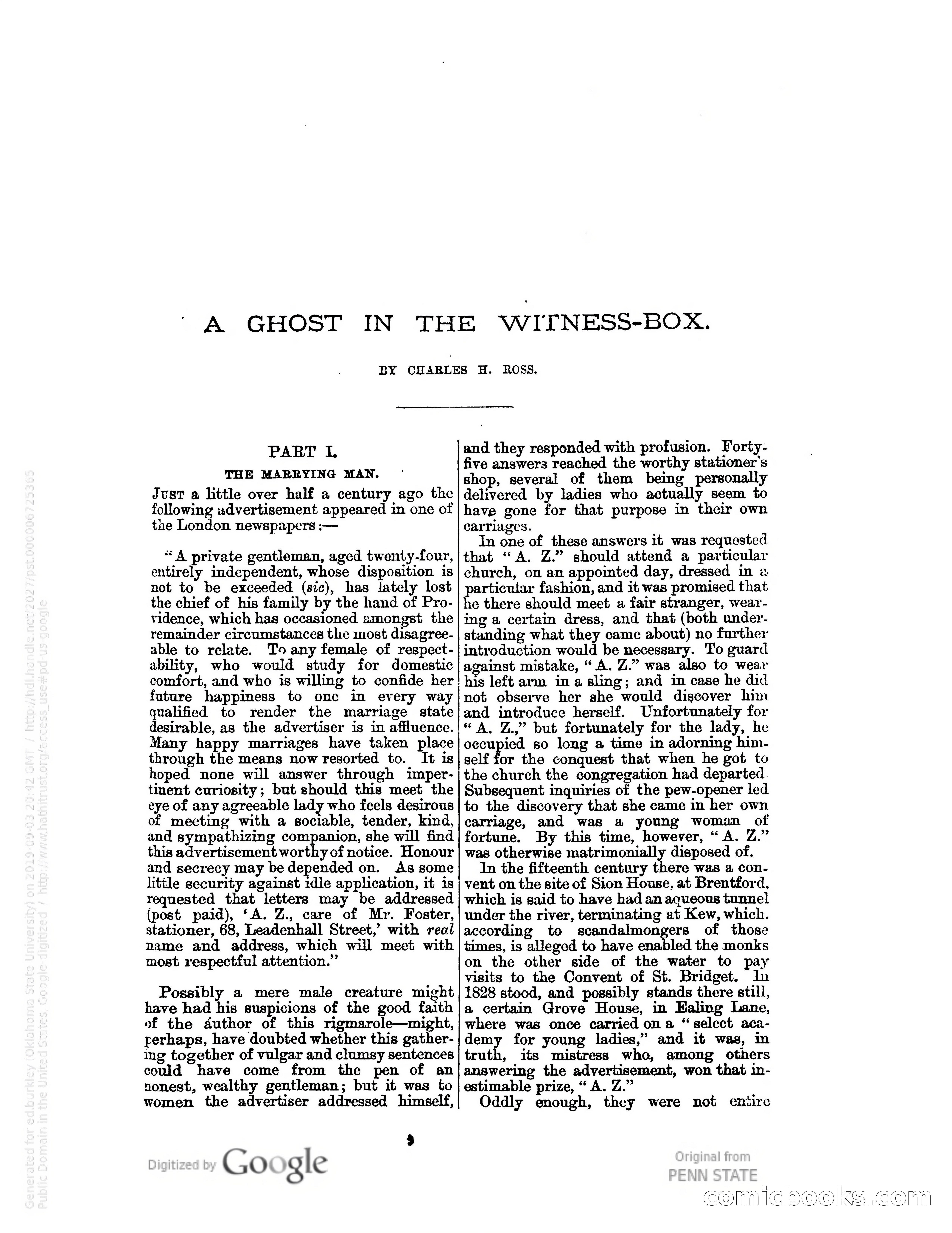
A restored page from Pulp Fiction, 1883. Page through the whole issue in the reader above.
📄 Transcribed text from this page (OCR, searchable)
Machine-transcribed from the original scan — historical spelling and the odd misread are preserved.
A GHOST IN THE WITNESS-BOX. BY CHARLES H. ROSS. PART I. THE MARRYING MAN. Just a little over half a century ago the following advertisement appeared in one of the London newspapers :— “A private gentleman, aged twenty-four, entirely independent, whose disposition is not to be exceeded (sic), has tately lost the chief of his family by the hand of Pro- vidence, which has occasioned amongst the remainder circumstances the most disagree- able to relate. To any female of respect- ability, who would study for domestic comfort, and who is willing to confide her future happiness to one im every way qualified to render the marriage state desirable, as the advertiser is in affluence. Many happy marriages have taken place through the means now resorted to. It 1s hoped none will answer through imper- tinent curiosity; but should this meet the eye of any agreeable lady who feels desirous of meeting with a sociable, tender, kind, and sympathizing companion, she will find this advertisement worthy of notice. Honour and secrecy may be depended on. As some litile security against idle application, it 1s requested that letters may be addressed (post paid), ‘A. Z., care of Mr. Foster, stationer, 68, Leadenhall Street,’ with real name and address, which will meet with most respectful attention.” Possibly a mere male creature might have had his suspicions of the good faith of the duthor of this rigmarole—might, perhaps, have doubted whether this gather- ing together of vulgar and clumsy sentences could have come from the pen of an nonest, wealthy gentleman; but it was to women the advertiser addressed himself, | Google and they responded with profusion. Forty- five answers reached the worthy stationer's shop, several of them being personally delivered by ladies who actually seem to have gone for that purpose in their own carriages. In one of these answers it was requested that “A. Z.” should attend a particular church, on an appointed day, dressed in z particular fashion, and it was promised that he there should meet a fair stranger, wear- ing a certain dress, and that (both under- standing what they came about) no farther introduction would be necessary. To guard against mistake, “A. Z.” was also to wear his left arm ina sling; and in case he did not observe her she would digcover him and introduce herself. Unfortunately for “A. Z.,” but fortunately for the lady, he occupied so long a time in adorning him- self for the conquest that when he got to the church the congregation had departed. Subsequent inquiries of the pew-opener led to the discovery that she came in her own carriage, and was a young woman of fortune. By this time, however, “A. Z.” was otherwise matrimonially disposed of. In the fifteenth century there was a con- vent on the site of Sion House, at Brentford, which is said to have had an aqueous tunnel under the river, terminating at Kew, which. according to scandalmongers of those times, is alleged to have enabled the monks on the other side of the water to pay visits to the Convent of St. Bridget. In 1828 stood, and possibly stands there still, a certain Grove House, in Haling Lane, where was once carried on a “select aca- demy for young ladies,” and it was, m truth, its mistress who, among others answering the advertisement, won that in- estimable prize, “A. Z.” Oddly enough, they were not entire CY, JOO S CO)