
Pulp Fiction, 1883 · page 75 of 142
Stories with a Vengeance — page 75: what you’re looking at
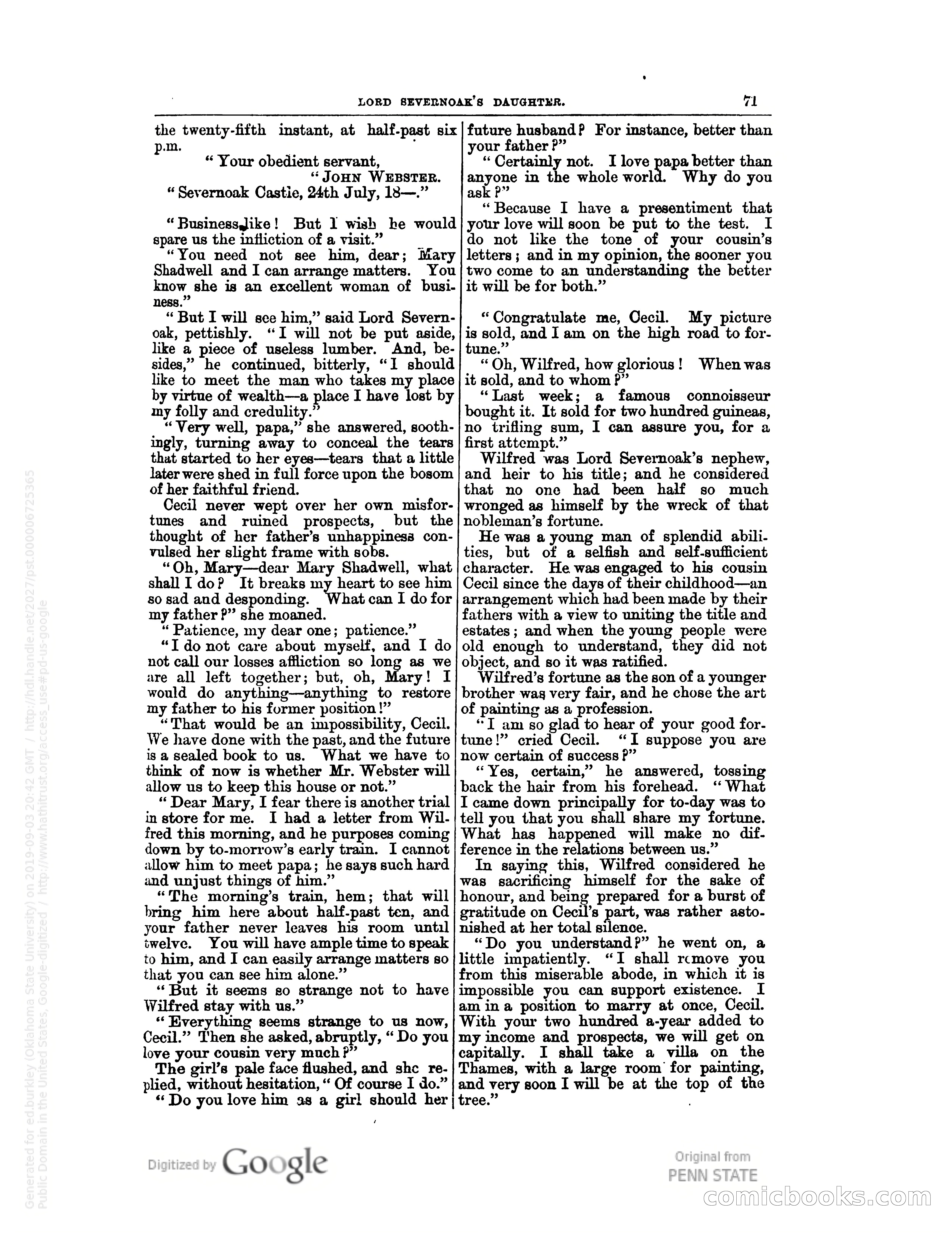
A restored page from Pulp Fiction, 1883. Page through the whole issue in the reader above.
📄 Transcribed text from this page (OCR, searchable)
Machine-transcribed from the original scan — historical spelling and the odd misread are preserved.
LORD SEVERNOAE’S DAUGHTER. the twenty-fifth instant, at half-past six p.m. “ Your obedient servant, ‘ JOHN WEBSTER. “ Severnoak Castie, 24th July, 183—.” “ Businessike! But 1 wish he would spare us the iniliction of a visit.” “You need not see him, dear; Mary Shadwell and I can arrange matters. You know she is an excellent woman of busi- ness.” “ But I will see him,” said Lord Severn- oak, pettishly. “I will not be put aside, like a piece of useless lumber. And, be- sides,” he continued, bitterly, “I should like to meet the man who takes my place by virtue of wealth—a place I have lost by my folly and credulity.” “Very well, papa,” she answered, sooth- ingly, turning away to conceal the tears that started to her eyes—tears that a little later were shed in full force upon the bosom of her faithful friend. Cecil never wept over her own misfor- tunes and ruined prospects, but the thought of her father’s unhappiness con- vulsed her slight frame with sobs. “Oh, Mary—dear Mary Shadwell, what shall I do? It breaks my heart to see him so sad and desponding. hat can I do for my father P”’ she moaned. “Patience, my dear one; patience.” “I do not care about myself, and I do not call our losses affliction so long as we are all left together; but, oh, ry! I would do anything—anything to restore my father to his former position!” “That would be an impossibility, Cecil. We have done with the past, and the future is a sealed book to us. What we have to think of now is whether Mr. Webster will allow us to keep this house or not.” “ Dear Mary, I fear there is another trial in store for me. I had a letter from Wil- fred this morning, and he purposes coming down by to-morrow’s early train. I cannot allow him to meet papa; he says such hard and unjust things of him.” “The morning’s train, hem; that will bring him here about half-past ten, and your father never leaves his room until twelve. You will have ample time to speak to him, and I can easily arrange matters so that you ean see him alone.”’ ‘But it seems so strange not to have Wilfred stay with us.” ‘‘ Everything seems strange to us now, Cecil.” Then she asked, abruptly, “ Do you love your cousin very much ?” The girl’s pale face flushed, and shc re- plied, without hesitation, “‘ Of course I do.” 71 future husband? For instance, better than your father P” “ Certainly not. I love papa better than anyone in the whole world. Why do you as 99 ‘Because I have a presentiment that your love will soon be put to the test. I do not like the tone of your cousin’s letters ; and in my opinion, the sooner you two come to an understanding the better it will be for both.” “Congratulate me, Cecil. My picture is sold, and 1 am on the high road to for- tune.”’ “Oh, Wilfred, how glorious! When was it sold, and to whom P” “Last week; a famous connoisseur bought it. It sold for two hundred guineas, no trifling sum, I can assure you, for a first attempt.” Wilfred was Lord Severnoak’s nephew, and heir to his title; and he considered that no one had been half so much wronged as himself by the wreck of that nobleman’s fortune. He was a young man of splendid abili- ties, but of a selfish and self-sufficient character. He was engaged to his cousin Cecil since the days of their childhood—an arrangement which had been made by their fathers with a view to uniting the title and estates ; and when the young people were old enough to understand, they did not object, and so it was ratified. Wilfred’s fortune as the son of a younger brother wag very fair, and he chose the art of painting as a profession. “TI am so glad to hear of your good for- tune!” cried Cecil. ‘I suppose you are now certain of success P” “Yes, certain,’ he answered, tossing back the hair from his forehead. ‘‘ What I came down principally for to-day was to tell you that you shall share my fortune. What has happened will make no dif- ference in the relations between us.” In saying this, Wilfred considered he was sacrificmg himself for the sake of honour, and being prepared for a burst of gratitude on Cecil’s part, was rather asto- nished at her total silence. “Do you understand?” he went on, a little impatiently. “I shall rcmove you from this miserable abode, in which it is impossible you can support existence. I am ina position to marry at once, Cecil. With your two hundred a-year added to my income and prospects, we will get on capitally. I shall take a villa on the Thames, with a large room for painting, and very soon I will be at the top of the “Do you love him as a girl should her tree.” Google CY, JOO S CO)