
Pulp Fiction, 1883 · page 74 of 142
Stories with a Vengeance — page 74: what you’re looking at
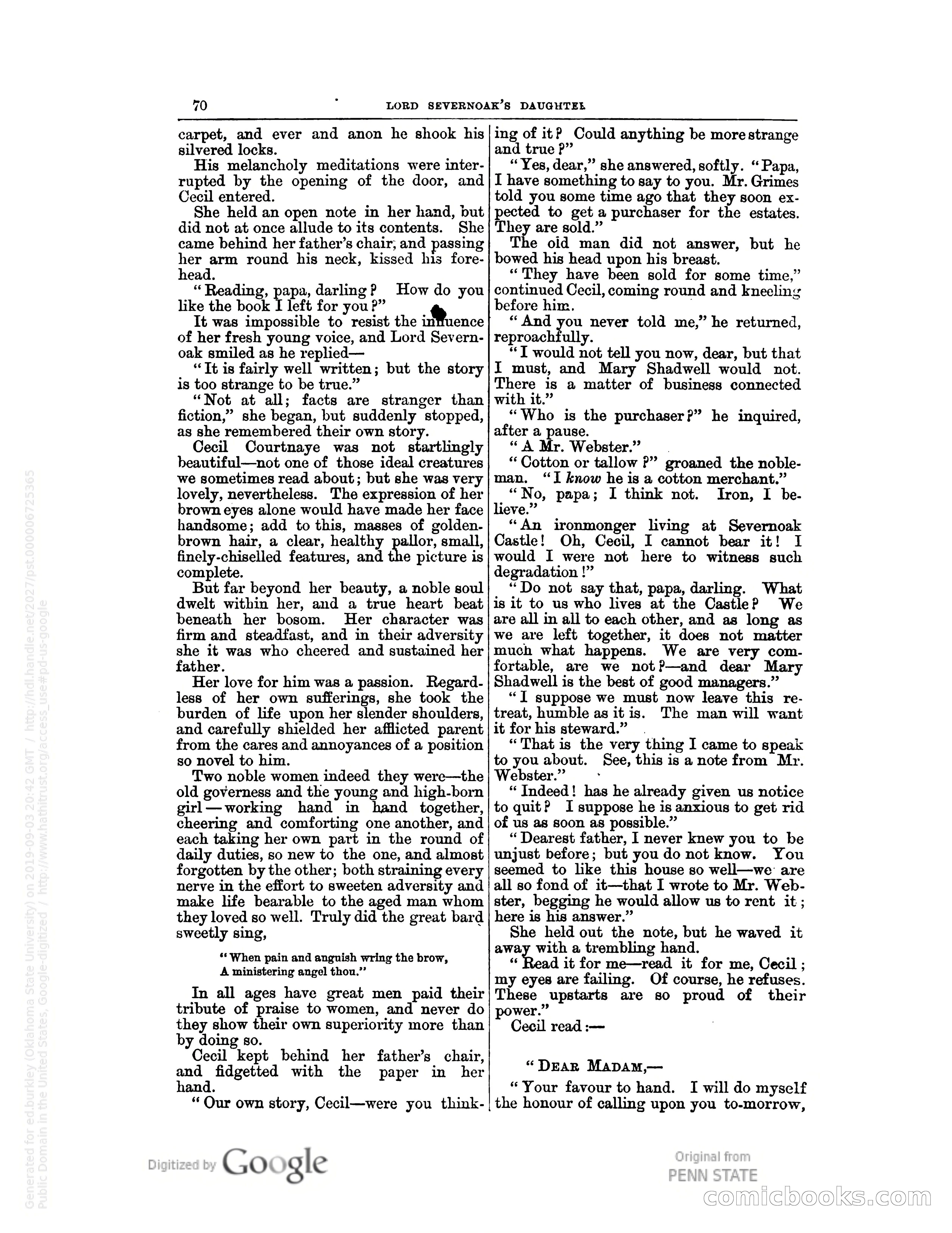
A restored page from Pulp Fiction, 1883. Page through the whole issue in the reader above.
📄 Transcribed text from this page (OCR, searchable)
Machine-transcribed from the original scan — historical spelling and the odd misread are preserved.
"0 " LORD SEVERNOAK’S DAUGHTEE carpet, and ever and anon he shook his silvered locks. His melancholy meditations were inter- rupted by the opening of the door, and Cecil entered. She held an open note in her hand, but did not at once allude to its contents. She came behind her father’s chair, and passing her arm round his neck, kissed his fore- head. “Reading, papa, darling? How do you like the book T left for you P” It was impossible to resist the infuence of her fresh young voice, and Lord Severn- oak smiled as he replied— “Tt is fairly well written; but the story is too strange to be true.” “Not at all; facts are stranger than fiction,” she began, but suddenly stopped, as she remembered their own story. Cecil Courtnaye was not starthngly beautiful—not one of those ideal creatures we sometimes read about; but she was very lovely, nevertheless. The expression of her brown eyes alone would have made her face handsome; add to this, masses of golden. brown hair, a clear, healthy pallor, small, finely-chiselled features, and the picture is complete. But far beyond her beauty, a noble soul dwelt within her, and a true heart beat beneath her bosom. Her character was firm and steadfast, and in their adversity she it was who cheered and sustained her father. Her love for him was a passion. Regard- less of her own sufferings, she took the burden of life upon her slender shoulders, and carefully shielded her afflicted parent from the cares and annoyances of a position so novel to him. Two noble women indeed they were—the old governess and the young and high-born girl—working hand in hand together, cheering and comforting one another, and each taking her own part in the round of daily duties, so new to the one, and almost forgotten by the other; both straining every nerve in the effort to sweeten adversity and make life bearable to the aged man whom they loved so well. Truly did the great bard sweetly sing, ** When pain and anguish wring the brow, A ministering angel thou.”’ In all ages have great men paid their tribute of praise to women, and never do they show their own superiority more than by doing so. Cecil kept behind her father’s chair, and fidgetted with the paper in her hand. “Qur own story, Cecil—were you think- Google ing of itP Could anything be more strange and true P” “Yes, dear,” she answered, softly. “Papa, I have something to say to you. Mr. Grimes told you some time ago that they soon ex- pected to get a purchaser for the estates. They are sold.” The oid man did not answer, but he bowed his head upon his breast. “They have been sold for some time,” continued Cecil, coming round and kneeling before him. | * And you never told me,” he returned, repsoachtally. ‘I would not tell you now, dear, but that I must, and Mary Shadwell would not. There is a matter of business connected with it.” “Who is the purchaser?” he inquired, after a pause. “A Mr. Webster.” “ Cotton or tallow ?” groaned the noble- man. “IJ know he is a cotton merchant.” “No, papa; I think not. Iron, I be- lieve.” “An ironmonger living at Severnoak Castle! Oh, Cecil, I cannot bear it! I would I were not here to witness such degradation !” “Do not say that, papa, darling. What is it to us who lives at the Castle? We are all m all to each other, and as long as we are left together, it does not matter much what happens. We are very com- fortable, are we not?P—and dear Mary Shadwell is the best of good managers.” “IT suppose we must now leave this re- treat, humble as itis. The man will want it for his steward.” . “That is the very thing I came to speak to you about. See, this is anotefrom Mr. Webster.” : “‘ Indeed! has he already given us notice to quit? I suppose he is anxious to get rid of us as soon as possible.” “ Dearest father, 1 never knew you to be unjust before; but you do not know. You seemed to like this house so well—we are all so fond of it—that I wrote to Mr. Web- ster, begging he would allow us to rent it; here is his answer.” She held out the note, but he waved it away with a trembling hand. ‘“‘ Read it for me—read it for me, Cecil ; my eyes are failing. Of course, he refuses. These upstarts are so proud of their wer.” Cecil read :— “DEAR Mapay,— “Your favour to hand. I will do myself the honour of calling upon you to-morrow, JOO @ © = a S CO)