
Pulp Fiction, 1883 · page 129 of 142
Stories with a Vengeance — page 129: what you’re looking at
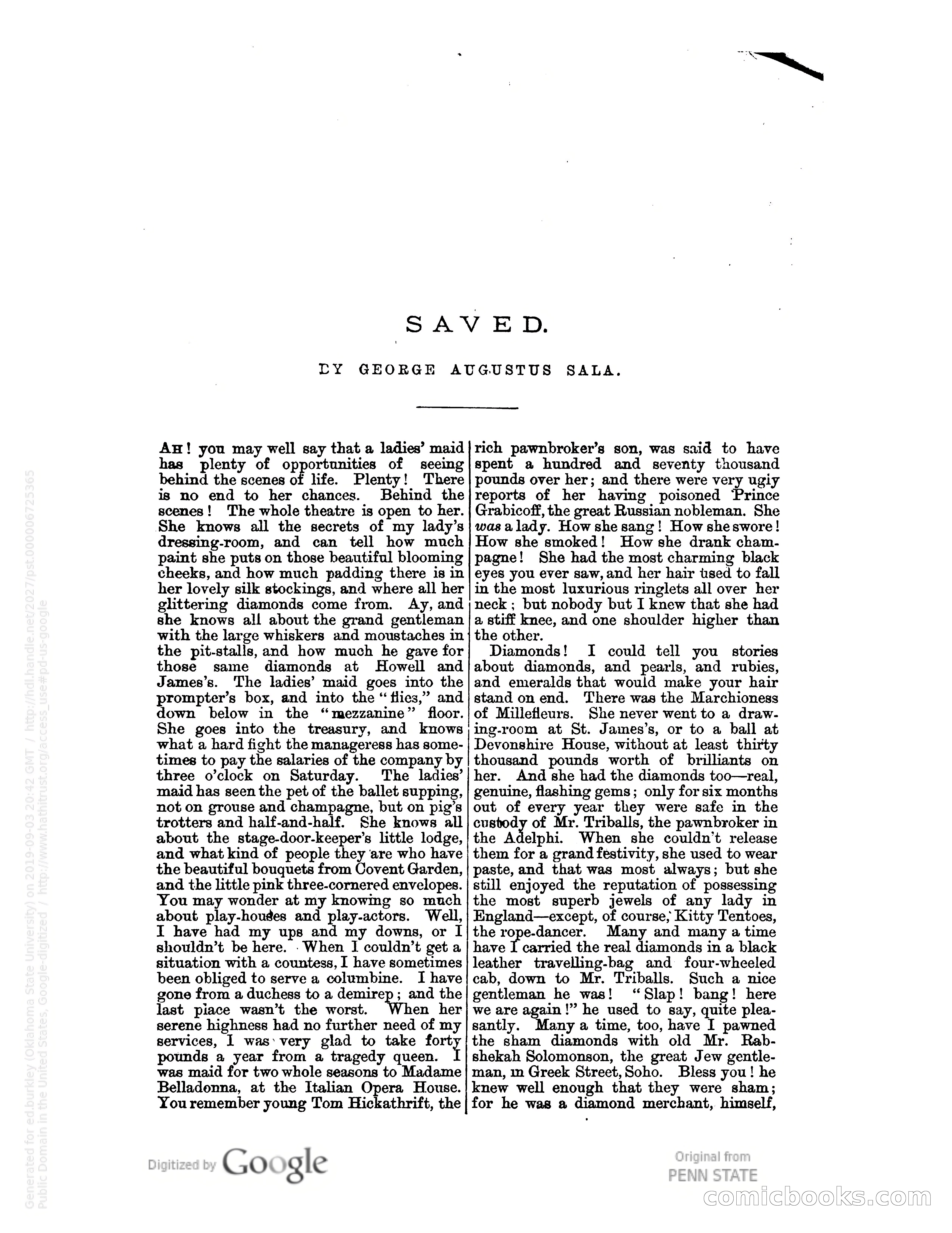
A restored page from Pulp Fiction, 1883. Page through the whole issue in the reader above.
📄 Transcribed text from this page (OCR, searchable)
Machine-transcribed from the original scan — historical spelling and the odd misread are preserved.
SAVED. CY GEORGE AUGUSTUS SALA. AH! you may well say that a ladies’ maid has plenty of opportunities of seeing behind the scenes of life. Plenty! There is no end to her chances. Behind the scenes! The whole theatre is open to her. She knows all the secrets of my lady’s dressing-room, and can tell how much paint she puts on those beautiful blooming cheeks, and how much padding there 1s in her lovely silk stockings, and where all her glittering diamonds come from. Ay, an she knows all about the grand gentleman with the large whiskers and moustaches in the pit-stalls, and how much he gave for those same diamonds at Howell and James’s. The ladies’ maid goes into the prompter’s box, and into the “ flies,” and down below in the “mezzanine” floor. She goes into the treasury, and knows what a hard fight the manageress has some- times to pay the salaries of the company by three o’clock on Saturday. The ladies’ maid has seen the pet of the ballet supping, not on grouse and champagne, but on pig’s trotters and half-and-half. She knows all about the stage-door-keeper’s little lodge, and what kind of people they are who have the beautiful bouquets from Covent Garden, and the little pink three-cornered envelopes. ‘You may wonder at my knowmg so much about play-houdes and play-actors. Well, I have had my ups and my downs, or I shouldn’t be here. .When I couldn’t get a situation with a countess, I have sometimes been obliged to serve a columbine. I have gone from a duchess to a demirep; and the last piace wasn’t the worst. en her serene highness had no further need of my services, 1 was: very glad to take forty pounds a year from a tragedy queen. was maid for two whole seasons to Madame Belladonna, at the Italian Opera House. You remember young Tom Hickathrift, the Google rich pawnbroker’s son, was said to have spent a hundred and seventy thousand pounds over her; and there were very ugiy reports of her having poisoned ‘Prince Grabicoff, the great Russian nobleman. She was alady. How she sang! How sheswore! How she smoked! How she drank cham- pagne! She had the most charming black eyes you ever saw, and her hair used to fall in the most luxurious ringlets all over her d;neck ; but nobody but I knew that she had a stiff knee, and one shoulder higher than the other. Diamonds! I could tell you stories about diamonds, and pearls, and rubies, and emeralds that would make your hair stand on end. There was the Marchioness of Millefleurs. She never went to a draw- ing-room at St. James’s, or to a ball at Devonshire House, without at least thirty thousand pounds worth of brilhants on her. And she had the diamonds too—real, genuine, flashing gems; only for six months out of every year they were safe in the custody of Mr. Triballs, the pawnbroker in the Adelphi. When she couldn't release them for a grand festivity, she used to wear paste, and that was most always; but she still enjoyed the reputation of possessing the most superb jewels of any lady in England—except, of course, Kitty Tentoes, the rope-dancer. Many and many a time have I carried the real diamonds in a black leather travelling-bag and four-wheeled cab, down to Mr. Triballs. Such a nice gentleman he was! “Slap! bang! here we are again!” he used to say, quite plea- santly. Many a time, too, have I pawned the sham diamonds with old Mr. Rab- shekah Solomonson, the great Jew gentle- man, in Greek Street,Soho. Bless you! he knew well enough that they were sham; for he was a diamond merchant, himself, CY, JOO S CO)