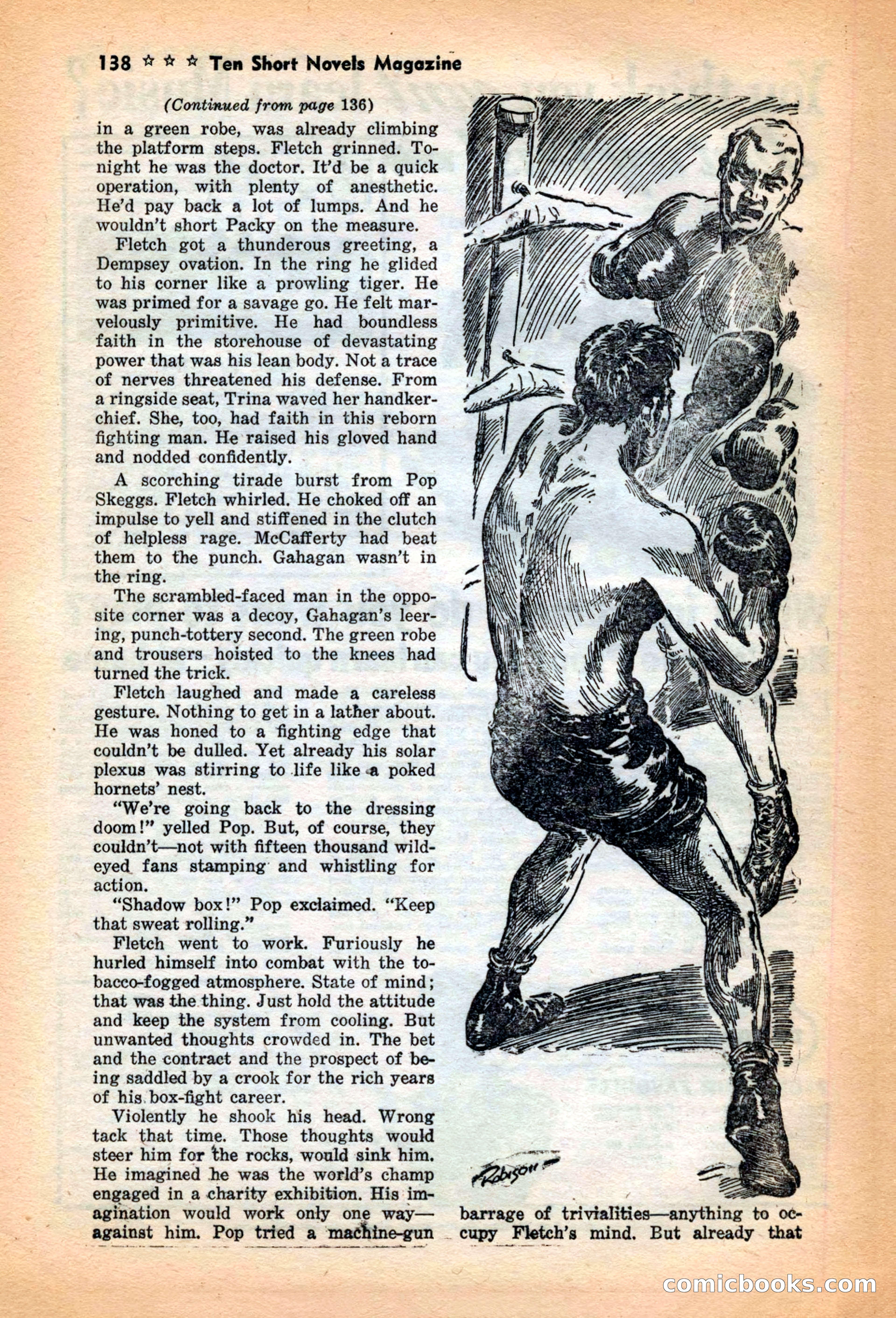
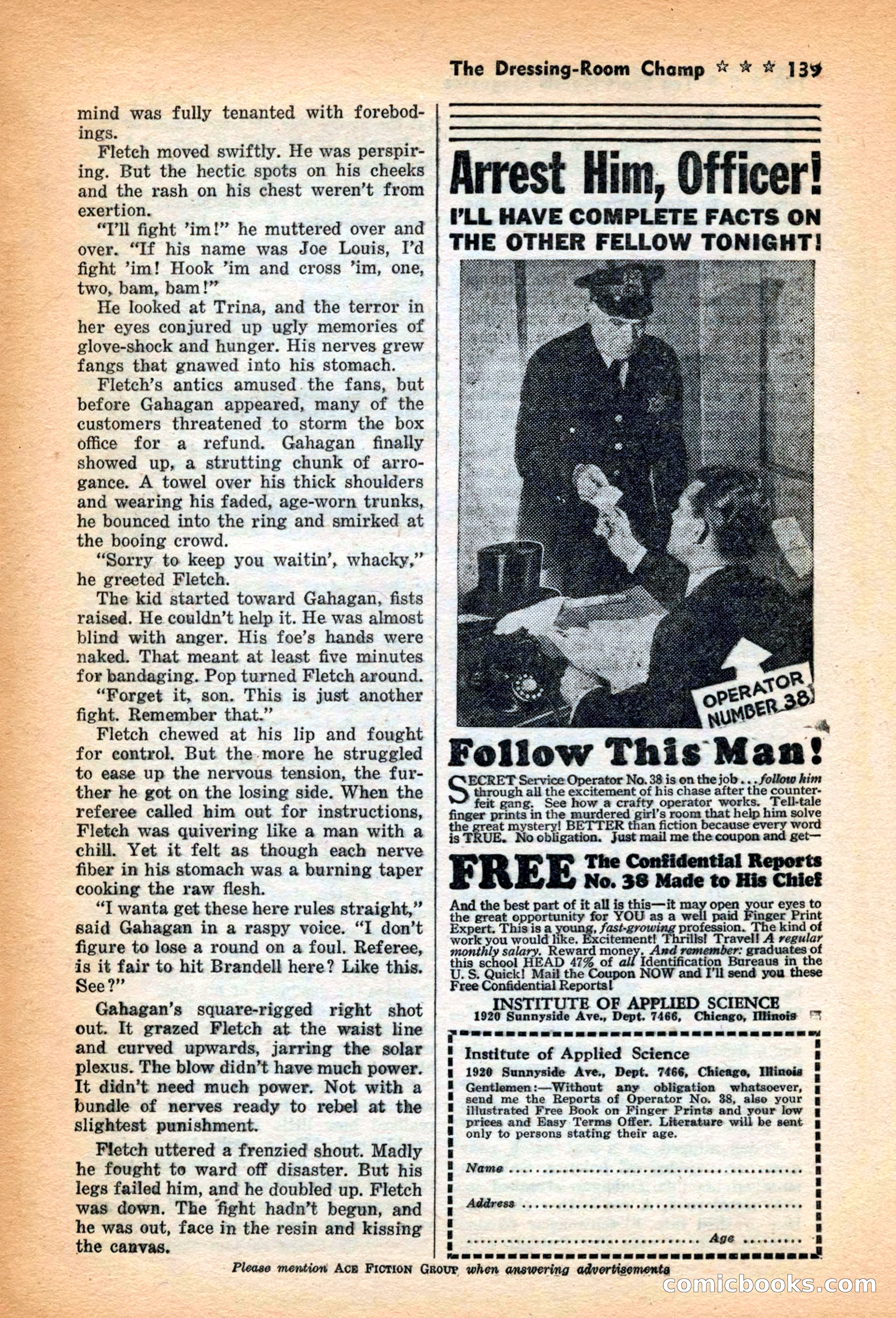
A complete issue · 148 pages · 1938
10 Short Novels Magazine
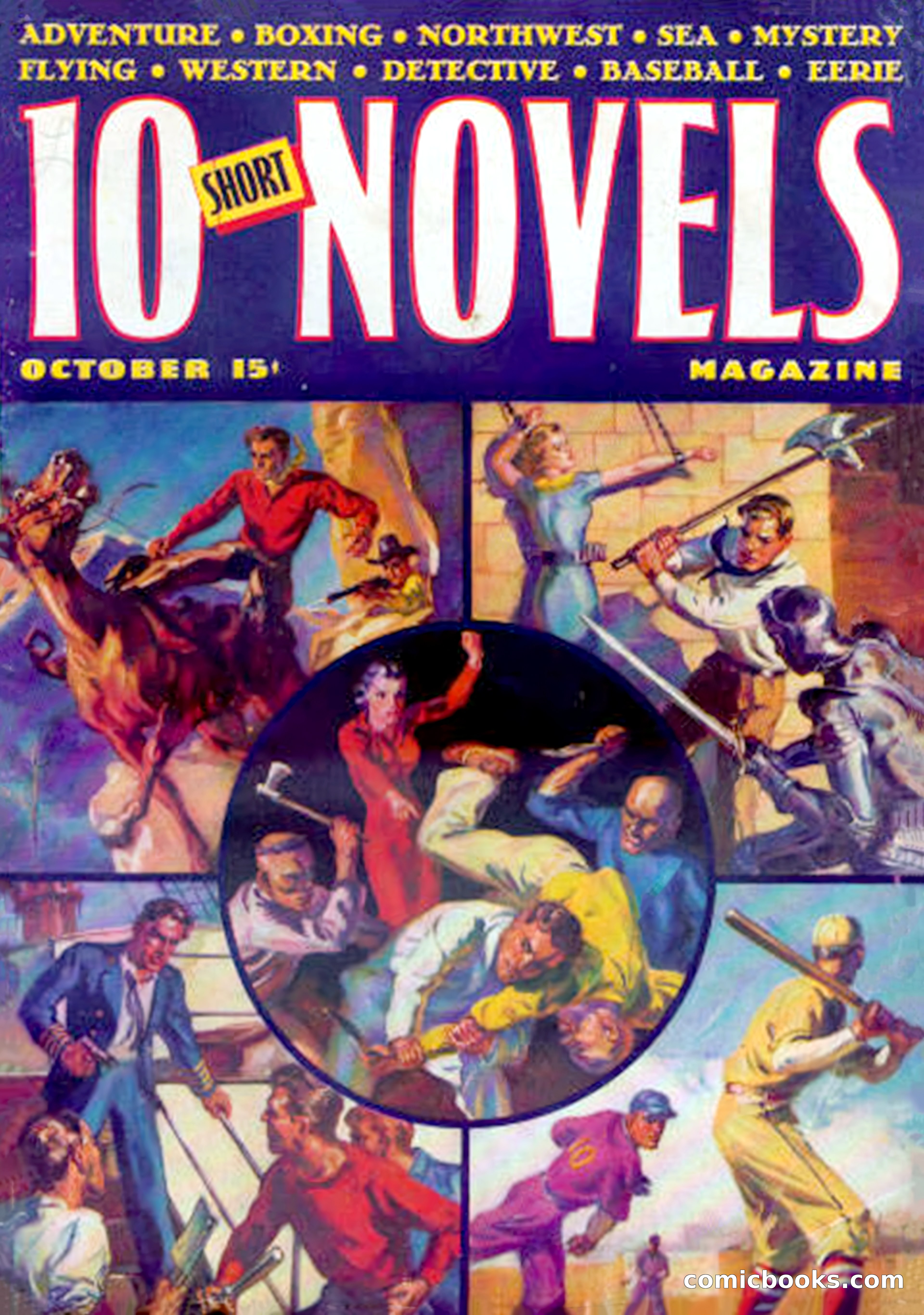
# 10 Short Novels Magazine Cover This is the cover of a pulp magazine titled "10 Short Novels," priced at October 15¢. The masthead lists genre categories including Adventure, Boxing, Northwest, Sea, Mystery, Flying, Western, Detective, Baseball, and Eerie. The cover features a collage of colorful illustrated vignettes arranged around a central circular scene depicting what appears to be action or conflict. The surrounding panels show various dramatic moments—figures in dynamic poses, some appearing to be in combat or perilous situations. The artwork uses vivid colors including reds, yellows, and blues typical of pulp magazine cover illustration. The overall composition suggests multiple adventure stories contained within this issue.
# Page Analysis This appears to be a mostly blank page from a pulp magazine, likely a section break or transitional page. At the top of the page is a small, heavily pixelated text element in black and yellow/gold coloring that is difficult to read clearly due to image quality. At the bottom of the page is another similarly degraded text element. The bulk of the page consists of white space. Without being able to reliably decipher the OCR'd text due to the image quality and pixelation, I cannot determine whether this is prose, an advertisement, or a title page. The layout suggests it may be a section divider or chapter break within a magazine issue.
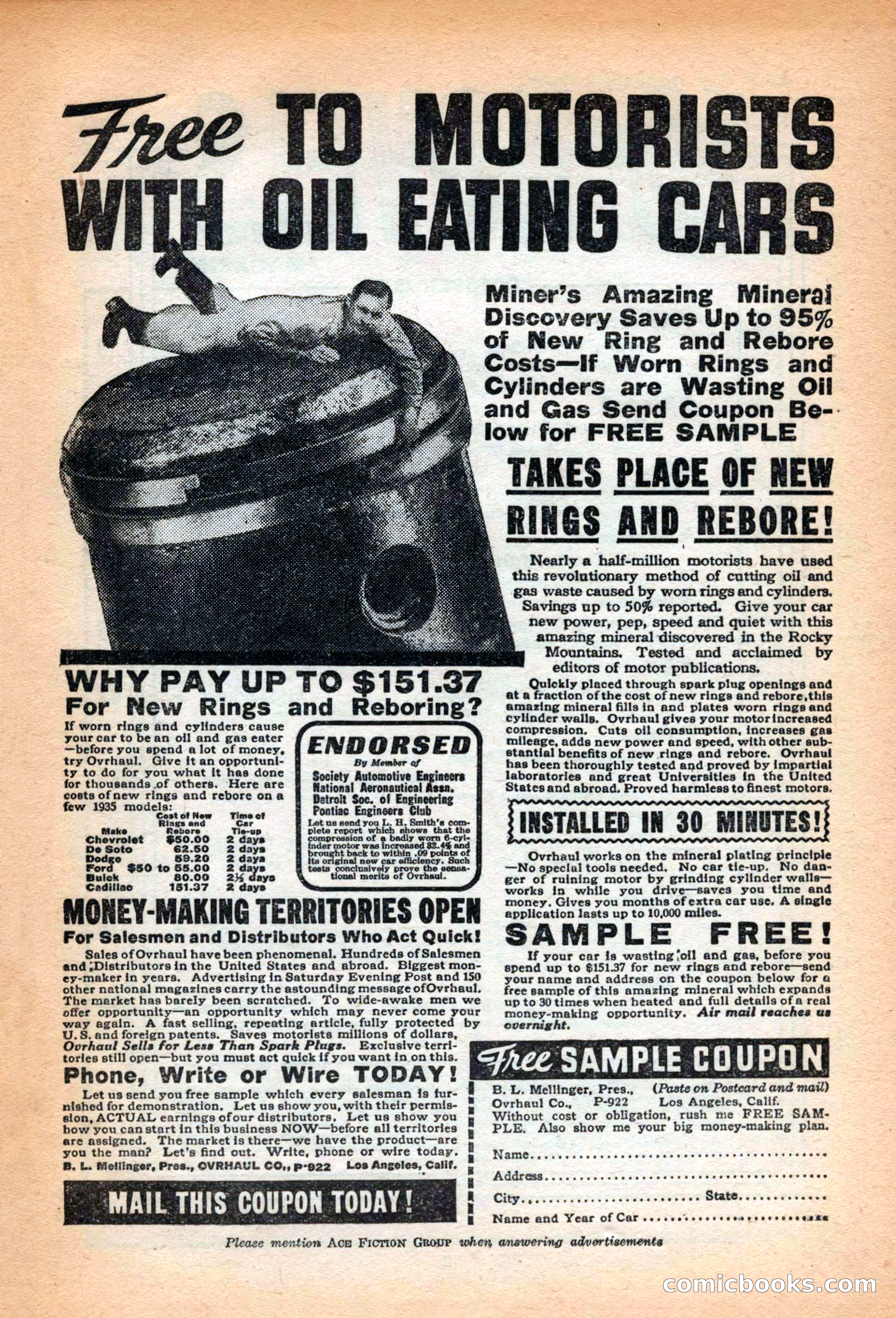
# Analysis of Page Content This is an **advertisement page** from a pulp magazine, not story content or a cover illustration. The page promotes "Overhaul," a mineral product claiming to restore worn automobile engines without replacing rings and cylinders. The ad features a large photograph of an engine component and uses sensational marketing language, promising savings of up to 95% on engine repair costs. It includes testimonials from engineering societies, claims of endorsement, and promises of sales territories for distributors. A coupon at the bottom allows readers to request a free sample. The advertisement emphasizes quick installation (30 minutes) and positions the product as a revolutionary discovery from the Rocky Mountains.
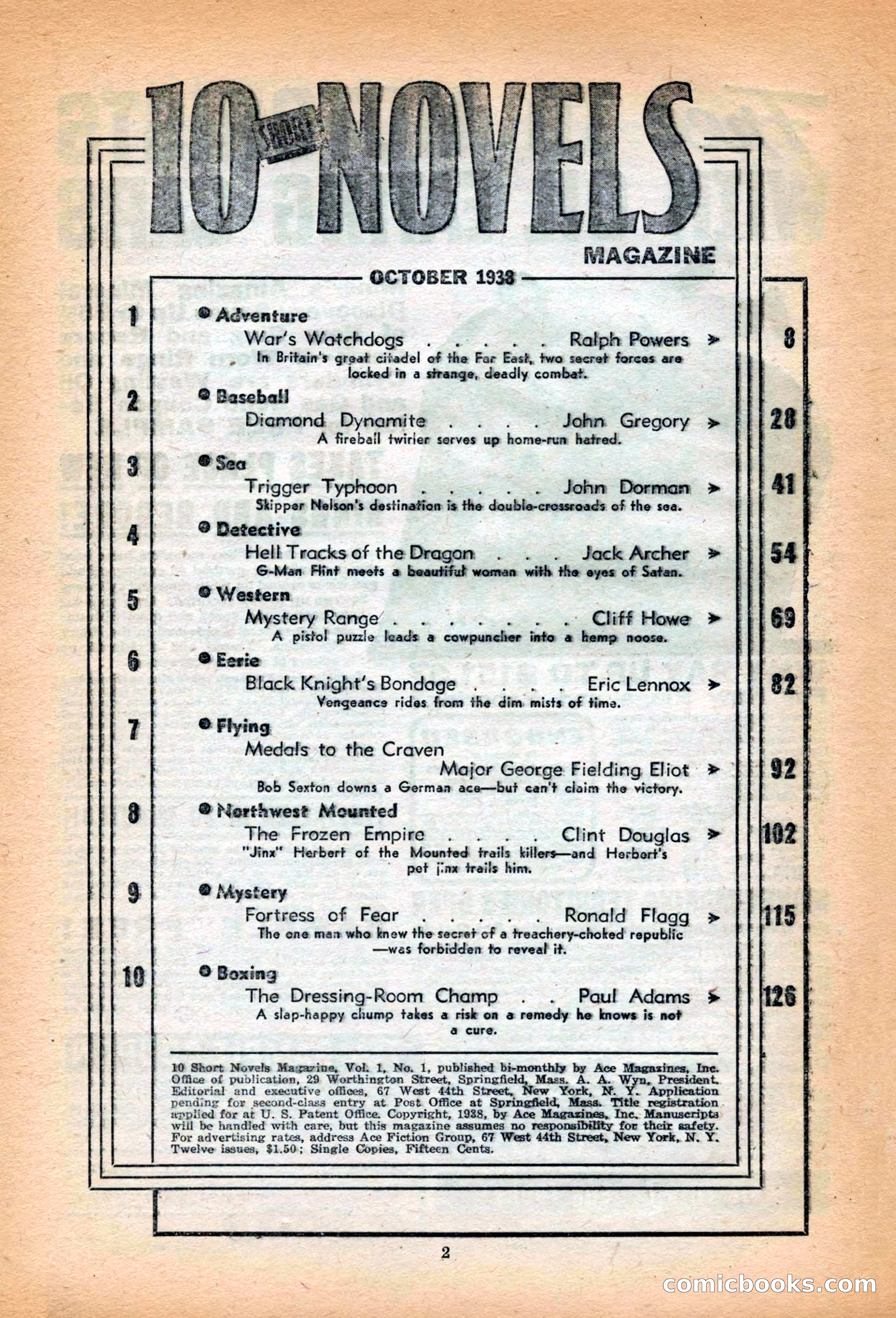
# Table of Contents Page This is a table of contents page from the October 1938 issue of *10 Novels Magazine*. It lists ten short novels across various genres: Adventure ("War's Watchdogs" by Ralph Powers), Baseball ("Diamond Dynamite" by John Gregory), Sea ("Trigger Typhoon" by John Dorman), Detective ("Hell Tracks of the Dragon" by Jack Archer), Western ("Mystery Range" by Cliff Howe), Eerie ("Black Knight's Bondage" by Eric Lennox), Flying ("Medals to the Craven" by Major George Fielding Eliot), Northwest Mounted ("Lord of Frozen Empire" by Clint Douglas), Mystery ("Fortress of Fear" by Ronald Flagg), and Boxing ("The Dressing-Room Champ" by Paul Adams). Publication details appear at the bottom.
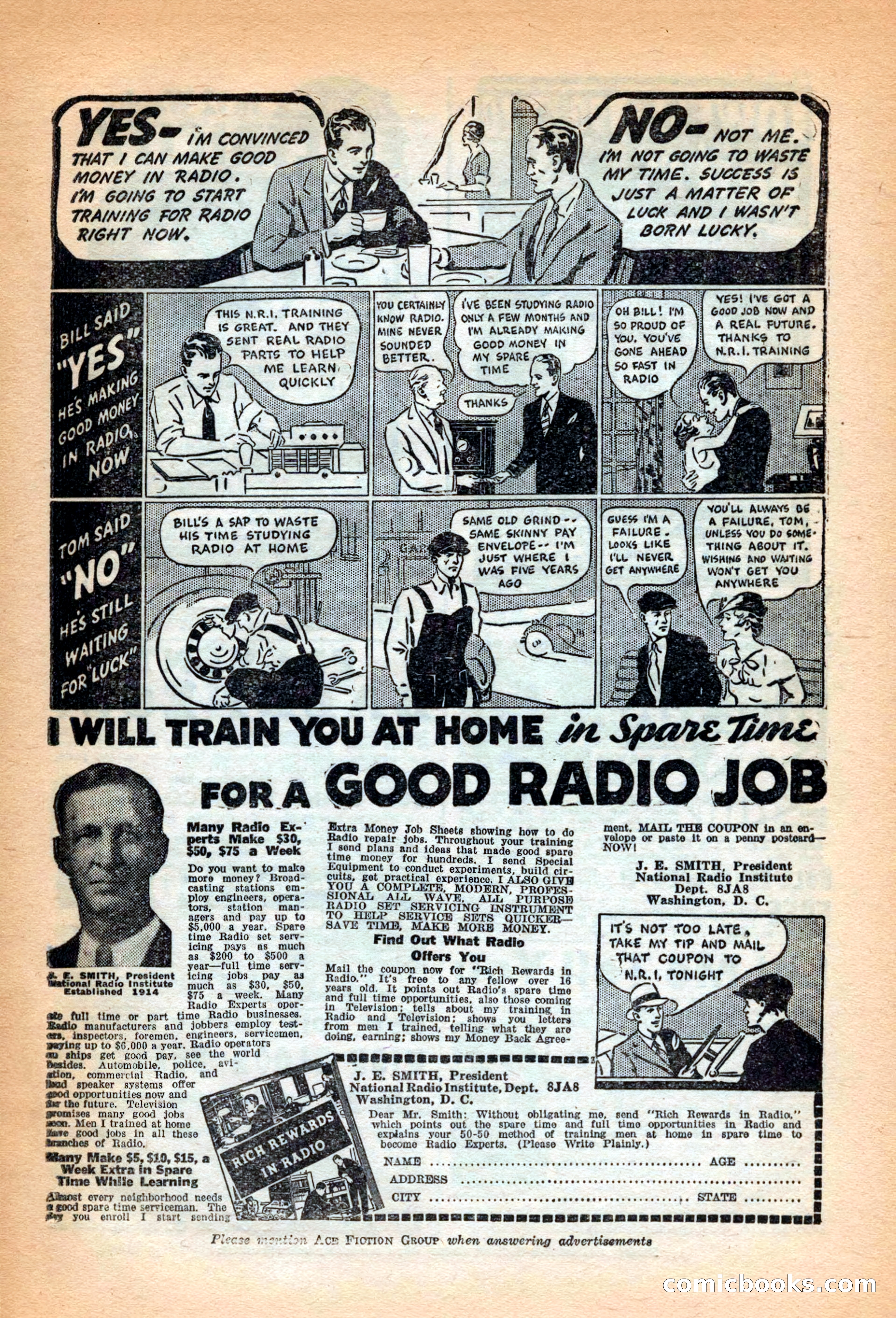
# Analysis This page is primarily **advertising content** rather than story prose or editorial material. It features a comic-strip style advertisement for the National Radio Institute's home training program in radio repair and operation. The ad uses a narrative format showing two men—Bill and Tom—discussing career prospects in radio, with Bill convinced that radio training will lead to good employment while Tom remains skeptical about luck-based success. The advertisement promises spare-time training for "a good radio job" and includes a mail-in coupon for interested readers. Earnings potential of $30-$6,000 yearly are mentioned as incentives.
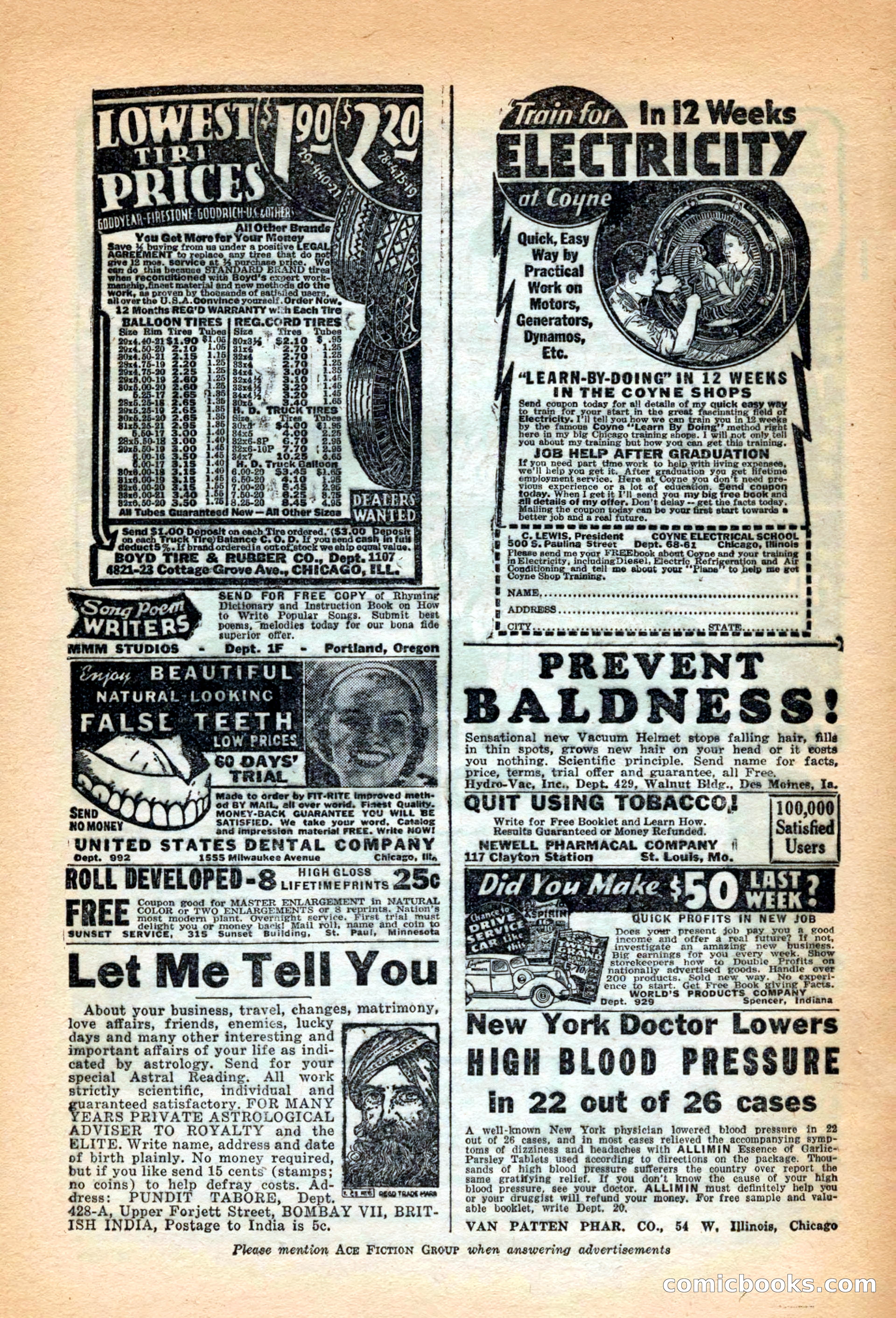
# What This Page Shows This is an **advertisement page** from a pulp magazine, containing multiple classified and display ads typical of early 20th-century publications. The visible advertisements promote various mail-order products and services, including: tire prices, an electricity training course offered by Coyne Electrical School, false teeth from United States Dental Company, a vacuum helmet to prevent baldness, songwriting instruction, astrology readings, photo enlargement services, quick profit schemes, and a medical treatment for high blood pressure. At the bottom, a note instructs readers to mention "Ace Fiction Group" when answering advertisements. The page reflects common pulp magazine monetization through diverse consumer product promotions rather than story content.
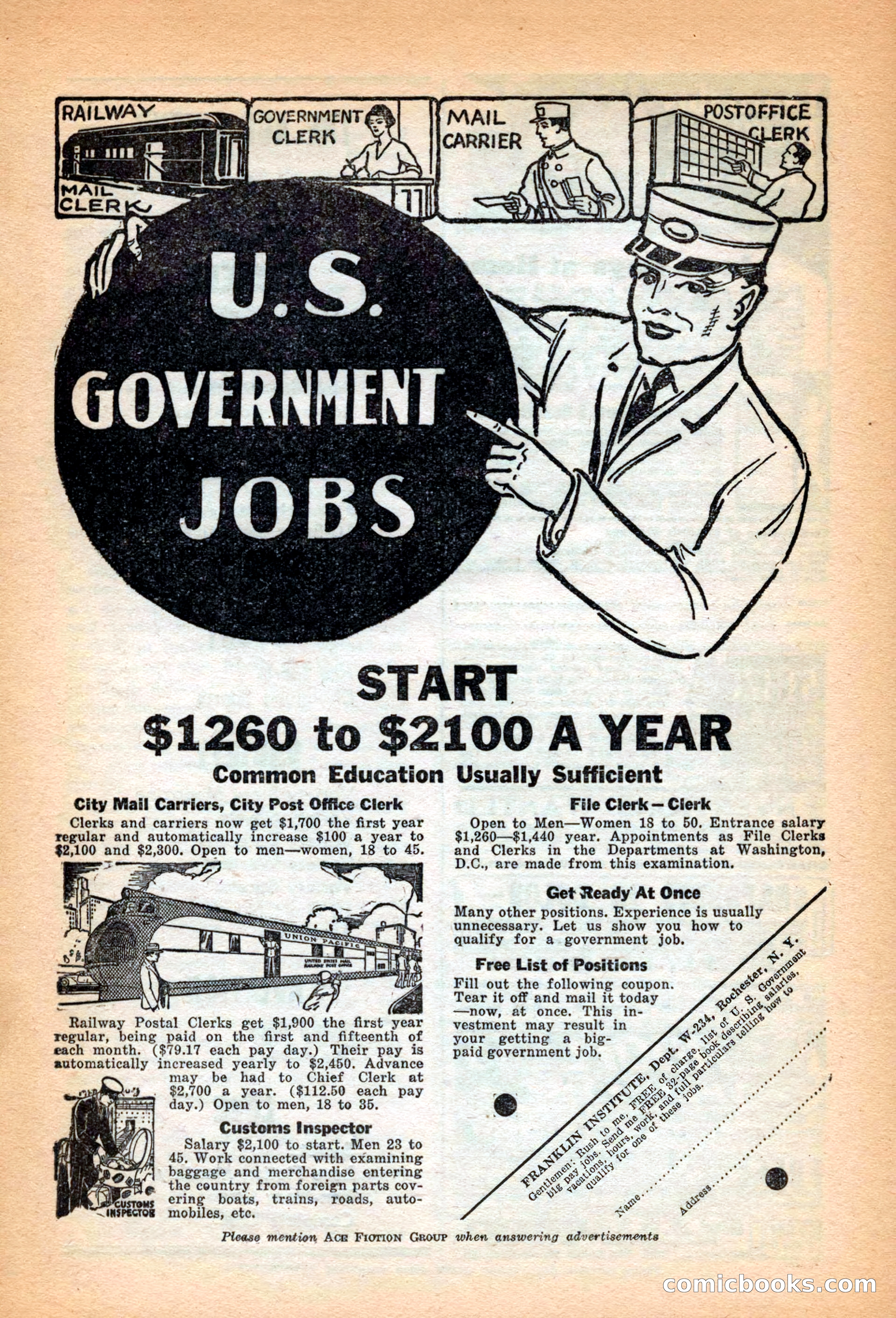
# U.S. Government Jobs Advertisement This is an advertisement page promoting federal employment opportunities. The page features a large illustration of a postal worker and smaller vignettes showing various government positions (Railway Mail Clerk, Government Clerk, Mail Carrier, and Postoffice Clerk). The ad emphasizes starting salaries ranging from $1,260 to $2,100 annually, requiring only "common education usually sufficient." It details specific positions including City Mail Carriers, Post Office Clerks, File Clerks, Railway Postal Clerks, and Customs Inspectors, with salary ranges and eligibility information. A tear-out coupon appears at the bottom right for readers to request a "Free List of Positions." The page indicates this is a recruitment advertisement placed in a pulp magazine.
# Page Description This is an advertisement and catalog page from an Ace Fiction pulp magazine. The left side features various vintage advertisements for correspondence courses (Swedish massage instruction), dental products, inventions wanted, and medical devices. The right side displays "THE ACE LINEUP"—a categorized listing of the magazine's available pulp fiction titles organized by genre: Western (titles like "Western Trails" and "Red Seal Western"), Detective-Mystery (including "Ten Detective Aces" and "Secret Agent X"), Sport, Variety, Aviation, and Love. This appears to be a contents or catalog page designed to promote the breadth of Ace Fiction's pulp offerings to readers.
# Page Description This is a **full-page advertisement** from a pulp magazine, not story content or editorial material. The ad promotes "Complete Diesel Training" through National Schools in Los Angeles, targeting men seeking to learn a profitable trade. It features illustrations of various diesel-powered vehicles and equipment (trucks, trains, planes, ships) and emphasizes "real shop experience" combined with classroom instruction. The advertisement includes a testimonial from a public school superintendent, details about transportation assistance to Los Angeles for students, and a tear-out coupon requesting a free book on diesel employment requirements. The layout is typical of mid-century vocational training advertisements, combining text, illustrations, and promotional offers.
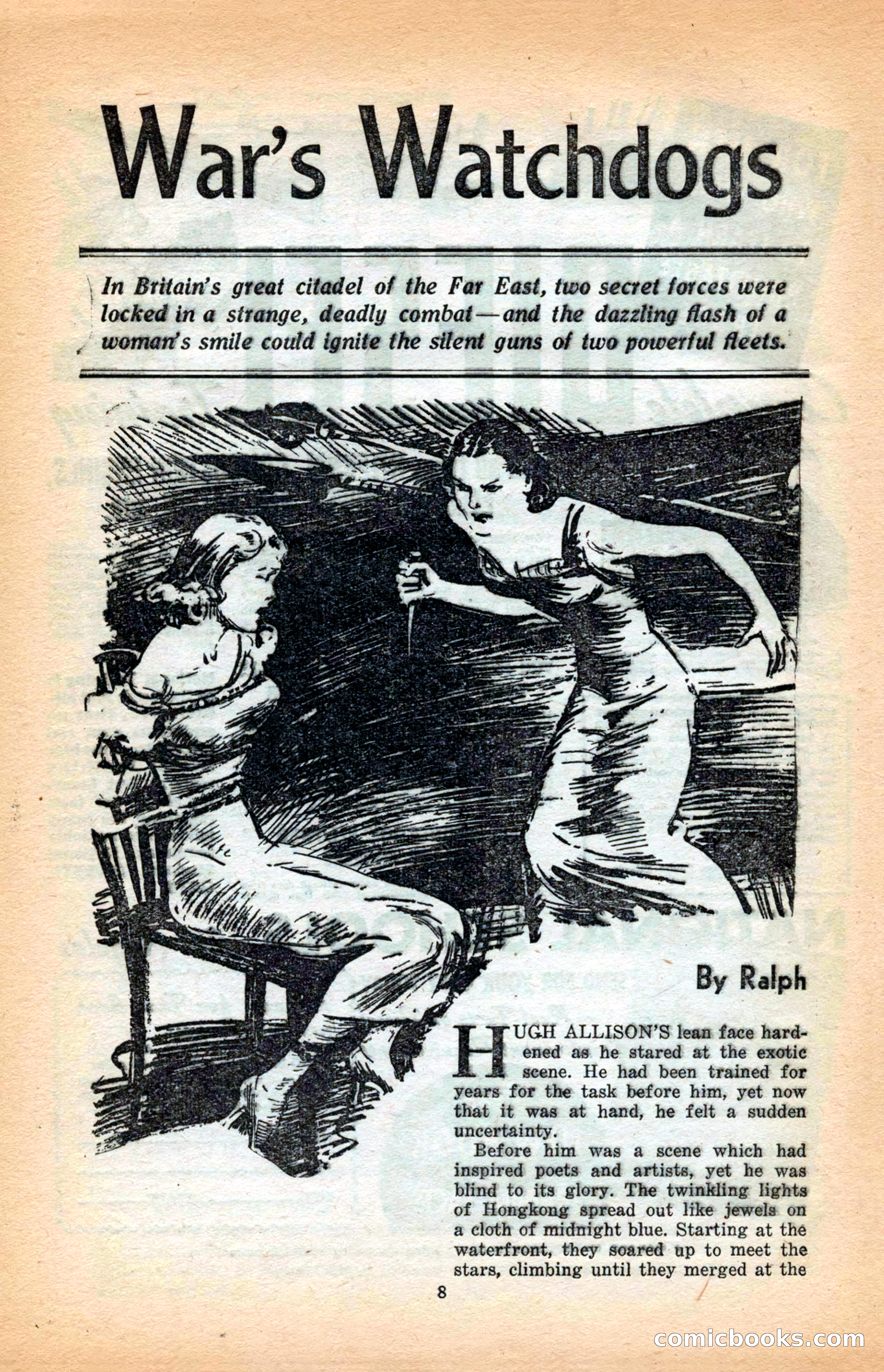
# War's Watchdogs This is an interior story page featuring an illustration and opening prose. The headline promises a tale set in Hong Kong involving "two secret forces" engaged in combat, with a woman's smile capable of triggering naval warfare. The illustration, credited to artist Ralph, depicts two women in an intimate moment—one seated, one leaning toward her. The prose below begins the narrative with protagonist Hugh Allison observing Hong Kong's nighttime harbor lights while experiencing uncertainty about an unspecified task. The descriptive language emphasizes the exotic setting and dramatic tension. This appears to be adventure or espionage fiction typical of early pulp magazines.
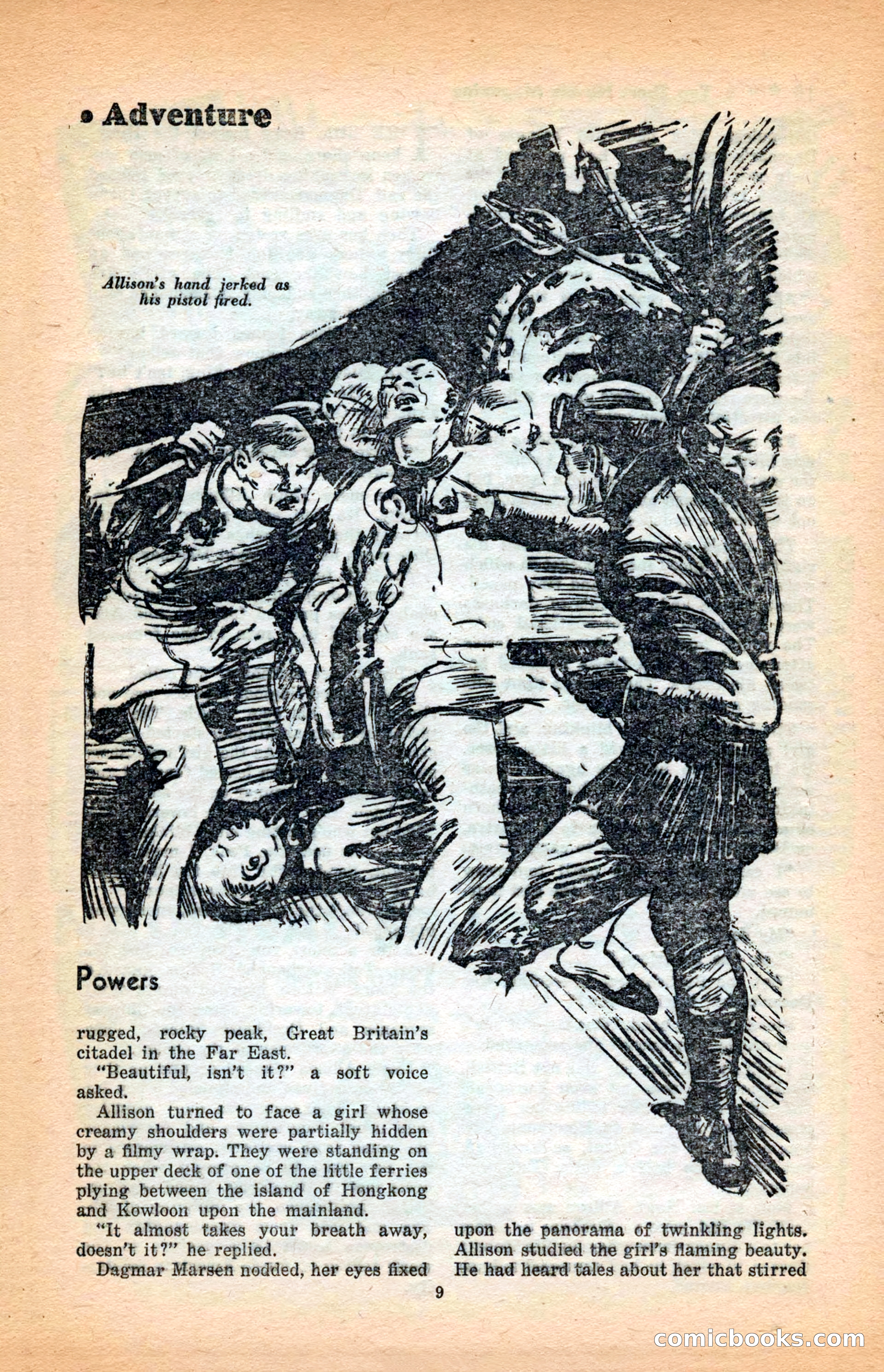
# Page Analysis This is an interior story page featuring a dramatic black-and-white illustration at the top showing multiple figures in what appears to be an action scene, with the caption "Allison's hand jerked as his pistol fired." The page is titled "Adventure" and contains a story section labeled "Powers." The prose describes a scene set on a ferry between Hongkong and Kowloon, where a character named Allison encounters a girl with "creamy shoulders" on the upper deck. The text mentions her beauty and references a character named Dagmar Marsen. The narrative involves gunfire and appears to be pulp adventure fiction, likely from an early-20th-century American magazine.
# Page Analysis This is a text-only page (page 10) from *Ten Short Novels Magazine*. It contains story prose featuring a character named Hugh Allison encountering a woman on a ferry near Hong Kong. The narrative describes their interaction—including exchanged glances and whispered conversation—and Allison recognizing the woman as someone he's been seeking. The passage continues with Allison and the woman (Dagmar) traveling by car to a hotel in Hong Kong, where officers and military personnel have gathered for a dinner dance. The text suggests a spy-thriller or international espionage plot set in colonial-era Hong Kong involving British, American, and Continental European characters.
# Page 12 of Ten Short Novels Magazine This page contains story prose (no illustrations visible). The text depicts a formal dinner party in Hongkong where Hugh Allison observes interactions between Count and Countess Uchida and other guests. During a dance, Allison notices an envelope being passed discreetly between the countess and a man named Dagmar. Betty, another guest, asks Allison about this suspicious exchange. Allison promises to obtain the envelope before the party ends. The narrative suggests an espionage or theft plot involving these cosmopolitan characters, with Allison apparently investigating the countess's activities.
# Page 13 of "War's Watchdogs" This is a text-only story page from what appears to be an espionage or spy thriller. The narrative follows Hugh Allison, who intercepts a coded letter addressed to "Mr. Allison" from a page boy. Allison decodes the message and discovers it references a character named Gross—apparently a dangerous German operative previously encountered in Hong Kong. The story involves international intrigue, with characters attempting to steal or protect a diplomatic code. The page includes dialogue between multiple characters operating in what seems to be a European setting, with mentions of Japanese and German operatives conducting surveillance.
# Page 14 of "Ten Short Novels Magazine" This page contains story prose with no illustration. The text appears to be from a spy or espionage thriller involving international characters—an American named Hugh Allison, a German baron (Von Schlechtweg), a Japanese nobleman (Count Uchida), and a woman named Betty. The narrative describes Allison discovering that Conrow, apparently a cipher expert, has been murdered in his locked hotel room. The neck is broken, suggesting foul play. Allison then contacts Carlton Chumleigh of the British Secret Service by telephone. The plot involves stolen documents, coded messages using a Japanese Kana code, and diplomatic intrigue among Western and Oriental characters.
# Page Analysis This is a story page from a pulp magazine titled "War's Watchdogs." The page contains dense prose fiction with no illustrations. The narrative describes a British intelligence agent named Allison investigating a murder in what appears to be a hotel. A young man has been found strangled with cloth—the apparent work of "Thuggee," Indian professional stranglers. Allison examines the body, recovers a piece of silk cloth as evidence, and learns that the victim had intercepted a "blinker-light message" written in an unknown cipher, likely German. The story involves espionage and suggests Allison must decode the message before enemy agents escape. A cigarette advertisement appears at the page bottom.
This is a page of story prose from *Ten Short Novels Magazine*. The text describes a character named Hugh deciphering an encrypted message using linguistic analysis and frequency tables. After breaking the initial cipher to read "WHEN THE MINO DETONATES, THE SHIP (HANGWA) TO THE SEA GRANDE," Hugh receives a mysterious second message written on a laundry package cuff mentioning "Little underwater ship unloaded in Canton off Chinese junk." The narrative suggests an espionage plot involving mysterious signals, radio apparatus, and international agents—likely Allison, Dagmar Marsen, and various European operatives—working around coded communications during what appears to be a wartime scenario.
# War's Watchdogs, Page 17 This page contains story prose from what appears to be a spy or espionage thriller. The text depicts Hugh Allison, apparently a secret service agent, encountering and fighting an assassin (referred to as a "Thug") in a hotel. After the intruder escapes through French doors, Allison discovers the attacker has disappeared. The scene then shifts to Allison observing various people in a room, including Count Uchida and others he suspects of being spies. The narrative concludes with Dagmar (a woman) suggesting to Betty Barrow that they visit tea houses, which makes Allison suspicious that Dagmar may be plotting revenge against Betty. The prose is typical early-20th-century hardboiled spy fiction.
# Page 18: Story Prose from "Ten Short Novels Magazine" This page contains prose fiction text arranged in two columns. The narrative appears to involve characters named Hugh, Betty Barrow, Allison, Uchida, and Dagmar discussing plans to visit "the Door to a Thousand Delights," which is described as an ornate establishment serving Asian cuisine near Hong Kong's harbor. The text details the restaurant's lavish interior—green-tiled roof, tables of jade and pearl, colorful stone chairs—and its menu offerings including exotic dishes like shark fins and caviar. The passage balances dialogue about social arrangements with descriptive passages about the location's architecture and culinary reputation. No illustrations are present on this page.
# Page Description This is a page of story prose from a pulp magazine titled "War's Watchdogs" (visible in the header). The text appears to be from the middle of a narrative involving characters named Dagmar, Betty, Allison, Count Uchida, and Hugh. The scene depicts a social gathering where opium smoking is offered and declined, followed by an encounter with a Chinese waiter and references to conflict involving a group called the Ying Lee. The passage involves intrigue and suspicion regarding a character named Ho. The writing style and content are consistent with early-20th-century adventure or espionage fiction.
This is a story prose page from *Ten Short Novels Magazine* (page 20). The text depicts a crime/mystery narrative involving an American man named Hugh, who confronts characters including Count Uchida and Baron von Schlechtweg over the disappearance of an American woman named Betty Barrow. After a violent altercation with a Chinese man, Hugh returns to question the count and baron about the missing woman's whereabouts. The page then shifts to Betty's perspective as she's held captive in an ornate room by native women, where she encounters a woman named Dagmar who appears to be her captor or interrogator. The story combines elements of international intrigue and mystery.
# Page Analysis This is a text-only page of story prose from a pulp magazine titled "War's Watchdogs" (page 21). The narrative depicts Betty Barrow, who appears to be a captive, attempting to reach a radio set while bound to a chair. Dagmar, seemingly an antagonist, has left the room with two Chinese women guarding Betty. The dialogue reveals Betty is trying to extract information about locations including "the Blue Dragon Grotto" and places near Hongkong and Macao. Dagmar grows suspicious of Betty's intentions and forcibly restrains her further, tying her to a teakwood chair. The scene suggests espionage or wartime intrigue, consistent with the magazine's title.
# Page Analysis This is story prose text from page 23 of "War's Watchdogs," a pulp fiction narrative. The page depicts an action sequence involving military/espionage characters: Dagmar makes threats via radio about killing someone's father, Hugh Allison searches for information and pursues a suspect named von Schlechtweg, and an amphibian aircraft called the Ranger approaches a coastal cavern where characters are positioned. The text describes radio conversations, pursuit, and what appears to be a confrontation involving a submarine or underwater vessel called the "Blue Dragon Grotto." The writing style and references to aircraft carriers, submarines, and international intrigue are consistent with early-20th-century adventure pulp fiction.
# Analysis of Page 24 from Ten Short Novels Magazine This page contains **story prose only** — no illustrations or advertisements visible. The text depicts an action sequence in which Hugh Allison, apparently searching for someone named Betty, enters an underground house near a subterranean lake. He discovers Betty bound to a chair and encounters several armed antagonists, including a large Chinese man (referred to as a "Thug"), a man named Dagmar Marsen, and three other men. A gunfight ensues. The passage emphasizes combat, weapon exchanges, and Allison's attempt to rescue Betty while outnumbered. The setting appears to be an exotic, underground location, consistent with pulp adventure fiction conventions.
# War's Watchdogs, Page 25 This page contains story prose printed in two columns on aged paper. The narrative depicts a military/naval action sequence in which Hugh Allison, apparently a bomber or military officer, pursues an amphibian aircraft over water while a woman named Dagmar—described as a threat—has infiltrated their vessel. The text describes Hugh directing an attack on the fleeing amphibian, receiving orders to monitor two women, and dealing with Dagmar's presence aboard their ship. The passage emphasizes tension and wartime danger, with references to British and Japanese military elements. No illustration is visible on this page.
# Page Analysis This is story prose from *Ten Short Novels Magazine* (page 26). The text depicts an action sequence involving a submarine called "the Squid" being attacked with bombs during what appears to be a military operation. Hugh Allison, identified as U.S. Navy Intelligence Corps, has captured a woman (Allison) and is piloting or directing an amphibian aircraft in combat. The narrative shifts to a scene in Hong Kong where Betty Barrow and Hugh Allison observe the city lights from a balcony, discussing past connections to someone named Dagmar Marsen and references to a character called "Count Uchida" and Japanese espionage activities. The prose suggests a wartime spy thriller with romantic and military elements.
# Page Description This is an advertisement page, not story content. It promotes "Half and Half" pipe tobacco, made by The American Tobacco Company. The ad features two instructional illustrations showing a man pinching his nostrils while smoking (left) and then releasing his nose while pointing upward (right). The accompanying text explains a "flavor test" claiming that tobacco flavor depends primarily on smell rather than taste, and promotes Half and Half's "Flavoroma" blend as combining taste and aroma in balanced proportions. The ad includes an illustration of the product's distinctive "telescope tin" that shrinks as tobacco is used.
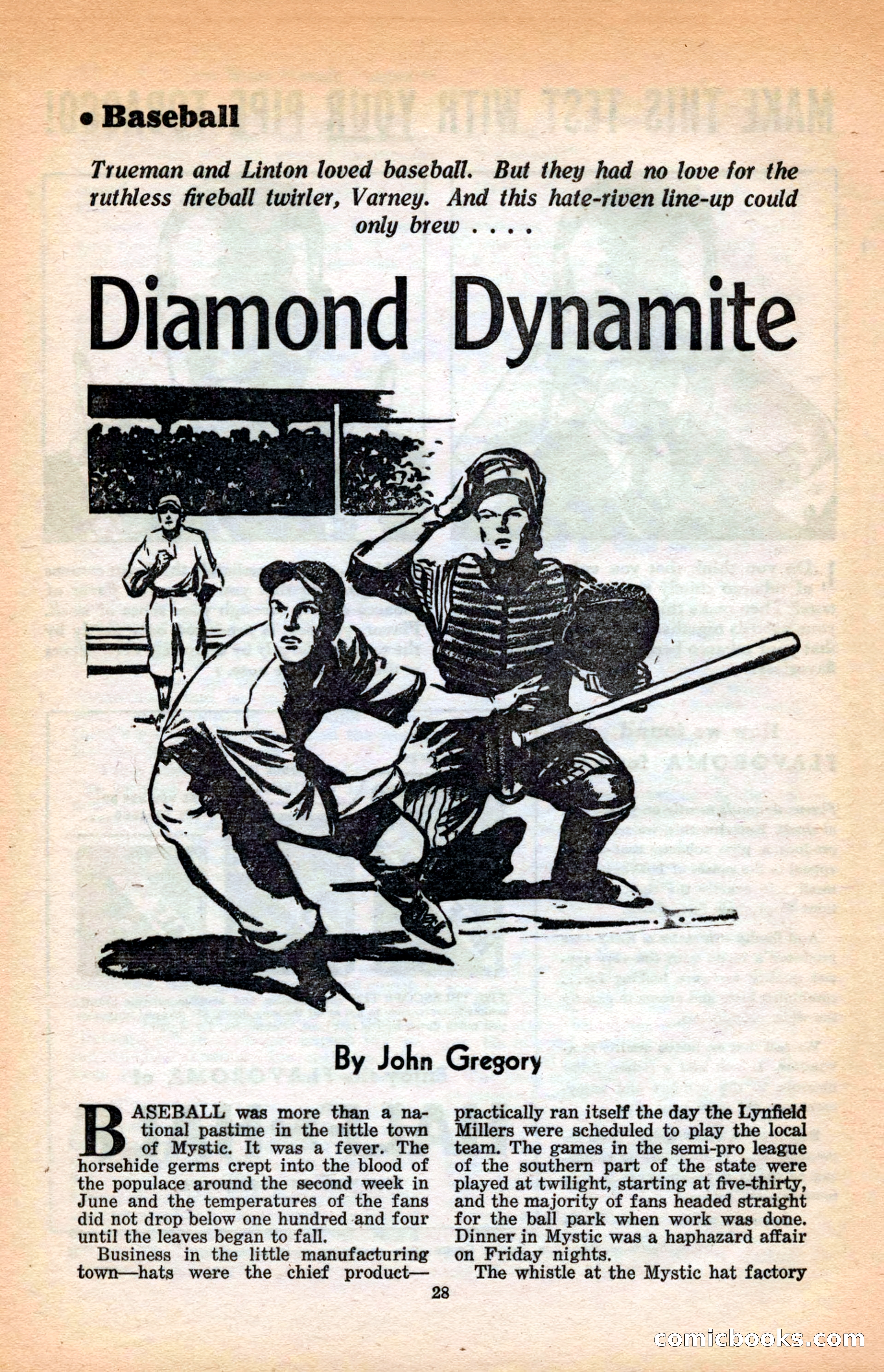
This is an interior story page from a pulp magazine featuring the beginning of a baseball-themed story titled "Diamond Dynamite" by John Gregory. The page includes a dramatic black-and-white illustration showing baseball players in action, with one catcher and batter prominently featured. The introductory text describes how two baseball-loving characters named Trueman and Linton harbor hatred for a "ruthless fireball twirler" named Varney, and their conflict "could only brew" the title story. The bottom half contains the opening paragraphs of the story itself, explaining that baseball was a passionate obsession in the small town of Mystic, dominating local business and social life.
This is a page of story prose from what appears to be a sports-themed pulp magazine (the header reads "Diamond Dynamite"). The narrative depicts a baseball game between the Mystic Hatters and the Lynfield Millers, with particular focus on the tension between characters Dib Trueman and Tom Linton, who appear to be rivals. The text describes game action—pitching, batting, and fielding—interspersed with dialogue revealing personal conflict between the men, apparently involving a woman named Sue Linton. The prose captures the competitive atmosphere of the game and suggests deeper interpersonal drama beyond the sport itself.
This is a page of story prose from *Ten Short Novels Magazine*. The text depicts a baseball game that turns chaotic when a fight breaks out between players from the Mystic and Lynfield teams. After police break up the brawl, the narrative follows Tom Linton and Dib Trueman as they leave the game and encounter various incidents—including what appears to be a robbery at a filling station and a subsequent encounter with a girl named Sue at a tavern. The passage combines sports action with crime elements typical of pulp fiction, showing characters navigating unexpected danger and intrigue.
# Analysis of Page 31 from "Diamond Dynamite" This page contains story prose from what appears to be a baseball-themed pulp fiction narrative. The text depicts a confrontation between characters named Duster Varney, Sue Linton, Tom Linton, and Dib Trueman, involving tensions over Sue's romantic involvement and threats related to a baseball game. The passage includes dialogue about keeping Sue away from the plate and references to the "Mystic team" traveling to Lynfield for a league game. The narrative describes interpersonal conflict, with Varney making threats and Tom attempting to mediate. The page is densely printed text with no illustrations, typical of pulp magazine interior pages.
# Page 82 — Ten Short Novels Magazine This page contains story prose from what appears to be a baseball-themed narrative. The text describes a dramatic moment during a game where a player named Tom Linton is struck by a pitch and severely injured. After being hit, Tom collapses and is rushed to the hospital. The passage focuses on the emotional reactions of those around him—particularly Dib Trueman, Sue Linton (Tom's sister), and Duster Varney—as they grapple with shock and concern over Tom's condition. The narrative includes dialogue and internal monologue conveying fear and uncertainty about the severity of his injuries.
# Diamond Dynamite, Page 33 This page contains story prose from what appears to be a hardboiled crime or drama narrative. The text describes a funeral scene and its aftermath, focusing on a character named Dib Trueman attending the burial of Tom Linton. The passage details Dib's emotional state, his interactions with other mourners, and his subsequent visit to the Linton home, where he searches Tom's room for something unspecified that Tom allegedly possessed. The narrative involves accusations that Dib may have caused Tom's death, with tensions between characters regarding responsibility and hidden objects.
# Page Analysis This is a page of story prose from *Ten Short Novels Magazine*. The text continues a narrative about baseball in a small town called Mystic, focusing on a player named Tommy Linton who has died and been memorialized with a monument at the local ball park. The story describes how a big league scout arrives to evaluate Duster Varney, a talented outfielder for the rival Lynfield Millers team, while the local Mystic team's morale has suffered. The narrative details Dib Trueman's emotional reaction to news coverage and his observations during a game. The page contains no illustrations or advertisements—only densely printed text in two columns.
# Page Content Analysis This is a prose story page from a pulp magazine titled "Diamond Dynamite." The page contains two sections of narrative text separated by a large decorative initial letter "S." The story appears to involve romantic drama and emotional conflict. A character named Sue Linton receives a letter from someone named Dib that reveals his feelings and reasons for leaving town. The text describes Sue's emotional reaction and her realization of her own feelings. The narrative then shifts to describe Dib Trueman's subsequent life, mentioning his college attendance and baseball ambitions. The visible portions focus on character motivation, unrequited love, and life decisions, typical of early pulp fiction romance or drama stories.
# Page Analysis This is a text-only story page from *Ten Short Novels Magazine* (page 36). The visible prose depicts a baseball narrative involving a character named Dib Trueman, who appears to be a young player considering his career options. The text describes conversations about professional baseball opportunities, including discussions with Duster Varney about joining teams and mentions of the Cincy Reds and Mystic Hatters. The passage includes dialogue where characters discuss signing contracts and playing prospects. The narrative style and subject matter suggest this is hardboiled or sports-oriented pulp fiction, typical of early-20th-century magazine serials.
# Page Analysis: Diamond Dynamite #37 This is an interior story illustration page from a pulp magazine. The dramatic black-and-white illustration shows a man in athletic wear (jersey marked "M") reaching upward, appearing to catch or dodge something above him, with an energetic, action-oriented composition typical of pulp fiction art. The prose below describes a plot involving characters named Sue Linton, Dib Trueman, and Tommy. Sue learns news of Trueman returning to town to play for a Cleveland club, which renews an old feud with someone named Varney. Sue leaves a drugstore hurriedly and searches around town for a familiar figure. The visible text suggests a romantic or dramatic narrative centered on these character conflicts, though the complete plot remains unclear from this excerpt alone.
# Page 38 of Ten Short Novels Magazine This is a story prose page from a pulp magazine, containing no illustrations. The text appears to be from a baseball-themed narrative involving characters named Dib Trueman, Sue, Duster Varney, and Tommy Linton. The story depicts a romantic reunion between Dib and Sue, followed by buildup to a baseball game where Dib plays for the "Mystic" team against a competing squad. The narrative describes crowd excitement, game action including pitching and hitting, and apparent tension surrounding a previous accident or incident involving Tommy Linton. The tone suggests this is likely a sports-adventure or romance story from the early pulp era.
# Page Analysis This is a text-only story page from a pulp magazine titled "Diamond Dynamite" (visible at top). The page contains prose fiction depicting a baseball game with dramatic stakes. The narrative describes Duster Varney, apparently a player, suffering an injury in center field during what appears to be a crucial game between the Cincy (Cincinnati) team and their opponents. The text focuses on the accident itself and the emotional reactions of spectators and people close to Varney, including his family members watching from the stands. The prose emphasizes the drama and tension of both the athletic competition and the personal crisis unfolding on the field.
# Page Analysis: Ten Short Novels Magazine, Page 40 This page contains **story prose** from what appears to be a mystery or crime narrative. The text describes events surrounding Tommy Linton's death, apparently caused by a blow to the head during a baseball game. The narrative follows Dib Trueman's investigation into whether the death was accidental or deliberate, with suspicion falling on a man named Varney. Sue Linton grieves Tommy's death while her father urges the family to move forward. At the bottom of the page is a **full-page advertisement** for Star Single-Edge Blades, priced at four blades for 10 cents, featuring a illustration of a man with a rifle and promotional text about shaving.
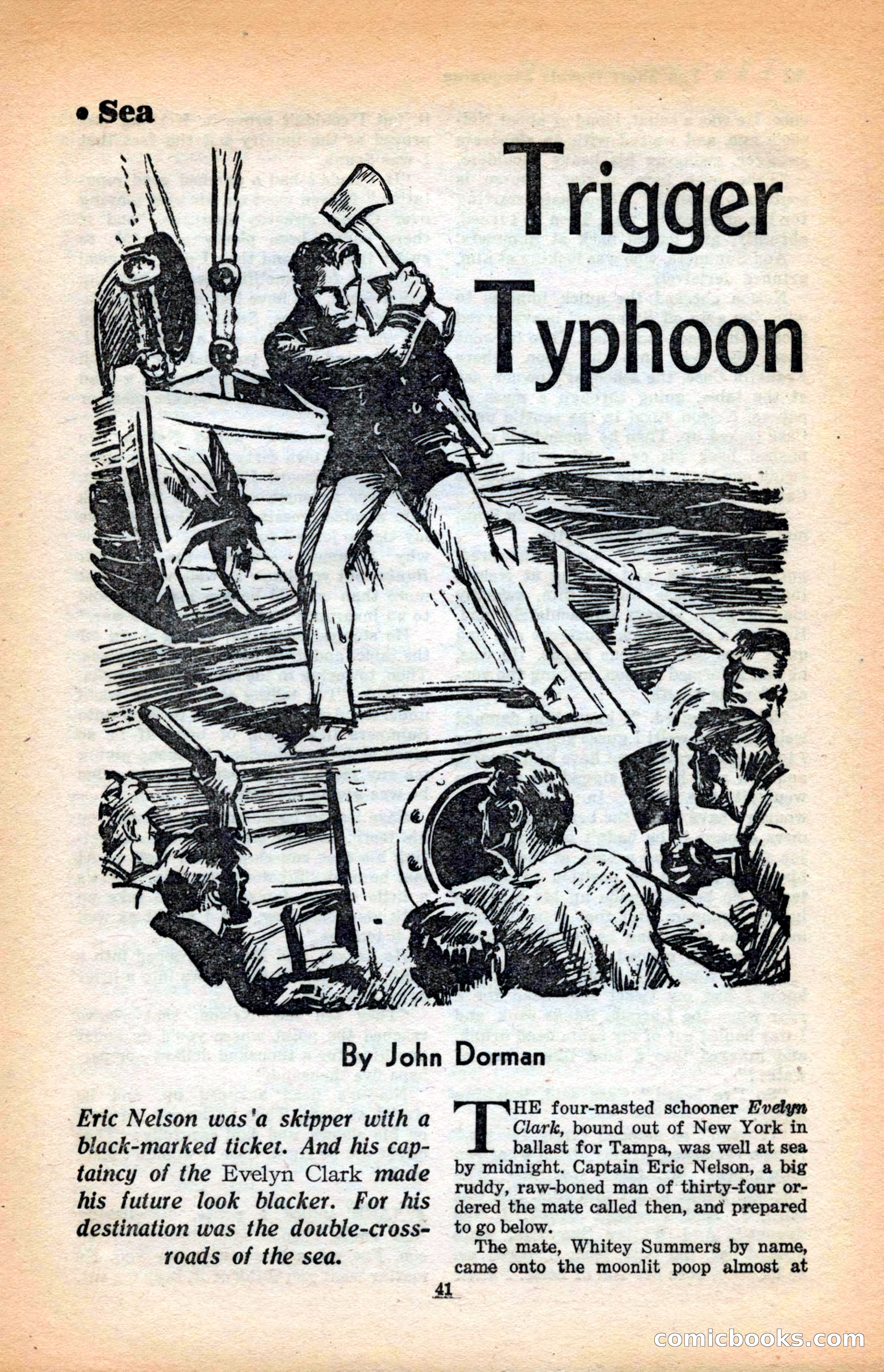
This is an interior story page from a pulp magazine, featuring an illustration and the opening prose of a story titled "Trigger Typhoon" by John Dorman. The dramatic black-and-white illustration depicts a man with an axe aboard a sailing ship, with sailors visible below deck. The visible text introduces Eric Nelson, described as a skipper with a "black-marked ticket" aboard the four-masted schooner *Evelyn Clark*, bound from New York to Tampa in ballast. The mate, Whitey Summers, is preparing to go below deck. The story appears to be maritime adventure fiction involving some form of conflict or danger at sea.
This is a text page from a pulp fiction story titled "Ten Short Novels Magazine" (visible in the header). The page shows prose narrative dialogue between two characters: Nelson and Case, a schooner's owner. They discuss Nelson's past troubles, including his suspension from a ship called the *Lucinda Banks* after being found drunk, and allegations that the ship was deliberately scuttled and drugged. Case appears to be offering Nelson some kind of proposition involving money—possibly five thousand dollars or more. The dialogue is characteristic of hardboiled crime or adventure fiction, with tense interpersonal conflict and hints of corruption or illegal activity.
# Page Content Analysis This is a **story prose page** (page 43) from a pulp fiction magazine titled "Trigger Typhoon." The visible text depicts a tense dialogue between characters named Nelson and Case. Case appears to be plotting an insurance fraud scheme involving the intentional sinking of a ship called the Dorothy Lee Clark to collect insurance money. He's attempting to persuade Nelson to participate in the plan, which would involve Nelson appearing to drown during the operation. Nelson initially resists, becoming angry and suspicious, but the conversation suggests Case may be coercing him into compliance through intimidation and manipulation regarding a contract Nelson has apparently already signed.
# Page Analysis This is story prose from "Ten Short Novels Magazine" (visible in the header). The page contains two columns of text depicting a conversation between characters named Nelson and Case aboard what appears to be a ship. Nelson, red-eyed from lack of sleep, confronts Case about his past reputation and trustworthiness as a sailor. Case offers Nelson shelter and work aboard his schooner, though Nelson remains skeptical of Case's motives and character. The passage establishes tension between the two men and hints at Nelson's desperate circumstances and limited options. No illustration is present on this page.
# Page Analysis This is a story prose page from a pulp magazine titled "Trigger Typhoon" (visible at top). The page contains two columns of text describing what appears to be a maritime adventure story. The narrative focuses on a character named Nelson, who is aboard a schooner near the Florida coast during an approaching storm. The text details Nelson's scheming plans involving the ship's abandonment and potential salvage fraud, while simultaneously depicting the crew responding to dangerous weather conditions with sails failing and water breaching the hull. The prose emphasizes the tension between Nelson's criminal plotting and the real maritime emergency unfolding around him.
# Page 46 of Ten Short Novels Magazine This page contains story prose (no illustrations). The visible text depicts a maritime disaster: a schooner has been driven dangerously close to shore during a violent storm off the Florida coast. The crew, led by a character named Nelson, must attempt a rescue using lifeboats while the vessel is in danger of breaking apart on the shoals. The passage describes the crew's grim assessment of their situation—the ship cannot be saved, and they face difficult choices about how to get men to safety before the schooner is destroyed by the surf. The narrative emphasizes the helplessness of their position and the inexorable movement of the damaged vessel toward the beach.
# Page 47 of "Trigger Typhoon" This is a page of story prose from what appears to be a pulp adventure magazine. The text describes a dramatic maritime scene where a ship is in distress and facing dangerous conditions. Nelson, apparently the commanding officer, makes critical decisions about how to save the vessel by attempting a risky maneuver involving the anchor and heading toward the beach. The passage details urgent orders being given to crew members, descriptions of worsening waves and surf, and the ship's desperate approach to shore. The writing emphasizes nautical terminology and the tension of sailors working under life-threatening circumstances during what seems to be a storm or typhoon.
# Page Analysis This page contains **story prose** from *Ten Short Novels Magazine*, appearing as page 48. The text describes a dramatic naval scene where a ship battles severe weather conditions. Captain Nelson and his crew work to save their vessel during what appears to be a hurricane or severe storm. The narrative details their efforts to manage the anchor, adjust sails, and operate pumps to prevent the ship from sinking as it takes on water. The passage emphasizes the tension between Nelson and another character named Case, while depicting the crew's desperate struggle against the elements and mounting damage to the ship.
# Page Analysis: Trigger Typhoon (pulp magazine) This is a story prose page from what appears to be a pulp adventure or action magazine titled "Trigger Typhoon." The page contains two columns of text describing a tense scene aboard a ship during or after a storm. The protagonist Nelson, who appears to be in conflict with characters named Case and Winlay, has armed himself and is moving cautiously through the vessel to locate Winlay. The text details Nelson's discovery of weapons and his strategic maneuvering through the ship's interior while avoiding detection. The narrative focuses on suspense and action typical of early-20th-century pulp fiction, though the specific genre (crime, adventure, or nautical thriller) remains unclear from this page alone.
# Page 50: Ten Short Novels Magazine This page contains story prose from what appears to be a hardboiled crime or adventure narrative. The text depicts a tense confrontation aboard a ship where a character named Nelson takes control of a dangerous situation involving men named Case, Summers, and Winlay. Nelson disarms Summers, takes his guns, and orders the men toward the pump room while maintaining command of the scene. The passage emphasizes the sudden violence and psychological tension of the moment, with Nelson acting decisively despite the precarious circumstances. The narrative focuses on action, character motivation, and the power dynamics between the armed men.
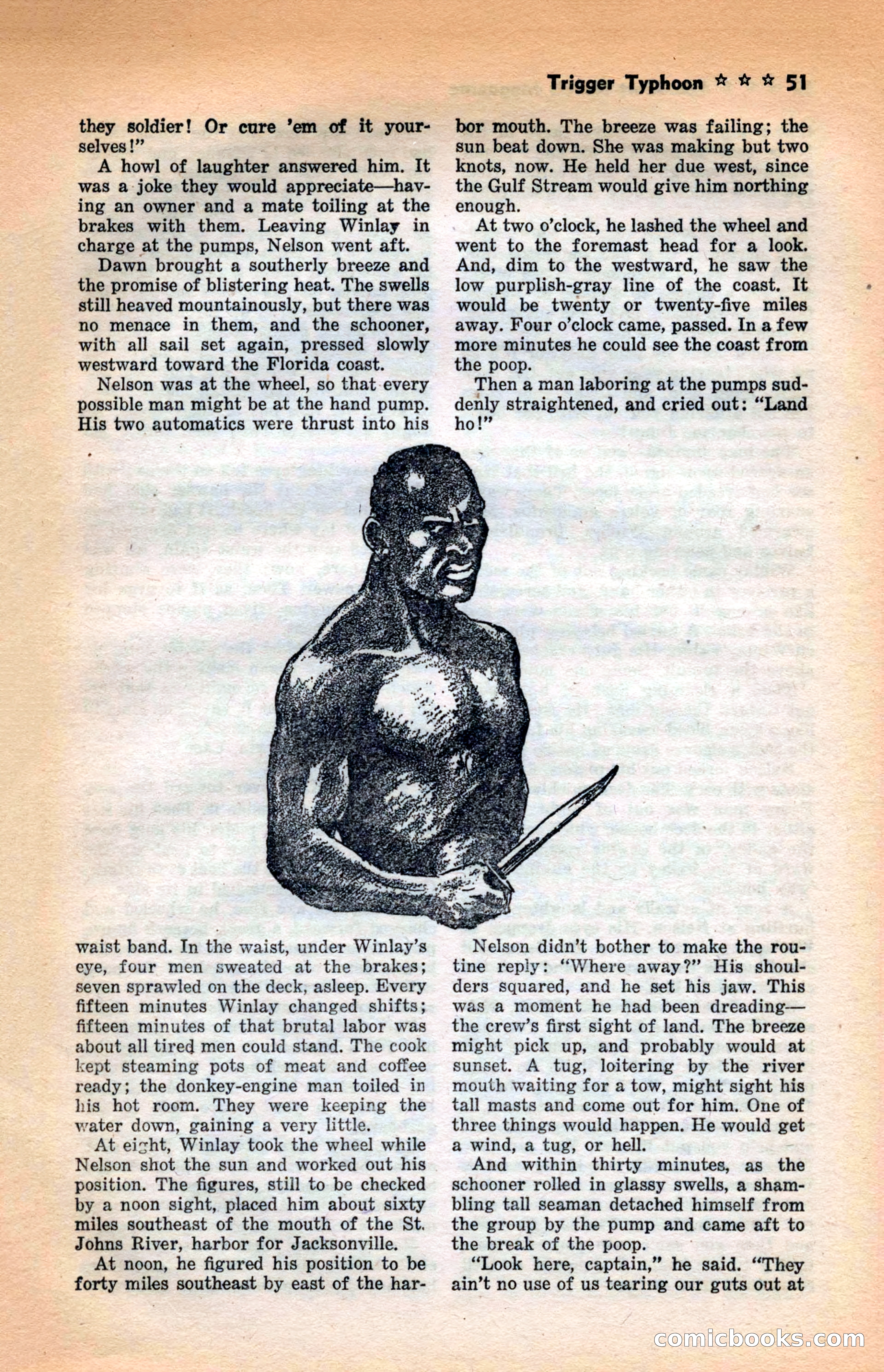
# Page Analysis: "Trigger Typhoon" This is a story prose page (page 51) from a pulp adventure magazine. The text describes a sailing vessel's journey toward the Florida coast, with the crew spotting land after hours at sea. A crew member at the pumps shouts "Land ho!" to alert Captain Nelson. The illustration depicts a shirtless man with distinctive facial markings holding a knife, apparently representing a character from the narrative. The prose focuses on nautical details—wind conditions, navigation calculations, and the exhausted crew's physical labor—establishing tension as the ship approaches its destination while facing uncertain circumstances.
# Page Analysis This is a text-only page of prose fiction from *Ten Short Novels Magazine* (page 52). The visible story depicts a violent confrontation aboard a ship between characters named Nelson, Case, and Winlay. Nelson has been shot and appears to be dying, while Case takes command and offers Nelson's crew a choice: take one boat and leave, or face further conflict. The passage describes intense action including gunfire, an axe being used as a weapon, and pursuit across the ship's deck. The narrative involves what appears to be a mutiny or pirate scenario, though the full context and story title are not visible on this page.
# Page Description This is a text page from a pulp fiction story titled "Trigger Typhoon" (page 53). The narrative prose describes a violent confrontation aboard what appears to be a ship, involving characters named Nelson, Summers, Winlay, and Case. Nelson engages in combat with a "Negro engineer," firing weapons and ultimately subduing him. The scene concludes with Nelson checking on an injured crew member and exchanging dialogue with Case about the incident's consequences. Below the story text is a full-page advertisement for Cremo Cigars, promoting a "3 for 10¢" offer with vintage imagery of Native American headdresses.
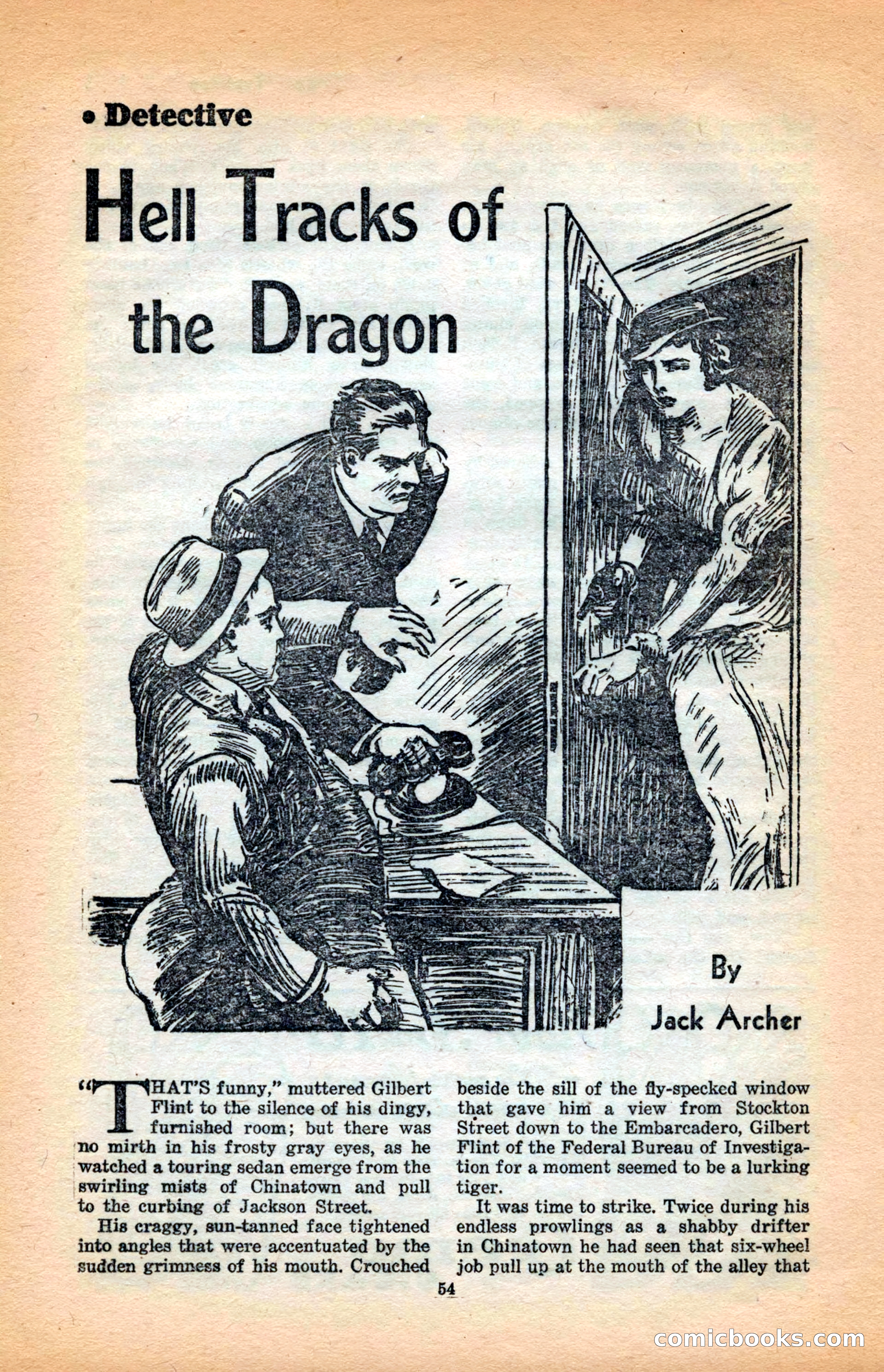
# Page Description This is a story opening page from a pulp detective magazine, titled "Hell Tracks of the Dragon" by Jack Archer. The page contains an illustration showing what appears to be a detective interview scene—a man and woman sitting at a desk while another man stands in a doorway. The visible prose introduces a character named Gilbert Flint of the Federal Bureau of Investigation, who observes something suspicious in Chinatown involving a "six-wheel job" (likely a vehicle). The narrative establishes a mystery involving observations in San Francisco's Chinatown district and hints at potential danger ("a lurking tiger").
# Page 55: Story Prose This page contains two columns of prose fiction text from what appears to be a hardboiled crime or mystery story. The narrative follows a character named G-Man Flint as he investigates a case involving the "Silver Dragon," a smuggling operation in San Francisco's Chinatown. The text describes Flint's surveillance of a location called Yut Lee's "Abode of Felicitous Fraternal Association," his encounter with a mysterious woman, and a subsequent confrontation involving gunfire and a getaway vehicle. The writing employs period-appropriate pulp fiction style with dramatic action sequences and noir-tinged descriptions of the urban setting.
# Page Analysis: "Ten Short Novels Magazine" This page contains story prose from what appears to be a hardboiled crime narrative. The text describes a violent confrontation in Chinatown involving a character named Hawk-nose, who has been shot and is wounded, and another character named Flint who becomes entangled in a brawl with hijackers near a parked car. The scene escalates when a Chinatown police squad arrives and orders the combatants to surrender. The prose emphasizes action, gunfire, and physical combat, with dialogue between characters negotiating the tense situation. The writing style and subject matter are typical of early pulp crime fiction.
# Page 57 of "Hell Tracks of the Dragon" This page contains story prose from what appears to be a hardboiled crime or adventure narrative. The text describes Detective Flint's investigation into a murdered man named Henrique Robles, whose car was destroyed in a fire. Flint and his partner McDermott discuss the crime scene evidence and trace the vehicle to a service station near the Mexican border, suspecting the car may have been used to transport contraband. The dialogue reveals details about the victim and suggests a connection to criminal activity, with references to opium trafficking and organized crime. No illustrations are visible on this page.
# Page Content Analysis This is a story text page (page 58) from *Ten Short Novels Magazine*. The visible prose is a hardboiled crime narrative following a character named Flint as he investigates a fortune teller named Alexander Kane in Yuma, Arizona. The story describes Flint obtaining Kane's phone number from a directory, reporting the matter to police headquarters, and then driving to Kane's isolated brown adobe house surrounded by grapefruit trees on the outskirts of town. The narrative is written in classic pulp detective fiction style with snappy dialogue and descriptions of the desert landscape. No illustrations are visible on this page—only dense text columns typical of pulp magazines.
This page contains story prose from what appears to be a science fiction or mystery tale titled "Hell Tracks of the Dragon." The narrative follows a character named Flint who discovers a dead body—identified as Alexander Kane, described as a psychic—sprawled on Spanish tiles in a house. Flint investigates the scene, finding blood trails that lead through the kitchen to a cellar and then into a study containing astrological charts and occult books. As Flint searches for clues about the death, he hears mysterious groans and sounds from elsewhere in the house, suggesting an intruder or additional danger may be present on the premises.
# Page 60 of Ten Short Novels Magazine This page contains story prose printed in two columns. The text describes a man named Flint attempting a daring escape from an office while being pursued by someone called Chinaman. After struggling through a barricaded door and window, Flint reaches a car outside. A tall man with a waxed black mustache then arrives at the house looking for "Professor Kane," introducing himself as Dr. Alvarez. The narrative focuses on action and suspense, with Flint trying to evade his pursuer while dealing with this unexpected visitor. The story appears to be crime or adventure fiction typical of early pulp magazines.
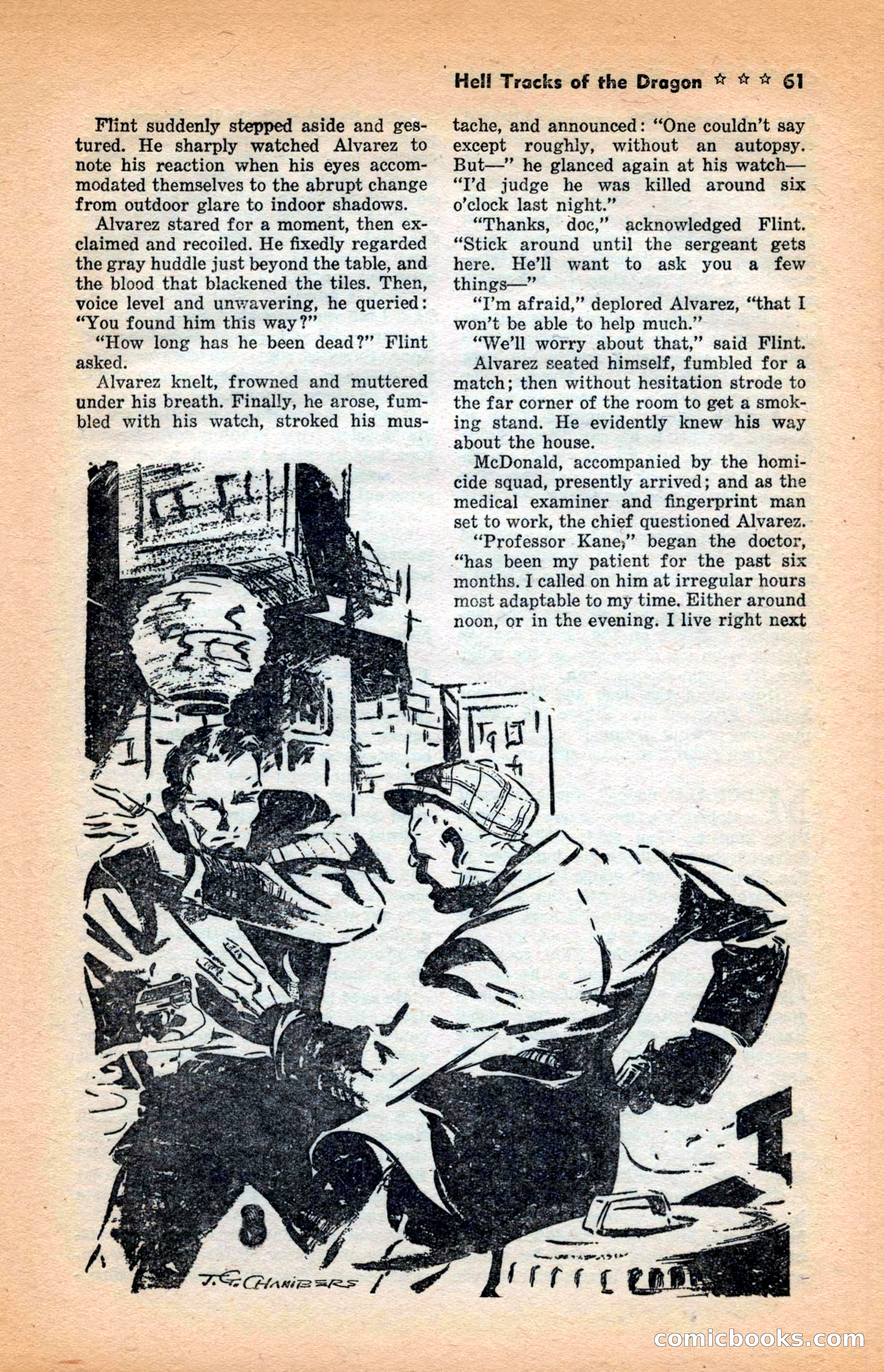
This is a story prose page from a pulp magazine titled "Hell Tracks of the Dragon." The visible text depicts a murder investigation scene where detective Flint questions Alvarez about a dead body found in a room. A illustration below shows what appears to be the crime scene with a body and investigators examining it. The dialogue reveals the victim was killed around six o'clock the previous night, and a medical examiner named Professor Kane arrives to begin the autopsy and investigation. The scene establishes the mystery setup typical of hardboiled crime fiction, with law enforcement gathering at the location to process evidence and interview witnesses.
# Page Analysis This is a **text page** from a pulp fiction story, containing no illustrations or advertisements. The visible prose appears to be from a **hardboiled crime or detective narrative**. It depicts Detective Flint investigating the death of Professor Kane, following clues about Kane's domestic habits and associates. The text mentions fingerprint evidence, interviews with witnesses (including McDonald and Alvarez), and references to a location called San Cristobal across the Mexican border. A key lead involves locating a man named Ramon Guevara, who reportedly delivered firewood to Kane's residence. The narrative includes dialogue between investigators discussing the case's progress and next steps.
# Page Analysis This is story prose from *Ten Short Novels Magazine* (page 64). The visible text depicts a crime narrative involving a character named Flint pursuing a woman named Valencia through what appears to be a Mexican border town. The passage describes a violent confrontation at a nightclub called La Estrella Blanca, where Flint rescues Valencia from captivity, leading to a shootout with bouncers. The narrative then shifts to police interactions, with officers discussing Valencia's arrival at an airport and a suspect named Miguel Smith. The writing style and subject matter—organized crime, border intrigue, and noir-style action—are typical of hardboiled crime pulp fiction from the early-to-mid twentieth century.
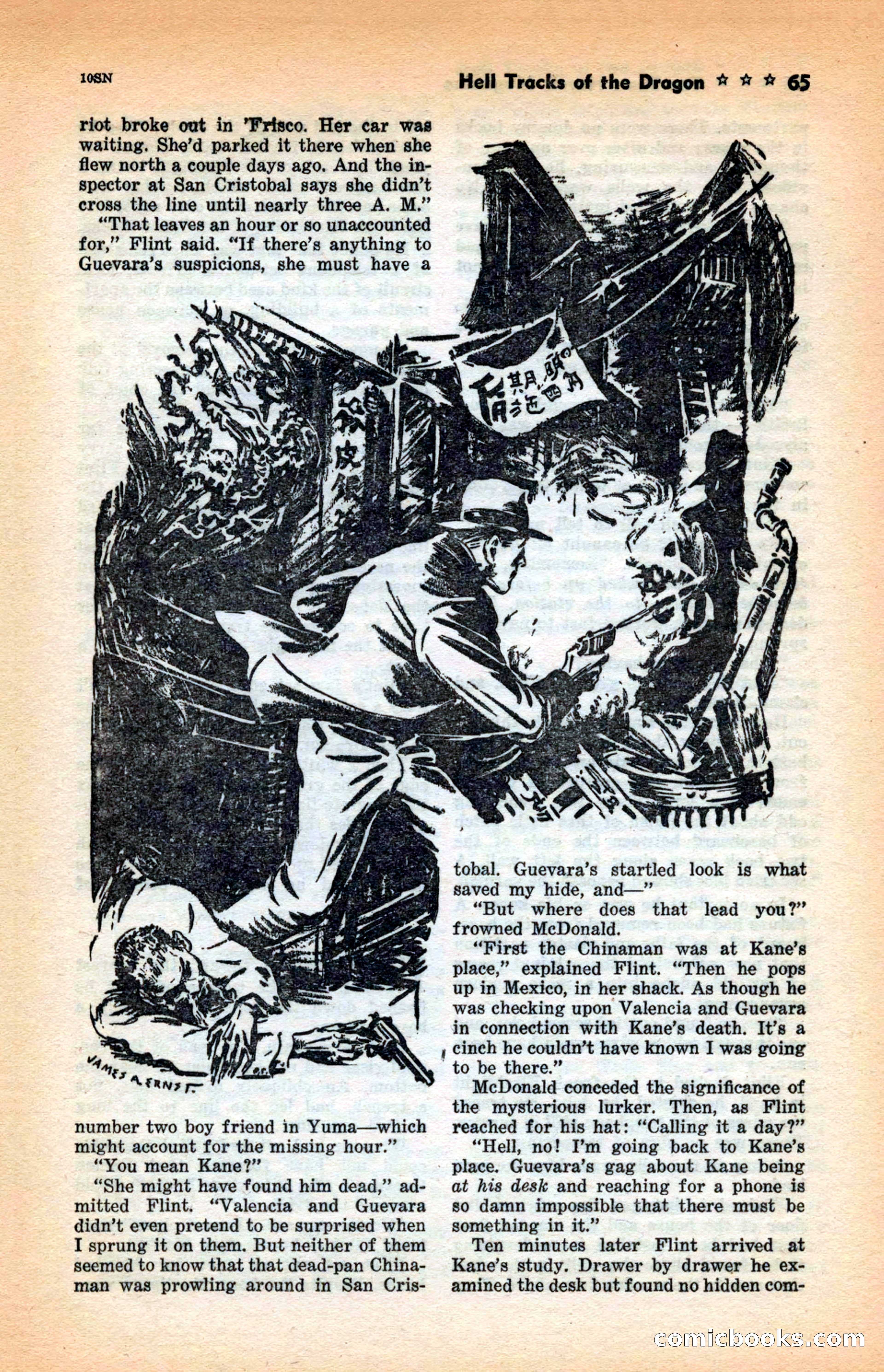
# Page Analysis: "Hell Tracks of the Dragon" This is a story page from a pulp magazine, containing both prose text and a black-and-white illustration. The illustration depicts what appears to be an interrogation or tense conversation scene with multiple figures in what looks like an Asian setting, given the visible Chinese characters on signage in the background. The visible prose discusses a mystery involving a woman's car left in Frisco, an unaccounted-for hour, and suspicions about a "dead-pan Chinaman" prowling around San Cristobal. Characters named Flint, Guevara, Valencia, and McDonald are investigating, discussing connections between deaths and mysterious activities in Mexico and Yuma. The narrative appears to be a hardboiled crime or mystery story with international intrigue elements.
This page contains story prose from what appears to be a crime or mystery pulp fiction tale. The visible text depicts a detective or investigator named Flint searching a house for clues related to a prisoner's escape and a smuggling operation. Flint discovers hidden wires and telephone connections in the walls and cellar, eventually tracing a cable to an underground irrigation system that likely provided an escape route. The narrative involves characters named McDonald, Valencia, Kane, and Guevara, with dialogue revealing details about how the prisoner was smuggled out. The page shows typical pulp fiction detective work—methodical searching, deduction, and uncovering criminal schemes through physical evidence.
# Analysis of Page 67 This page contains story prose from a pulp fiction narrative titled "Hell Tracks of the Dragon." The text depicts an intense action scene in which the protagonist Flint, visiting a doctor's office, becomes trapped in a violent confrontation. After being attacked with a gas weapon and knife by an assailant (a "Chinaman"), Flint attempts to escape while suffering from poisonous vapor inhalation. The passage includes a radio broadcast mentioning a "Miguel Smith—Mexican Mike" wanted for murder in connection with a Telegraph Pass incident. The prose emphasizes Flint's physical distress and the dangerous circumstances surrounding him.
# Page 68: Ten Short Novels Magazine This is a text page from a pulp fiction story featuring dialogue and prose. The narrative concerns a crime investigation involving a character named Alvarez, who appears to have been killed. A detective named Flint is questioning people about the circumstances—specifically whether Alvarez murdered someone named Kane. The passage reveals details about smuggling operations, an autopsy, and potential alibis. A woman named Valencia is being questioned, and there's discussion of events in San Francisco and Mexico. The page ends with dialogue suggesting a female character escaped during a riot and was never caught in smuggling activities.
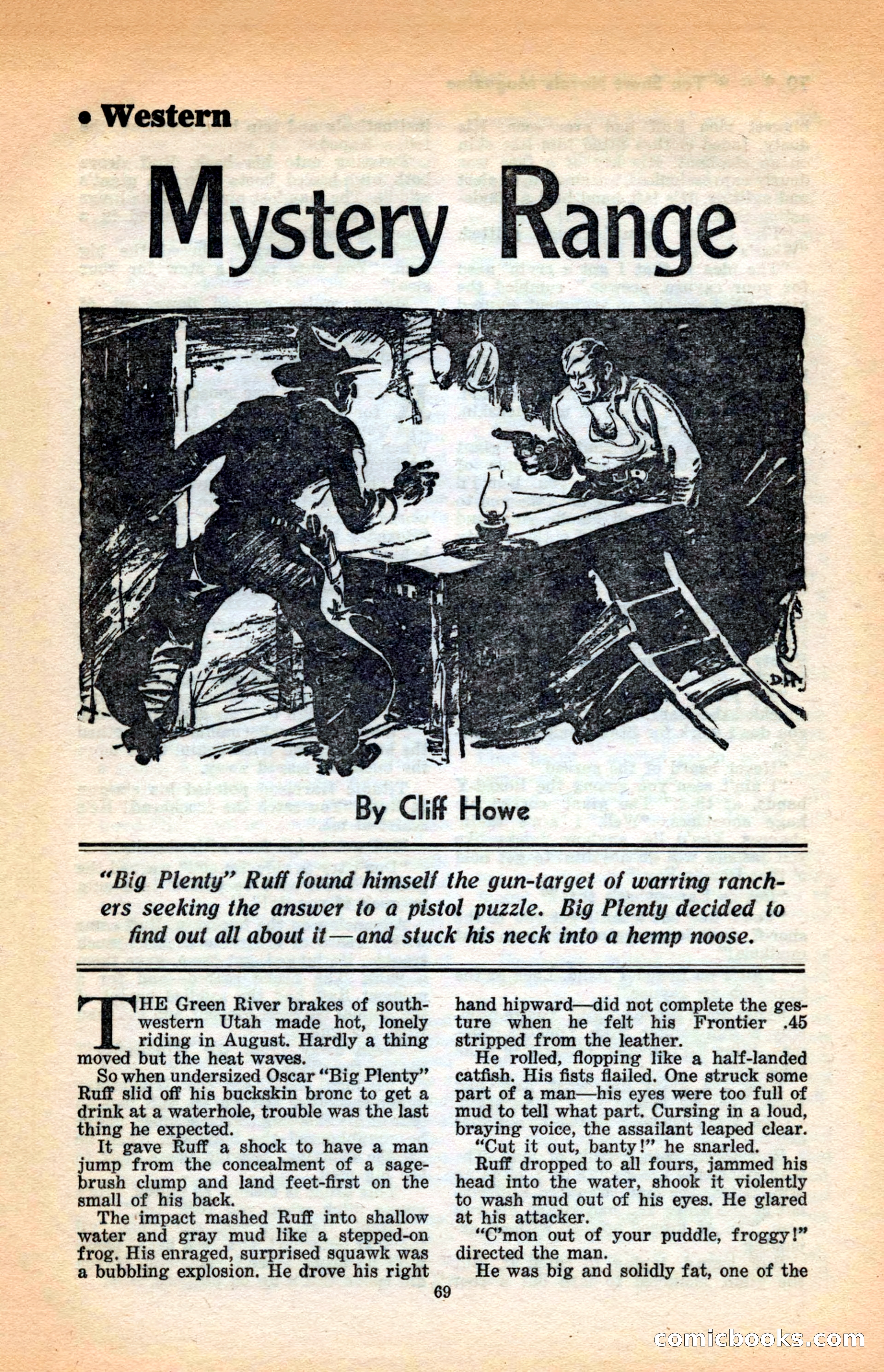
# Western Mystery Range This page displays the opening of a short story titled "Western Mystery Range" by Cliff Howe. It features a black-and-white illustration showing several men gathered around a table in what appears to be an indoor setting, likely a ranch or saloon. The story's premise, according to the visible synopsis, involves a character named "Big Plenty" Ruff who becomes entangled in a mystery when he is shot at by warring ranchers seeking answers to a "pistol puzzle." The narrative begins with Ruff being thrown from his horse into a waterhole, where he encounters a man and becomes involved in a physical altercation. The text is a Western adventure story typical of pulp fiction magazines from the early twentieth century.
# Page 70: Ten Short Novels Magazine This page contains story prose from what appears to be a Western pulp fiction narrative. The text depicts a confrontation between a tough, weathered character named Oscar Ruff and a giant man, likely involving a dispute over a horse or buckskin. The dialogue is written in heavy dialect with colloquialisms typical of pulp Western fiction ("froggy," "yallerhammer"). The scene involves physical conflict, with Ruff attempting to gain control of a buckskin horse while the giant threatens him with a Winchester rifle. The narrative emphasizes action and colorful language characteristic of early-20th-century pulp adventure stories aimed at working-class readers.
# Page Analysis This is a **story prose page** from the pulp magazine *Mystery Range* (visible at top). The text depicts an action scene in which a character named Ruff engages in a violent confrontation with a large man (referred to as "the giant") over a buckskin horse. After being knocked down, Ruff retrieves weapons and throws guns and a knife away to fight fairly. A girl named Miss Dawn appears and warns Ruff about the man's strength. Ruff pursues the fleeing buckskin on horseback while the girl and giant remain behind. The scene concludes with four armed men suddenly appearing and pointing guns at Ruff, suggesting an impending dramatic confrontation.
This page contains story prose from "Ten Short Novels Magazine" (visible in the header as page 72). Chapter II, titled "Necktie Party," depicts a confrontation between a character named Ruff and four men, including one called Silky Ed Crowder. The passage describes Ruff's capture and interrogation by these men, who appear to be searching for information about a missing gun and the location of "Devil's Ear" and someone named Zeke McCann. The text includes dialogue and physical action as Ruff is threatened and bound. The narrative style and subject matter—involving guns, ranches, and frontier-style conflict—suggests this is a Western or hardboiled adventure story.
# Analysis of Page 73 from "Mystery Range" This is a **story prose page** from what appears to be a Western pulp magazine titled "Mystery Range." The page contains two columns of text depicting a confrontation between a character named Ruff (apparently a Broken-Stirrup rider) and Stan Yonkel, an old rancher and foreman. The dialogue reveals that Zeke McCann, a prospector, has gone missing after discovering something called the "Devil's Ear"—possibly a mine—and was subsequently kidnapped by drygunchers. The men discuss whether to involve the law in searching for Zeke and his discovery, with tensions rising as they debate their next moves.
# Page 74 of Ten Short Novels Magazine This page contains story prose in a two-column layout. The visible text depicts a Western scene in which characters execute an elaborate plan to lynch a man named Ruff by hanging him from a tree. Silky Ed Crowder and Stan Yonkel prepare the noose while others ride away with their horses. Ruff, tied to the buckskin horse beneath the tree limb, realizes the knot is a slipknot that will tighten when weight is applied. In desperation, he retrieves a gun from his shirt and shoots the rope, then swings from the tree in an attempt to strangle—the passage cuts off mid-action. The writing style and content are consistent with pulp Western fiction of the early twentieth century.
# Page Analysis This is a text page from a pulp fiction story titled "Mystery Range," showing Chapter III: "Dead Man." The page contains story prose only, with no illustrations or advertisements. The narrative depicts a Western scene where a character named Ruff has been rescued from a hanging by a girl named Dawn Lorde. They discuss a conflict involving a man named Zeke McCann and accusations of kidnapping and rustling at the "Broken-Stirrup ranch." The passage includes dialogue and action sequences involving gunplay and confrontation between characters including Titanic Harrison and the girl, who becomes angry when Ruff suggests the hanging was a hoax designed to rescue him.
# Page Analysis This is a text-only page (76) from *Ten Short Novels Magazine*, containing prose fiction. The visible story depicts a Western action scene involving a man named Ruff pursuing a girl who has been seized, apparently by someone called Titanic Harrison. After Ruff fires at Harrison and the girl escapes into a gully, he tracks them and discovers Harrison has been shot. Ruff then encounters a group of cowboys—including Stan Yonkel and Silky Ed Crowder—who arrive on horseback. The passage culminates in a tense standoff where the men draw guns, though the full context and story title remain unclear from this excerpt alone.
# Analysis of Page 77 from Mystery Range This is a story prose page from the pulp magazine *Mystery Range*. The page shows Chapter IV, titled "Blasting Death," continuing a Western narrative involving characters named Ruff, Stan Yonkel, and Silky Ed Crowder. The plot concerns the kidnapping of a girl named Dawn Lorde and confusion about whether the Boxed-Y ranch outfit or Ruff's group was responsible. The men debate the girl's whereabouts and safety while discussing their next moves, including plans to visit the sheriff. The text is printed in two columns with dialogue and narrative prose typical of pulp Western fiction.
# Page Analysis This is a **story prose page** (page 78) from *Ten Short Novels Magazine*, containing the continued narrative of what appears to be a Western story. The visible text depicts an action sequence where a character named Ruff responds to a ranch house fire. Old Stan Yonkel's home is burning after what seems to be an attack. Ruff discovers Stan injured but alive, then writes a note accusing "Silky Ed Crowder" and "your spread of punchers" of the attack, suggesting they've used "black powder under the house with a long fuse." Ruff then carries the wounded Yonkel to a freight wagon, covers him with a tarp, and prepares to pursue the suspected kidnappers who have taken a girl prisoner.
This is a page of story prose from a pulp magazine titled "Mystery Range," numbered 79. The page contains two chapters of what appears to be a Western adventure story. The narrative follows a character named Ruff pursuing a gang that has kidnapped a girl, leading to a confrontation at a canyon shack. Chapter V, titled "Trick Kill," begins at the bottom of the page, describing a violent encounter where Ruff fights a man using Stan Yonkel's six-gun. The text emphasizes action and gunplay typical of early pulp Western fiction.
# Page Analysis This is a text-only story page (page 80) from *Ten Short Novels Magazine*. The visible prose continues a Western action narrative involving characters named Ruff, Dawn Lorde, Silky Ed Crowder, and old Zeke McCann. The passage depicts a tense hostage situation in a shack where the captors are negotiating—apparently involving dynamite, gunpowder, and a plan to escape through a canyon. The text references "the Boxed-Y" (likely a ranch) and includes dialogue about threatening to blow up the canyon. The narrative appears to be pulp Western fiction with action-adventure elements typical of early-20th-century magazine storytelling.
This page contains story prose from a pulp magazine titled "Mystery Range" (visible in the header as page 81). The text depicts an action sequence in a canyon setting involving gunfire and conflict between multiple characters, including figures named Ruff, Crowder, Stan Yonkel, and Old Zeke McCann. The narrative describes a shootout, with characters taking cover and exchanging gunfire, followed by dialogue about asbestos rock formations and a character named "Devil's Ear." The page is entirely text with no illustrations visible—it continues a Western or adventure story with emphasis on gunplay and outdoor action sequences.
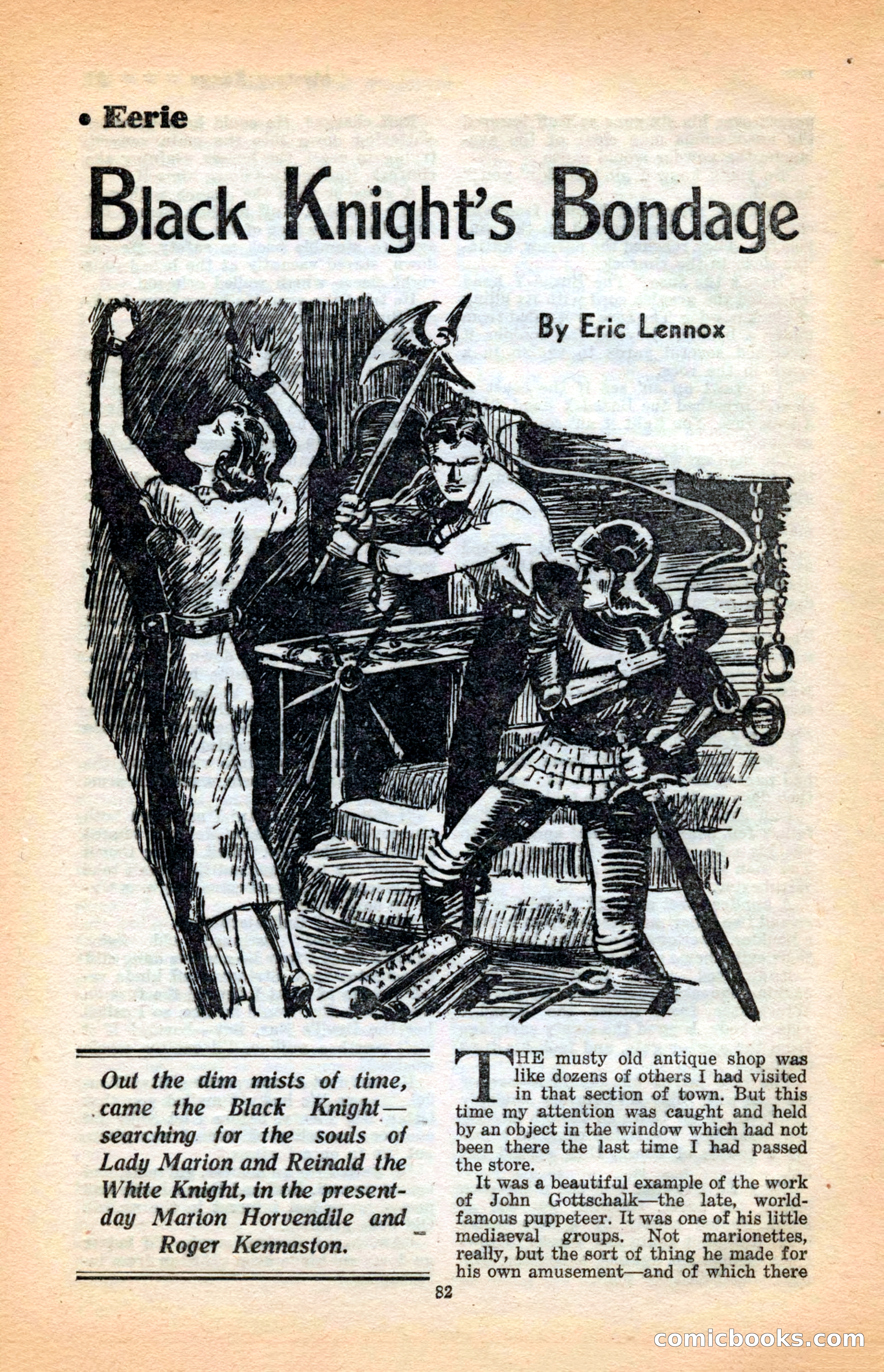
# Page Analysis This is an interior story page from an "Eerie" pulp magazine featuring "Black Knight's Bondage" by Eric Lennox. The page contains a dramatic black-and-white illustration showing a medieval scene with a man wielding an axe, a woman in distress with raised arms, and armored figures. The visible text introduces a narrative about the Black Knight searching through time for the souls of Lady Marion and Reinald the White Knight, who appear in the present day as Marion Horvendile and Roger Kennaston. The prose describes the narrator visiting an antique shop and discovering a beautiful medieval puppet work by the famous puppeteer John Gottschalk. The page number is 82.
# Black Knight's Bondage - Page 83 This page contains story prose in a two-column format. The text describes a narrator's discovery of a mysterious half of a golden disc with unknown inscriptions at an antique shop. The narrator argues with the shopkeeper about ownership, claiming the other half is a family heirloom. The shopkeeper reveals he's held the piece for years and mentions a young female customer (identified as "Mademoiselle M'sieu P. Montors, at the Musée Metropolitan") who recently became interested in purchasing it. The narrative concerns itself with questions of ownership and the mysterious origins of this ancient artifact.
# Page Analysis This is story prose from *Ten Short Novels Magazine* (page 84), showing two columns of text with a large decorative "M" starting a new section partway down. The visible text describes a narrator's mysterious encounter in a museum's armor room with a beautiful, ethereal young woman who appears to materialize from the shadows. The passage explores the narrator's emotional response to her—a mixture of fear and fascination—and culminates in an unexpected passionate embrace. The narrative voice is introspective and atmospheric, emphasizing supernatural or ghostly elements, though the exact nature of the woman remains unclear and deliberately mysterious to both the narrator and reader.
# Page Analysis: Black Knight's Bondage, Page 85 This page contains story prose from what appears to be a fantasy or adventure narrative titled "Black Knight's Bondage." The text describes an intimate encounter between two characters who discover each other's true identities. The male protagonist, initially believing the female character was someone else, learns her name is actually Kennaston (or similar), while she realizes he is "Reinald" and references "the White Knight." The passage depicts emotional recognition and reunion, with dialogue revealing confusion about their identities and mysterious circumstances surrounding their meeting. No illustration is visible on this text-heavy page.
This is a page of story prose from *Ten Short Novels Magazine* (visible in the header as page 86). The text appears to be from a supernatural horror story involving a narrator, a woman named Marion Horvendile, and a menacing shadow figure that materializes near a window at night. The narrator experiences growing terror as an unexplained dark presence—described as "a malevolent entity, the agent of evil and terror"—manifests in his room and advances toward him and Marion. The passage emphasizes psychological horror through the narrator's helplessness and fear as the shadowy form approaches. No illustrations are visible on this page.
# Page Analysis This is a **story prose page** from what appears to be a science fiction or adventure pulp magazine titled "Black Knight's Bondage" (page 87). The text describes a dramatic scene in which the narrator, imprisoned or captured, experiences a violent encounter. After discovering his companion Marion has disappeared, the narrator is brutally restrained—held by the neck with iron clamps and twisted arms while being dragged across a floor. He's then thrown into a dark room and chained to a rack by wrists and ankles. The passage emphasizes physical torment and anguish, written in first-person perspective with vivid, visceral language typical of pulp fiction action sequences. There are no illustrations visible on this page—only dense columns of printed text.
# Page Analysis This is a text-only page from *Ten Short Novels Magazine* (visible in the header). The page contains prose fiction—specifically dialogue and narrative describing a tragic romance between two characters. A woman named Marion recounts to her captor how she was separated from her lover Perion de Montors after they were caught together and taken back to a castle. The story involves magical elements (a sorcerer, a sigil, reincarnation) and themes of doomed love across lifetimes. The narrative reveals Marion's suffering during years of separation from Perion and hints at ongoing supernatural consequences of their forbidden relationship.
# Page Analysis This is a story prose page (numbered 89) from a pulp magazine titled "Black Knight's Bondage." The visible text depicts a dramatic scene of torture and captivity: a character named Marion is being whipped by the Black Knight while bound in chains. The narrative describes the Black Knight's monologue explaining a centuries-old curse linking him to Marion, his attempts to break the spell through her love, and his escalating violence when she refuses to submit. The prose is Gothic horror with explicit descriptions of physical torture, characteristic of early pulp fiction's sensational style.
# Page Analysis This is a story prose page from *Ten Short Novels Magazine* (visible in the header). The text describes a violent supernatural encounter in what appears to be a museum torture chamber. The narrator recounts a combat with a demonic or ghostly adversary wielding a pike, during which he was struck and nearly killed. The passage then shifts to the narrator's recovery, where a psychiatrist attributes the events to a nervous breakdown and hallucination. However, the narrator questions this diagnosis, noting physical evidence—an old sword on the museum floor—that seems to confirm the encounter was real rather than imagined. The narrative explores tension between supernatural horror and rational explanation.
# Page Analysis: "Black Knight's Bondage" (Page 91) This is a story prose page from a pulp magazine. The text continues a narrative in which the narrator recalls encountering a mysterious antique dealer named Perion de Montors, and subsequently reunites with his beloved Marion in New York. The passage describes an emotional reunion and Marion revealing that she was hospitalized and suffered burns beneath her left arm, which she cannot fully remember acquiring. The narrator struggles to comprehend the mysterious circumstances surrounding her injury and hospitalization. A small decorative illustration of a woman's profile appears at the bottom of the page.
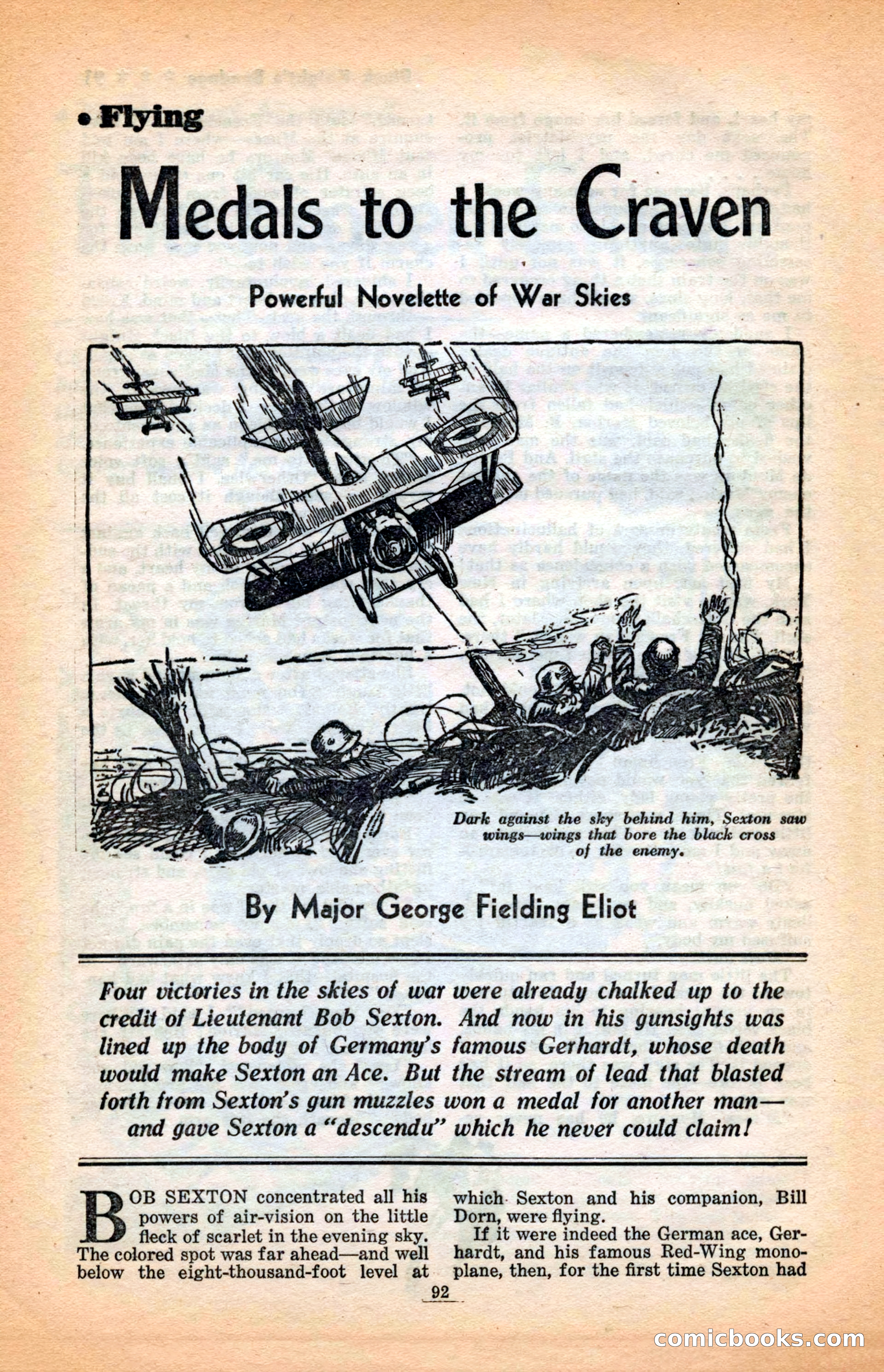
This is a story page from a pulp magazine featuring "Medals to the Craven," described as a "Powerful Novelette of War Skies" by Major George Fielding Eliot. The page includes an illustration depicting World War I aerial combat, showing military biplanes attacking ground forces in a trench. The visible prose describes Lieutenant Bob Sexton, a fighter pilot credited with four aerial victories, who has lined up his gun sights on an enemy aircraft (apparently the German ace Gerhardt). However, the narrative indicates that Sexton's gunfire, while successful in earning him another medal, somehow resulted in a dishonorable "descendu" (likely referring to being shot down). The text sets up a conflict between military achievement and personal shame.
# Page Analysis This is a story prose page from a pulp magazine, numbered 93 and titled "Medals to the Craven." The text describes an aerial combat scene between American and German pilots during what appears to be World War I. The narrative focuses on pilot Sexton pursuing an enemy aircraft (a Boche flyer) piloted by someone named Gerhardt, with detailed descriptions of their aerial maneuvers, gunfire exchanges, and the tension of combat. The passage emphasizes Sexton's determination to prevent Gerhardt's escape while dealing with his own aircraft's vulnerabilities. The writing style is typical of early-20th-century adventure pulp fiction.
This page contains story prose from *Ten Short Novels Magazine*. The text describes a World War I aerial combat sequence in which a pilot named Sexton struggles to fly his damaged aircraft, the Nieuport, back to Allied lines while dealing with engine damage, machine-gun fire, and exposure to German poison gas. The narrative follows Sexton's desperate efforts to maintain altitude and reach safety despite increasingly dire circumstances—his damaged wing, failing engine, and the toxic fumes threatening to incapacitate him. The page is entirely text with no illustrations or advertisements visible.
# Page Analysis This is a text page from a pulp fiction story titled "Medals to the Craven." The page contains story prose describing a World War I pilot named Bob Sexton recovering from injuries in a hospital and being visited by fellow pilot Owens. The narrative covers Sexton's crash landing, his hospitalization, and a subsequent conversation about military leadership and combat experience. The text discusses Sexton's return to duty and mentions the controversial status of another pilot named Dorn, whose actions during combat are debated among the airmen. The page uses period-appropriate dialogue and military aviation terminology typical of early-20th-century war fiction.
# Page Analysis This is a story prose page from *Ten Short Novels Magazine* (page 96), featuring two columns of text with no illustrations. The narrative depicts a World War I aerial combat sequence. A pilot named Sexton, recently assigned to B Flight under deputy leader Dorn, participates in a dangerous patrol mission at high altitude. The text describes Sexton's physical struggle with the aircraft controls, his difficulty breathing at altitude, and his growing concern about engine damage to his lungs. The passage conveys mounting tension as Sexton completes his patrol solo between four and five thousand feet, battling both mechanical challenges and troubling thoughts about his aviation future.
This is a page of story prose from a pulp magazine, printed in two columns on aged paper. The narrative concerns a military pilot named Sexton who has experienced engine trouble during a flight and must report to a major. The major confronts Sexton about leaving formation before encountering enemy aircraft, and suggests the pilot may be suffering from combat fatigue or nerves. Sexton denies illness but appears shaken. The major ultimately advises him to rest and recover, warning that pilots who have "cracked up" often never regain their nerve. The text appears to be from a wartime aviation story, likely from the 1940s era based on the context and magazine style.
This page contains story prose from what appears to be a military aviation narrative. The text describes a conflict between two pilots, Sexton and Dorn, during World War I. Sexton has been accused of cowardice by fellow airmen, but his superior officer privately reassures him, explaining that the major recognizes Sexton's true character despite appearances. The passage then shifts to describe a new assignment: Sexton's flight will conduct a ground-strafing attack on German positions in the Bonneville sector, with expectations of enemy counter-attack. The major briefs the pilots on their orders, tactics, and available equipment, including bombs and ammunition.
This page contains story prose from "Medals to the Craven," appearing on page 99 of the publication. The text describes a World War I aerial combat sequence in which pilot Sexton leads his B Flight in bombing runs against German positions. After sustaining damage and losses, Sexton lands to rearm and prepare for a second attack. The narrative focuses on a tense exchange between Sexton and another pilot named Dorn, who appears reluctant or unable to continue flying due to shell-shock. Sexton attempts to motivate Dorn to rejoin the afternoon mission, ultimately succeeding. The passage emphasizes the psychological and physical toll of combat flying during the war.
# Page Description This is a page of story prose from *Ten Short Novels Magazine*. The text appears to be from an aerial combat narrative set during World War I, focusing on a pilot named Sexton engaged in a dogfight with German Fokker aircraft. The passage describes intense aerial combat—including attacks on trenches, the downing of enemy planes, and Sexton's own aircraft being damaged and eventually crashing. The narrative culminates with Sexton's crash landing in a shell-hole, where he sustains injuries and lies wounded. The writing emphasizes action, danger, and the chaos of aerial warfare, typical of early-20th-century pulp fiction adventure stories.
# Page Analysis This is a **story prose page** from a pulp magazine, numbered 101 and titled "Medals to the Craven." The text depicts a hospital scene where Major Bassett visits the injured pilot Sexton, who lies heavily bandaged after a crash landing. The major delivers news that Sexton is being offered command of a new ground-strafe squadron, though Sexton's injuries—including damaged lungs—are severe. The dialogue reveals tension between military duty and Sexton's recovery, with the major ultimately encouraging him to heal and return to active service. The narrative suggests this is an aviation-themed pulp story, likely from the early-to-mid 20th century.
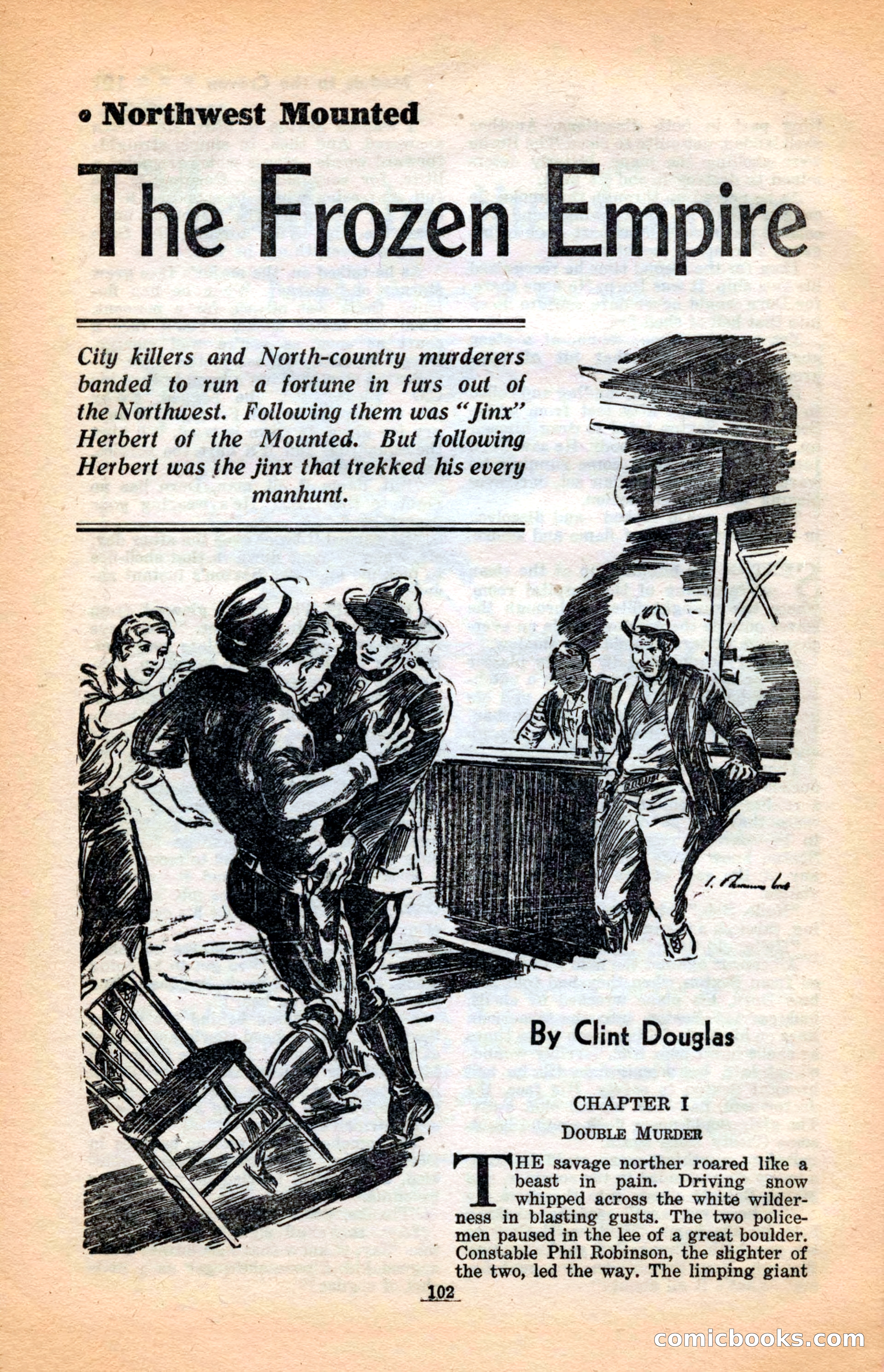
This is a story introduction page from a pulp magazine featuring "The Frozen Empire" by Clint Douglas, a Northwest Mounted Police tale. The page displays the story title, a subtitle explaining that criminals operating in the Canadian Northwest are being pursued by "Jinx" Herbert of the Mounted Police, and the beginning of Chapter 1, titled "Double Murder." An illustration shows what appears to be a confrontation scene with multiple figures in period clothing. The opening prose describes two policemen, including Constable Phil Robinson, pausing near a boulder while investigating in harsh winter conditions. The page number indicates this is page 102 of the magazine.
# Page 103 of "The Frozen Empire" This page contains story prose from what appears to be a serialized adventure narrative. The visible text depicts a tense scene where police officers pursue fugitives across a snow-covered landscape near the U.S.-Canadian border. Constable "Jinx" Herbert and Robinson discover a dead trapper named Yance Fifield and spot a fleeing girl in the snow. The narrative then shifts to explaining the International Boundary Line between the United States and Canada, noting its passage through remote Alaskan territory and describing Sam Dillard's Halfway House—a location straddling both countries that allegedly harbors fugitives. The prose mixes action sequences with geographical exposition.
# Page Analysis This is a text page from *Ten Short Novels Magazine* (page 104), containing prose fiction with no illustrations. The visible text shows the conclusion of one chapter and the beginning of Chapter II, titled "Out of the Blizzard." The story appears to be a hardboiled crime or western narrative involving a character named Sam Dillard, a large man with a scarred face, and a young girl who has witnessed a crime. The girl reports that two constables from a nearby post are coming, and Sam Dillard, who appears frightened, hides as officers arrive. The passage suggests a fugitive or criminal scenario set in a snowy wilderness location.
# Analysis of Page 105 from "The Frozen Empire" This is a page of story prose from a pulp fiction narrative titled "The Frozen Empire" (visible in the header). The text depicts a tense confrontation scene at what appears to be Halfway House, a remote outpost. Two law enforcement officers—Jinx Herbert and Phil Robinson—encounter Harl Pancoast and his associates. The scene involves escalating tension over food and supplies, culminating in a violent physical altercation between Herbert and Pancoast. The writing employs vivid descriptions of the harsh wilderness setting and the characters' physical features and demeanor typical of pulp adventure fiction.
# Page Analysis This is a story prose page from *Ten Short Novels Magazine* (page 106). It contains Chapter III, titled "Cold Duck," continuing a narrative about characters named Jinx Herbert, Phil Robinson, and others in what appears to be a crime or adventure story. The visible text shows dialogue and action involving these men discussing a woman, an international boundary situation, and plans to cross into the United States. The page is entirely text with no illustrations, featuring typical pulp magazine typography and formatting from the early-to-mid 20th century.
# Page Analysis This is a **text-only story page** (page 107) from what appears to be a science fiction pulp magazine titled *The Frozen Empire*. The page contains two sections of prose narrative. The first section depicts a tense confrontation in a cabin where characters named Jinx Herbert and Phil Robinson engage in a shootout with armed men. The second section, beginning "Chapter IV: Framed," shifts perspective to Jinx Herbert regaining consciousness after being struck, discovering his companion Phil Robinson is dead. The text describes Herbert's disoriented state and his realization that he's been framed for Robinson's death by someone—apparently an Inspector Snell—whom Herbert suspects of involvement in the incident.
# Page Analysis This is a text-only page (108) from *Ten Short Novels Magazine*, containing prose fiction. The visible story appears to be a crime or detective narrative involving Inspector Snell and a character named Jinx Herbert. The dialogue centers on a murder investigation following the death of someone named Phil Robinson, who was apparently a police officer. Herbert denies involvement and expresses frustration with Snell's accusations, while Snell warns Herbert about evading Canadian law. The passage concludes with Herbert following snow tracks, seemingly attempting to escape or investigate independently. The tone and subject matter suggest a hardboiled crime or mystery story.
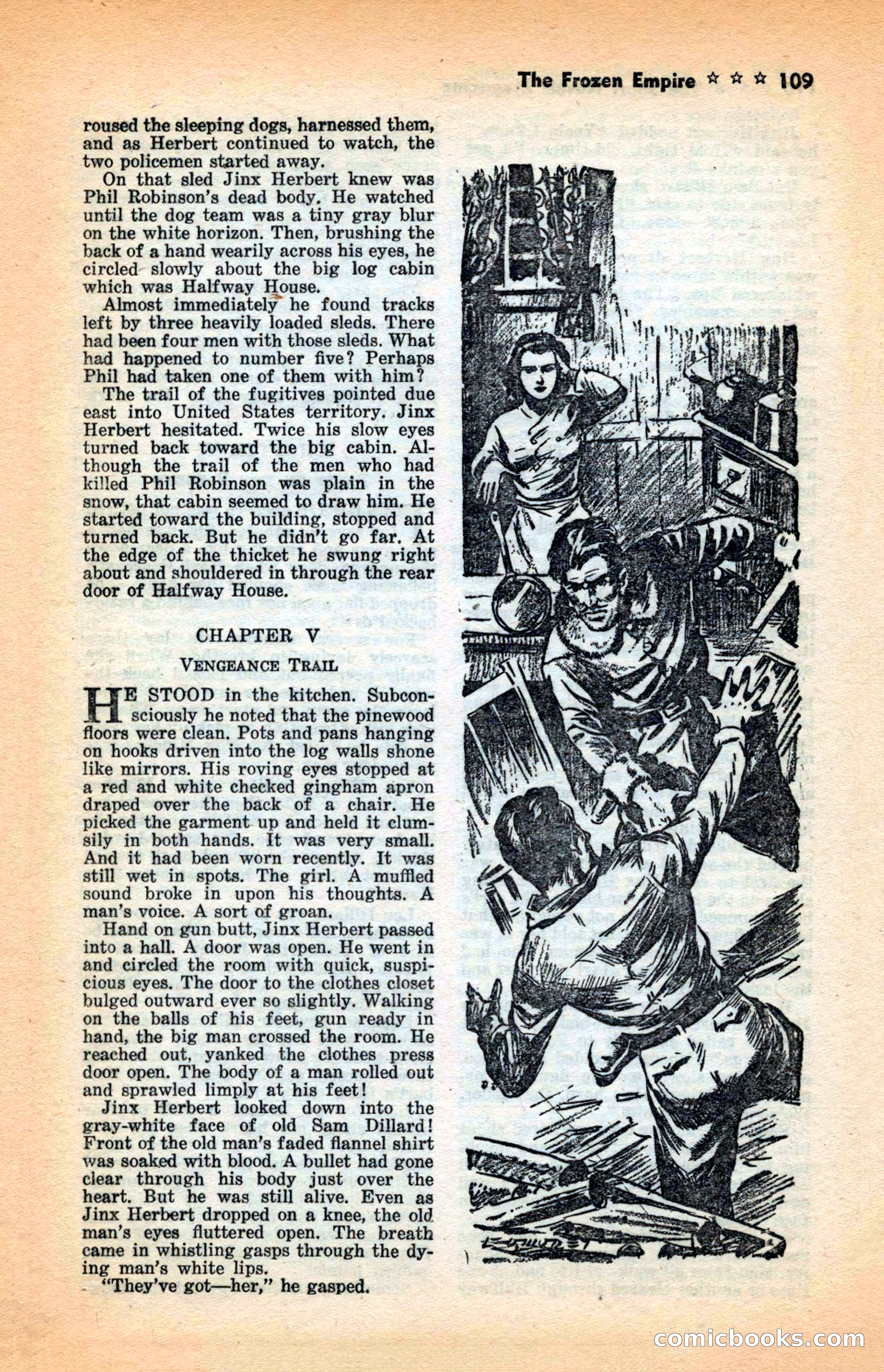
# Page Analysis This is a story page from *The Frozen Empire*, numbered 109. It contains prose narrative alongside a black-and-white illustration. The text describes Jinx Herbert discovering Phil Robinson's dead body on a sled and subsequently finding tracks of multiple sleds heading toward United States territory. A new chapter titled "Vengeance Trail" begins mid-page, detailing a character entering a kitchen where he discovers a woman's gingham apron and then finds a dying man—identified as old Sam Dillard—shot through the chest on the floor. The illustration depicts what appears to be the dramatic scene of the wounded man being discovered in the kitchen.
# Page Analysis This is a text-only page (110) from *Ten Short Novels Magazine*, containing story prose in two columns. The visible text depicts an adventure narrative set in a snowy wilderness. The story describes characters pursuing what appears to be criminals or fugitives across terrain, with mentions of sleds and wolves. A girl character escapes from a camp and hides while being tracked. The narrative involves tension and danger, with references to characters named Jinx Herbert, Lou Dillard, and Pug Mincher. Chapter VI, titled "Fight on the Barrens," begins partway down the page, suggesting this is a serialized novelette. The prose style and subject matter are consistent with early-20th-century pulp adventure fiction.
This page contains story prose from what appears to be "The Frozen Empire," a science fiction or adventure narrative. The text describes an intense action sequence in a cold, mountainous setting where characters named Jinx Herbert, Johnny Boston, Lou Dillard, Pug Mincher, and Tick Ellsworth are engaged in combat. The passage depicts gunfire, a fall down a snowy slope, and a fatal confrontation between Johnny Boston and Jinx Herbert. The narrative focuses on survival, violence, and conflict among this group in harsh winter conditions, with detailed descriptions of injuries and deaths resulting from their struggle.
# Page Analysis This is story prose from a pulp magazine, specifically Chapter VII titled "To the Death" from what appears to be an adventure or western narrative. The page depicts an intense nighttime confrontation in a snow-covered camp where protagonist Jinx Herbert, pursuing fugitives Pug Mincher and Lou Dillard, encounters armed adversaries. The text describes Jinx's tense stalking through darkness, a gunfight with a man guarding the camp, and the sudden appearance of Lou Dillard. The passage emphasizes atmospheric tension—frost, darkness, gunfire—building toward violent conflict in an isolated winter setting.
# Page Analysis This is a text-only story page from a pulp magazine titled "The Frozen Empire" (page 113). The page contains two sections of prose narrative describing violent action in what appears to be a frontier or arctic setting. The first section depicts a gunfight involving characters named Jinx Herbert, Pug Mincher, Lou Dillard, and Harl Pancoast, with gunshots, a physical struggle, and fatalities. The second section, marked by a large "T," shifts forward ten days to describe the arrival of three dog sleds at a Royal Northwest Mounted Police post, carrying furs, dead bodies, and an injured girl named Lou Dillard. The narrative concerns frontier justice or conflict resolution.
# Page Analysis This is a story prose page from *Ten Short Novels Magazine* (page 114), featuring continued narrative dialogue. The text depicts a conversation between Inspector Snell and a character named Jinx Herbert, discussing criminal matters involving someone named Pancoast and a gang. Inspector Snell explains why he discharged Herbert from service, referencing murders, stolen furs, and an escape into United States territory. The passage includes dialogue about Herbert's marriage to Lou Dillard and mentions of a character named Ben Briggs. At the bottom is a decorative illustration—a stylized silhouette of a woman's face wearing a wide-brimmed hat, used as a section divider. The text appears to be crime or detective fiction.
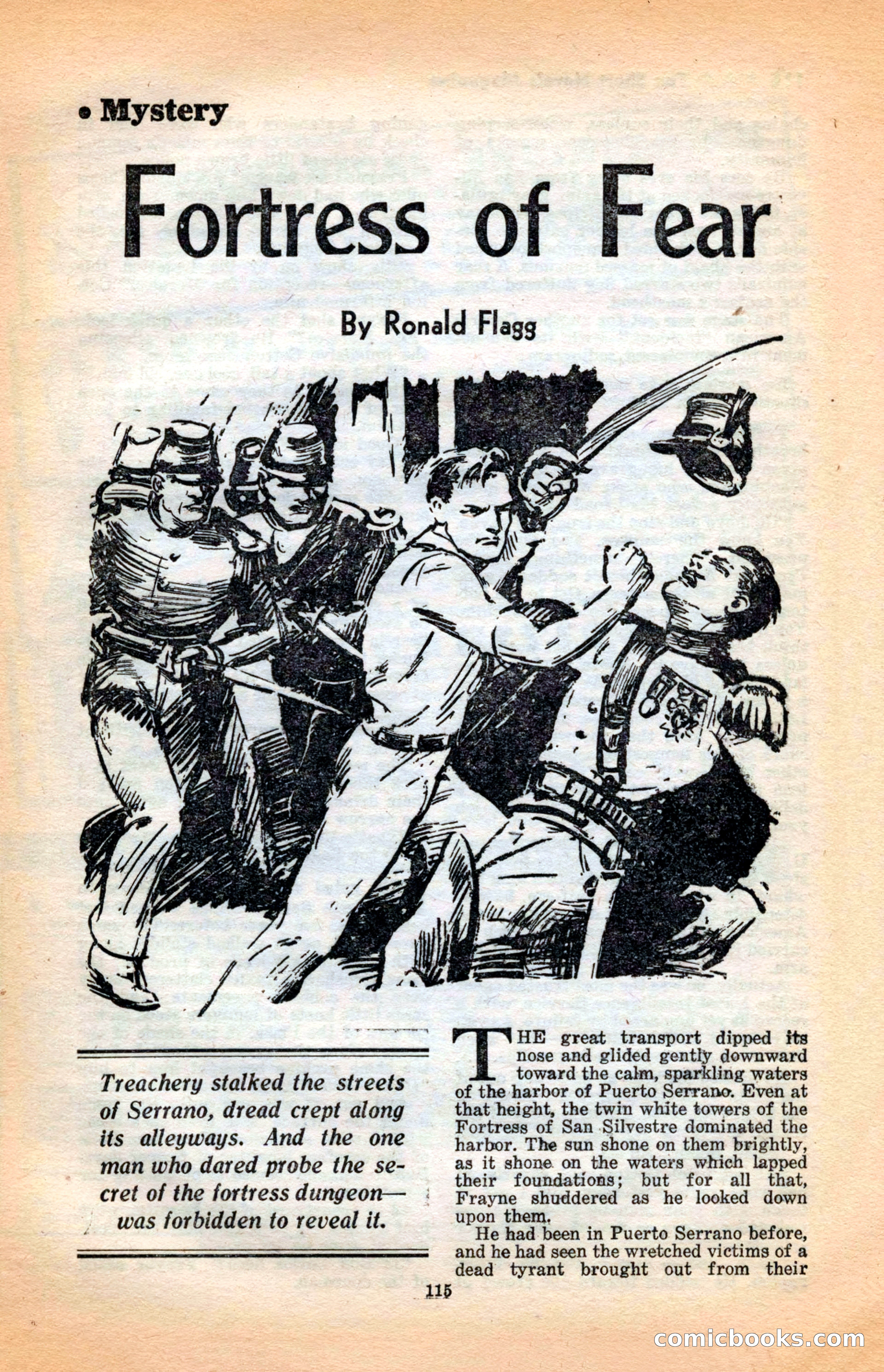
This is a story page from a pulp magazine featuring the mystery tale "Fortress of Fear" by Ronald Flagg. The page includes a dramatic black-and-white illustration depicting what appears to be armed soldiers or guards confronting a shirtless man in an action scene, with a fortress visible in the background. The visible prose describes a great transport ship approaching Puerto Serrano and its harbor, where the twin white towers of the Fortress of San Silvestre dominate the landscape. The text mentions treachery stalking the streets of Serrano and references a forbidden secret within the fortress dungeon that one man is forbidden to reveal. The page number is 115.
# Page Analysis This is a text-only page from *Ten Short Novels Magazine* (page 116) containing story prose. The visible narrative follows Lieutenant-Commander Philip Frayne, a Naval Intelligence agent, as he arrives in Puerto Serrano to investigate what appears to be a political crisis. The text describes Frayne meeting with Bob Cotton and observing the local situation, including military vehicles at the American Legion building. The story suggests underlying tension and instability in the location, with Frayne tasked with understanding the nature of a problem that requires diplomatic rather than military intervention. The passage emphasizes intelligence gathering and careful observation of the political landscape.
# Page Analysis This page contains story prose from a pulp fiction magazine titled "Fortress of Fear" (page 117). The text describes a scene in which Commander Frayne meets with General Francisco Moruelo, the vice president of Serrano and commander-in-chief of the army, in a crowded reception hall. Frayne attempts to extract information about Don Carlos's health and current location while navigating political tensions with various Serrano officials. The passage includes dialogue revealing that Don Carlos remains at his hacienda and is in ill health, while Frayne strategically conceals his true purposes for being in the country.
# Page Analysis This is a prose story page from *Ten Short Novels Magazine* (page 118). The text shows a dramatic scene involving a character named Frayne, a young officer who has apparently shot himself after a confrontation with a woman named Elena Aranaga (daughter of a president) and a man named Morales. The passage depicts the aftermath—Frayne wounded, Morales and other officers present, with discussion about the incident and American diplomatic involvement. The narrative appears to be from a political or romantic drama set in what seems to be a Latin American location, given references to "American soil" and colonial authorities. No illustration is visible on this page.
# Analysis of Page 119 from "Fortress of Fear" This is a **story prose page** with no illustrations. The text continues a narrative about Philip Frayne, who appears to be an intelligence agent investigating a murder in Puerto Serrano. The passage describes Frayne's discovery of a note from Elena Armaga, his subsequent meeting with a stevedore named Manuel, and conversation about a young soldier named Esteban who was shot in San Silvestre. The scene shifts to two men in a back room discussing the incident. The text suggests this is a spy thriller or adventure pulp story involving political intrigue and violence in a Spanish colonial setting.
This page contains story prose from what appears to be "Ten Short Novels Magazine" (visible in the header). The text depicts a scene set at Fortress San Silvestre, where a character named Frayne navigates past sentries and guards while attempting to access a dungeon. Frayne encounters a drunk sentry, threatens him, then moves deeper into the fortress. He discovers another character named Uriarte opening a trunk in a great hall (sala), and Frayne observes this covertly before Uriarte notices him. The narrative focuses on tension and espionage, with dialogue in both English and Spanish phrases. The setting and tone suggest this is likely adventure or spy fiction from an early-twentieth-century pulp magazine.
# Page Analysis: "Fortress of Fear" (Page 121) This is a text-only story page from a pulp magazine, containing prose fiction with no illustrations or advertisements visible. The narrative follows a character named Frayne who has escaped from a dungeon at Castle of San Silvestre. The text describes his harrowing escape through dark passages, his confrontation with a guard named Morales, and his desperate flight toward freedom through a French window leading to a waiting motor car. The passage includes action sequences involving combat, injury, and pursuit, written in the dramatic style characteristic of early pulp adventure fiction.
# Page Analysis This is a **text-only story page** from *Ten Short Novels Magazine* (page 122). The prose describes an action sequence involving a character named Frayne who is escaping in a car while being pursued by armed guards and police. The narrative follows Frayne's desperate dash through a gate and across a plaza, with gunfire exchanged, before he abandons the vehicle and commandeers a taxi to reach a boat (the *Hartford*) at a pier. The scene then shifts to an admiral's cabin where three men—Admiral Manning, an American minister, and Frayne—meet to discuss what appears to be a military or espionage situation. The text is dense pulp fiction prose with period dialogue and action-adventure themes typical of early-20th-century adventure serials.
This is a page of story prose from a pulp magazine titled "Fortress of Fear" (page 123). The text depicts a dramatic scene involving military and political intrigue, apparently set at a coastal fortress called Torre Blanco. A character named Frayne infiltrates the fortress through an opening in its walls while guards debate matters of honor and national politics. The narrative includes dialogue about Don Carlos Aranaga, threats, and what appears to be a suicide plot. The page contains no illustrations—only dense columns of printed text typical of pulp fiction magazines. The story appears to involve espionage, political conflict, and possibly revolution during an unspecified historical period.
This is a text page from a pulp magazine, containing story prose without illustrations. The visible narrative concerns a character named Frayne who is attempting a covert operation involving photography during what appears to be a military or political crisis. The text describes Frayne using a camera to document evidence while under fire, then developing photographs in a darkroom. A minister and admiral are shown examining the resulting prints, with discussion of reporting the situation to Washington. The passage emphasizes tension and urgency, with references to gunfire, danger, and high-stakes decision-making among government officials. The story appears to be spy or espionage fiction.
# Page Analysis This is a prose story page (page 125) from a pulp magazine titled "Fortress of Fear." The text describes a violent scene in Puerto Serrano where a man named Francisco Fernando Morales flees a pursuing mob through narrow streets. He attempts to reach an American cruiser called the *Hartford* for sanctuary. The passage depicts brutal street violence, mentions officials witnessing the chaos from the ship, and includes dialogue between characters named Frayne and Elena Aranaga discussing Morales's fate and the involvement of photographs in stirring up the mob. At the bottom is a small illustration of a woman's face in profile. The story appears to be adventure or political intrigue fiction set in a Latin American port city.
# "The Dressing-Room Champ" This is a story page from a pulp magazine featuring a boxing story by Paul Adams. The page includes an illustration showing two boxers in a ring, with what appears to be a third figure observing from above. The visible text describes a boxer named Fletch Brandell who, despite being error-prone in the ring, is given one last chance by his manager Dude McCafferty to fight. The manager threatens to end Fletch's career if he loses, while Fletch hopes to use an unspecified remedy to improve his performance—though the text suggests he knows this remedy may not actually work.
# Page 127: "The Dressing-Room Champ" This is a story prose page from a pulp magazine featuring what appears to be a boxing narrative. The text describes a fight scene between two boxers named Fletch and Packy Gahagan in a boxing ring, with spectators watching. The story details the physical action of their bout, the crowd's reaction, and various character perspectives including that of a woman named Trina Forbes who watches anxiously from ringside. The prose employs period-typical hardboiled language and vivid descriptions of the boxing match's violence and drama. No illustration is visible on this page—it is entirely text.
# Page Analysis This is a **prose story page** from *Ten Short Novels Magazine* (page 128), containing what appears to be a hardboiled boxing narrative. The text describes McCafferty attempting to manage young fighter Fletch Brandell, who has recently fought Steamboat Travis. The passage details their interactions—McCafferty's frustration with Brandell's potential, Pop Skeggs' interest in managing the fighter, and McCafferty's efforts to secure Brandell's future by offering him money and a contract. The story focuses on boxing training, career disputes, and negotiation between the various male characters in what appears to be a mid-twentieth-century prizefighting world.
This is a text page from a pulp fiction magazine titled "Ten Short Novels Magazine." The page contains prose narrative describing a boxer named Fletch who has suffered brain damage from repeated fights and is now struggling with poverty and lost ambitions in New York City. The story details how Fletch's career has deteriorated, his relationship with his trainer Pop Skeggs, and mentions other boxers like Dude McCafferty and Packy Gahagan. The narrative appears to be from a hardboiled boxing story, focusing on Fletch's physical decline, financial desperation, and emotional isolation as he confronts his failed dreams of an art career.
This page contains story prose from a pulp fiction narrative titled "The Dressing-Room Champ" (page 131). The illustration shows a boxing scene with multiple figures in a ring, depicting what appears to be a physical confrontation or fight. The text describes a boxer named Fletch who, after being mistreated by other fighters and a manager named Pop Skeggs, moves to another rooming house to escape his debts. The narrative details Fletch's struggles in the boxing circuit under the assumed name Jimmy Brand, his rapid physical deterioration over three months, and his financial difficulties. The story appears to be a hardboiled sports fiction tale about boxing and working-class life.
# Page Analysis This page contains story prose from *Ten Short Novels Magazine* (page 132). The text depicts a hardboiled crime narrative involving a boxer named Fletch Brandell who has fallen into poverty and desperation. After losing his fighting career, Fletch encounters his former love Trina Forbes, who is now wealthy and stylishly dressed. She urges him to abandon boxing ambitions, but Fletch accepts a job offer from a fight manager named Dude McCafferty to train for an upcoming match. The passage explores Fletch's internal struggle between pride and hunger, showing his physical and emotional deterioration as he pursues a comeback in the boxing ring.
# Page Content Analysis This is a story prose page numbered 133, titled "The Dressing-Room Champ." The text describes a boxing match and its aftermath, focusing on a fighter named Fletch who fights an opponent named Gahagan in what appears to be a brutal bout. After the fight, Fletch sits in a restaurant with an older man named Pop Skeggs, discussing Fletch's injuries, his temperament, and his future in boxing. Pop suggests Fletch lacks the necessary nerve for professional fighting and references other boxers. The dialogue and narrative suggest this is hardboiled pulp fiction dealing with boxing culture and fighter psychology in early-20th-century America. The page contains only text with no illustrations visible.
# Page Analysis This is **story prose** from *Ten Short Novels Magazine* (page 134), appearing to be from a hardboiled boxing/crime story. The visible text depicts a confrontation between fighter Fletch and his manager Pop Skeggs over a stolen contract, followed by Fletch's boxing match against an opponent at the Garden ring. The passage describes their dispute, Fletch's victory, and subsequent negotiations where manager Dude McCafferty attempts to control Fletch's career by having him fight predetermined bouts. The narrative focuses on boxing matches, managerial disputes, and fighter management in what appears to be 1920s-30s pulp fiction style.
# Page Analysis This is a **story page with an illustration** from a pulp magazine. The page number is 135, titled "The Dressing-Room Champ." The prose discusses a boxer named Fletch Brandell and his success in the ring, mentioning opponents like the Bat Nelsons and Joe Grimms. The text explains medical concepts about the solar plexus and nerve damage from punches. It describes Fletch's tactics for protecting himself during fights and notes that a boxing commission has decided Packy Gahagan must defeat Fletch Brandell to enter a lightweight tournament. The illustration shows a boxer in fighting stance inside a boxing ring, depicted in black and white line art typical of pulp-era sports fiction.
# Page 136: Story Prose from "Ten Short Novels Magazine" This is a text page containing story prose, identified as page 136 from "Ten Short Novels Magazine." The narrative appears to be a hardboiled boxing or sports story involving characters named Fletch, McCafferty, Pop Skeggs, and Steamboat Travis. The visible text depicts preparations for a boxing match at the National Auditorium, with dialogue about betting, fighting contracts, and pre-fight arrangements. The story includes romantic subplot elements involving a character named Trina and references to the "Gahagan" fight. The page ends with "(Continued on page 138)," indicating this is mid-story. The text style and subject matter are consistent with early-20th-century pulp fiction conventions.
# What's on This Page This is an advertisement page, not story prose. The ad promotes music instruction courses through the U.S. School of Music, claiming that anyone can learn to play an instrument "easily, quickly, in spare time at home." It features photographs of musicians playing various instruments and includes a mail-in coupon offering a free demonstration lesson. The page lists multiple instruments available for instruction—including piano, violin, guitar, and trumpet—and emphasizes that no special talent or previous training is required. The ad appears designed to appeal to readers interested in self-improvement through musical education.
# Page 138: Ten Short Novels Magazine This is an interior story page from a pulp magazine, featuring prose text in two columns with an accompanying illustration. The visible text describes a boxing match scene involving a character named Fletch, who appears to be a fighter preparing for or engaged in combat. The narrative mentions other characters including Pop Skeggs, Trina, and references to McCafferty and Gahagan. The illustration shows a muscular boxer in fighting stance. The text discusses Fletch's mental state during the match and his struggles with unwanted thoughts that threaten his focus and performance. The page is numbered 138 and continues from a previous page.
# Page Analysis This is page 139 from a pulp fiction magazine, containing story prose on the left and an advertisement on the right. The visible text describes a boxing match scene where a young fighter named Fletch, despite being outmatched and injured, fights an opponent while an older man named Gahagan appears as a referee or manager figure. The prose focuses on Fletch's nervousness, physical pain, and the tension of the moment. The right side features a full-page advertisement for the "Institute of Applied Science," offering "Free Confidential Reports" and promising information about fingerprinting and crime investigation, seemingly targeted at young readers interested in detective work.
# Page Analysis This page contains **story prose** from a pulp fiction magazine titled "Ten Short Novels Magazine" (visible at top). The text appears to be the continuation of a boxing story (noted as "Continued on page 142" at bottom). The narrative describes an intense boxing match between two fighters named Fletch and Gahagan. Fletch, a struggling young boxer, is fighting despite injuries and exhaustion, while his manager urges him to continue. The prose depicts brutal details of their physical combat in vivid, dramatic language typical of early-20th-century pulp fiction. The passage emphasizes Fletch's desperation and dwindling strength as the fight progresses.
This page is entirely advertising material from the International Correspondence Schools. It promotes five vocational and technical training courses: Mechanical Engineering, Radio, Diesel Power, Air Conditioning, and Advertising. Each section includes brief copy highlighting career opportunities and promises a free booklet. Below these main advertisements appears a coupon form for readers to request information about specific courses or trades, with checkboxes for various technical and business subjects. The page emphasizes job training and career advancement for ambitious men during what appears to be the mid-20th century.
# Page Analysis This is a text page from a pulp fiction magazine containing story prose and advertisements. The visible story excerpt describes a boxing match in progress, continuing from page 140. The protagonist, Fletch, appears to be a boxer struggling through a difficult round against an opponent named Gahagan, with the referee making controversial calls that favor Gahagan. The narrative focuses on Fletch's physical exhaustion and desperation as he tries to stay competitive despite the official's apparent bias. The page is surrounded by period advertisements for a radio, detective work opportunities, shoe sales commissions, love control instructions, and a skin remedy for pimples—typical classifieds of early pulp magazines.
# Description of Page This is an **advertising page** from a pulp magazine, filled entirely with classified advertisements and mail-order offers typical of early-20th-century periodicals. The ads promote various products and services including: a picture ring service (48¢), mail-order matchmaking clubs for lonely people seeking romance, medical booklets about epilepsy and stomach ulcers, a German semi-automatic pistol ($9.95), fertility information for women, and correspondence clubs. Several "Lonely?" ads appear multiple times throughout, offering confidential introductions and romantic correspondence services. The page represents the commercial aspect of pulp magazines, where classified advertising generated significant revenue alongside fiction content.
# Page 144: Ten Short Novels Magazine This page contains story prose, advertisements, and editorial content. The main narrative (continued from page 142) depicts a boxing match between characters named Fletch and Gahagan, describing their intense fight with vivid detail about punches, the crowd's reaction, and Fletch's victory. The page also features advertisements and articles encouraging readers to become writers, including a piece titled "How do you know you can't WRITE?" and information about the Newspaper Institute of America's writing instruction program. A photograph of what appears to be J.N. Ottrie from Lisbon, North Dakota accompanies a testimonial about self-supporting through writing. The content blends fiction with practical career guidance for aspiring writers.
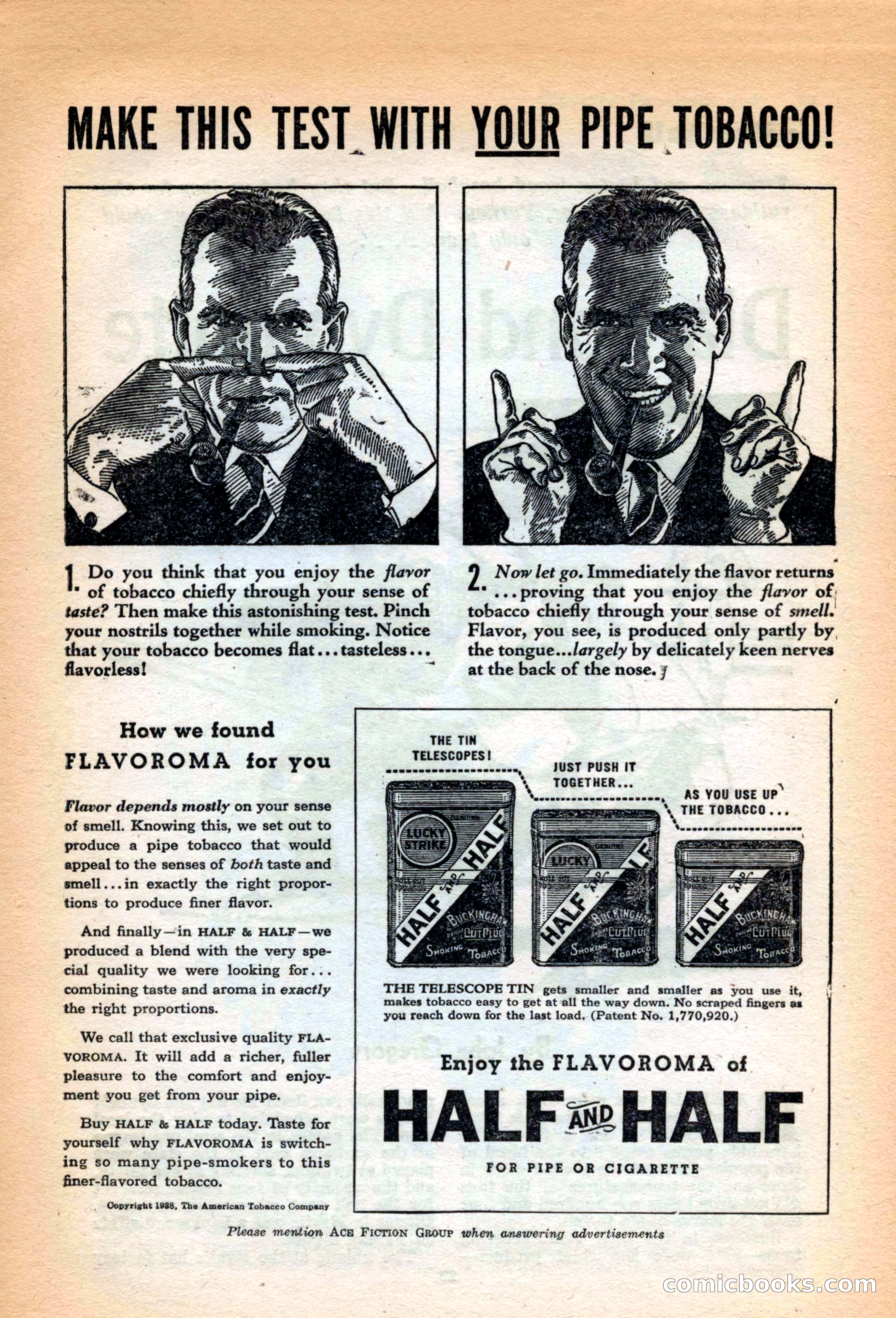
# Analysis This is an **advertisement page**, not story prose or editorial content. The page promotes Charles Atlas's "Dynamic Tension" exercise system through a testimonial format. It features photographs of muscular men and includes a dialogue at the top where someone named Bill asks about training, and Atlas claims his method produces results in seven days without special equipment. The page includes a coupon offering a free book titled "Everlasting Health and Strength" and promises to transform the reader into "a New Man" through a seven-day trial. The advertisement emphasizes rapid, visible physical transformation and includes Atlas's address in New York City for mail orders.
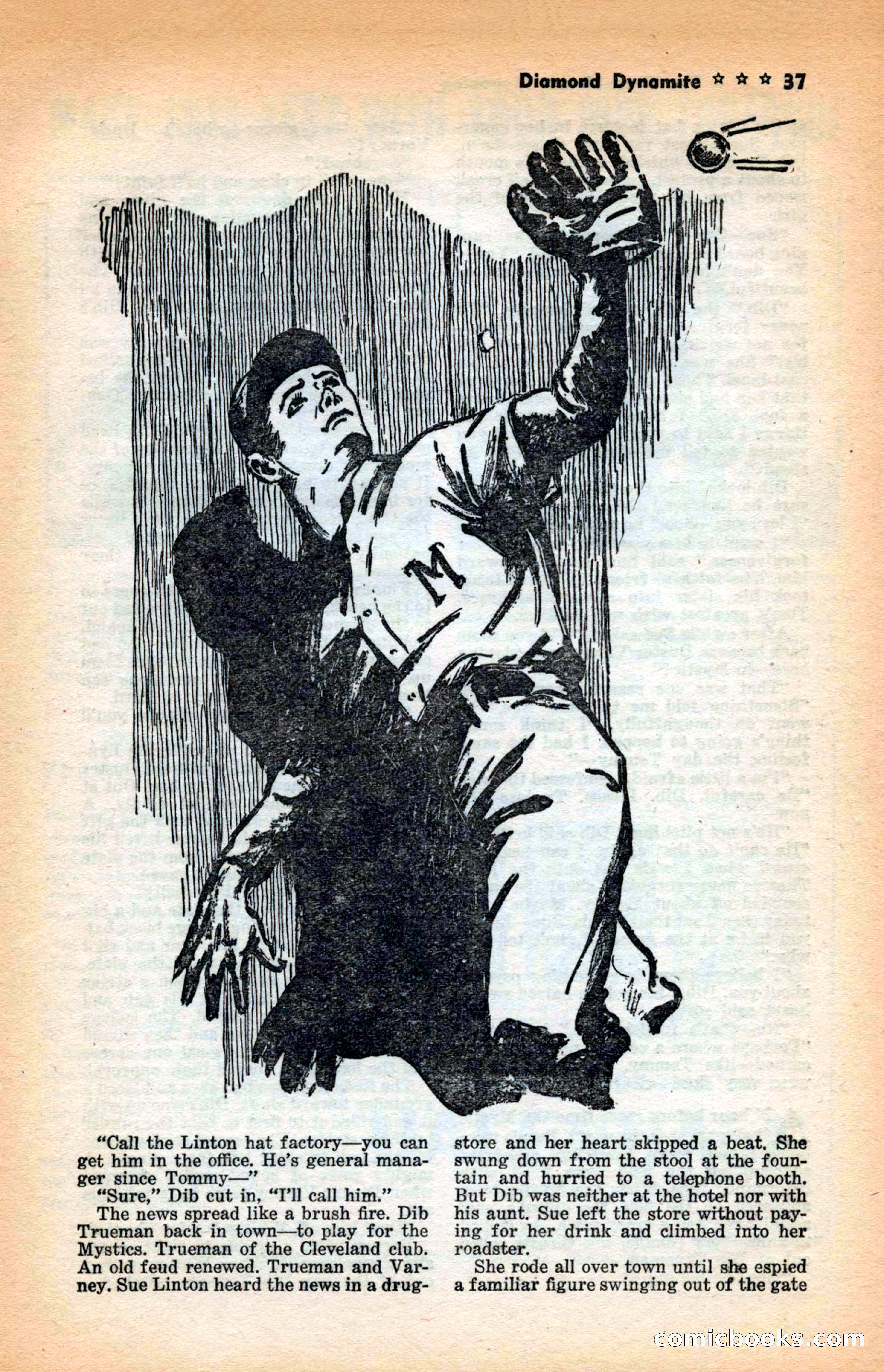
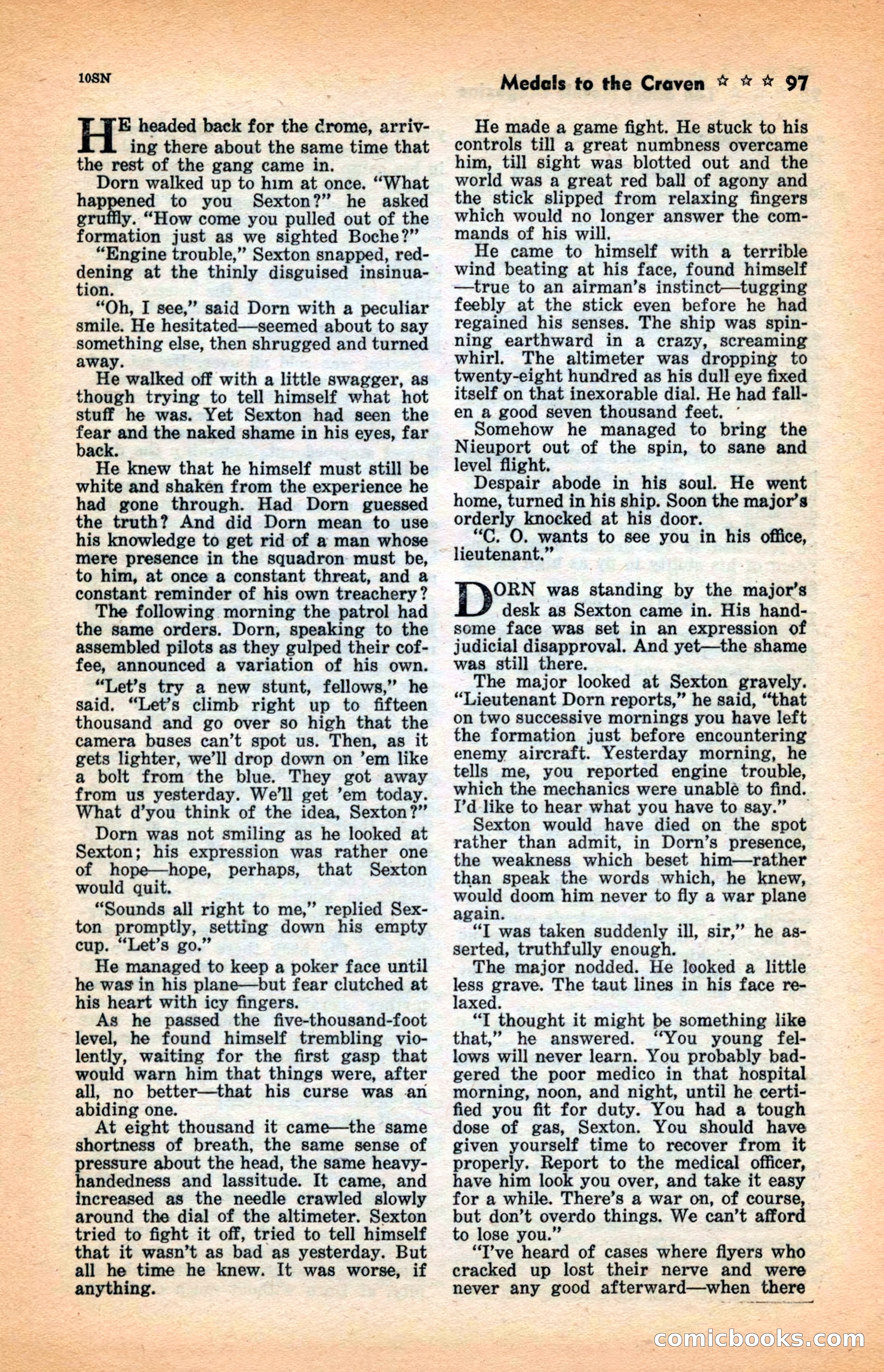
# Advertisement Page for H.F. Athlete's Foot Treatment This is a full-page advertisement from an early-20th-century publication promoting "H.F.," a mail-order remedy for athlete's foot (fungal infection). The page features a cartoonish illustration of a distressed man scratching his feet, accompanied by educational text about the condition's symptoms and spread. The advertisement claims H.F. will relieve itching immediately and cure the infection within ten days. A coupon at the bottom invites readers to mail for a free trial bottle, with the manufacturer (Gore Products, Inc. of New Orleans) promising a $1.00 refund if unsatisfied after ten days. The overall design uses bright yellow, red, and blue colors typical of period advertising.