
Pulp Fiction, 1938 · page 121 of 148
10 Short Novels Magazine — page 121: what you’re looking at
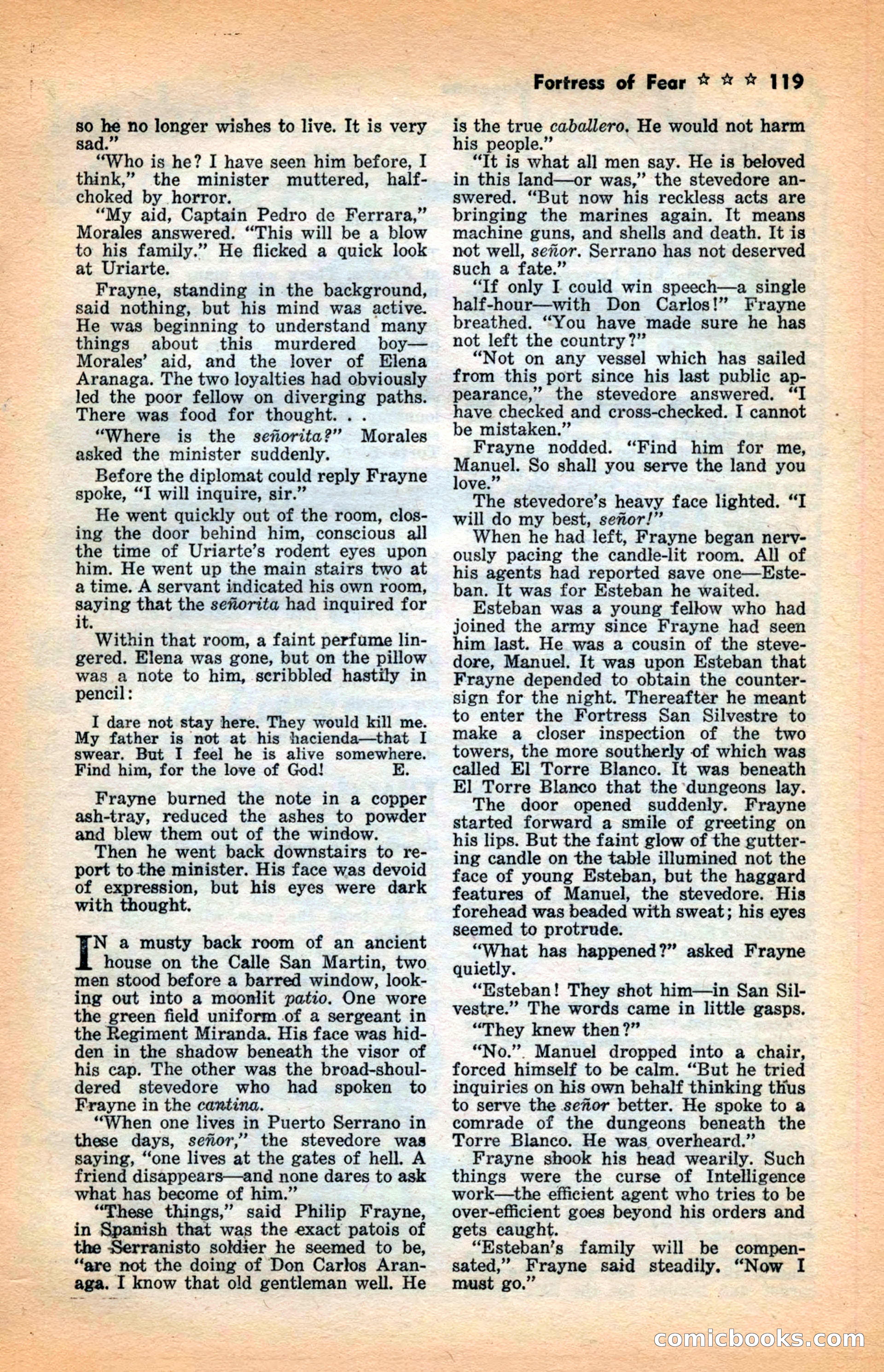
A restored page from Pulp Fiction, 1938. Page through the whole issue in the reader above.
📄 Transcribed text from this page (OCR, searchable)
Machine-transcribed from the original scan — historical spelling and the odd misread are preserved.
abi no longer wishes to live. It is very sa +B “Who is he? I have seen him before, I think,” the minister muttered, half- choked by horror. “My aid, Captain Pedro de Ferrara,” Morales answered. “This will be a blow to his family.” He flicked a quick look at Uriarte. Frayne, standing in the background, said nothing, but his mind was active. He was beginning to understand many things about this murdered boy— Morales’ aid, and the lover of Elena Aranaga. The two loyalties had obviously led the poor fellow on diverging paths. There was food for thought... “Where is the senorita?” Morales asked the minister suddenly. Before the diplomat could reply Frayne spoke, “I will inquire, sir.” He went quickly out of the room, clos- ing the door behind him, conscious all the time of Uriarte’s rodent eyes upon him. He went up the main stairs two at a time. A servant indicated his own room, saying that the sevorita had inquired for it. Within that room, a faint perfume lin- gered. Elena was gone, but on the pillow was ‘ note to him, seribbled hastily in pencil: I dare not stay here. They would kill me. My father is not at his hacienda—that I swear. But I feel he is alive somewhere. Find him, for the love of God! E. Frayne burned the note in a copper ash-tray, reduced the ashes to powder and blew them out of the window. Then he went back downstairs to re- port to the minister. His face was devoid of expression, but his eyes were dark with thought. N a musty back room of an ancient house on the Calle San Martin, two men stood before a barred window, look- ing out into a moonlit patio. One wore the green field uniform of a sergeant in the Regiment Miranda. His face was hid- den in the shadow beneath the visor of his cap. The other was the broad-shoul- dered stevedore who had spoken to Frayne in the cantina. ‘When one lives in Puerto Serrano in these days, sevor,’ the stevedore was saying, “one lives at the gates of hell. A friend disappears—and none dares to ask what has become of him.” “These things,” said Philip Frayne, in Spanish that was the exact patois of the Serranisto soldier he seemed to be, “are not the doing of Don Carlos Aran- aga. I know that old gentleman well. He Fortress of Fear * * * 119° is the true caballero, He would not harm his people.” “It is what all men say. He is beloved in this land—or was,” the stevedore an- swered. “But now his reckless acts are bringing the marines again. It means machine guns, and shells and death. It is not well, sefzor. Serrano has not deserved such a fate.” “If only I could win speech—a single half-hour—with Don Carlos!” Frayne breathed. “You have made sure he has not left the country?” “Not on any vessel which has sailed from this port since his last public ap- pearance,” the stevedore answered. “I have checked and cross-checked. I cannot be mistaken.” Frayne nodded. “Find him for me, ee So shall you serve the land you ove.” The stevedore’s heavy face lighted. “I will do my best, sevor!”’ When he had left, Frayne began nerv- ously pacing the candle-lit room. All of his agents had reported save one—Este- ban. It was for Esteban he waited. Esteban was a young fellow who had joined the army since Frayne had seen him last. He was a cousin of the steve- dore, Manuel. It was upon Esteban that Frayne depended to obtain the counter- sign for the night. Thereafter he meant to enter the Fortress San Silvestre to make a closer inspection of the two towers, the more southerly of which was called El Torre Blanco. It was beneath El Torre Blanco that the dungeons lay. The door opened suddenly. Frayne started forward a smile of greeting on his lips. But the faint glow of the gutter- ing candle on the table illumined not the face of young Esteban, but the haggard features of Manuel, the stevedore. His forehead was beaded with sweat; his eyes seemed to protrude. “What has happened?” asked Frayne quietly. “Esteban! They shot him—in San Sil- vestre.” The words came in little gasps. “They knew then?” “No.” Manuel dropped into a chair, forced himself to be calm. “But he tried inquiries on his own behalf thinking thus to serve the setor better. He spoke to a comrade of the dungeons beneath the Torre Blanco. He was overheard.” Frayne shook his head wearily. Such things were the curse of Intelligence work—the efficient agent who tries to be over-efficient goes beyond his orders and gets caught. “Esteban’s family will be compen- sated,” Frayne said steadily. “Now I must go.’ (E00) OOK Sita Pe