
Pulp Fiction, 1938 · page 146 of 148
10 Short Novels Magazine — page 146: what you’re looking at
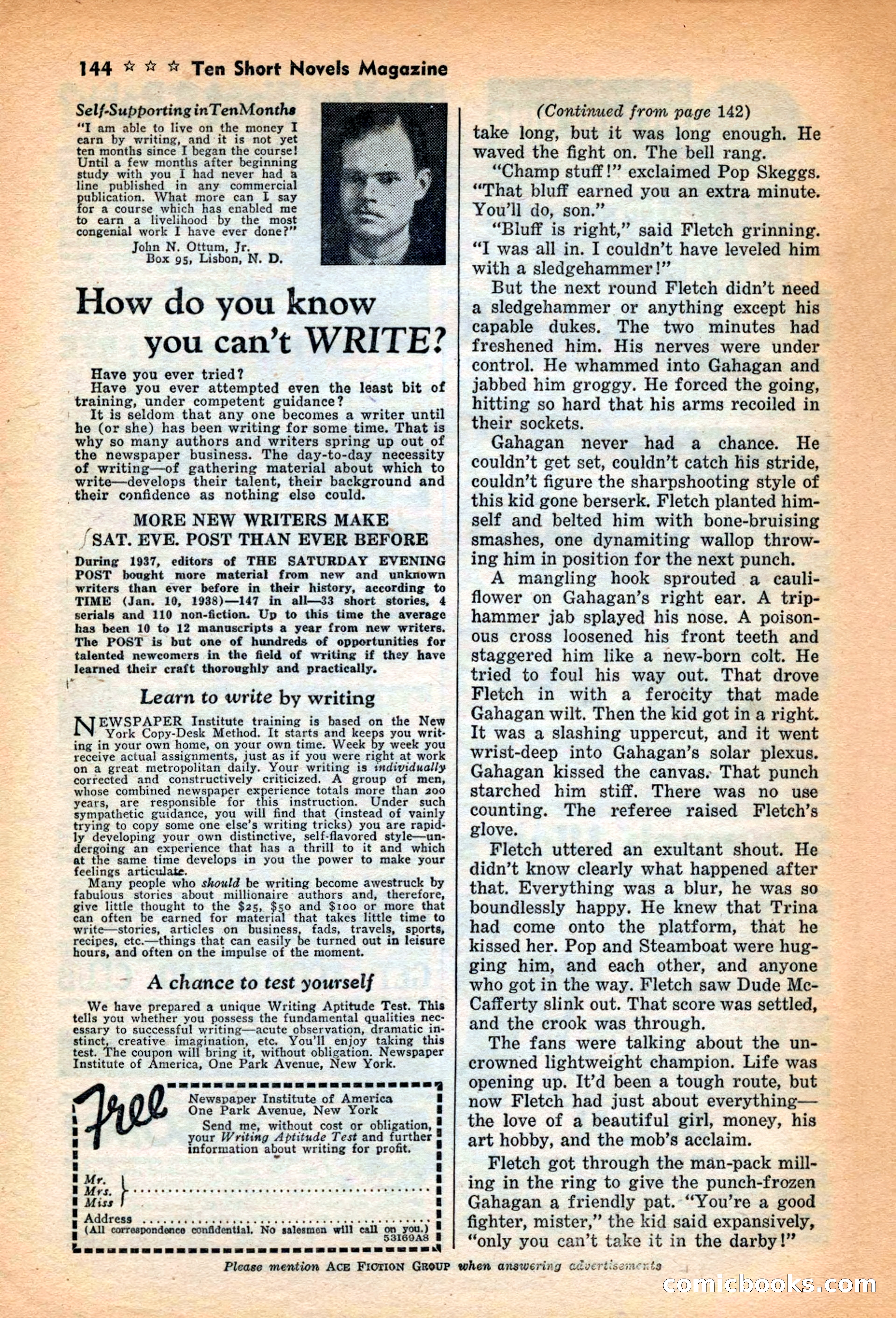
A restored page from Pulp Fiction, 1938. Page through the whole issue in the reader above.
📄 Transcribed text from this page (OCR, searchable)
Machine-transcribed from the original scan — historical spelling and the odd misread are preserved.
-Self-Supporting inTenMonths “I am able to live on the money I earn by writing, and it is not yet ten months since I began the course! Until a few months after beginning study with you I had never had a line published in any commercial ublication. What more can I say or a course which has enabled me to earn a livelihood by the most congenial work I have ever done?” John N. Ottum, Jr. Box gs, Lisbon, N. D. How do you know you can’t WRITE? Have you ever tried? Have you ever attempted even the least bit of training, under competent guidance? It is seldom that any one becomes a writer until he (or she) has been writing for some time. That is why so many authors and writers spring up out of the newspaper business. The day-to-day necessity of writing—of gathering material about which to write—develops their talent, their background and their confidence as nothing else could. _ MORE NEW WRITERS MAKE. {SAT. EVE. POST THAN EVER BEFORE During 1937, editors of THE SATURDAY EVENING POST bought more material from new and unknown writers than ever before in their history, according to TIME (Jan. 10, 1938)—147 in all—33 short stories, 4 serials and 110 non-fiction. Up to this time the average has been 10 to 12 manuscripts a year from new writers. The POST is but one of hundreds of opportunities for talented newcomers in the field of writing if they have learned their craft thoroughly and practically. Learn to write by writing NEWSPAPER Institute training is based on the New York Copy-Desk Method. It starts and oes you writ- ing in your own home, on your own time. Week by week you receive actual assignments, just as if you were right at work on a great metropolitan daily. Your writing is individually corrected and constructively criticized. A group of men, whose combined newspaper experience totals more than 200 years, are responsible for this instruction. Under such sympathetic guidance, you will find that (instead of vainl trying to copy some one else’s writing tricks) you are rapid- ly developing your own distinctive, self-flavored style—un- oe oing an experience that has a thrill to it and which at the same time develops in you the power to make your feelings articulate. Many people who should be writing become awestruck by fabulous stories about millionaire authors and, therefore, give little thought to the $25, $50 and $100 or more that can often be earned for material that takes little time to write—stories, articles on business, fads, travels, sports, recipes, etc.—things that can easily be turned out in leisure hours, and often on the impulse of the moment. ~ Achance to test yourself We have prepared a unique Writing Aptitude Test. This tells you whether you possess the fundamental qualities nec- essary to successful writing—acute observation, dramatic in- stinct, creative imagination, etc, You’ll enjoy taking this test. The coupon will bring it, without sag aa | Newspaper Institute of merica, One Park Avenue, New York. tt tl | Newspaper Institute of America H ’ One Park Avenue, New York 4 Send me, without cost or obli ation, § rt your Writing Aptitude Test and further g information about writing for profit. - g E a Mr. a | Mrs. *eeeeveeeeeeeeneeeneeee “ee eeweeveeevpeeeeeereeeeee® a i Miss | W Address Srewn eS EES pce COA CER CET CLOT Ce - (All correspondence confidential. No salesmen will call on you.) ' 53160A8 & TT TITILILILLILLiLTL LeeLee Please mention ACE Ficrion GROUP when answering advertisements Comicbooks:com) (Continued from page 142) take long, but it was long enough. He waved the fight on. The bell rang. “Champ stuff!” exclaimed Pop Skeggs. “That bluff earned you an extra minute. | You’ll do, son.” : . “Bluff is right,” said Fletch grinning. — “I was all in. I couldn’t have leveled him > with a sledgehammer!” r oe - ~ But the next round Fletch didn’t need a sledgehammer or anything except his capable dukes. The two minutes had freshened him. His nerves were under control. He whammed into Gahagan and jabbed him groggy. He forced the going, hitting so hard that his arms recoiled in their sockets. Gahagan never had a chance. He couldn’t get set, couldn’t catch his stride, couldn’t figure the sharpshooting style of this kid gone berserk. Fletch planted him- self and belted him with bone-bruising smashes, one dynamiting wallop throw- ing him in position for the next punch. A mangling hook sprouted a cauli- flower on Gahagan’s right ear. A trip- hammer jab splayed his nose. A poison- ous cross loosened his front teeth and staggered him like a new-born colt. He tried to foul his way out. That drove Fletch in with a ferocity that made Gahagan wilt. Then the kid got in a right. It was a slashing uppercut, and it went wrist-deep into Gahagan’s solar plexus. Gahagan kissed the canvas. That punch starched him stiff. There was no use counting. The referee raised Fletch’s glove. 3S a= Ss > eet Set ee Pe he ee - in eet a =5 a <a Fletch uttered an exultant shout. He ~ didn’t know clearly what happened after that. Everything was a blur, he was so boundlessly happy. He knew that Trina had come onto the platform, that he kissed her. Pop and Steamboat were hug- ging him, and each other, and anyone who got in the way. Fletch saw Dude Mc- Cafferty slink out. That score was settled, and the crook was through. The fans were talking about the un- | crowned lightweight champion. Life was opening up. It’d been a tough route, but now Fletch had just about everything— the love of a beautiful girl, money, his — art hobby, and the mob’s acclaim. Fletch got through the man-pack mill- ing in the ring to give the punch-frozen Gahagan a friendly pat. “You’re a good fighter, mister,” the kid said expansively, “only you can’t take it in the darby!” \ POP PAPO Ty ture Sia hag ae Be hte