
Pulp Fiction, 1938 · page 126 of 148
10 Short Novels Magazine — page 126: what you’re looking at
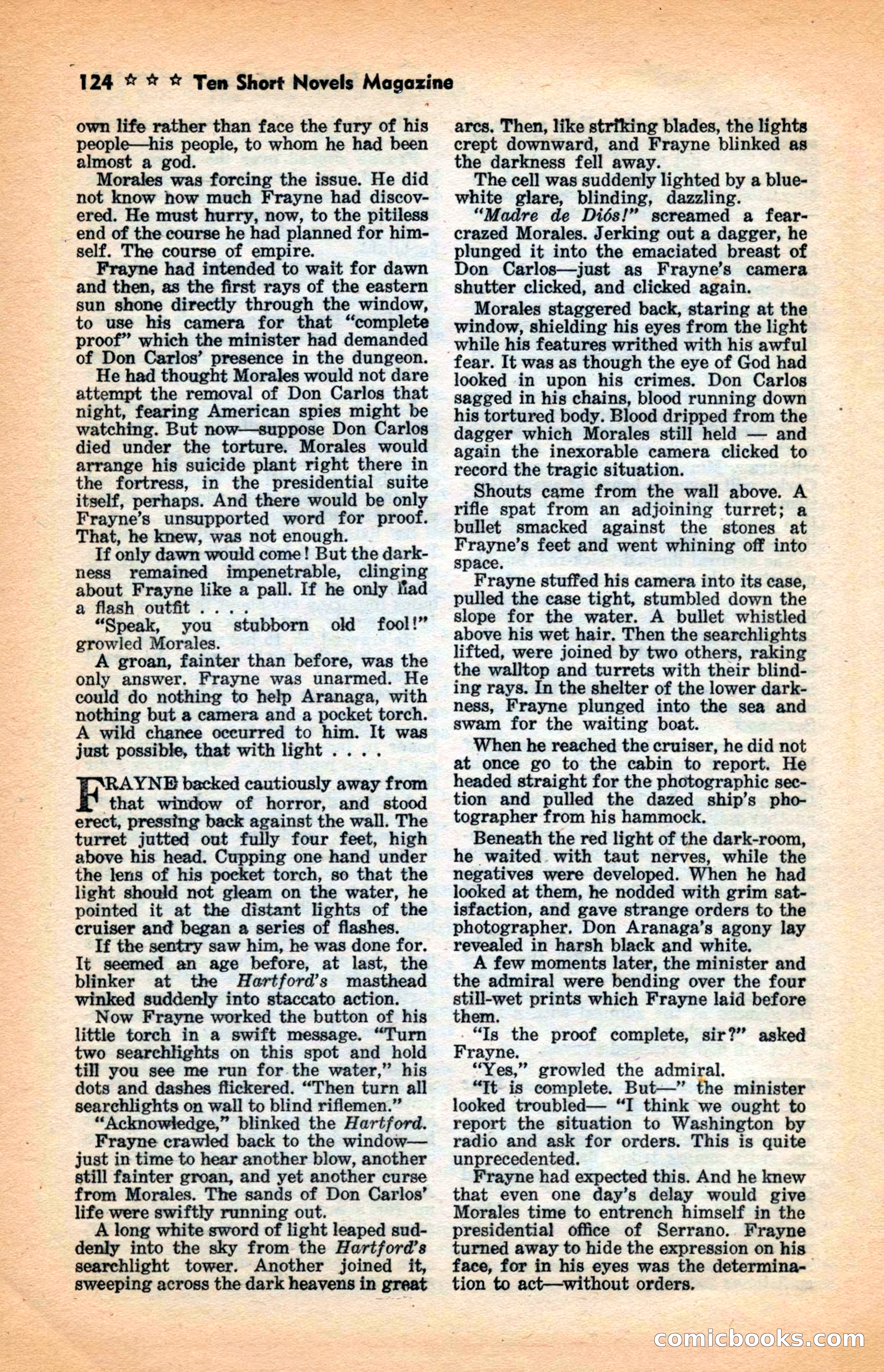
A restored page from Pulp Fiction, 1938. Page through the whole issue in the reader above.
📄 Transcribed text from this page (OCR, searchable)
Machine-transcribed from the original scan — historical spelling and the odd misread are preserved.
(124 * * * Ten Short Novels Magazine sweeping across the dark heavens own life rather than face the fury of his people—his people, to whom he had been almost a god. Morales was forcing the issue. He did not know how much Frayne had discov- ered. He must hurry, now, to the pitiless _ end of the course he had planned for him- self. The course of empire. Frayne had intended to wait for dawn and then, as the first rays of the eastern sun shone directly through the window, to use his camera for that “complete proof” which the minister had demanded of Don Carlos’ presence in the dungeon. He had thought Morales would not dare attempt the removal of Don Carlos that night, fearing American spies might be watching. But now—suppose Don Carlos died under the torture. Morales would arrange his suicide plant right there in the fortress, in the presidential suite itself, perhaps. And there would be only Frayne’ s unsupported word for proof. That, he knew, was not enough. If only dawn would come! But the dark- ness remained impenetrable, clinging about Frayne ae a pall. If he only Mad a flash outfit . ‘stubborn old fool!” “Speak, you. growled Morales. A groan, fainter than before, was the only answer. Frayne was unarmed. He could do nothing to help Aranaga, with nothing but a camera and a pocket torch. A wild chanee occurred to him. It was just possible, that with light .... RAYNE backed cautiously away from that window of horror, and stood erect, pressing back against the wall. The turret jutted out fully four feet, high above his head. Cupping one hand under the lens of his poeket torch, so that the light should not on the water, he pointed it at the distant lights of the cruiser and began a series of flashes. If the sentry saw him, he was done for. It seemed an age before, at last, the blinker at the Haeartford’s masthead winked suddenly into staccato action. Now Frayne worked the button of his little torch in a swift message. rn two searchlights on this spot and hold till you see me run for the water,” his dots and dashes flickered. “Then turn all searchlights on wall to blind riflemen.” “Acknowledge,” blinked the Hartford. Frayne crawled back to the window— just in time to hear another blow, another still fainter groan, and yet another curse from Morales. The sands of Don Carlos’ life were swiftly running out. A long white sword of light leaped sud- denly into the sky from the Hartford’s searchlight tower. Another joined it, in great a ee ee, Sas > Oe a a, ap — a. a oe Ces eS tei 5 0b ee a nn a a ee ee Os” gt gn et OE, Rg ge * me lee ee ae ee hn OS el —— . ae OS ne tad a oe ee eo ot = > = att ae ” mS a aS a ee en nes Fs - i ll ae ee ~- - Lt PLS Se _ > can a - - al _ « « _ = x ares. Then, like striking blades, the lights crept downward, and Frayne blinked as the darkness fell away The cell was saddeniy lighted by a blue- white glare, blinding, dazzling. “Madre de Didés!” screamed a fear- crazed Morales. Jerking out a dagger, he plunged it into the emaciated breast of Don Carlos—just as Frayne’s camera shutter clicked, and clicked again. Morales staggered back, staring at the window, shielding his eyes from the light while his features writhed with his awful fear. It was as though the eye of God had looked in upon his crimes. Don Carlos sagged in his chains, blood running down his tortured body. Blood dripped from the dagger which Morales still held — and again the inexorable camera clicked to record the tragic situation. Shouts came from the wall above. A rifle spat from an adjoining turret; a bullet smacked against the stones at Frayne’s feet and went whining off into space. Frayne stuffed his camera into its case, pulled the case tight, stumbled down the slope for the water. A bullet whistled above his wet hair. Then the searchlights lifted, were joined by two others, raking the walltop and turrets with their blind- ing rays. In the shelter of the lower dark- ness, Frayne plunged into the sea and swam for the waiting boat. When he reached the cruiser, he did not at once go to the cabin to report. He headed straight for the photographic sec- tion and pulled the dazed ship’s pho- tographer from his hammock. Beneath the red light of the dark-room, he waited with taut nerves, while the negatives were developed. When he had looked at them, he nodded with grim sat- isfaction, and gave strange orders to the photographer. Don Aranaga’s agony lay revealed in harsh black and white. A few moments later, the minister and the admiral were bending over the four — prints which Frayne laid before em. -“Tgs the proof complete, sir?” asked Frayne. “Yes,” growled the admiral. “Tt is complete. But—” the minister looked troubled— “I think we ought to report the situation to Washington by radio and ask for orders. This is quite unprecedented. e had this. And he knew that even one day’s delay would give Morales time to entrench himself in the presidential office of Serrano. Frayne turned away to hide the expression on his face, for in his eyes was the determina-— tion to act—without orders. EO PIE OOOL<