
Pulp Fiction, 1938 · page 96 of 148
10 Short Novels Magazine — page 96: what you’re looking at
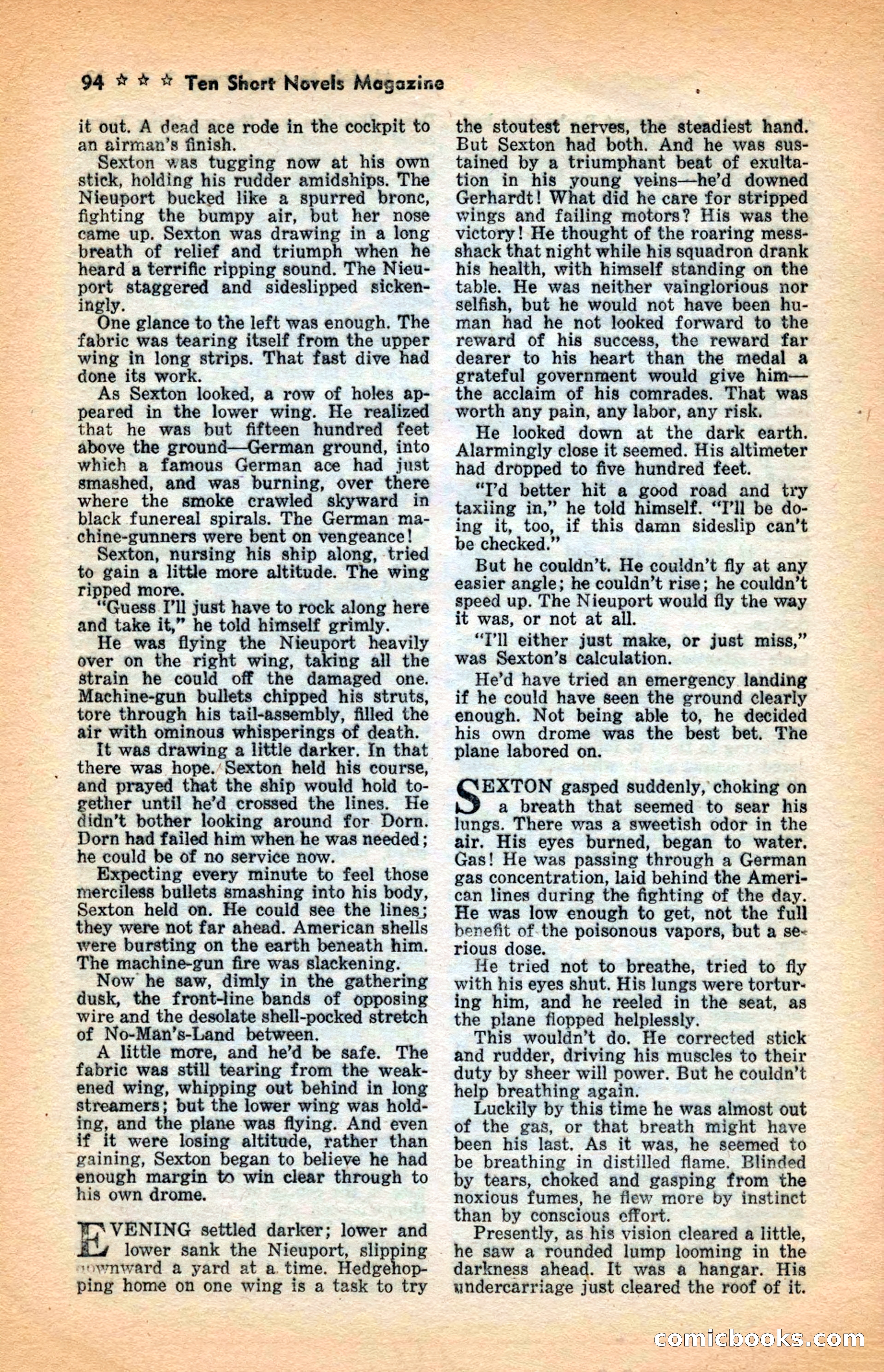
A restored page from Pulp Fiction, 1938. Page through the whole issue in the reader above.
📄 Transcribed text from this page (OCR, searchable)
Machine-transcribed from the original scan — historical spelling and the odd misread are preserved.
_chine-gunners were 94 * * *% Ten Short Novels Magazine it out. A dead ace rode in the cockpit to an airman’s finish. Sexton was tugging now at his own stick, holding his rudder amidships. The Nieuport bucked like a spurred brone, fighting the bumpy air, but her nose came up. Sexton was rahi on in a = breath of relief and triumph when he heard a terrific ripping thos The Nieu- ol staggered and sideslipped sicken- ing One glance to the left was enough. The fabric was tearing itself from the upper wing in long strips. That fast dive had done its work. As Sexton looked, a row of holes ap- peared in the lower wing. He realized that he was but fifteen hundred feet above the ground—German ground, into which a famous German ace had just smashed, and was burning, over there where the smoke crawled skyward in black funereal spirals. The German ma- t on vengeance! Sexton, nursing his ship along, tried to gain a little more altitude. The wing ripped more. “Guess I’ll just have to rock along here and take it,” he told himself grimly. He was flying the Nieuport heavily over on the right wing, taking all the strain he could off the damaged one. Machine-gun bullets chipped his struts, tore through his tail-assembly, filled the air with ominous whisperings of death. it was drawing a little darker. In that there was hope.‘Sexton held his course, and prayed that the ship would hold to- ether until he’d crossed the lines. He idn’t bother looking around for Dorn. Dorn had failed him when he was needed ; he could be of no service now. Expecting every minute to feel those merciless bullets smashing into his body, Sexton held on. He could see the lines; they were not far ahead. American shells were bursting on the earth beneath him. The machine-gun fire was slackening. Now he saw, dimly in the gathering dusk, the front-line bands of opposing wire and the desolate a stretch of No-Man’s-Land betwee A little more, and he’d ie safe. The fabric was still tearing from the weak- ened wing, whipping out behind in long streamers; but the lower wing was hold- ing, and the plane was flying. And even if it were losing altitude, rather than ‘gaining, Sexton began to believe he had enough margin t win clear through to his own drome. VENING settled darker; lower and lower sank the Nieuport, slipping sownward a yard at a time. Hedgehop- ping home on one wing is a task to try the stoutest nerves, the steadiest hand. But Sexton had both. And he was sus- tained by a triumphant beat of exulta- tion in his young veins—he’d downed Gerhardt! What did he care for stripped wings and failing motors? His was the victory! He thought of the roaring mess- shack that night while his squadron drank his health, with himself standing on the table. He was neither vainglorious nor selfish, but he would not have been hu- man had he not looked forward to the reward of his success, the reward far dearer to his heart than the medal a grateful government would give him— the acclaim of his comrades. That was worth any pain, any labor, any risk. He looked down at the dark earth. Alarmingly close it seemed. His altimeter had dropped to five hundred feet. “Td better hit a good road and try taxiing in,” he told himself. “T’ll be do- ing it, too, if this damn sideslip can’t be checked.” But he couldn’t. He couldn’t fly at any easier angle; he couldn’t rise; he couldn’t speed up. The Nieuport would fly the way it was, or not at all. “T’ll either just make, or just miss,” was Sexton’s calculation. He’d have tried an emergency landing if he could have seen the ground clearly enough. Not being able to, he decided his own drome was the best bet. The plane labored on. EXTON gasped suddenly, choking on a breath that seemed to sear his lungs. There was a sweetish odor in the air. His eyes burned, began to water. Gas! He was passing through a German gas concentration, laid behind the Ameri- can lines during the fighting of the day. He was low enough to get, not the full benefit ofthe poisonous vapors, but a se- rious dose. He tried not to breathe, tried to fly with his eyes shut. His lungs were tortur- ing him, and he reeled in the seat, as the plane fiopped helplessly. This wouldn’t do. He corrected stick and rudder, driving his muscles to their duty by sheer will power. But he couldn’t help breathing again. Luckily by this time he was almost out of the gas, or that breath might have been his last. As it was, he seemed to be breathing in distilled flame. Blinded by tears, choked and gasping from the noxious fumes, he flew more by instinct than by conscious effort. Presently, as his vision cleared a little, he saw a rounded lump looming in the darkness ahead. It was a hangar. His undercarriage just cleared the roof of it. Comicbooks.c