
Pulp Fiction, 1938 · page 134 of 148
10 Short Novels Magazine — page 134: what you’re looking at
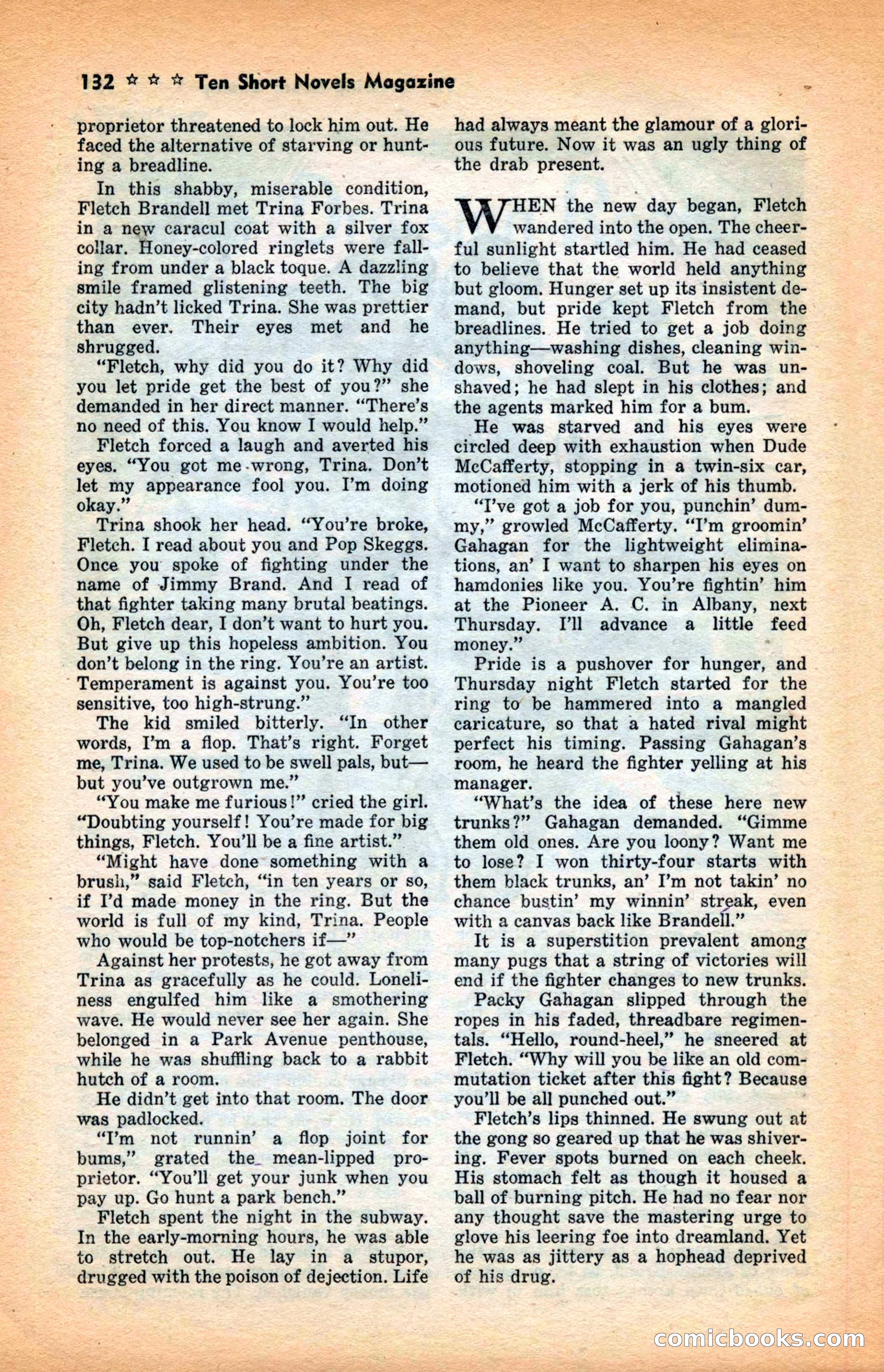
A restored page from Pulp Fiction, 1938. Page through the whole issue in the reader above.
📄 Transcribed text from this page (OCR, searchable)
Machine-transcribed from the original scan — historical spelling and the odd misread are preserved.
ee 1 32 ba wo Ten Short hiovais: Magexine Griteioior threatened to lock him out. He _ faced the alternative of starving or hunt- ing a breadline. | In this shabby, miserable condition, Fletch Brandell met Trina Forbes. Trina in a new caracul coat with a silver fox collar. Honey-colored ringlets were fall- ing from under a black toque. A dazzling smile framed glistening teeth. The big city hadn’t licked Trina. She was prettier than ever. Their eyes met and he shrugged. “Fletch, why did you do it? Why did you let pride get the best of you?” she demanded in her direct manner. “There’s no need of this. You know I would help.” Fletch forced a laugh and averted his eyes. “You got me-wrong, Trina. Don’t let my appearance fool you. I’m doing okay. ” Trina shook her head. “You’re broke, Fletch. I read about you and Pop Skeggs. Once you spoke of fighting under the name of Jimmy Brand. And I read of that fighter taking many brutal beatings. Oh, Fletch dear, I don’t want to hurt you. But give up this hopeless ambition. You - don’t belong in the ring. You’re an artist. ~ Temperament is against you. You’re too sensitive, too high-strung.”’ The kid smiled bitterly. “In other words, I’m a flop. That’s right. Forget me, Trina. We used to be swell pals, but— but you’ve outgrown me.” “You make me furious!” cried the girl. “Doubting yourself! You’re made for big things, Fletch. You'll be a fine artist.” “Might have done something with a brush,” said Fletch, “in ten years or so, if I’d made money in the ring. But the world is full of my kind, Trina. People who would be top-notchers if—” Against her protests, he got away from Trina as gracefully as he could. Loneli- ness engulfed him like a smothering wave. He would never see her again. She belonged in a Park Avenue penthouse, while he was shuffling back to a rabbit hutch of a room. He didn’t get into that room. The door was padlocked. “l’m not runnin’ a flop joint for bums,” grated the. mean-lipped pro- prietor. “You’ll get your junk when you pay up. Go hunt a park bench.” Fletch spent the night in the subway. In the early-morning hours, he was able to stretch out. He lay in a_ stupor, drugged with the poison of dejection. Life al 7” See Se eT = << o- a * rs << —>-* = - * * Si ae ee *, a, - ~ So ee _ > Sy ea 3 had always meant the glamour of a glori- ous future. Now it was an ugly thing of the drab present. Wwe the new day began, Fletch wandered into the open. The cheer- ful sunlight startled him. He had ceased to believe that the world held anything but gloom. Hunger set up its insistent de- oe. ; . = a, —_ mand, but pride kept Fletch from the breadlines. He tried to get a job doing anything—washing dishes, cleaning win- ~ dows, shoveling coal. But he was un- shaved; he had slept in his clothes; and the agents marked him for a bum. He was starved and his eyes were circled deep with exhaustion when Dude McCafferty, stopping in a twin-six car, motioned him with a jerk of his thumb. “T’ve got a job for you, punchin’ dum- my,” growled McCafferty. ‘I’m groomin’ Gahagan for the lightweight elimina- tions, an’ I want to sharpen his eyes on hamdonies like you. You’re fightin’ him at the Pioneer A. C. in Albany, next Thursday. Ill advance a little feed money.” ; Pride is a pushover for hunger, and . Thursday night Fletch started for the ring to be hammered into a mangled caricature, so that a hated rival might perfect his timing. Passing Gahagan’s room, he heard the fighter yelling at his — manager. “What’s the idea of these here new trunks?” Gahagan demanded. “Gimme them old ones. Are you loony? Want me to lose? I won thirty-four starts with them black trunks, an’ I’m not takin’ no chance bustin’ my winnin’ streak, even with a canvas back like Brandell.” It is a superstition prevalent among many pugs that a string of victories will end if the fighter changes to new trunks. Packy Gahagan slipped through the ropes in his faded, threadbare regimen- tals. “Hello, round-heel,” he sneered at Fletch. “Why will you be like an old com- mutation ticket after this fight? Because you'll be all punched out.” Fletch’s lips thinned. He swung out at the gong so geared up that he was shiver- ing. Fever spots burned on each cheek. His stomach felt as though it housed a ball of burning pitch. He had no fear nor any thought save the mastering urge to glove his leering foe into dreamland. Yet he was as jittery as a hophead deprived of his drug. al ~ - b _- Ti mm SE 0 , 0 , SOM « =, é 4A = 4-2 oe ome ” ~ :. a e « - =. 2