
Pulp Fiction, 1938 · page 108 of 148
10 Short Novels Magazine — page 108: what you’re looking at
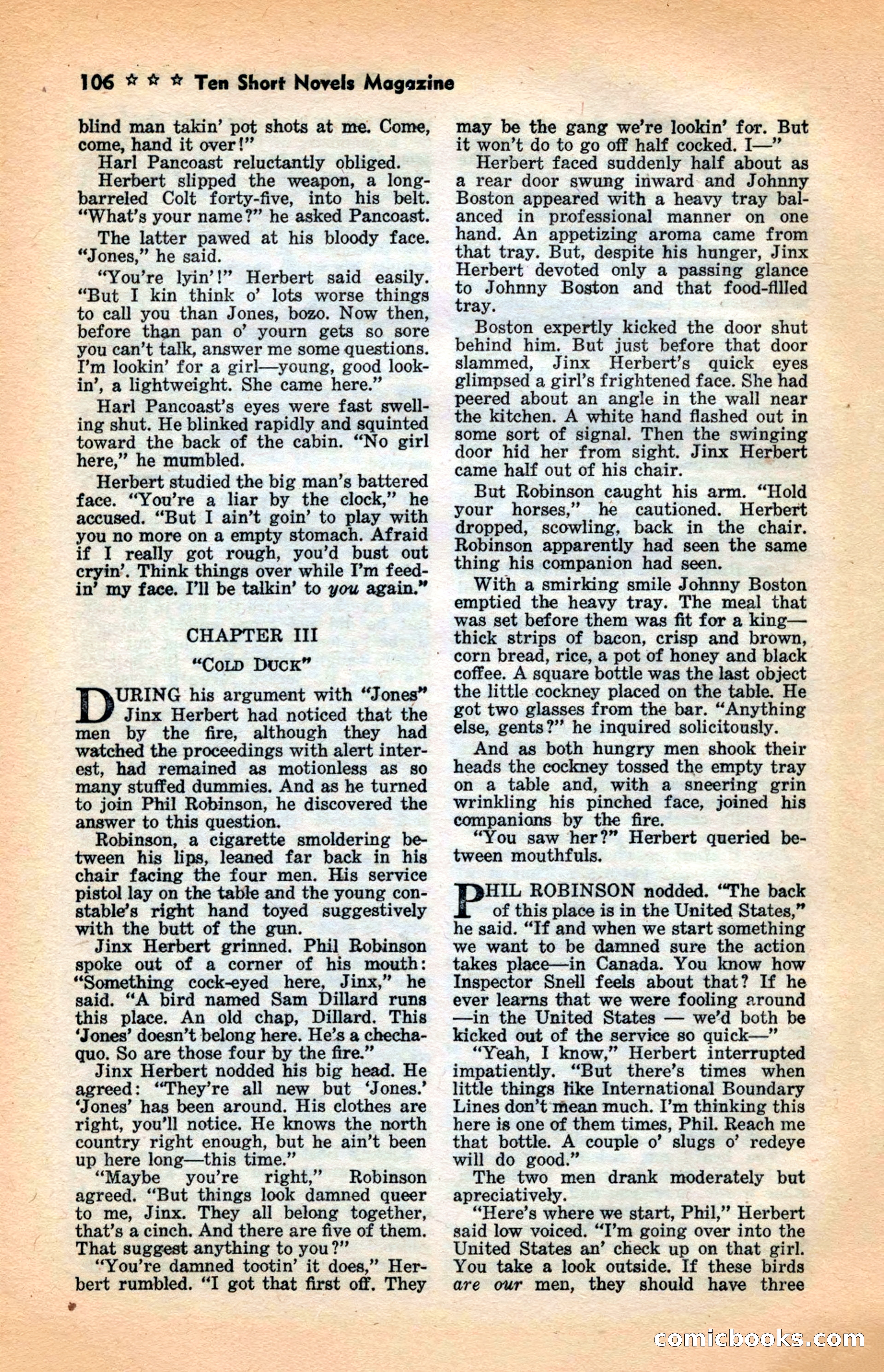
A restored page from Pulp Fiction, 1938. Page through the whole issue in the reader above.
📄 Transcribed text from this page (OCR, searchable)
Machine-transcribed from the original scan — historical spelling and the odd misread are preserved.
3 106 * ® © Ten Short Novels Magazine blind man takin’ pot shots at me. Come, come, hand it over!” Harl Pancoast reluctantly obliged. Herbert slipped the weapon, a long- barreled Colt forty-five, into his belt. “What's your name?” he asked Pancoast. The latter pawed at his bloody face. “Jones,” he said. *You’re lyin’!” Herbert said easily. “But I kin think o’ lots worse things to call you than Jones, bozo. Now then, before than pan o’ yourn gets so sore you can’t talk, answer me some questions. I’m lookin’ for a girl—young, good look- in’, a lightweight. She came here.” Harl Pancoast’s eyes were fast swell- ing shut. He blinked rapidly and squinted toward the back of the cabin. “No girl here,” he mumbled. Herbert studied the big man’s battered face. “You’re a liar by the clock,” he accused. “But I ain’t goin’ to play with you no more on a empty stomach. Afraid i 3 really got rough, you’d bust out yeh Think things over while ’m feed- my face. I’ll be talkin’ to you again.” CHAPTER III “CoLD DUCK” URING his argument with “Jones” Jinx Herbert had noticed that the men by the fire, although they had watched the proceedings with alert inter- est, had remained as motionless as so many stuffed dummies. And as he turned to join Phil Robinson, he discovered the answer to this question. Robinson, a cigarette smoldering be- tween his lips, leaned far back in his chair facing the four men. His service pistol lay on the table and the young con- stable’s right hand toyed suggestively with the butt of the gun. Jinx Herbert grinned. Phil Robinson spoke out of a corner of his mouth : cock-eyed here, Jinx,” he said. “A bird named Sam Dillard runs this place. An old chap, Dillard. This ‘Jones’ doesn’t belong here. He’s a checha- quo. So are those four by the fire.” Jinx Herbert nodded his big head. He agreed: “They’re all new but ‘Jones.’ ‘Jones’ has been around. His clothes are right, you’ll notice. He knows the north country right enough, but he ain’t been up here long—this time.” “Maybe you’re right,” Robinson agreed. “But things look damned queer to me, Jinx. They all belong together, that’s a cinch. And there are five of them. That suggest anything to you?” “You’re damned tootin’ it does,’ Her- bert rumbled. “I got that first off. They Sg may be the gang we’re lookin’ for. But it won’t do to go off half cocked. I—” Herbert faced suddenly half about as a rear door swung inward and Johnny Boston appeared with a heavy tray bal- anced in professional manner on one hand. An appetizing aroma came from that tray. But, despite his hunger, Jinx Herbert devoted only a passing glance Ms Johnny Boston and that food-filled ray. Boston expertly kicked the door shut behind him. But just before that door slammed, Jinx Herbert’s quick eyes glimpsed a girl’s frightened face. She had peered about an angle in the wall near the kitchen. A white hand flashed out in some sort of signal. Then the swinging door hid her from sight. Jinx Herbert came half out of his chair. But Robinson caught his arm. “Hold your horses,” he cautioned. Herbert dropped, scowling, back in the chair. Robinson apparently had seen the same thing his companion had seen. With a smirking smile Johnny Boston emptied the heavy tray. The meal that was set before them was fit for a king— thick strips of bacon, crisp and brown, ’ corn bread, rice, a pot of honey and black coffee. A square bottle was the last object the little cockney placed on the table. He got two glasses from the bar. “Anything else, gents?”’ he inquired solicitously. And as both hungry men shook their heads the cockney tossed the empty tray on a table and, with a sneering grin wrinkling his pinched face, joined his companions by the fire. “You saw her?” Herbert queried be- tween mouthfuls. HIL ROBINSON nodded. “The back of this place is in the United States,” he said. “If and when we start something we want to be damned sure the action takes place—in Canada. You know how Inspector Snell feels about that? If he ever learns that we were fooling around —in the United States — we’d both be kicked out of the service so quick—” “Yeah, I know,” Herbert interrupted impatiently. “But there’s times when little things tike International Boundary Lines don’t mean much. I’m thinking this here is one of them times, Phil. Reach me that bottle. A couple o’ slugs o’ redeye will do good.” The two men drank moderately but apreciatively. “Here’s where we start, Phil,” Herbert said low voiced. “I’m going over into the United States an’ check up on that girl. You take a look outside. If these birds are our men, they should have three comicbooks-com