
Pulp Fiction, 1938 · page 60 of 148
10 Short Novels Magazine — page 60: what you’re looking at
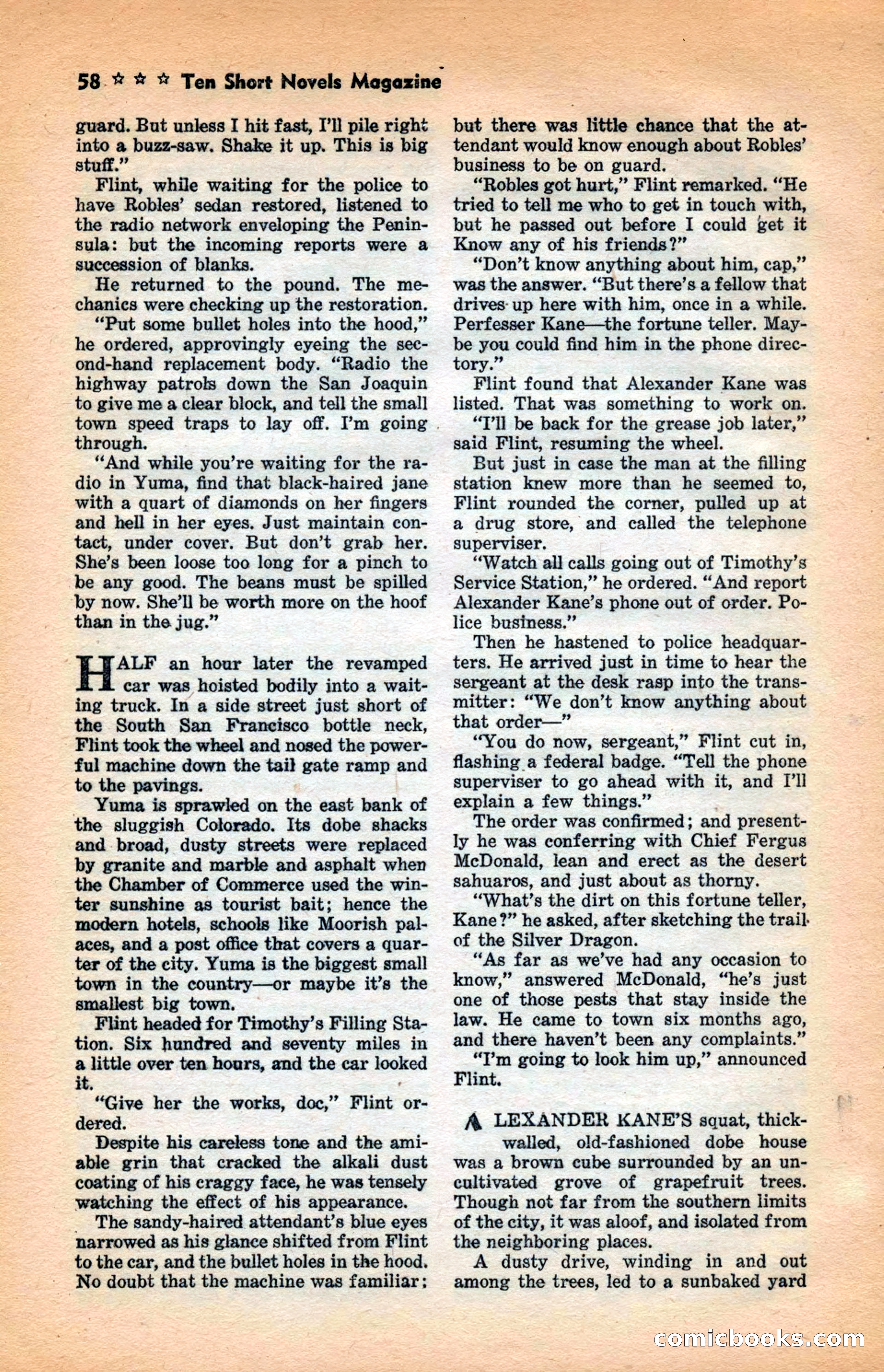
A restored page from Pulp Fiction, 1938. Page through the whole issue in the reader above.
📄 Transcribed text from this page (OCR, searchable)
Machine-transcribed from the original scan — historical spelling and the odd misread are preserved.
= 58. * * Ten Short Novels Magazine guard. But unless I hit fast, I’ll pile right into a buzz-saw. Shake it up. This is big stuff.” Flint, while waiting for the police to have Robles’ sedan restored, listened to the radio network enveloping the Penin- sula: but the incoming reports were a succession of blanks. He returned to the pound. The me- chanics were checking up the restoration. “Put some bullet holes into the hood,” he ordered, approvingly eyeing the sec- ond-hand replacement body. “Radio the highway patrols down the San Joaquin to give me a clear block, and tell the small town speed traps to lay off. ’m going . through. “And while you’re waiting for the ra- dio in Yuma, find that black-haired jane with a quart of diamonds on her fingers and hell in her eyes. Just maintain con- tact, under cover. But don’t grab her. She’s been loose too long for a pinch to be any good. The beans must be spilled by now. She’ll be worth more on the hoof than in the jug.” ALF an hour later the revamped car was hoisted bodily into a wait- ing truck. In a side street just short of the South San Francisco bottle neck, Flint took the wheel and nosed the power- ful machine down the tail gate ramp and to the pavings. Yuma is sprawled on the east bank of the sluggish Colorado. Its dobe shacks and broad, dusty streets were replaced by granite and marble and asphalt when the Chamber of Commerce used the win- ter sunshine as tourist bait; hence the modern hotels, schools like Moorish pal- aces, and a post office that covers a quar- ter of the city. Yuma is the biggest small town in the country—or maybe it’s the smallest big town. Flint headed for Timothy’s Filling Sta- tion. Six hundred and seventy miles in a little over ten hours, and the car looked it, “Give her the works, doc,” Flint or- dered. Despite his careless tone and the ami- able grin that cracked the alkali dust coating of his craggy face, he was tensely watching the effect of his appearance. _ The sandy-haired attendant’s blue eyes narrowed as his glance shifted from Flint to the car, and the bullet holes in the hood. - No doubt that the machine was familiar; but there was little chance that the at- tendant would know enough about Robles’ business to be on guard. “Robles got hurt,” Flint remarked. “He tried to tell me who to get in touch with, but he passed out before I could get it Know any of his friends?” “Don’t know anything about him, cap,” was the answer. “But there’s a fellow that drives: up here with him, once in a while. Perfesser Kane—the fortune teller. May- be you could find him in the phone direc- tory.” Flint found that Alexander Kane was listed. That was something to work on. “T’ll be back for the grease job later,” said Flint, resuming the wheel. But just in case the man at the filling station knew more than he seemed to, Flint rounded the corner, pulled up at a drug store, and called the telephone superviser. “Watch all calls going out of Timothy’s Service Station,” he ordered. “And report Alexander Kane’s phone out of order. Po- lice business.” Then he hastened to police headquar- ters. He arrived just in time to hear the sergeant at the desk rasp into the trans- mitter: “We don’t know anything about that order—” “You do now, sergeant,” Flint cut in, flashing a federal badge. “Tell the phone superviser to go ahead with it, and [ll explain a few things.” The order was confirmed; and present- ly he was conferring with Chief Fergus McDonald, lean and erect as the desert sahuaros, and just about as thorny. ‘“‘What’s the dirt on this fortune teller, Kane?” he asked, after sketching the trail: of the Silver Dragon. “As far as we’ve had any occasion to know,” answered McDonald, “he’s just one of those pests that stay inside the law. He came to town six months ago, and there haven’t been any complaints.” “l’m going to look him up,” announced Flint. A LEXANDER KANE’S squat, thick- walled, old-fashioned dobe house was a brown cube surrounded by an un- cultivated grove of grapefruit trees. Though not far from the southern limits of the city, it was aloof, and isolated from the neighboring places. A dusty drive, winding in and out among the trees, led to a sunbaked yard EOPMIE OC KS $ se? rn) be Ge r Ai pias diey rae ae y : ih ty VRP mr Wit SEPOS) i >) ; Nook 0 . ‘ -8 ¥ al com