
Pulp Fiction, 1938 · page 50 of 148
10 Short Novels Magazine — page 50: what you’re looking at
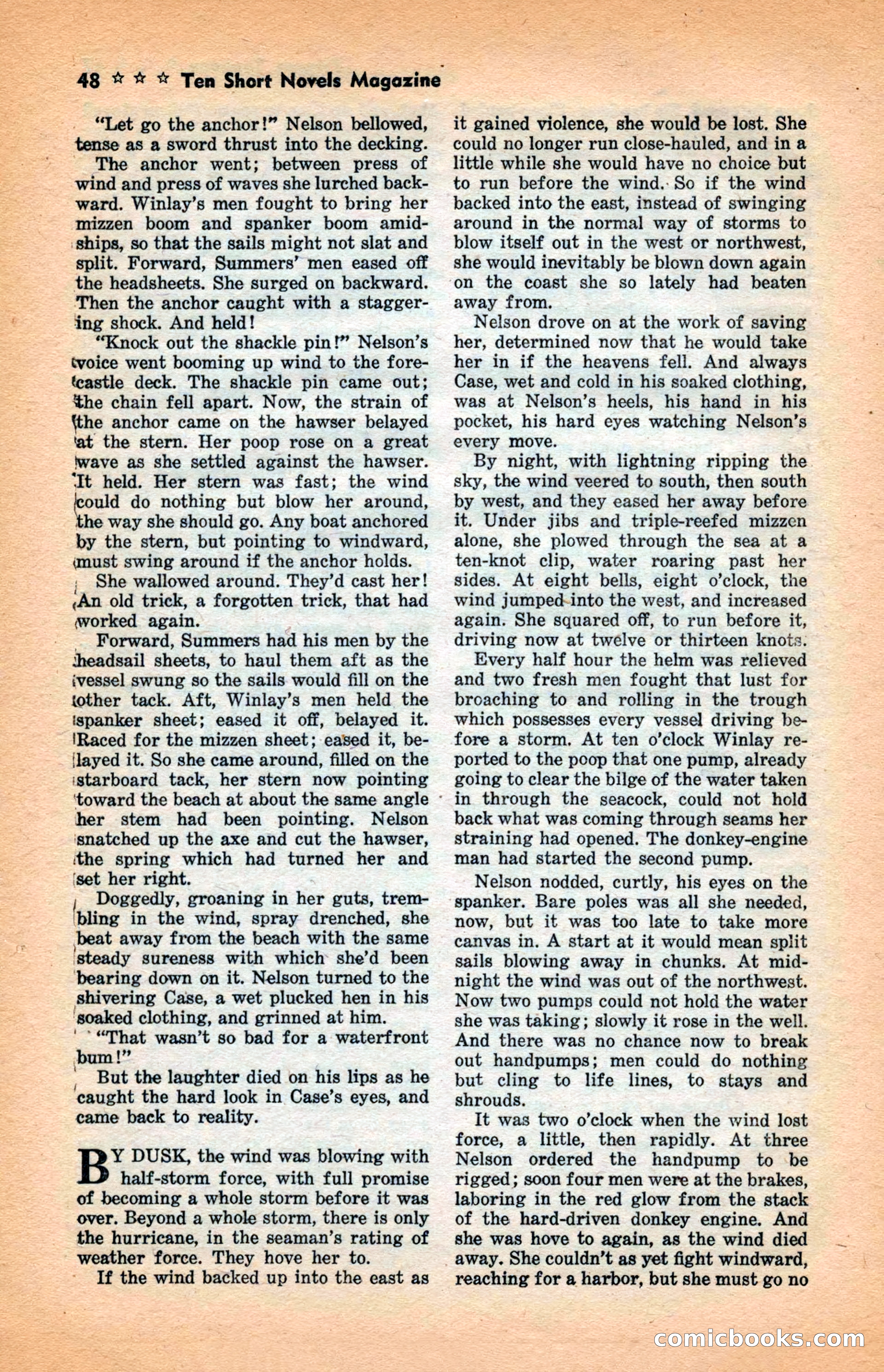
A restored page from Pulp Fiction, 1938. Page through the whole issue in the reader above.
📄 Transcribed text from this page (OCR, searchable)
Machine-transcribed from the original scan — historical spelling and the odd misread are preserved.
“Let go the anchor!” Nelson bellowed, tense as a sword thrust into the decking. - The anchor went; between press of wind and press of waves she lurched back- ward. Winlay’s men fought to bring her mizzen boom and spanker boom amid- ‘ships, so that the sails might not slat and split. Forward, Summers’ men eased off the headsheets. She surged on backward. Then the anchor caught with a stagger- ing shock. And held! “Knock out the shackle pin!’”’ Nelson’s tvoice went booming up wind to the fore- teastle deck. The shackle pin came out; the chain fell apart. Now, the strain of {the anchor came on the hawser belayed ‘at the stern. Her poop rose on a great wave as she settled against the hawser. ‘It held. Her stern was fast; the wind uld do nothing but blow her around, he way she should go. Any boat anchored by the stern, but pointing to windward, (must swing around if the anchor holds. ; She wallowed around. They’d cast her! An old trick, a forgotten trick, that had (worked again. - Forward, Summers had his men by the _ theadsail sheets, to haul them aft as the ivessel swung so the sails would fill on the tother tack. Aft, Winlay’s men held the ispanker sheet; eased it off, belayed it. 'Raced for the mizzen sheet; eased it, be- ‘layed it. So she came around, filled on the istarboard tack, her stern now pointing ‘toward the beach at about the same angle - her stem had been pointing. Nelson ‘snatched up the axe and cut the hawser, ithe spring which had turned her and ‘set her right. Doggedly, groaning in her guts, trem- bling in the wind, spray drenched, she beat away from the beach with the same ‘steady sureness with which she’d been bearing down on it. Nelson turned to the shivering Case, a wet plucked hen in his ‘soaked clothing, and grinned at him. '* “That wasn’t so bad for a waterfront bum!” But the laughter died on his lips as he ‘caught the hard look in Case’s eyes, and came back to reality. Y DUSK, the wind was blowing with half-storm force, with full promise _of becoming a whole storm before it was over. Beyond a whole storm, there is only _ the hurricane, in the seaman’s rating of ~ weather force. They hove her to. If the wind backed up into the east as = «48 wt t Ten Short Novels Magazine it gained violence, she would be lost. She could no longer run close-hauled, and in a little while she would have no choice but to run before the wind.:So if the wind backed into the east, instead of swinging around in the normal way of storms to blow itself out in the west or northwest, she would inevitably be blown down again on the coast she so lately had beaten away from. Nelson drove on at the work of saving her, determined now that he would take her in if the heavens fell. And always Case, wet and cold in his soaked clothing, was at Nelson’s heels, his hand in his pocket, his hard eyes watching Nelson’s every move. By night, with lightning ripping the sky, the wind veered to south, then south by west, and they eased her away before it. Under jibs and triple-reefed mizzen alone, she plowed through the sea at a ten-knot clip, water roaring past her sides. At eight bells, eight o’clock, the wind jumped-into the west, and increased again. She squared off, to run before it, driving now at twelve or thirteen knots. Every half hour the helm was relieved and two fresh men fought that lust for broaching to and rolling in the trough which possesses every vessel driving be- fore a storm, At ten o’clock Winlay re- ported to the poop that one pump, already going to clear the bilge of the water taken in through the seacock, could not hold back what was coming through seams her straining had opened. The donkey-engine man had started the second pump. Nelson nodded, curtly, his eyes on the spanker. Bare poles was all she needed, now, but it was too late to take more canvas in. A start at it would mean split sails blowing away in chunks. At mid- night the wind was out of the northwest. Now two pumps could not hold the water she was taking; slowly it rose in the well. And there was no chance now to break out handpumps; men could do nothing but cling to life lines, to stays and shrouds. It was two o’clock when the wind lost force, a little, then rapidly. At three Nelson ordered the handpump to be rigged; soon four men were at the brakes, laboring in the red glow from the stack of the hard-driven donkey engine. And she was hove to again, as the wind died _ away. She couldn’t as yet fight windward, reaching for a harbor, but she must go no Eomicbooks.c