
Pulp Fiction, 1938 · page 119 of 148
10 Short Novels Magazine — page 119: what you’re looking at
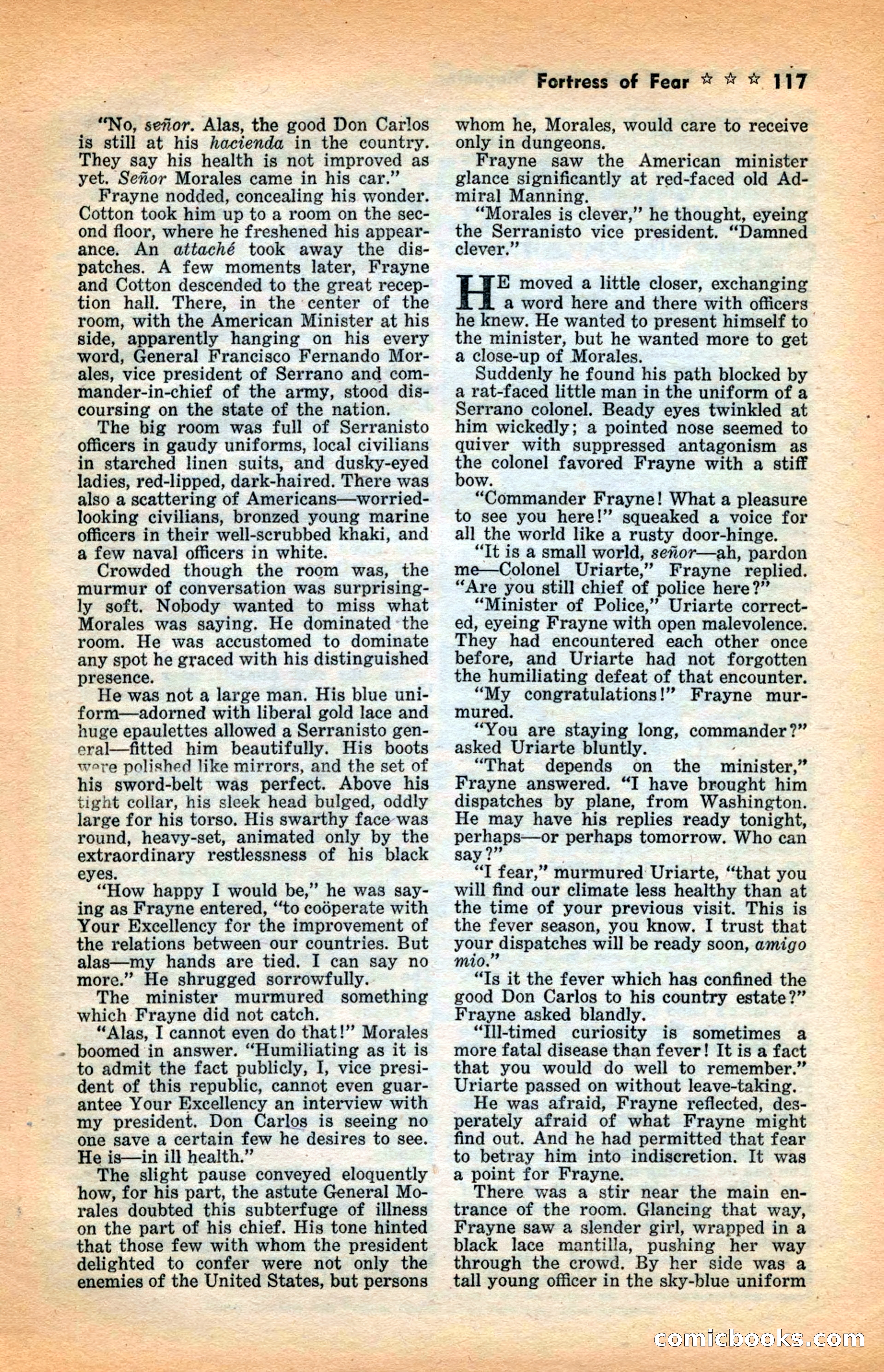
A restored page from Pulp Fiction, 1938. Page through the whole issue in the reader above.
📄 Transcribed text from this page (OCR, searchable)
Machine-transcribed from the original scan — historical spelling and the odd misread are preserved.
“No, sevior. Alas, the good Don Carlos is still at his hacienda in the country. They say his health is not improved as yet. Seftor Morales came in his car.” Frayne nodded, concealing his wonder. Cotton took him up to a room on the sec- ond floor, where he freshened his appear- ance. An attaché took away the dis- patches. A few moments later, Frayne and Cotton descended to the great recep- tion hall. There, in the center of the room, with the American Minister at his side, apparently hanging on his every word, General Francisco Fernando Mor- ales, vice president of Serrano and com- mander-in-chief of the army, stood dis- coursing on the state of the nation. The big room was full of Serranisto officers in gaudy uniforms, local civilians in starched linen suits, and dusky-eyed ladies, red-lipped, dark-haired. There was also a seattering of Americans—worried- looking civilians, bronzed young marine officers in their well-scrubbed khaki, and a few naval officers in white. Crowded though the room was, the murmur of conversation was surprising- ly soft. Nobody wanted to miss what Morales was saying. He dominated ‘the room. He was accustomed to dominate any spot he graced with his distinguished presence. He was not a large man. His blue uni- - form—adorned with liberal gold lace and huge epaulettes allowed a Serranisto gen- eral—fitted him beautifully. His boots were polished like mirrors, and the set of his sword-belt was perfect. Above his tight collar, his sleek head bulged, oddly large for his torso. His swarthy face was round, heavy-set, animated only by the extraordinary restlessness of his black eyes. “How happy I would be,” he was say- ing as Frayne entered, “‘to codperate with Your Excellency for the improvement of the relations between our countries. But alas—my hands are tied. I can say no more.” He shrugged sorrowfully. The minister murmured something which Frayne did not catch. “Alas, I cannot even do that!’ Morales boomed in answer. “Humiliating as it is to admit the fact publicly, I, vice presi- dent of this republic, cannot even guar- antee Your Excellency an interview with my president. Don Carlos is seeing no one save a certain few he desires to see. He is—in ill health.” : The slight pause conveyed eloquently how, for his part, the astute General Mo- rales doubted this subterfuge of illness on the part of his chief. His tone hinted that those few with whom the president delighted to confer were not only the enemies of the United States, but persons ee Se an Se OSes ae On Sat! a eo ee x - ~, -_" ~ ~< om Rete ae Sn ae ee oe ee” whom he, Morales, would care to receive only in dungeons. : Frayne saw the American minister glance significantly at red-faced old Ad- miral Manning. “Morales is clever,” he thought, eyeing the Serranisto vice president. “Damned clever.” E moved a little closer, exchanging a word here and there with officers he knew. He wanted to present himself to the minister, but he wanted more to get a close-up of Morales. Suddenly he found his path blocked by a rat-faced little man in the uniform of a Serrano colonel. Beady eyes twinkled at him wickedly; a pointed nose seemed to quiver with suppressed antagonism as 0 colonel favored Frayne with a stiff ow. “Commander Frayne! What a pleasure to see you here!”’ squeaked a voice for all the world like a rusty door-hinge. “It is a small world, sevior—ah, pardon me—Colonel Uriarte,” Frayne replied. “Are you still chief of police here?” “Minister of Police,’ Uriarte correct- ed, eyeing Frayne with open malevolence. They had encountered each other once before, and Uriarte had not forgotten the humiliating defeat of that encounter. “My congratulations!” Frayne mur- mured. “You are staying long, commander?” asked Uriarte bluntly. ; “That depends on the minister,” Frayne answered. “I have brought him dispatches by plane, from Washington. He may have his replies ready tonight, perhaps—or perhaps tomorrow. Who can say ?” “T fear,” murmured Uriarte, “that you will find our climate less healthy than at the time of your previous visit. This is the fever season, you know. I trust that your dispatches will be ready soon, amigo mio.” “Is it the fever which has confined the good Don Carlos to his country estate?” Frayne asked blandly. “Tll-timed curiosity is sometimes a more fatal disease than fever! It is a fact that you would do well to remember.” Uriarte passed on without leave-taking. He was afraid, Frayne reflected, des- perately afraid of what Frayne might find out. And he had permitted that fear to betray him into indiseretion. It was a point for Frayne. There was a stir near the main en- trance of the room. Glancing that way, Frayne saw a slender girl, wrapped in a black lace mantilla, pushing her way through the crowd. By her side was a tall young officer in the sky-blue uniform 4 a ge Oe a ‘ ee o_o