
Pulp Fiction, 1938 · page 124 of 148
10 Short Novels Magazine — page 124: what you’re looking at
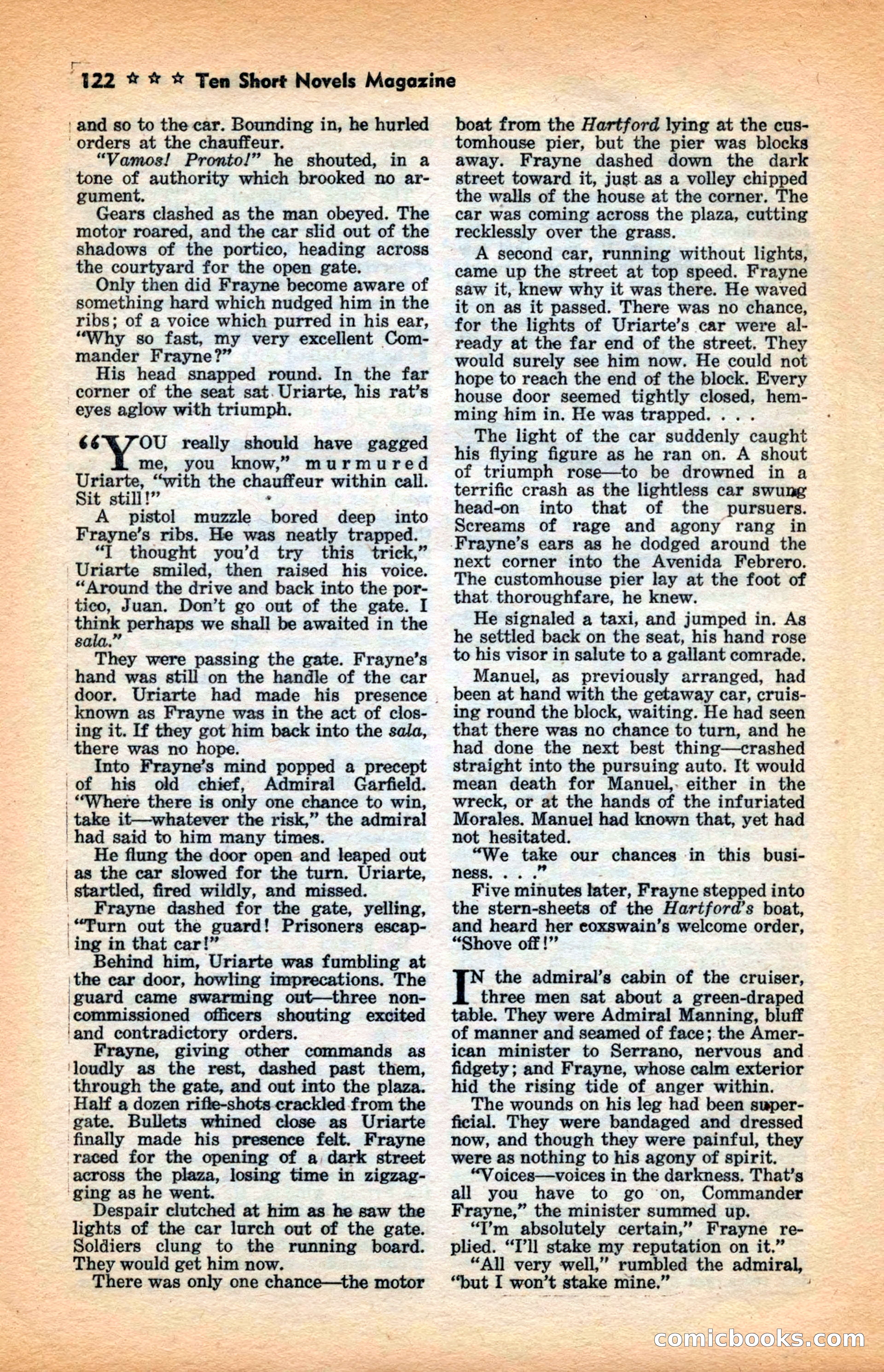
A restored page from Pulp Fiction, 1938. Page through the whole issue in the reader above.
📄 Transcribed text from this page (OCR, searchable)
Machine-transcribed from the original scan — historical spelling and the odd misread are preserved.
‘and so to the car. Bounding in, he hurled orders at the chauffeur. “Vamos! Pronto!” he shouted, in a tone of authority which brooked no ar- gument. Gears clashed as the man obeyed. The motor roared, and the car slid out of the shadows of the portico, heading across the courtyard for the open gate. Only then did Frayne become aware of something hard which nudged him in the ribs; of a voice which purred in his ear, “Why so fast, my very excellent Com- mander Frayne?” His head snapped round. In the far corner of the seat sat. Uriarte, his rat’s eyes aglow with triumph. 66 OU really should have gagged me, you know,” murmured Uriarte, “with the chauffeur within call. Sit still!” A pistol muzzle Sed deep into Frayne’s ribs. He was neatly trapped. “IT thought you’d try this trick,” ‘Uriarte smiled, then raised his voice. “Around the drive and back into the por- tico, Juan. Don’t go out of the gate. I — perhaps we shall be awaited in the sala.” They were passing the gate. Frayne’s hand was still on the handle of the car door. Uriarte had made his presence | known as Frayne was in the act of clos- ing it. If they got him back into the sala, there was no hope. _ Into Frayne’s mind popped a precept ‘of his old chief, Admiral Garfield. . “Where there is only one chance to win, | take it—whatever the risk,” the admiral ‘had said to him many times. _ He flung the door open and leaped out as the car slowed for the turn. Uriarte, ' startled, fired wildly, and missed. Frayne dashed for the gate, yelling, “urn out the guard! Prisoners escap- ing in that car!” Behind him, Uriarte was fumbling at ithe car door, howling imprecations. The ‘guard came swarming out—three non- ‘commissioned officers shouting excited ‘and contradictory orders. Frayne, giving other commands as ‘loudly as the rest, dashed past them, through the gate, and out into the plaza. Half a dozen rifle-shots crackled from the gate. Bullets whined close as Uriarte ‘finally made his presence felt. Frayne raced for the opening of a dark street across the plaza, losing time in zigzag- ‘ging as he went. Despair clutched at him as he saw the lights of the car lurch out of the gate. Soldiers clung to the running board. They would get him now. There was only one chance—the motor ee "422 * & * Ten Short Novels 5 isaaicins boat from the Hartford lying at the cus- omhouse pier, but the pier was blocks away. Frayne dashed down the dark street toward it, just.as a volley chipped the walls of the house at the corner. The car was coming across the plaza, cutting recklessly over the grass. A second car, running without lights, came up the street at top speed. Frayne saw it, knew why it was there. He waved it on as it passed. There was no chance, for the lights of Uriarte’s car were al- ready at the far end of the street. They would surely see him now. He could not hope to reach the end of the block. Every house door seemed tightly closed, hem- ming him in. He was trapped... . The light of the car suddenly caught his flying figure as he ran on. A shout of triumph rose—to be drowned in a terrific crash as the lightless car swung head-on into that of the pursuers. Screams of rage and agony rang in -Frayne’s ears as he dodged around the next corner into the Avenida Febrero. The customhouse pier lay at the foot of that. thoroughfare, he knew. He signaled a taxi, and jumped in. As he settled back on the seat, his hand rose to his visor in salute to a gallant comrade, Manuel, as previously arranged, had been at hand with the getaway car, cruis- ing round the block, waiting. He had seen that there was no chance to turn, and he had done the next best thing—crashed straight into the pursuing auto. It would mean death for Manuel,. either in the wreck, or at the hands of the infuriated Morales. Manuel had known that, yet had not hesitated. “We take our chances in this busi- ness, .. .” Five minutes later, Frayne stepped into the stern-sheets of the Hartford’s boat, and heard her eoxswain’s welcome order, “Shove off!” the admiral’s cabin of the cruiser, three men sat about a green-draped table. They were Admiral Manning, bluff of manner and seamed of face; the Amer- ican minister to Serrano, nervous and. fidgety; and Frayne, whose calm exterior hid the rising tide of anger within. The wounds on his leg had been super- ficial. They were bandaged and dressed now, and though they were painful, they were as nothing to his agony of spirit. “V oices—voices in the darkness. That’s all you have to go on, Commander Frayne,” the minister summed up. “l’m absolutely certain,” Frayne re- plied. “I’ll stake my reputation on it.” “All very well,” rumbled the admiral, “but I won't stake mine,’ “