
Pulp Fiction, 1938 · page 120 of 148
10 Short Novels Magazine — page 120: what you’re looking at
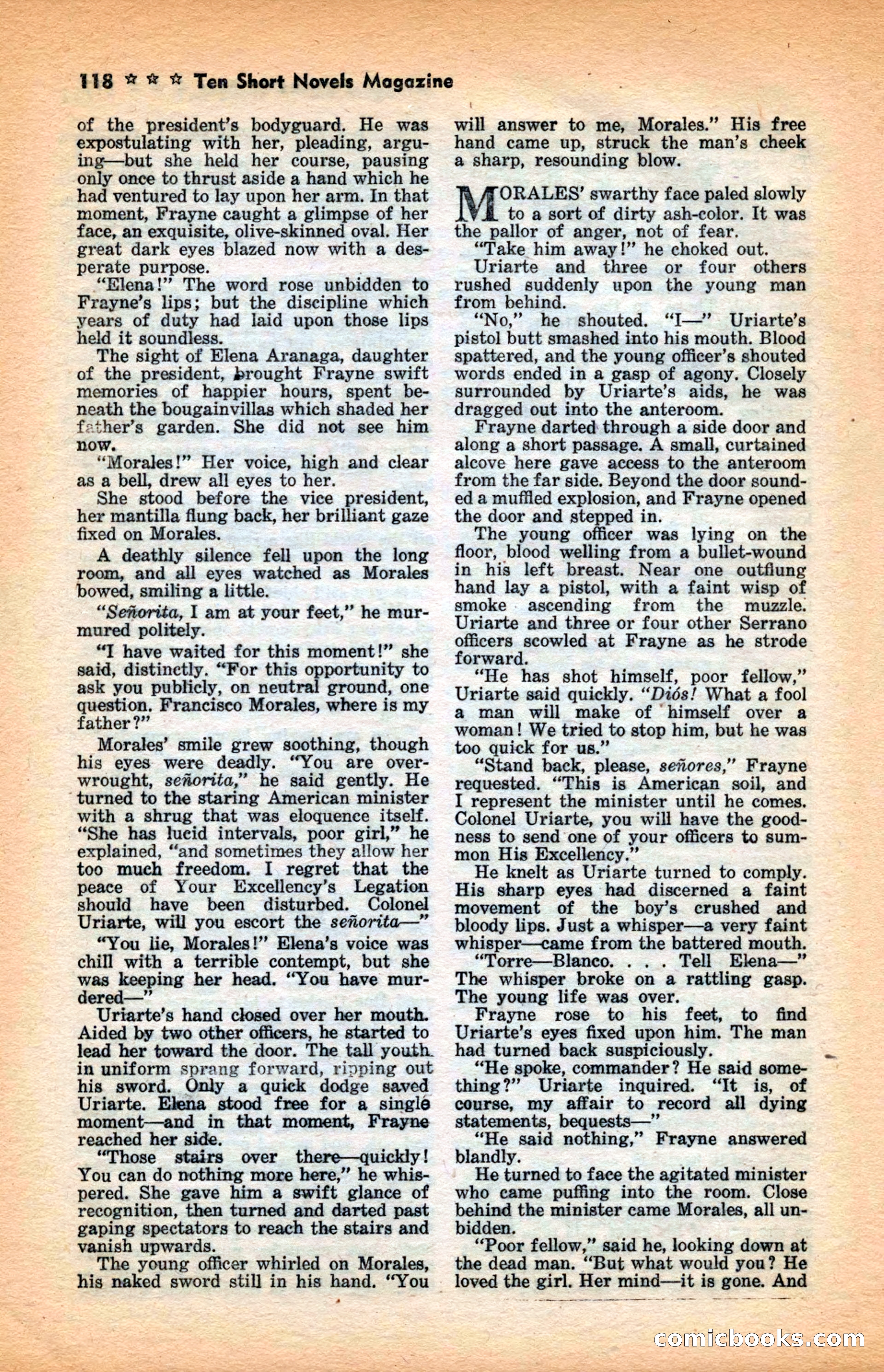
A restored page from Pulp Fiction, 1938. Page through the whole issue in the reader above.
📄 Transcribed text from this page (OCR, searchable)
Machine-transcribed from the original scan — historical spelling and the odd misread are preserved.
See Hg * # © % Ten Short Novels aasihes of the president’s bodyguard. He was expostulating with her, pleading, argu- ing—but she held her course, pausing only once to thrust aside a hand which he had ventured to lay upon her arm. In that moment, Frayne caught a glimpse of her face, an exquisite, olive-skinned oval. Her great dark eyes blazed now with a des- perate purpose. “Elena!” The word rose unbidden to Frayne’s lips; but the discipline which vears of duty had laid upon those lips held it soundless. The sight of Elena Aranaga, daughter of the president, brought Frayne swift memories of happier hours, spent be- neath the bougainvillas which shaded her father’s garden. She did not see him now. “Morales!” Her voice, high and clear as a bell, drew all eyes to her. She stood before the vice president, her mantilla flung back, her brilliant gaze fixed on Morales. A deathly silence fell upon the long room, and all eyes watched as Morales bowed, smiling a little. “Seftorita, I am at your feet,” he mur- mured politely. “T have waited for this moment!” she said, distinctly. “For this opportunity to ask you publicly, on neutral ground, one question. Francisco Morales, where is my father?” Morales’ smile grew soothing, though his eyes were deadly. “You are over- wrought, sevorita,” he said gently. He ‘turned to the staring American minister with a shrug that was eloquence itself. “She has lucid intervals, poor girl,” he explained, “and sometimes they allow her too much freedom. I regret that the peace of Your Excellency’s Legation should have been disturbed. Colonel Uriarte, will you escort the sevorita—” “You lie, Morales!’”’ Elena’s voice was chill with a terrible contempt, but she ine, Sepa her head. “You have mur- er a Uriarte’s hand closed over her mouth. Aided by two other officers, he started to lead her toward the door. The tall youth. in uniform sprang forward, ripping out his sword. Only a quick dodge saved Uriarte. Elena stood free for a single moment—and in that moment, Frayne reached her side. “Those stairs over there—quickly! You can do nothing more here,’’ he whis- pered. She gave him a swift glance of recognition, then turned and darted past gaping spectators to reach the stairs and vanish upwards. The young officer whirled on Morales, his naked sword still in his hand. “You — t will answer to me, Morales.” His free hand came up, struck the man’s cheek a sharp, resounding blow. ORALES’ swarthy face paled slowly to a sort of dirty ash-color. It was the pallor of anger, not of fear. “Take him away!” he choked out. Uriarte and three or four others rushed suddenly upon the young man from behind. “No,” he shouted. “I—”’ Uriarte’s pistol butt smashed into his mouth. Blood spattered, and the young officer’s shouted words ended in a gasp of agony. Closely surrounded by Uriarte’s aids, he was dragged out into the anteroom. Frayne darted through a side door and along a short passage. A small, curtained alcove here gave aceess to the anteroom from the far side. Beyond the door sound- ed a muffled explosion, and Frayne opened the door and stepped in. The young officer was lying on the floor, blood welling from a bullet-wound in his left breast. Near one outflung hand lay a pistol, with a faint wisp of smoke. ascending from the muzzle. Uriarte and three or four other Serrano officers scowled at Frayne as he strode forward. “He has shot himself, poor fellow,” Uriarte said quickly. “Dids! What a fool a man will make of himself over a woman! We tried to stop him, but he was too quick for us.” “Stand back, please, sefiores,” Frayne requested. “This is American soil, and I represent the minister until he comes. Colonel Uriarte, you will have the good- ness to send one of your officers to sum- mon His Excellency.” He knelt as Uriarte turned to comply. His sharp eyes had discerned a faint movement of the boy’s crushed and bloody lips. Just a whisper—a very faint whisper—came from the battered mouth. “Torre—Blanco. . .. Tell Elena—” The whisper broke on a rattling gasp. The young life was over. Frayne rose to his feet, to find Uriarte’s eyes fixed upon him. The man had turned back suspiciously. “He spoke, commander? He said some- thing?” Uriarte inquired. “It is, of course, my affair to record all dying statements, bequests—” “He said nothing,” Frayne answered blandly. He turned to face the agitated minister who came puffing into the room. Close behind the minister came Morales, all un- bidden. “Poor fellow,” said he, looking down at the dead man. “But what would you? He loved the girl. Her mind—it i is } gone. And ee ee —_——