
Pulp Fiction, 1938 · page 52 of 148
10 Short Novels Magazine — page 52: what you’re looking at
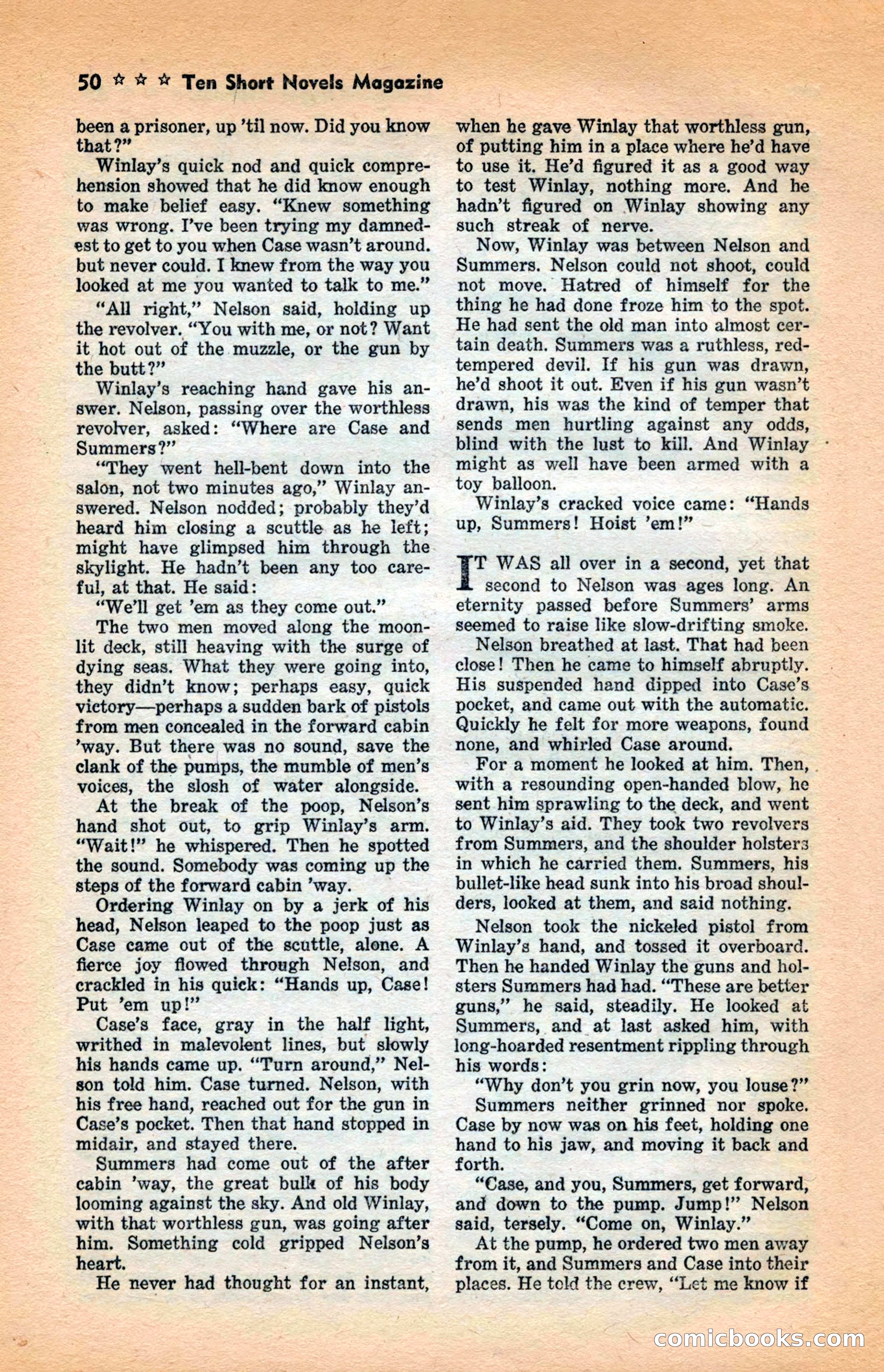
A restored page from Pulp Fiction, 1938. Page through the whole issue in the reader above.
📄 Transcribed text from this page (OCR, searchable)
Machine-transcribed from the original scan — historical spelling and the odd misread are preserved.
50 * * * Ten Short Novels Magazine been a prisoner, up ’til now. Did you know that?” Winlay’s quick nod and quick compre- hension showed that he did know enough to make belief easy. “Knew something was wrong. I’ve been trying my damned- est to get to you when Case wasn’t around. but never could. I knew from the way you looked at me you wanted to talk to me.” “All right,” Nelson said, holding up the revolver. “You with me, or not? Want it hot out of the muzzle, or the gun by the butt?” Winlay’s reaching hand gave his an- swer. Nelson, passing over the worthless revolver, asked: “Where are Case and Summers?” “They went hell-bent down into the salon, not two minutes ago,” Winlay an- swered. Nelson nodded; probably they’d heard him closing a scuttle as he left; might have glimpsed him through the skylight. He hadn’t been any too care- ful, at that. He said: “We'll get ’em as they come out.” The two men moved along the moon- lit deck, still heaving with the surge of dying seas. What they were going into, they didn’t know; perhaps easy, quick vietory—perhaps a sudden bark of pistols from men concealed in the forward cabin ’way. But there was no sound, save the clank of the pumps, the mumble of men’s voices, the slosh of water alongside. At the break of the poop, Nelson’s hand shot out, to grip Winlay’s arm. “Wait!” he whispered. Then he spotted the sound. Somebody was coming up the steps of the forward cabin ’way. Ordering Winlay on by a jerk of his head, Nelson leaped to the poop just as Case came out of the scuttle, alone. A fierce joy flowed through Nelson, and crackled in his quick: “Hands up, Case! Put ’em up!” Case’s face, gray in the half light, writhed in malevolent lines, but slowly his hands came up. “Turn around,” Nel- son told him. Case turned. Nelson, with his free hand, reached out for the gun in Case’s pocket. Then that hand stopped in midair, and stayed there. Summers had come out of the after cabin ’way, the great bull of his body looming against the sky. And old Winlay, with that worthless gun, was going after him. Something cold gripped Nelson’s heart. He never had thought for an instant, =o ey © try St. Pe oe » Sonn ne - when he gave Winlay that worthless gun, of putting him in a place where he’d have to use it. He’d figured it as a good way to test Winlay, nothing more. And he hadn’t figured on Winlay showing any such streak of nerve. Now, Winlay was between Nelson and Summers. Nelson could not shoot, could not move. Hatred of himself for the thing he had done froze him to the spot. He had sent the old man into almost cer- tain death. Summers was a ruthless, red- tempered devil. If his gun was drawn, he’d shoot it out. Even if his gun wasn’t drawn, his was the kind of temper that sends men hurtling against any odds, blind with the lust to kill. And Winlay - might as well have been armed with a toy balloon. Winlay’s cracked voice came: “Hands up, Summers! Hoist ’em!” T WAS all over in a second, yet that second to Nelson was ages long. An eternity passed before Summers’ arms seemed to raise like slow-drifting smoke. Nelson breathed at last. That had been close! Then he came to himself abruptly. His suspended hand dipped into Case’s poeket, and came out with the automatic. Quickly he felt for more weapons, found none, and whirled Case around. For a moment he looked at him. Then, . with a resounding open-handed blow, he sent him sprawling to the deck, and went to Winlay’s aid. They took two revolvers from Summers, and the shoulder holsters in which he carried them. Summers, his bullet-like head sunk into his broad shoul- ders, looked at them, and said nothing. Nelson took the nickeled pistol from Winlay’s hand, and tossed it overboard. Then he handed Winlay the guns and hol- sters Summers had had. “These are better guns,” he said, steadily. He looked at Summers, and at last asked him, with long-hoarded resentment rippling through his words: “Why don’t you grin now, you louse?” Summers neither grinned nor spoke. Case by now was on his feet, holding one hand to his jaw, and moving it back and forth. “Case, and you, Summers, get forward, and down to the pump. Jump!” Nelson said, tersely. “Come on, Winlay.” At the pump, he ordered two men away from it, and Summers and Case into their places. He teld the crew, “Let me know if cComicbooks-co