
Pulp Fiction, 1938 · page 130 of 148
10 Short Novels Magazine — page 130: what you’re looking at
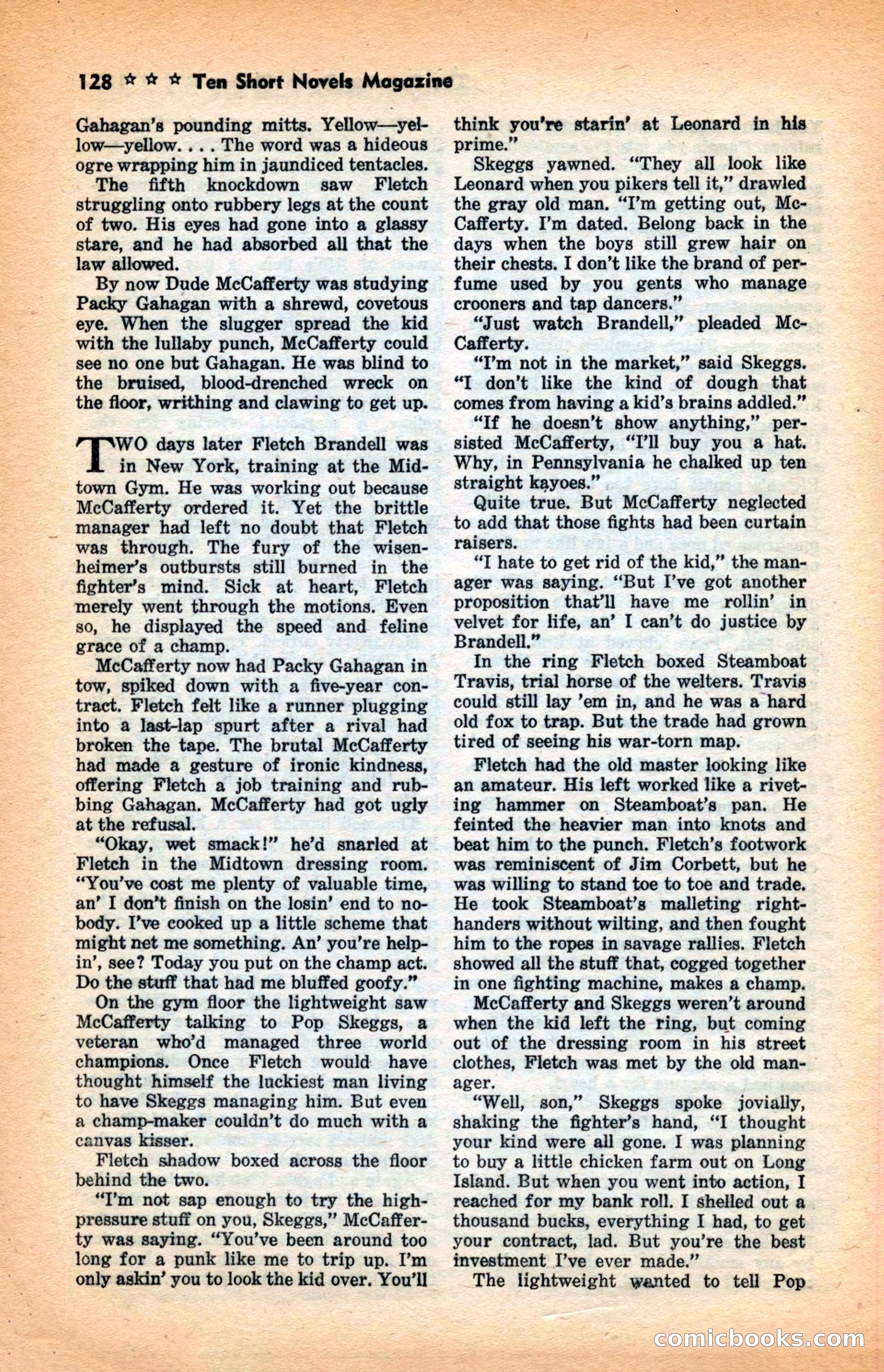
A restored page from Pulp Fiction, 1938. Page through the whole issue in the reader above.
📄 Transcribed text from this page (OCR, searchable)
Machine-transcribed from the original scan — historical spelling and the odd misread are preserved.
--128 * * *& Ten Short Novels Magazine Gahagan’s pounding mitts. Yellow—yel- low—yellow. ... The word was a hideous ogre wrapping him in jaundiced tentacles. The fifth knockdown saw _ Fletch struggling onto rubbery legs at the count of two. His eyes had gone into a glassy stare, and he had absorbed all that the law allowed. By now Dude McCafferty was studying Packy Gahagan with a shrewd, covetous eye. When the slugger spread the kid with the lullaby punch, McCafferty could see no one but Gahagan. He was blind to the bruised, blood-drenched wreck on the floor, writhing and clawing to get up. WO days later Fletch Brandell was in New York, training at the Mid- town Gym. He was working out because McCafferty ordered it. Yet the brittle manager had left no doubt that Fletch was through. The fury of the wisen- heimer’s outbursts still burned in the fighter’s mind. Sick at heart, Fletch merely went through the motions. Even so, he displayed the speed and feline grace of a champ. McCafferty now had Packy Gahagan in tow, spiked down with a five-year con- tract. Fletch felt like a runner plugging into a last-lap spurt after a rival had broken the tape. The brutal McCafferty had made a gesture of ironic kindness, offering Fletch a job training and rub- bing Gahagan. McCafferty had got ugly at the refusal. “Okay, wet smack!” he’d snarled at Fletch in the Midtown dressing room. “You’ve cost me plenty of valuable time, an’ I don’t finish on the losin’ end to no- body. I’ve cooked up a little scheme that might net me something. An’ you’re help- in’, see? Today you put on the champ act. Do the stuff that had me bluffed goofy.” On the gym floor the lightweight saw McCafferty talking to Pop Skeggs, a veteran who'd managed three world champions. Once Fletch would have thought himself the luckiest man living to have Skeges managing him. But even a champ-maker couldn’t do much with a canvas kisser. Fletch shadow boxed across the floor behind the two. “I’m not sap enough to try the high- pressure stuff on you, Skeggs,’”’ McCaffer- ty was saying. “You’ve been around too long for a punk like me to trip up. I’m only askin’ you to look the kid over. You'll think you’re starin’ at Leonard in his | prime.” Skeggs yawned. “They all look like Leonard when you pikers tell it,’’ drawled the gray old man. “I’m getting out, Mc- Cafferty. I’m dated. Belong back in the days when the boys still grew hair on their chests. I don’t like the brand of per- fume used by you gents who manage crooners and tap dancers.” “Just watch Brandell,” pleaded Mc- Cafferty. “I’m not in the market,” said Skeggs. “IT don’t like the kind of dough that comes from having a kid’s brains addled.” “If he doesn’t show anything,” per- sisted McCafferty, “I'll buy you a hat. Why, in Pennsylvania he chalked up ten straight kayoes.” Quite true. But McCafferty neglected to add that those fights had been curtain raisers. “T hate to get rid of the kid,” the man- ager was saying. “But I’ve got another proposition that'll have me rollin’ in velvet for life, an’ I can’t do justice by Brandell.” In the ring Fletch boxed Steamboat Travis, trial horse of the welters. Travis could still lay ’em in, and he was a hard old fox to trap. But the trade had grown tired of seeing his war-torn map. Fletch had the old master looking like an amateur. His left worked like a rivet- ing hammer on Steamboat’s pan. He feinted the heavier man into knots and beat him to the punch. Fletch’s footwork was reminiscent of Jim Corbett, but he was willing to stand toe to toe and trade. He took Steamboat’s malleting right- handers without wilting, and then fought him to the ropes in savage rallies. Fletch showed all the stuff that, cogged together in one fighting machine, makes a champ. McCafferty and Skeggs weren’t around when the kid left the ring, but coming out of the dressing room in his street clothes, Fletch was met by the old man-— ager. “Well, son,” Skeggs spoke jovially, shaking the fighter’s hand, “I thought your kind were all gone. I was planning to buy a little chicken farm out on Long Island. But when you went into action, I reached for my bank roll. I shelled out a thousand bucks, everything I had, to get your contract, lad. But you’re the best investment I’ve ever made.” The lightweight wanted to tell Pop. COMME OO Sat ac Ona OS ~— <