
Pulp Fiction, 1938 · page 97 of 148
10 Short Novels Magazine — page 97: what you’re looking at
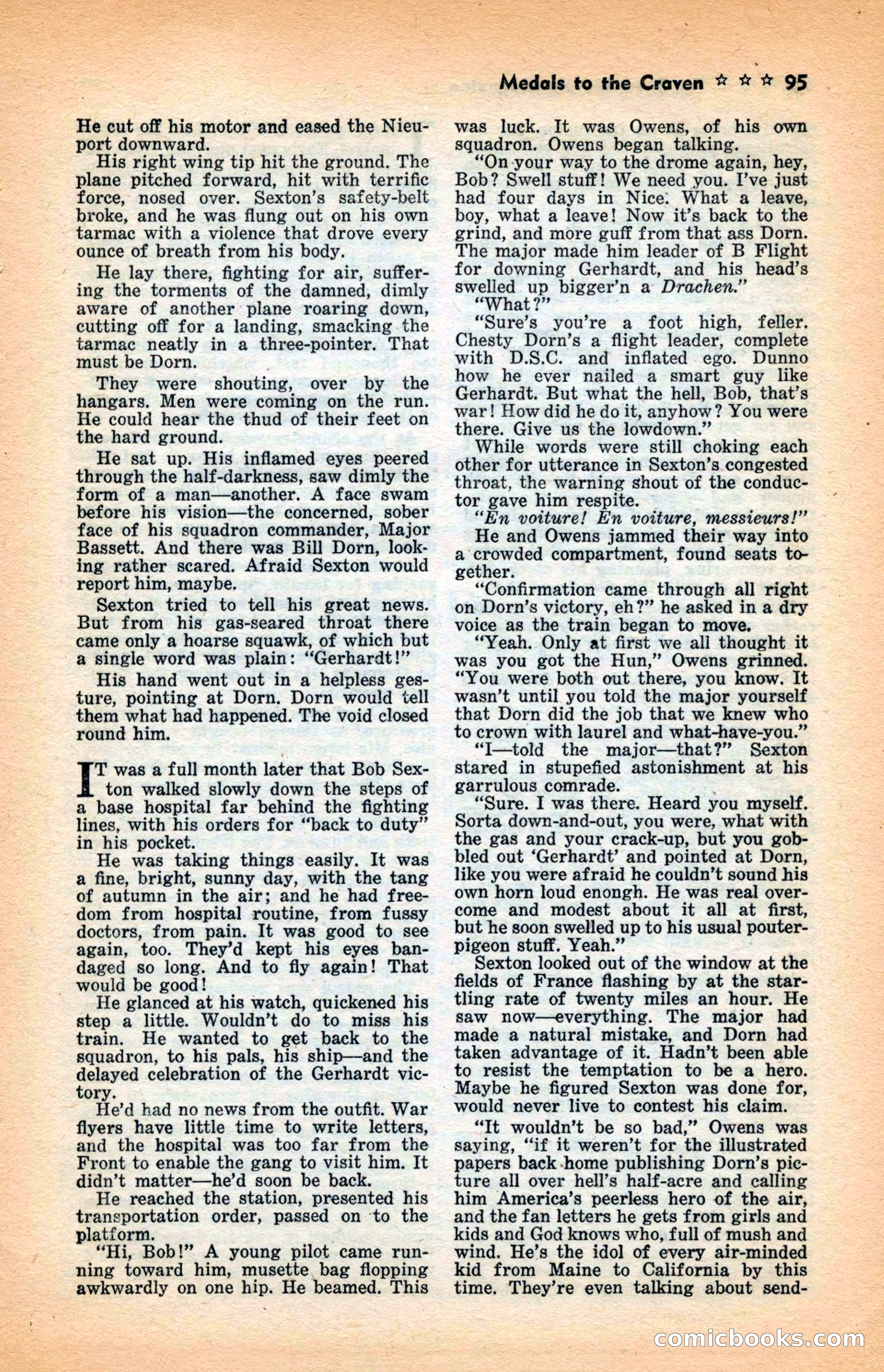
A restored page from Pulp Fiction, 1938. Page through the whole issue in the reader above.
📄 Transcribed text from this page (OCR, searchable)
Machine-transcribed from the original scan — historical spelling and the odd misread are preserved.
I ae Ce ie a i eg ee a ty ee Bs Rg A ae bt Re a RT a ee AE NE aD eT aan a an Se ans ——<— * > ae >” ne te ~" 3 Se Se. airs ie og Os Mey —<— — Ser ae A hg Se ce —— ie x Sn? Bp < - ene >= He cut off his motor and eased the Nieu- port downward. His right wing tip hit the ground. The plane pitched forward, hit with terrific force, nosed over. Sexton’s safety-belt broke, and he was flung out on his own tarmac with a violence that drove every ounce of breath from his body. He lay there, fighting for air, suffer- ing the torments of the damned, dimly aware of another plane roaring down, cutting off for a landing, smacking the tarmac neatly in a three-pointer. That must be Dorn. They were shouting, over by the hangars. Men were coming on the run. He could hear the thud of their feet on the hard ground. He sat up. His inflamed eyes peered through the half-darkness, saw dimly the form of a man—another. A face swam before his vision—the concerned, sober face of his squadron commander, Major Bassett. And there was Bill Dorn, look- ing rather scared. Afraid Sexton would report him, maybe. Sexton tried to tell his great news. But from his gas-seared throat there came only a hoarse squawk, of which but a single word was plain: “Gerhardt!” His hand went out in a helpless ges- ture, pointing at Dorn. Dorn would tell them what had happened. The void closed round him. T was a full month later that Bob Sex- ton walked slowly down the steps of a base hospital far behind the fighting lines, with his orders for “back to duty” in his pocket. He was taking things easily. It was a fine, bright, sunny day, with the tang of autumn in the air; and he had free- dom from hospital routine, from fussy doctors, from pain. It was good to see again, too. They’d kept his eyes ban- daged so long. And to fly again! That - would be good! He glanced at his watch, quickened his step a little. Wouldn’t do to miss his train. He wanted to get back to the squadron, to his pals, his ship—and the delayed celebration of the Gerhardt vic- tory. He’ d had no news from the outfit. War flyers have little time to write letters, and the hospital was too far from the Front to enable the gang to visit him. It didn’t matter—he’d soon be back. He reached the station, presented his transportation order, passed on to the platform. “Hi, Bob!” A young pilot came run- ning toward him, musette bag flopping awkwardly on one Bb He beamed. This =. Medals to the Craven * te te 95 was luck. It was Owens, of his own squadron. Owens began talking. “On-your way to the drome again, hey, Bob? Swell stuff! We need you. I’ve just had four days in Nice: What a leave, boy, what a leave! Now it’s back to the grind, and more guff from that ass Dorn. The major made him leader of B Flight for downing Gerhardt, and his head’s swelled up bigger’n a ‘Drachen.” “What? “Sure’s you’re a foot high, feller. Chesty Dorn’s a flight leader, complete with D.S.C. and inflated ego. Dunno how he ever nailed a smart guy like Gerhardt. But what the hell, Bob, that’s war! How did he do it, anyhow? You were there. Give us the lowdown.” While words were still choking each other for utterance in Sexton’s congested throat, the warning shout of the conduc- tor gave him respite. “Kin voiture! En voiture, messieurs!” He and Owens jammed their way into a crowded compartment, found seats to- gether. “Confirmation came through all right on Dorn’s victory, eh?” he asked in a dry voice as the train began to move. “Yeah. Only at first we all thought it was you got the Hun,” Owens grinned. “You were both out there, you know. It wasn’t until you told the major yourself that Dorn did the job that we knew who to crown with laurel and what-have-you.” “I—told the major—that?” Sexton stared in stupefied astonishment at his garrulous comrade. “Sure. I was there. Heard you myself. Sorta down-and-out, you were, what with the gas and your crack-up, but you gob- bled out ‘Gerhardt’ and pointed at Dorn, like you were afraid he couldn’t sound his own horn loud enongh. He was real over- come and modest about it all at first, but he soon swelled up to his usual pouter- pigeon stuff. Yeah.” Sexton looked out of the window at the fields of France flashing by at the star- tling rate of twenty miles an hour. He saw now—everything. The major had made a natural mistake, and Dorn had taken advantage of it. Hadn’t been able to resist the temptation to be a hero. Maybe he figured Sexton was done for, would never live to contest his claim. “Tt wouldn’t be so bad,” Owens was saying, “if it weren’t for the illustrated papers back-home publishing Dorn’s pic- ture all over hell’s half-acre and calling him America’s peerless hero of the air, and the fan letters he gets from girls and kids and God knows who, full of mush and wind. He’s the idol of every air-minded kid from Maine to California by this time. They’re even talking about send- CEOPMICLOOO S (E@)