
Pulp Fiction, 1938 · page 98 of 148
10 Short Novels Magazine — page 98: what you’re looking at
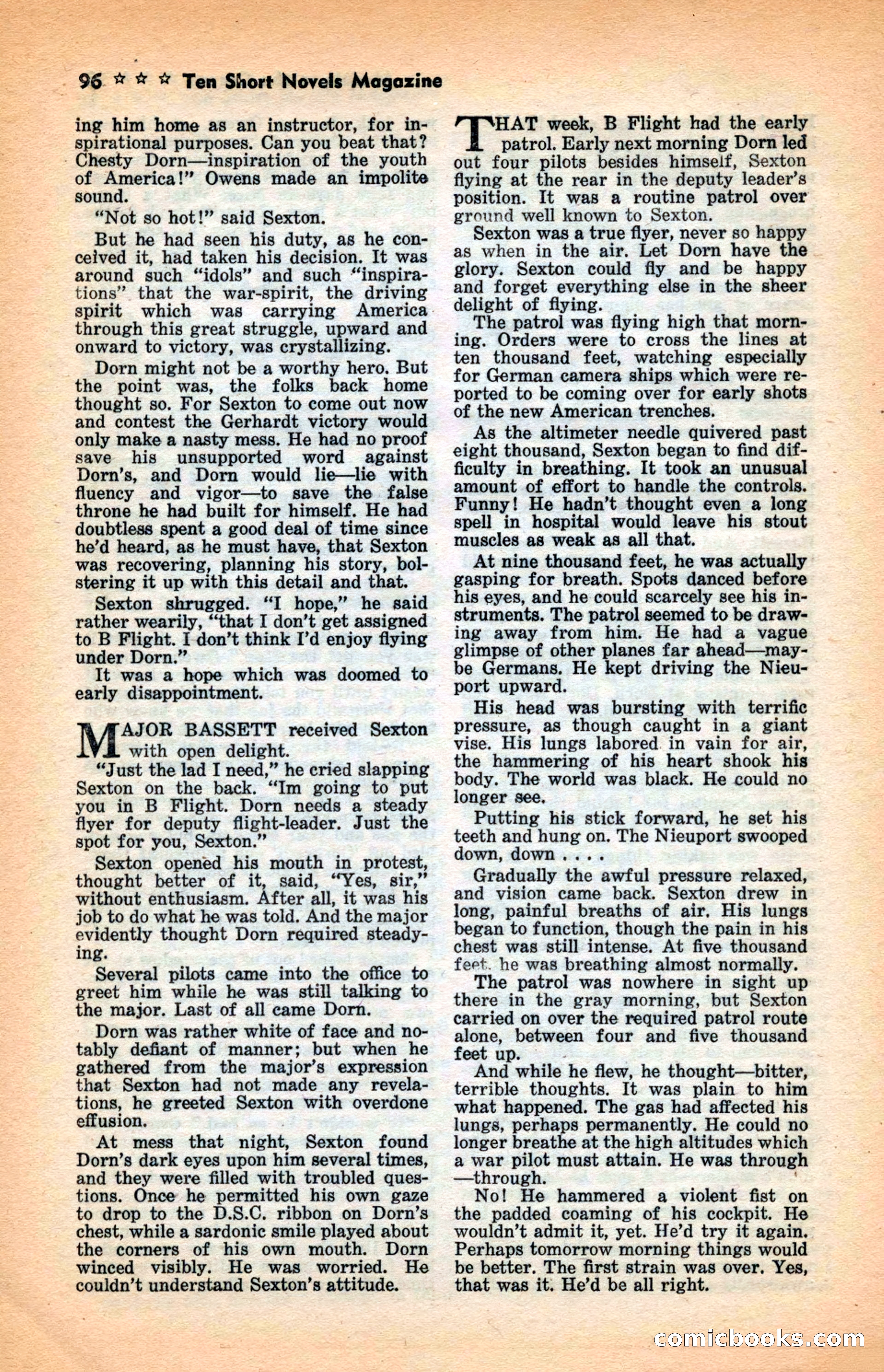
A restored page from Pulp Fiction, 1938. Page through the whole issue in the reader above.
📄 Transcribed text from this page (OCR, searchable)
Machine-transcribed from the original scan — historical spelling and the odd misread are preserved.
ae. —— = _. 96% * * Ten Short Novels Magazine ing him home as an instructor, for in- — purposes. Can you beat that? Dorn—inspiration of the youth of America!” Owens made an impolite sound. “Not so hot!” said Sexton. But he had seen his duty, as he con- ceived it, had taken his decision. It was around such “idols” and such “inspira- tions” that the war-spirit, the driving spirit which was carrying America. through this great struggle, upward and onward to victory, was crystallizing. Dorn might not be a worthy hero. But the point was, the folks back home thought so. For Sexton to come out now and contest the Gerhardt victory would only make a nasty mess. He had no proof save his unsupported word against Dorn’s, and Dorn would lie—lie with fluency and vigor—to save the false throne he had built for himself. He had doubtless spent a good deal of time since he’d heard, as he must have, that Sexton was recovering, planning his story, bol- stering it up with this detail and that. Sexton shrugged. “I hope,” he said rather wearily, “that I don’t get assigned to B Flight. I don’t think I’d enjoy flying under Dorn.” It was a hope which was doomed to early disappointment. AJOR BASSETT received Sexton with open delight. “Just the lad I need,” he cried slapping Sexton on the back. “Im going to put you in B Flight. Dorn needs a steady flyer for deputy flight-leader. Just the spot for you, Sexton.” Sexton opened his mouth in protest, thought better of it, said, “Yes, sir,” without enthusiasm. After all, it was his job to do what he was told. And the major evidently thought Dorn required steady- ing. Several pilots came into the office to greet him while he was still talking to the major. Last of all came Dorn. Dorn was rather white of face and no- tably defiant of manner; but when he gathered from the major’s expression that Sexton had not made any revela- tions, he greeted Sexton with overdone effusion. , At mess that night, Sexton found Dorn’s dark eyes upon him several times, and they were filled with troubled ques- tions. Once he permitted his own gaze to drop to the D.S.C. ribbon on Dorn’s chest, while a sardonic smile played about the corners of his own mouth. Dorn winced visibly. He was worried. He couldn’t understand Sexton’s attitude. HAT week, B Flight had the early patrol. Early next morning Dorn led out four pilots besides himself, Sexton flying at the rear in the deputy leader’s position. It was a routine patrol over ground well known to Sexton. Sexton was a true flyer, never so happy as when in the air. Let Dorn have the glory. Sexton could fly and be happy and forget everything else in the sheer delight of flying. The patrol was flying high that morn- ing. Orders were to cross the lines at ten thousand feet, watching especially for German camera ships which were re- ported to be coming over for early shots of the new American trenches. As the altimeter needle quivered past eight thousand, Sexton began to find dif- ficulty in breathing. It took an unusual amount of effort to handle the controls. Funny! He hadn’t thought even a long spell in hospital would leave his stout muscles as weak as all that. At nine thousand feet, he was actually gasping for breath. Spots danced before his eyes, and he could scarcely see his in- struments. The patrol seemed to be draw- ing away from him. He had a vague glimpse of other planes far ahead—may- be Germans. He kept driving the Nieu- port upward. His head was bursting with terrific pressure, as though caught in a giant vise. His lungs labored. in vain for air, the hammering of his heart shook his body. The world was black. He could no longer see, Putting his stick forward, he set his teeth and hung on. The Nieuport swooped down, down.... Gradually the awful pressure relaxed, and vision came back. Sexton drew in long, painful breaths of air. His lungs began to function, though the pain in his chest was still intense. At five thousand feet. he was breathing almost normally. The patrol was nowhere in sight up there in the gray morning, but Sexton carried on over the required patrol route alone, between four and five thousand feet up. And while he flew, he thought—bitter, terrible thoughts. It was plain to him what happened. The gas had affected his lungs, perhaps permanently. He could no longer breathe at the high altitudes which a war pilot must attain. He was throug —through. No! He hammered a violent fist on the padded coaming of his cockpit. He wouldn’t admit it, yet. He’d try it again. Perhaps tomorrow morning things would be better. The first strain was over. Yes, that was it. He’d be all right. CORDIC OOO KS CO