
Pulp Fiction, 1938 · page 90 of 148
10 Short Novels Magazine — page 90: what you’re looking at
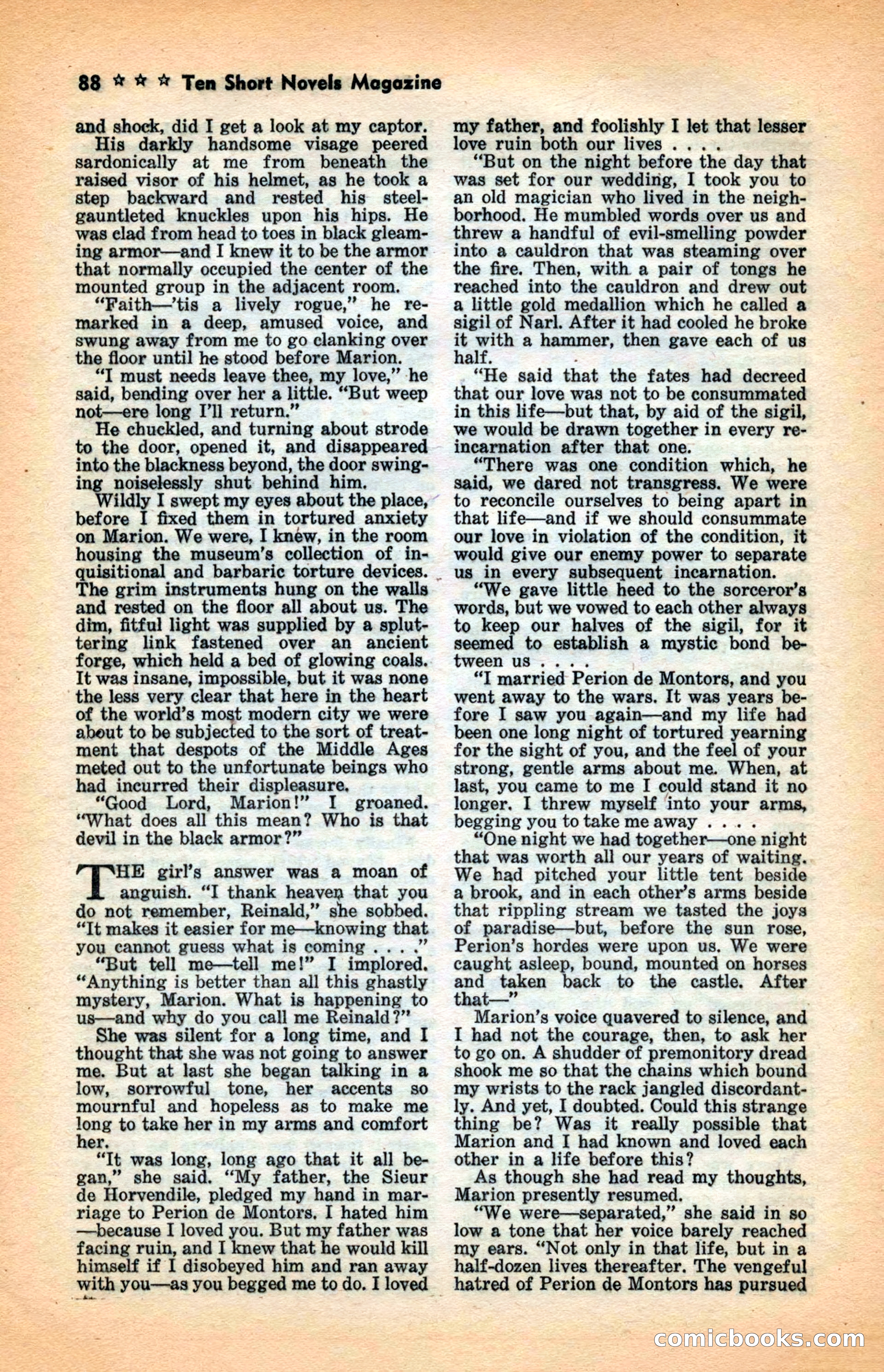
A restored page from Pulp Fiction, 1938. Page through the whole issue in the reader above.
📄 Transcribed text from this page (OCR, searchable)
Machine-transcribed from the original scan — historical spelling and the odd misread are preserved.
88 * * % Ten Short Novels Magazine and shock, did I get a look at my captor. His darkly handsome visage peered sardonically at me from beneath the raised visor of his helmet, as he took a step backward and rested his steel- gauntleted knuckles upon his hips. He was clad from head to toes in black gleam- ing armor—and I knew it to be the armor that normally occupied the center of the mounted group in the adjacent room. “Faith—'tis a lively rogue,” he re- marked in a deep, amused voice, and swung away from me to go clanking over the floor until he stood before Marion. “T must needs leave thee, my love,” -he said, bending over her a little. “But weep not—ere long I’ll return.” He chuckled, and turning about strode to the door, opened it, and disappeared into the blackness beyond, the door swing- —— shut behind him. ildly I swept my eyes about the place, before I fixed them in tortured anxiety on Marion. We were, I knew, in the room housing the museum’s collection of in- — and barbaric torture devices. he grim instruments hung on the walls and rested on the floor all about us. The dim, a haar was supplied by a splut- tering li fastened over an ancient forge, which held a bed of glowing coals. It was insane, impossible, but it was none the less very clear that here in the heart of the world’s most modern city we were about to be subjected to the sort of treat- ment that despots of the Middle Ages meted out to the unfortunate beings who had incurred their displeasure, Lord, Marion!” I groaned. “What does all this mean? Who is that devil in the black armor?” HE girl’s answer was a moan of anguish. “I thank heaven that you do not remember, Reinald,” she sobbed. “Tt makes it easier for me—knowing that you cannot guess what is coming . “But tell me—tell me!” I implored. ‘Anything is better than all this ghastly mystery, Marion. What is happening to us—and why do you call me Reinald?” was silent for a long time, and I thought that she was not going to answer me. But at last she began talking in a low, sorrowful tone, her accents so mournful and hopeless as to make me long to take her in my arms and comfort er. “It was long, long ago that it all be- gan,” she said. “My father, the Sieur de Horvendile, pledged my hand in mar- riage to Perion de Montors, I hated him —because I loved you. But my father was facing ruin, and I knew that he would kill himself if I disobeyed him and ran away ‘with you—as you begged me to do. I loved — my father, and foolishly I let that lesser love ruin both our lives . . “But on the night before the day that was set for our wedding, I took you to an old magician who lived in the neigh- borhood. He mumbled words over us and threw a handful of evil-smelling powder into a cauldron that was steaming over the fire. Then, with a pair of tongs he reached into the cauldron and drew out a little gold medallion which he called a sigil of Narl. After it had cooled he broke . — a hammer, then gave each of us a “He said that the fates had decreed that our love was not to be consummated in this life—but that, by aid of the sigil, we would be drawn together in every re- incarnation after that one. “There was one condition which, he said, we dared not transgress. We were to reconcile ourselves to being apart in that life—and if we should consummate our love in violation of the condition, it would give our enemy power to separate _ us in every subsequent incarnation. “We gave little heed to the sorceror’s words, but we vowed to each other always to keep our halves of the sigil, for it seemed to establish a mystic bond be- tween us... “I married Perion de Montors, and you went away to the wars. It was years be- fore I saw you again—and my life had been one long night of tortured yearning for the sight of you, and the feel of your strong, gentle arms about me. When, at last, you came to me I could stand it no longer. I threw myself into your arms, begging you to take me away . “One night we had together—one night that was worth all our years of waiting. We had pitched your little tent beside a brook, and in each other’s arms beside that rippling stream we tasted the joys of paradise—but, before the sun rose, Perion’s hordes were upon us. We were caught asleep, bound, mounted on horses ae taken back to the castle. After Marion’s voice quavered to silence, and I had not the courage, then, to ask her to go on. A shudder of premonitory dread shook me so that the chains which bound my wrists to the rack jangled discordant- ly. And yet, I doubted. Could this strange thing be? Was it really possible that Marion and I had known and loved each other in a life before this? As though she had read my thoughts, Marion presently resumed. “We were—separated,” she said in so low a tone that her voice barely reached my ears. “Not only in that life, but in a half-dozen lives thereafter. The vengeful hatred of Perion de Montors has pursued Comicbooks.com