
Pulp Fiction, 1938 · page 110 of 148
10 Short Novels Magazine — page 110: what you’re looking at
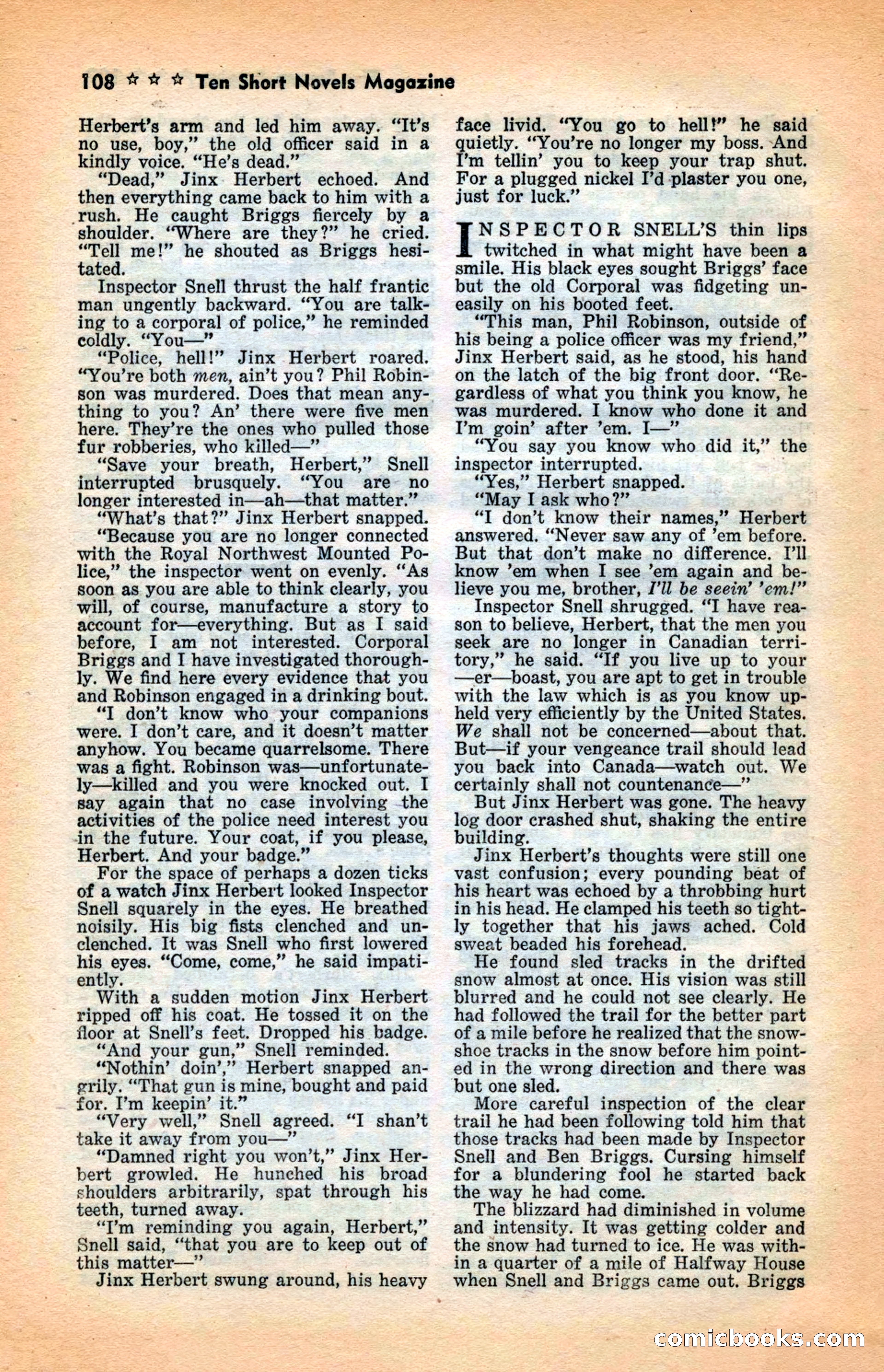
A restored page from Pulp Fiction, 1938. Page through the whole issue in the reader above.
📄 Transcribed text from this page (OCR, searchable)
Machine-transcribed from the original scan — historical spelling and the odd misread are preserved.
108 * wow Ten Short Novels Magazine Herbert’s arm and led him away. “It’s no use, boy,” the old officer said in a kindly voice. “He’s dead.” “Dead,” Jinx Herbert echoed. And then everything came back to him with a rush. He caught Briggs fiercely by a shoulder. “Where are they?” he cried. “Tell me!” he shouted as Briggs hesi- tated. Inspector Snell thrust the half frantic man ungently backward. “You are talk- ing to a corporal of police,” he reminded coldly. “You—” “Police, hell!” Jinx Herbert roared. “You’re both men, ain’t you? Phil Robin- son was murdered. Does that mean any- thing to you? An’ there were five men here. They’re the ones who pulled those fur robberies, who killed—” “Save your breath, Herbert,” Snell interrupted brusquely. “You are no longer interested in—ah—that matter.” “What’s that?” Jinx Herbert snapped. “Because you are no longer connected with the Royal Northwest Mounted Po- lice,” the inspector went on evenly. ‘‘As soon as you are able to think clearly, you will, of course, manufacture a story to account for—everything. But as I said before, I am not interested. Corporal Briggs and I have investigated thorough- ly. We find here every evidence that you and Robinson engaged in a drinking bout. “T don’t know who your companions were. I don’t care, and it doesn’t matter anyhow. You became quarrelsome. There was a fight. Robinson was—unfortunate- ly—killed and you were knocked out. I say again that no case involving -the activities of the police need interest you in the future. Your coat, if you please, Herbert. And your badge.” For the space of perhaps a dozen ticks of a watch Jinx Herbert looked Inspector Snell squarely in the eyes. He breathed noisily. His big fists clenched and un- clenched. It was Snell who first lowered his eyes. “Come, come,” he said impati- ently. With a sudden motion Jinx Herbert ripped off his coat. He tossed it on the floor at Snell’s feet. Dropped his badge. “And your gun,” Snell reminded. ‘Nothin’ doin’,”’ Herbert snapped an- erily. “That gun is mine, bought and paid for. I’m keepin’ it.” “Very well,” Snell agreed. “I shan’t take it away from you—” “Damned right you won’t,” Jinx Her- bert growled. He hunched his broad shoulders arbitrarily, spat through his teeth, turned away. “I’m reminding you again, Herbert,” Snell said, “that you are to keep out of this matter—” Jinx Herbert swung around, his heavy face livid. NSPECTOR SNELL’S thin lips twitched in what might have been a smile. His black eyes sought Briggs’ face but the old Corporal was fidgeting un- easily on his booted feet. “This man, Phil Robinson, outside of his being a police officer was my friend,” Jinx Herbert said, as he stood, his hand on the latch of the big front door. ‘‘Re- gardless of what you think you know, he was murdered. I know who done it and I’m goin’ after ’em. I—” “You say you know who did it,” the inspector interrupted. “Yes,” Herbert snapped. “May I ask who?” “T don’t know their names,” Herbert answered, “Never saw any of ’em before. But that don’t make no difference. [ll know ’em when I see ’em again and be- lieve you me, brother, /’ll be seein’ ’em!” Inspector Snell shrugged. “I have rea- son to believe, Herbert, that the men you seek are no longer in Canadian terri- tory,” he said. “If you live up to your —er—hboast, you are apt to get in trouble with the law which is as you know up- held very efficiently by the United States. We shall not be concerned—about that. But—if your vengeance trail should lead you back into Canada—watch out. We certainly shall not countenance—” But Jinx Herbert was gone. The heavy log door crashed shut, shaking the entire building. Jinx Herbert’s thoughts were still one vast confusion; every pounding beat of his heart was echoed by a throbbing hurt in his head. He clamped his teeth so tight- ly together that his jaws ached. Cold sweat beaded his forehead. He found sled tracks in the drifted snow almost at once. His vision was still blurred and he could not see clearly. He had followed the trail for the better part of a mile before he realized that the snow- shoe tracks in the snow before him point- ed in the wrong direction and there was but one sled. More careful inspection of the clear trail he had been following told him that those tracks had been made by Inspector Snell and Ben Briggs. Cursing himself for a blundering fool he started back the way he had come. The blizzard had diminished in volume and intensity. It was getting colder and the snow had turned to ice. He was with- in a quarter of a mile of Halfway House when Snell and Briggs came out. Briggs Eomicbooks “You go to hell!” he said cage “You’re no longer my boss. And ’m tellin’ you to keep your trap shut. For a plugged nickel I’d plaster you one, just for luck.”