
Pulp Fiction, 1938 · page 132 of 148
10 Short Novels Magazine — page 132: what you’re looking at
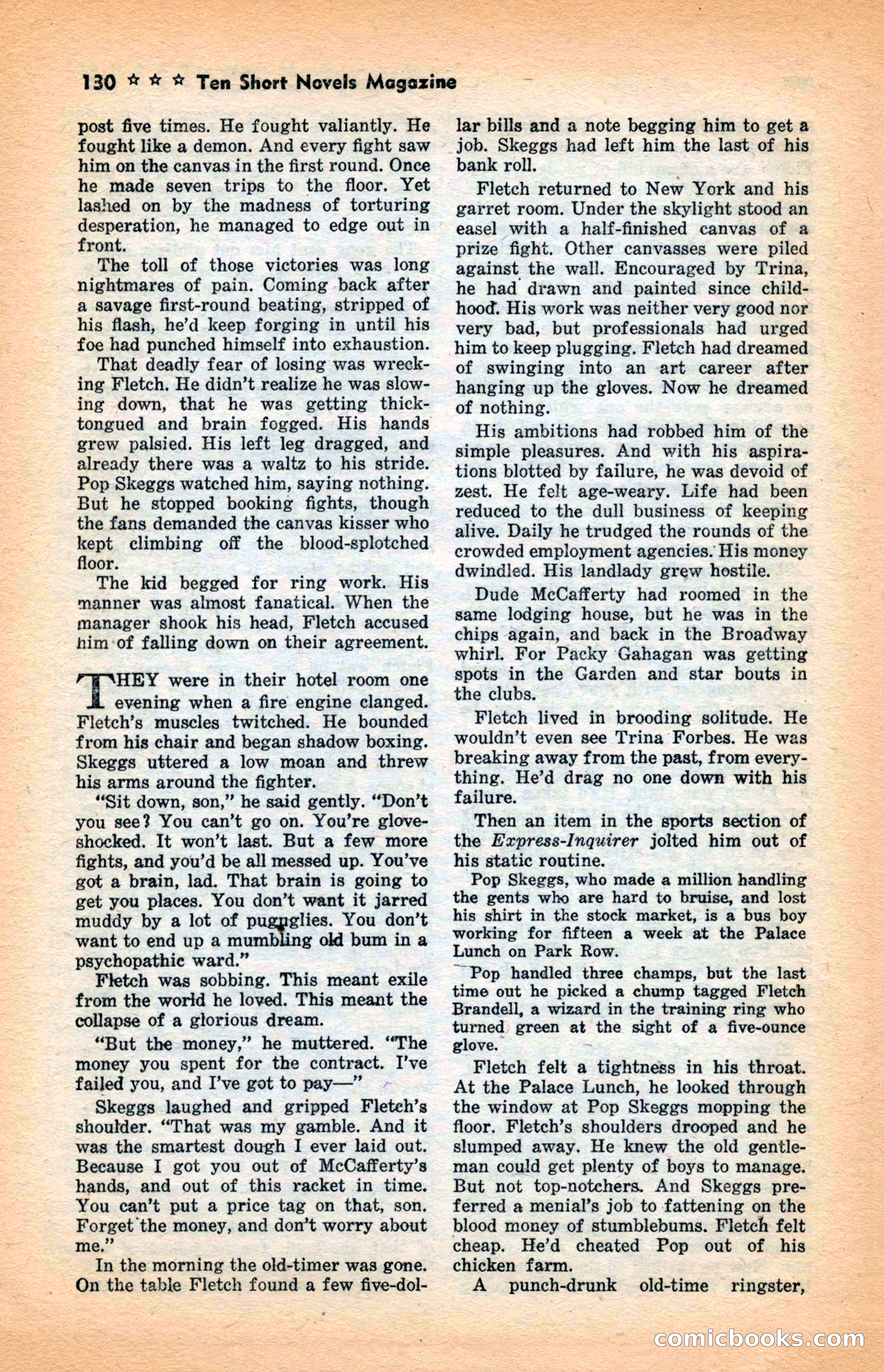
A restored page from Pulp Fiction, 1938. Page through the whole issue in the reader above.
📄 Transcribed text from this page (OCR, searchable)
Machine-transcribed from the original scan — historical spelling and the odd misread are preserved.
130 * * * Ten Short Novels Magazine “4 post five times. He fought valiantly. He fought like a demon. And every fight saw him on the canvas in the first round. Once he made seven trips to the floor. Yet lashed on by the madness of torturing desperation, he managed to edge out in front. The toll of those victories was long nightmares of pain. Coming back after a savage first-round beating, stripped of his flash, he’d keep forging in until his foe had punched himself into exhaustion. That deadly fear of losing was wreck- ing Fletch. He didn’t realize he was slow- ing down, that he was getting thick- tongued and brain fogged. His hands grew palsied. His left leg dragged, and already there was a waltz to his stride. Pop Skeggs watched him, saying nothing. But he stopped booking fights, though the fans demanded the canvas kisser who kept climbing off the blood-splotched floor. The kid begged for ring work. His manner was almost fanatical. When the manager shook his head, Fletch accused him:‘of falling down on their agreement. HEY were in their hotel room one evening when a fire engine clanged. Fletch’s muscles twitched. He bounded from his chair and began shadow boxing. Skeggs uttered a low moan and threw his arms around the fighter. “Sit down, son,” he said gently. “Don’t you see? You can’t go on. You’re glove- shocked. It won’t last. But a few more fights, and you’d be all messed up. You’ve got a brain, lad. That brain is going to get you places. You don’t want it jarred muddy by a lot of p lies. You don’t want to end up a mumbling old bum in a psychopathic ward.” Fletch was sobbing. This meant exile from the world he loved. This meant the collapse of a glorious dream. “But the money,” he muttered. “The money you spent for the contract. I’ve failed you, and I’ve got to pay—” Skeggs laughed and gripped Fletch’s shoulder. “That was my gamble. And it was the smartest dough I ever laid out. Because I got you out of McCafferty’s hands, and out of this racket in time. You can’t put a price tag on that, son. Forget the money, and don’t worry about me.” In the morning the old-timer was gone. On the table Fletch found a few five-dol- lar bills and a note begging him to get a job. Skeggs had left him the last of his bank roll. Fletch returned to New York and his garret room. Under the skylight stood an easel with a half-finished canvas of a prize fight. Other canvasses were piled against the wall. Encouraged by Trina, he had drawn and painted since child- hood. His work was neither very good nor very bad, but professionals had urged him to keep plugging. Fletch had dreamed of swinging into an art career after hanging up the gloves. Now he dreamed of nothing. His ambitions had robbed him of the simple pleasures. And with his aspira- tions blotted by failure, he was devoid of — zest. He felt age-weary. Life had been reduced to the dull business of keeping alive. Daily he trudged the rounds of the crowded employment agencies. His money dwindled. His landlady grew hostile. Dude McCafferty had roomed in the same lodging house, but he was in the chips again, and back in the Broadway whirl. For Packy Gahagan was getting spots in the Garden and star bouts in the clubs. Fletch lived in brooding solitude. He wouldn’t even see Trina Forbes. He was breaking away from the past, from every- thing. He’d drag no one down with his failure. Then an item in the sports section of the Express-Inquirer jolted him out of his static routine. Pop Skeggs, who made a million handling the gents who are hard to bruise, and lost his shirt in the stock market, is a bus boy working for fifteen a week at the Palace Lunch on Park Row. Pop handled three champs, but the last time out he picked a chump tagged Fletch Brandell, a wizard in the training ring who turned green at the sight of a five-ounce glove. Fletch felt a tightness in his throat. At the Palace Lunch, he looked through the window at Pop Skeggs mopping the floor. Fletch’s shoulders drooped and he slumped away. He knew the old gentle- man could get plenty of boys to manage. But not top-notchers. And Skeggs pre- ferred a menial’s job to fattening on the blood money of stumblebums. Fletch felt cheap. He’d cheated Pop out of his chicken farm. A punch-drunk old-time ringster, com c IOOKS LHe)