
Pulp Fiction, 1938 · page 101 of 148
10 Short Novels Magazine — page 101: what you’re looking at
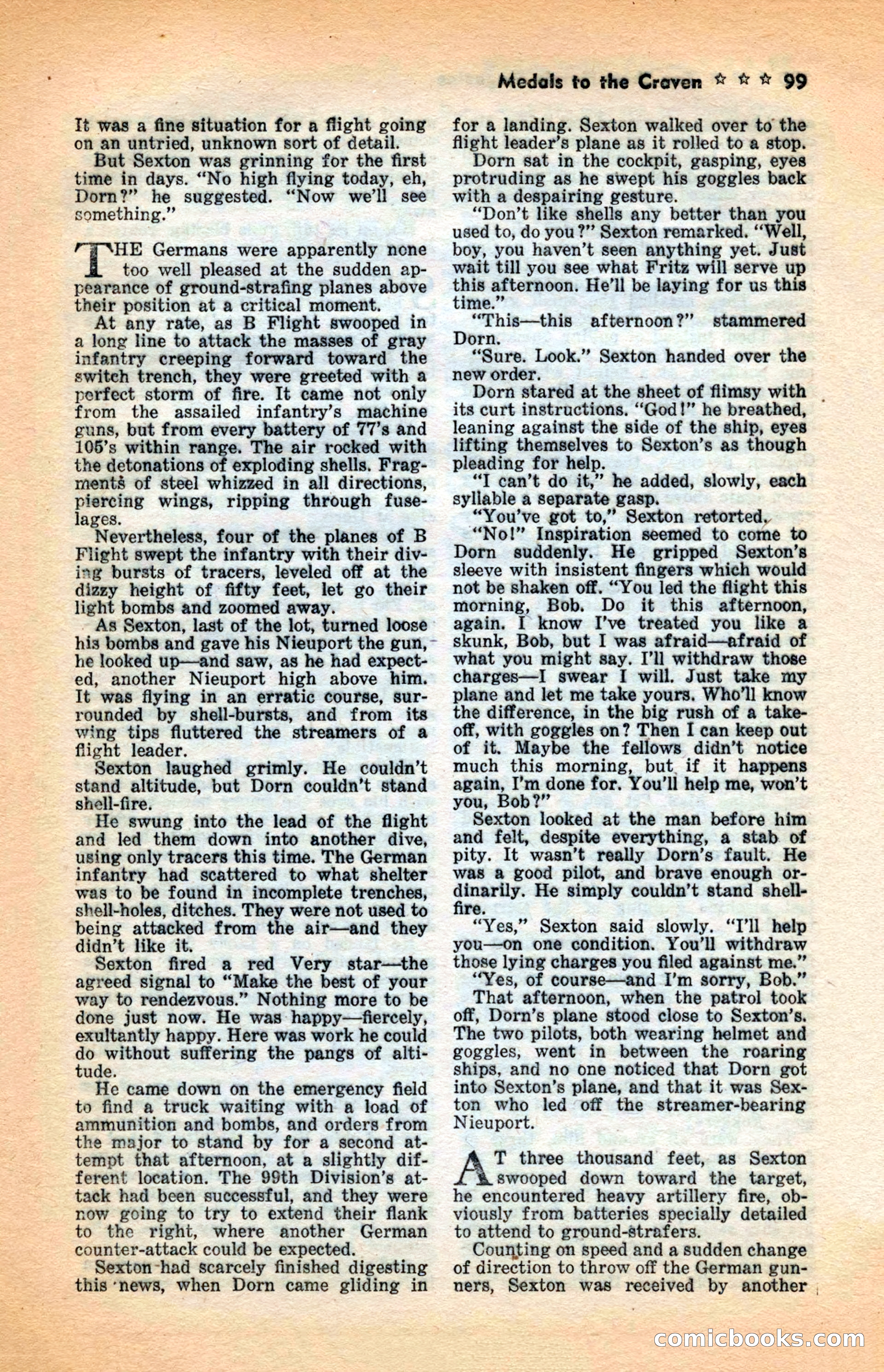
A restored page from Pulp Fiction, 1938. Page through the whole issue in the reader above.
📄 Transcribed text from this page (OCR, searchable)
Machine-transcribed from the original scan — historical spelling and the odd misread are preserved.
It was a fine situation for a flight going on an untried, unknown sort of detail. But Sexton was grinning for the first time in days. “No high flying today, eh, Dorn?” he suggested. “Now we'll see something.” HE Germans were apparently none too well pleased at the sudden ap- pearance of ground-strafing planes above their position at a critical moment. At any rate, as B Flight swooped in a long line to attack the masses of gray infantry creeping forward toward the switeh trench, they were greeted with a perfect storm of fire. It came not only from the assailed infantry’s machine guns, but from every battery of 77’s and 105’s within range. The air rocked with the detonations of exploding shells. Frag- ments of steel whizzed in all directions, — wings, ripping through fuse- ages. Nevertheless, four of the planes of B Flight swept the infantry with their div- ing bursts of tracers, leveled off at the dizzy height of fifty feet, let go their light bombs and zoomed away. - As Sexton, last of the lot, turned loose his bombs and gave his Nieuport the gun, - he looked up—and saw, as he had expect- ed, another Nieuport high above him. It was flying in an erratic course, sur- rounded by shell-bursts, and from its wing tips fluttered the streamers of a flight leader. Sexton laughed grimly. He couldn’t stand altitude, but Dorn couldn’t stan shell-fire. : He swung into the lead of the flight and led them down into another dive, using only tracers this time. The German infantry had scattered to what shelter was to be found in incomplete trenches, shell-holes, ditches. They were not used to being attacked from the air—and they didn’t like it. Sexton fired a red Very star—the agreed signal to “Make the best of your way to rendezvous.” Nothing more to be done just now. He was happy—fiercely, exultantly happy. Here was work he could eo suffering the pangs of alti- ude. He came down on the emergency field to find a truck waiting with a load of ammunition and bombs, and orders from the major to stand by for a second at- tempt that afternoon, at a slightly dif- ferent location. The 99th Division’s at- tack had been successful, and they were now going to try to extend their flank to the right, where another German counter-attack could be expected. Sexton-had scarcely finished digesting this ‘news, when Dorn came gliding in < ~ eg ee, SSNS << Seaiis “ae - on oN mt er en, —— ag te Sa ee BOP E wt ig Sag ane ae ey ; : a . — ent : he ee ‘oes w ee ~ 5 es a oe + . Fg Pi = = —— ~ — mee = Medals to the Craven * * * 99 for a landing. Sexton walked over to the flight leader’s plane as it rolled to a stop. Dorn sat in the cockpit, gasping, eyes protruding as he swept his goggles back with a despairing gesture. “Don’t like shells any better than you used to, do you?” Sexton remarked. ‘Well, boy, you haven’t seen anything yet. Just wait till you see what Fritz will serve up this afternoon. He’ll be laying for us this time.” “This—this afternoon?” stammered Dorn, “Sure. Look.” Sexton handed over the new order. Dorn stared at the sheet of flimsy with its curt instructions. “God!” he breathed, — leaning against the side of the ship, eyes lifting themselves to Sexton’s as though pleading for help. “T can’t do it,” he added, slowly, each syllable a separate gasp. “You’ve got to,” Sexton retorted, “Nol” Inspiration seemed to come to Dorn suddenly. He gripped Sexton’s sleeve with insistent fingers which would not be shaken off. “You led the flight this morning, Bob. Do it this afternoon, again. I know I’ve treated you like a skunk, Bob, but I was afraid—afraid of what you might say. I'll withdraw those charges—I swear I will. Just take my plane and let me take yours. Who'll know the difference, in the big rush of a take- off, with goggles on? Then I can keep out of it. Maybe the fellows didn’t notice much this morning, but. if it happens again, I’m done for. You’ll help me, won’t you, Bob?” Sexton looked at the man before him and felt, despite everything, a stab of pity. It wasn’t really Dorn’s fault. He was a good pilot, and brave enough or- ae He simply couldn’t stand shell- re. “Yes,” Sexton said slowly. “I'll help you—on one condition. You'll withdraw those lying charges you filed against me.” “Yes, of course—and I’m sorry, Bob.” That afternoon, when the patrol took off, Dorn’s plane stood close to Sexton’s. The two pilots, both wearing helmet and goggles, went in between the roaring ships, and no one noticed that Dorn got into Sexton’s plane, and that it was Sex- ton who led off the streamer-bearing Nieuport. T three thousand feet, as Sexton swooped down toward the target, he encountered heavy artillery fire, ob- viously from batteries specially detailed to attend to ground-strafers. Counting on speed and a sudden change of direction to throw off the German gun- ners, Sexton was received by another . Comicbvoo KS (EO)