
Pulp Fiction, 1938 · page 125 of 148
10 Short Novels Magazine — page 125: what you’re looking at
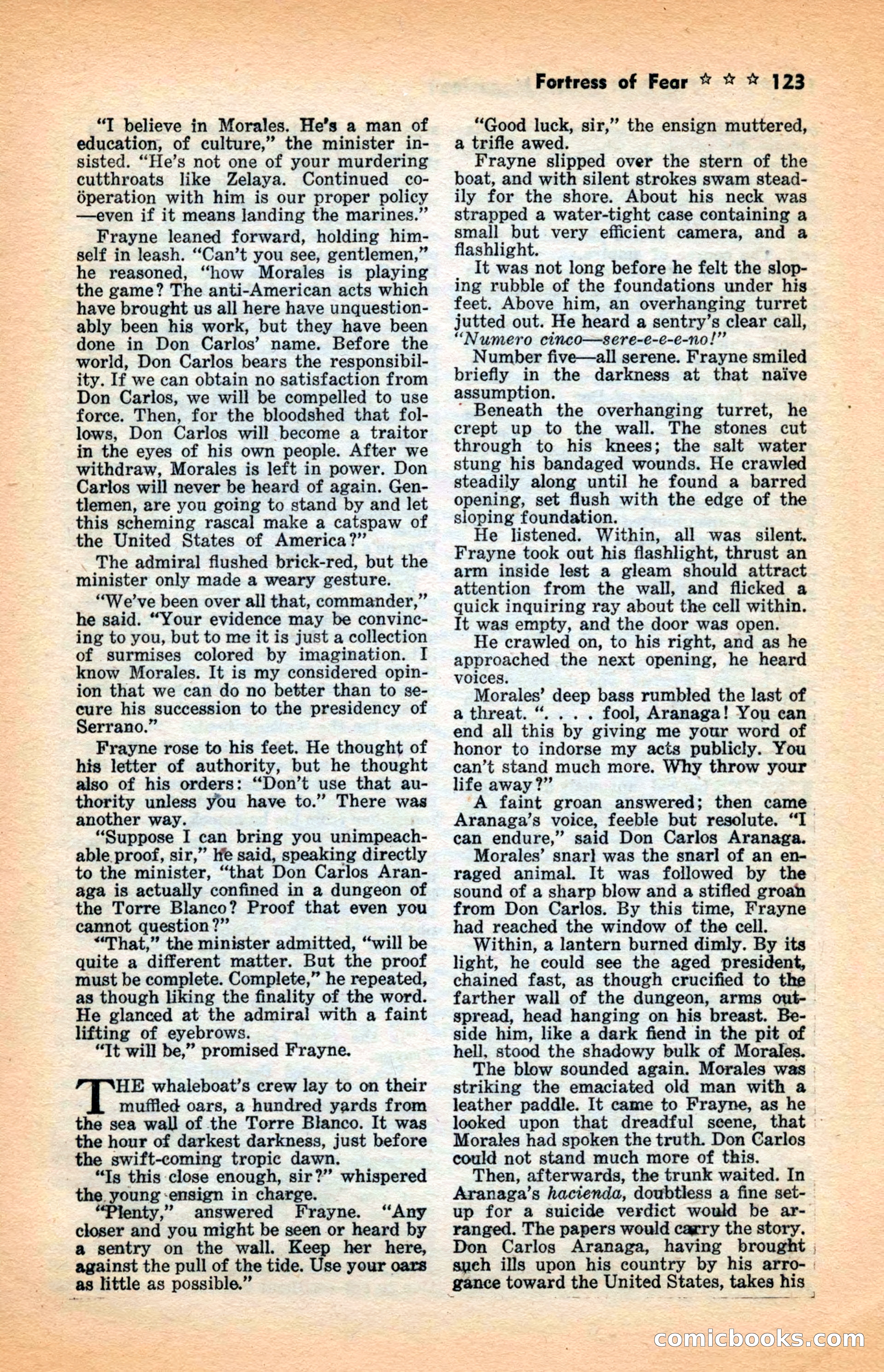
A restored page from Pulp Fiction, 1938. Page through the whole issue in the reader above.
📄 Transcribed text from this page (OCR, searchable)
Machine-transcribed from the original scan — historical spelling and the odd misread are preserved.
“I believe in Morales. He’s a man of education, of culture,” the minister in- sisted. “He’s not one of your murdering cutthroats like Zelaya. Continued co- Operation with him is our proper policy —even if it means landing the marines.” Frayne leaned forward, holding him- self in leash. “Can’t you see, gentlemen,” he reasoned, “how Morales is playing the game? The anti-American acts which have brought us all here have unquestion- ably been his work, but they have been done in Don Carlos’ name. Before the world, Don Carlos bears the responsibil- ity. If we can obtain no satisfaction from Don Carlos, we will be compelled to use force. Then, for the bloodshed that fol- lows, Don Carlos will become a traitor in the eyes of his own people. After we withdraw, Morales is left in power. Don Carlos will never be heard of again. Gen- tlemen, are you going to stand by and let this scheming rascal make a catspaw of the United States of America?” The admiral] flushed brick-red, but the minister only made a weary gesture. “We've been over all that, commander,” he said. “Your evidence may be convinc- ing to you, but to me it is just a collection of surmises colored by imagination. I know Morales. It is my considered opin- ion that we can do no better than to se- cure his succession to the presidency of Serrano.” Frayne rose to his feet. He thought of his letter of authority, but he thought also of his orders: “Don’t use that au- thority unless you have to.” There was another way. “Suppose I can bring you unimpeach- able proof, sir,” He said, speaking directly to the minister, “that Don Carlos Aran- aga is actually confined in a dungeon of the Torre Blanco? Proof that even you cannot question?” “That,” the minister admitted, “will be quite a different matter. But the proof must be complete. Complete,” he repeated, as though liking the finality of the word. He glanced at the admiral with a faint lifting of eyebrows. “Tt will be,” promised Frayne. HE whaleboat’s crew lay to on their muffled oars, a hundred yards from the sea wall of the Torre Blanco. It was the hour of darkest darkness, just before the swift-coming tropic dawn, “Is this close enough, sir?” whispered the young: ensign in charge. “Plenty,” answered Frayne. “Any closer and you might be seen or heard by sentry on the wall. K her here, against the pull of the tide. Use your oars as little as possible.” Fortress of Fear * * * 123 “Good luck, sir,” the ensign muttered, a trifle awed. Frayne slipped over the stern of the boat, and with silent strokes swam stead- ily for the shore. About his neck was strapped a water-tight case containing a small but very efficient camera, and a flashlight. It was not long before he felt the slop- ing rubble of the foundations under his feet. Above him, an overhanging turret jutted out. He heard a sentry’s clear call, “Numero cinco—sere-e-e-e-no!”’ Number five—all serene. Frayne smiled briefly in the darkness at that naive assumption. ' Beneath the overhanging turret, he crept up to the wall. The stones cut through to his knees; the salt water stung his bandaged wounds. He crawled steadily along until he found a barred opening, set flush with the edge of the sloping foundation. He listened. Within, all was _ silent. Frayne took out his flashlight, thrust an arm inside lest a gleam should attract attention from the wall, and flicked a quick inquiring ray about the cell within. It was empty, and the door was open. He crawled on, to his right, and as he approached the next opening, he heard voices. Morales’ deep bass rumbled the last of a threat. “. . .. fool, Aranaga! You can end all this by giving me your word of honor to indorse my acts publicly. You can’t stand much more. Why throw your life away?” A faint groan answered; then came. Aranaga’s voice, feeble but resolute, “I can endure,” said Don Carlos Aranaga. Morales’ snar} was the snarl of an en- raged animal. It was followed by the sound of a sharp blow and a stifled groan from Don Carlos. By this time, Frayne had reached the window of the cell. Within, a lantern burned dimly. By its light, he could see the aged president, chained fast, as though crucified to the farther wall of the dungeon, arms out-. spread, head hanging on his breast. Be- side him, like a dark fiend in the pit of hell, stood the shadowy bulk of Morales. The blow sounded again. Morales was . striking the emaciated old man with a leather paddle. It came to Frayne, as he looked upon that dreadful seene, that — Morales had spoken the truth. Don Carlos could not stand much more of this. Then, afterwards, the trunk waited. In Aranaga’s hacienda, doubtless a fine set-— up for a suicide verdict would be ar- ranged. The papers would carry the story. Don Carlos Aranaga, having brought — such ills upon his country by his arro- | — — -———————- — Comicboo = i gance toward the United States, takes his Say com)