
Pulp Fiction, 1938 · page 100 of 148
10 Short Novels Magazine — page 100: what you’re looking at
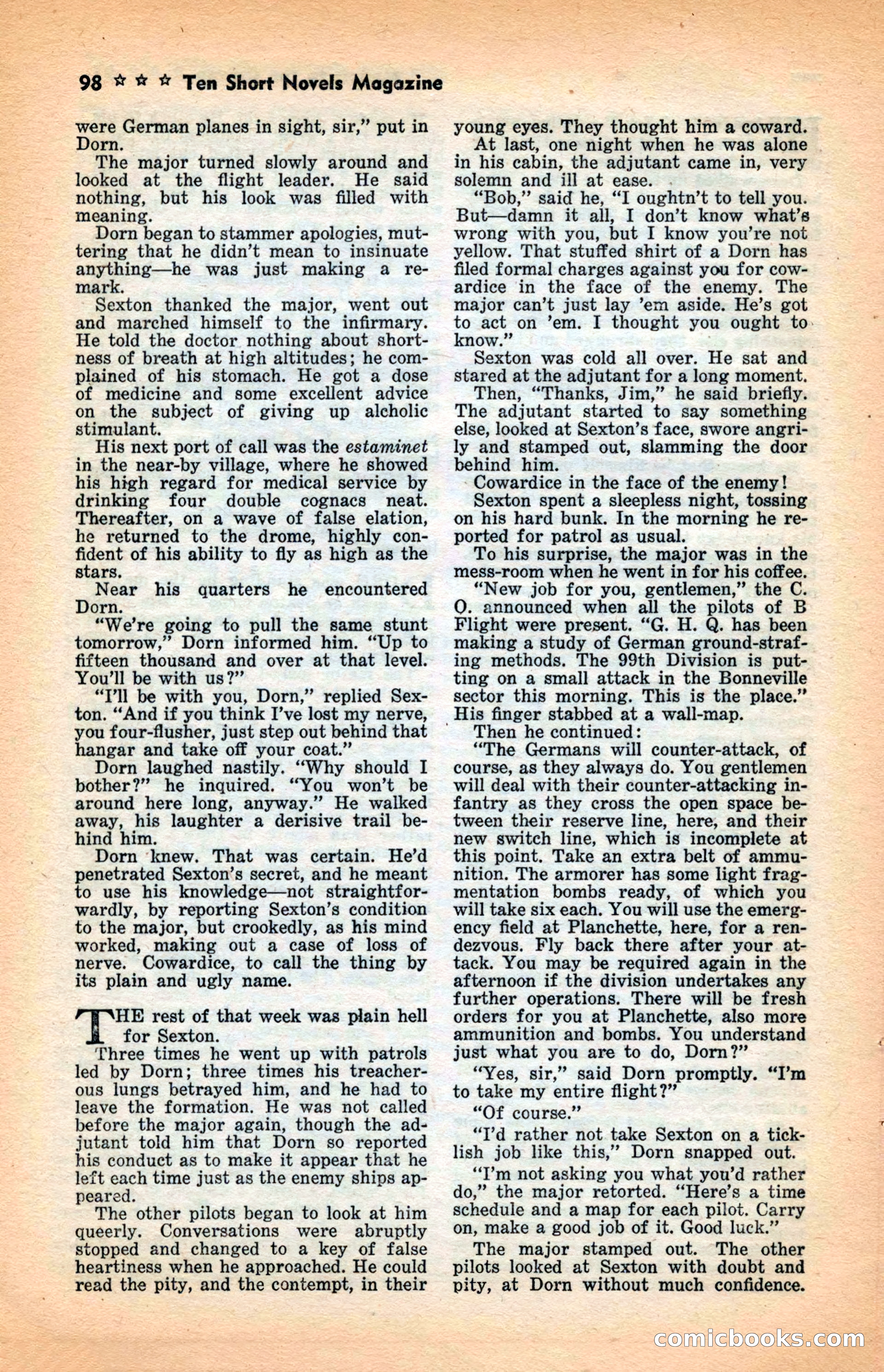
A restored page from Pulp Fiction, 1938. Page through the whole issue in the reader above.
📄 Transcribed text from this page (OCR, searchable)
Machine-transcribed from the original scan — historical spelling and the odd misread are preserved.
98 * * * Ten Short Novels Magazine were German planes in sight, sir,” put in Dorn. The major turned slowly around and looked at the flight leader. He said nothing, but his look was filled with meaning. Dorn began to stammer apologies, mut- tering that he didn’t mean to insinuate anything—he was just making a re- mark. Sexton thanked the major, went out and marched himself to the infirmary. He told the doctor nothing about short- ness of breath at high altitudes; he com- plained of his stomach. He got a dose of medicine and some excellent advice on the subject of giving up alcholic stimulant. His next port of call was the estaminet in the near-by village, where he showed his high regard for medical service by drinking four double cognacs neat. Thereafter, on a wave of false elation, he returned to the drome, highly con- fident of his ability to fly as high as the stars. Near his quarters he encountered Dorn. “We're going to pull the same stunt tomorrow,” Dorn informed him. “Up to fifteen thousand and over at that level. You’ll be with us?” “T’ll be with you, Dorn,” replied Sex- ton. “And if you think I’ve lost my nerve, you four-flusher, just step out behind that hangar and take off your coat.” Dorn laughed nastily. ‘““Why should I bother?” he inquired. “You won’t be around here long, anyway.” He walked away, his laughter a derisive trail be- hind him. Dorn knew. That was certain. He’d penetrated Sexton’s secret, and he meant to use his knowledge—not straightfor- wardly, by reporting Sexton’s condition to the major, but crookedly, as his mind worked, making out a case of loss of nerve. Cowardice, to call the thing by its plain and ugly name. HE rest of that week was plain hell for Sexton. Three times he went up with patrols led by Dorn; three times his treacher- ous lungs betrayed him, and he had to leave the formation. He was not called before the major again, though the ad- jutant told him that Dorn so reported his conduct as to make it appear that he left each time just as the enemy ships ap- peared. The other pilots began to look at him queerly. Conversations were abruptly stopped and changed to a key of false heartiness when he approached. He could read the pity, and the contempt, in their young eyes. They thought him a coward. At last, one night when he was alone | in his cabin, the adjutant came in, very solemn and ill at ease. . “Bob,” said he, “I oughtn’t to tell you. But—damn it all, I don’t know what’s wrong with you, but I know you’re not yellow. That stuffed shirt of a Dorn has filed formal charges against you for cow- ardice in the face of the enemy. The major can’t just lay ’em aside. He’s got to act on ’em. I thought you ought to: know.” Sexton was cold all over. He sat and stared at the adjutant for a long moment. Then, “Thanks, Jim,” he said briefly. The adjutant started to say something else, looked at Sexton’s face, swore angri- ly and stamped out, slamming the door behind him. - Cowardice in the face of the enemy! Sexton spent a sleepless night, tossing on his hard bunk. In the morning he re- ported for patrol as usual. To his surprise, the major was in the mess-room when he went in for his coffee. “New job for you, gentlemen,” the C. O. announced when all the pilots of B Flight were present. “G. H. Q. has been making a study of German ground-straf- ing methods. The 99th Division is put- ting on a small attack in the Bonneville sector this morning. This is the place.” His finger stabbed at a wall-map. Then he continued: “The Germans will counter-attack, of course, as they always do. You gentlemen will deal with their counter-attacking in- fantry as they cross the open space be- tween their reserve line, here, and their new switch line, which is incomplete at this point. Take an extra belt of ammu- nition. The armorer has some light frag- mentation bombs ready, of which you will take six each. You will use the emerg- ency field at Planchette, here, for a ren- dezvous. Fly back there after your at- tack. You may be required again in the afternoon if the division undertakes any further operations. There will be fresh orders for you at Planchette, also more ammunition and bombs. You understand just what you are to do, Dorn?” “Yes, sir,” said Dorn promptly. “I’m to take my entire flight?” “Of course.” “T’d rather not take Sexton on a tick- lish job like this,’ Dorn snapped out. “T’m not asking you what you’d rather do,” the major retorted. ““Here’s a time schedule and a map for each pilot. Carry on, make a good job of it. Good luck.” The major stamped out. The other pilots looked at Sexton with doubt and pity, at Dorn without much confidence. COPMNICLOOO KS com