
Pulp Fiction, 1938 · page 118 of 148
10 Short Novels Magazine — page 118: what you’re looking at
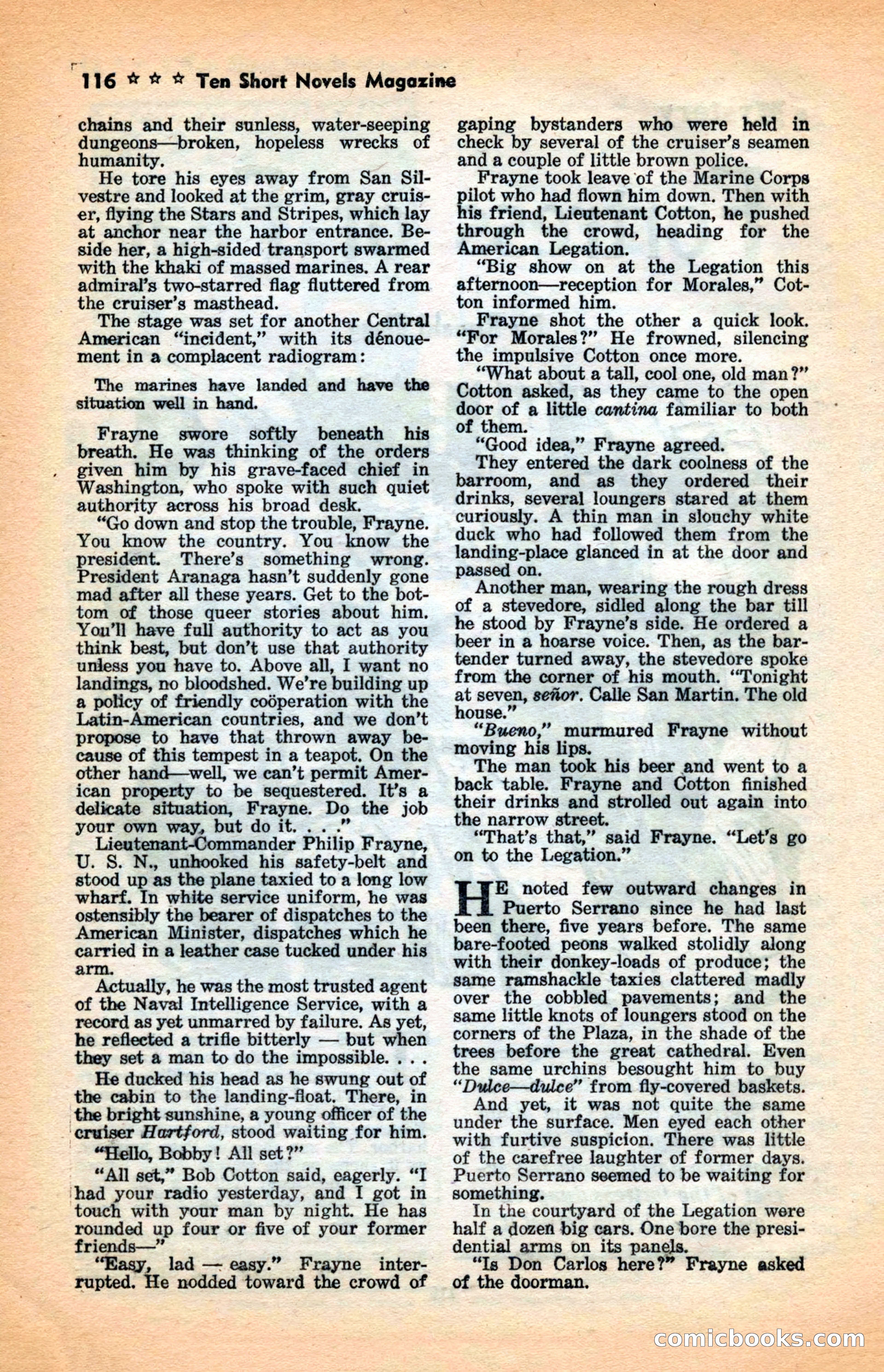
A restored page from Pulp Fiction, 1938. Page through the whole issue in the reader above.
📄 Transcribed text from this page (OCR, searchable)
Machine-transcribed from the original scan — historical spelling and the odd misread are preserved.
‘had your radio yesterday, and I “116 * & * Ten Short Novels Magozine ' chains and their sunless, Waher-secpins dungeons—broken, hopeless wrecks o humanity. He tore his eyes away from San Sil- vestre and looked at the grim, gray cruis- er, flying the Stars and Stripes, which lay at anchor near the harbor entrance. Be- side her, a high-sided transport swarmed with the khaki of massed marines. A rear admiral’s two-starred flag fluttered from _ the cruiser’s masthead. The stage was set for another Central American “incident,” with its dénoue- ment in a complacent radiogram: The marines have landed and have the situation well in hand. Frayne swore softly beneath his He was thinking of the orders given him by his grave-faced chief in Washington, who spoke with such quiet authority across his broad desk. “Go down and stop the trouble, Frayne. You know the country. You know the president. There’s something wrong. President Aranaga hasn’t suddenly gone mad after all these years. Get to the bot- tom of those queer stories about him. You'll have full authority to act as you think best, but don’t use that authority umless you have to. Above all, I want no landings, no bloodshed. We’re building up a policy of friendly codperation with the Latin-American countries, and we don’t propose to have that thrown away be- cause of this tempest in a teapot. On the other hand—vwell, we can’t permit Amer- situati your own way, but do it. Lieu der Pritip Fs Frayne, Uz. S. N., unhooked his safety-belt and stood up as the plane taxied to a long low wharf. In white service uniform, he was ostensibly the bearer of dispatches to the American Minister, dispatches which he carried in a leather case tucked under his arm. Actually, he was the most trusted agent of the Naval Intelligence Service, with a record as yet unmarred by failure. As yet, he reflected a trifle bitterly — but when they set a man to do the impossible... . He ducked his head as he swung out of the cabin to the landing-float. There, in the bright sunshine, a young officer of the Hartford, stood waiting for him. “Hello, Bobby! All set?” “All set,” Bob Cotton said, eagerly. “I got in touch with your man by night. He has rounded up four or five of your former friends—” seipted lad — easy.” Frayne inter- pted. He nodded toward the crowd of gaping bystanders who were held in check by several of the cruiser’s seamen and a couple of little brown police. Frayne took leave of the Marine Corps pilot who had flown him down. Then with his friend, Lieutenant Cotton, he pushed through the crowd, heading for the American Legation. “Big show on at the Legation this afternoon—reception for Morales,” Cot- ton informed him. Frayne shot the other a quick look. “For Morales?” He frowned, silencing the impulsive Cotton once more. ‘What about a tall, cool one, old man?” Cotton asked, as they came to the open door of a little cantina familiar to both of them. “Good idea,” Frayne agreed. They entered the dark coolness of the barroom, and as they ordered their drinks, several loungers stared at them curiously. A thin man in slouchy white duck who had followed them from the landing-place glanced in at the door and passed on. Another man, wearing the rough dress of a stevedore, sidled along the bar till he stood by Frayne’s side. He ordered a beer in a hoarse voice. Then, as the bar- tender turned away, the stevedore spoke from the corner of his mouth. “Tonight at seven, sefwor. Calle San Martin. The old house.” “Bueno,” murmured Frayne without moving his lips. The man took his beer and went to a back table. Frayne and Cotton finished their drinks and strolled out again into the narrow street. “That’s that,” said Frayne. “Let’s go on to the Legation.” E noted few outward changes in Puerto Serrano since he had last been there, five years before. The same bare-footed peons walked stolidly along with their donkey-loads of produce; the same ramshackle taxies clattered madly over the cobbled pavements; and the same little knots of loungers stood on the corners of the Plaza, in the shade of the trees before the great cathedral. Even the same urchins besought him to buy “Dulee—dulce” from fly-covered baskets. And yet, it was not quite the same © under the surface. Men eyed each other with furtive suspicion. There was little of the carefree laughter of former days. Puerto Serrano seemed to be waiting for something. In the courtyard of the Legation were half a dozen big cars. One bore the presi- dential arms on its panels. “Ts Don Carlos here?” Frayne asked of the doorman. Gomichbooks ON