
Pulp Fiction, 1938 · page 112 of 148
10 Short Novels Magazine — page 112: what you’re looking at
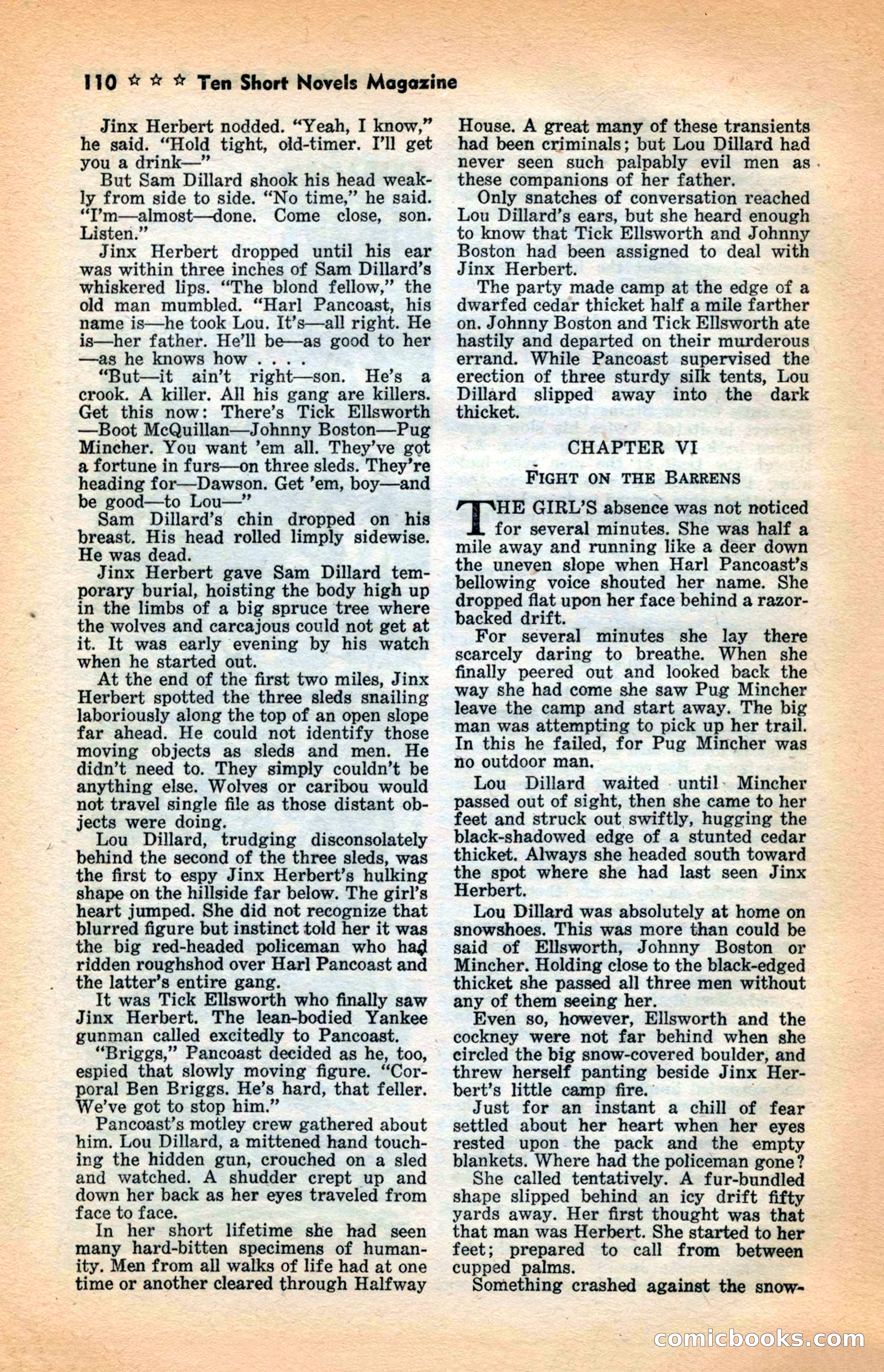
A restored page from Pulp Fiction, 1938. Page through the whole issue in the reader above.
📄 Transcribed text from this page (OCR, searchable)
Machine-transcribed from the original scan — historical spelling and the odd misread are preserved.
110 * * * Ten Short Novels Magazine Jinx Herbert nodded. “Yeah, I know,” he said. “Hold tight, old-timer. Ill get you a drink—” But Sam Dillard shook his head weak- ly from side to side. “No time,” he said. “T’m—almost—done. Come close, son. Listen.” Jinx Herbert dropped until his ear was within three inches of Sam Dillard’s whiskered lips. “The blond fellow,” the old man mumbled. “Harl Pancoast, his name is—he took Lou. It’s—all right. He is—her father. He’ll be—as good to her —as he knows how.... “But—it ain’t right—son. He’s a crook. A killer. All his gang are killers. Get this now: There’s Tick Ellsworth —Boot McQuillan—Johnny Boston—Pug Mincher. You want ’em all. They’ve got a fortune in furs—on three sleds. They’re heading for—Dawson. Get ’em, boy—and be good—to Lou—” Sam Dillard’s chin dropped on his breast. His head rolled limply sidewise. He was dead. Jinx Herbert gave Sam Dillard tem- porary burial, hoisting the body high up in the limbs of a big spruce tree where the wolves and carcajous could not get at it. It was early evening by his watch when he started out. At the end of the first two miles, Jinx Herbert spotted the three sleds snailing laboriously along the top of an open slope far ahead. He could not identify those moving objects as sleds and men. He didn’t need to. They simply couldn’t be anything else. Wolves or caribou would not travel single file as those distant ob- jects were doing. Lou Dillard, trudging disconsolately behind the second of the three sleds, was the first to espy Jinx Herbert’s hulking shape on the hillside far below. The girl’s heart jumped. She did not recognize that blurred figure but instinct told her it was the big red-headed policeman who hag ridden roughshod over Har] Pancoast and the latter’s entire gang. It was Tick Ellsworth who finally saw Jinx Herbert. The lean-bodied Yankee gunman called excitedly to Pancoast. “Briggs,” Pancoast decided as he, too, espied that slowly moving figure. “Cor- poral Ben Briggs. He’s hard, that feller. We've got to stop him.” Pancoast’s motley crew gathered about him. Lou Dillard, a mittened hand touch- ing the hidden gun, crouched on a sled and watched. A shudder crept up and down her back as her eyes traveled from face to face. In her short lifetime she had seen many hard-bitten specimens of human- ity. Men from all walks of life had at one time or another cleared through Halfway House. A great many of these transients had been criminals; but Lou Dillard had never seen such palpably evil men as. these companions of her father. Only snatches of conversation reached Lou Dillard’s ears, but she heard enough to know that Tick Ellsworth and Johnny Boston had been assigned to deal with Jinx Herbert. The party made camp at the edge of a dwarfed cedar thicket half a mile farther on. Johnny Boston and Tick Ellsworth ate hastily and departed on their murderous errand. While Pancoast supervised the erection of three sturdy silk tents, Lou Dillard slipped away into the dark thicket. CHAPTER VI FIGHT ON THE BARRENS HE GIRUL’S absence was not noticed for several minutes. She was half a mile away and running like a deer down the uneven slope when Harl Pancoast’s bellowing voice shouted her name. She dropped flat upon her face behind a razor- backed drift. For several minutes she lay there scarcely daring to breathe. When she finally peered out and looked back the way she had come she saw Pug Mincher leave the camp and start away. The big man was attempting to pick up her trail. In this he failed, for Pug Mincher was no outdoor man, Lou Dillard waited . until. Mincher passed out of sight, then she came to her feet and struck out swiftly, hugging the black-shadowed edge of a stunted cedar thicket. Always she headed south toward the spot where she had last seen Jinx Herbert. Lou Dillard was absolutely at home on snowshoes. This was more than could be said of Ellsworth, Johnny Boston or Mincher. Holding close to the black-edged thicket she passed all three men without any of them seeing her. Even so, however, Ellsworth and the cockney were not far behind when she circled the big snow-covered boulder, and threw herself panting beside Jinx Her- bert’s little camp fire.’ Just for an instant a chill of fear settled about her heart when her eyes rested upon the pack and the empty blankets. Where had the policeman gone? She called tentatively. A fur-bundled shape slipped behind an icy drift fifty yards away. Her first thought was that that man was Herbert. She started to her feet; prepared to call from between cupped palms. Something crashed against the snow- Gomichbooks