
Pulp Fiction, 1938 · page 99 of 148
10 Short Novels Magazine — page 99: what you’re looking at
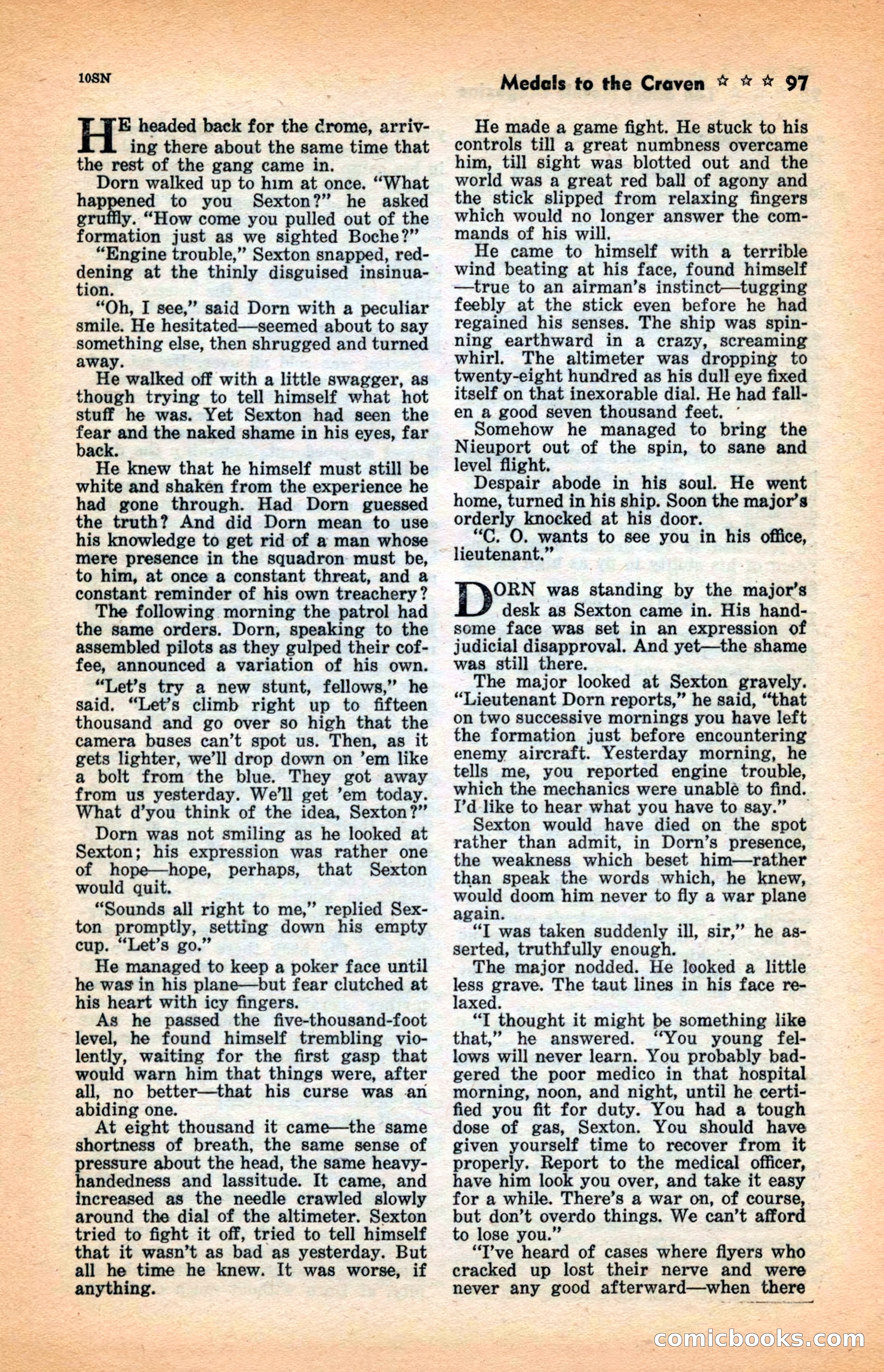
A restored page from Pulp Fiction, 1938. Page through the whole issue in the reader above.
📄 Transcribed text from this page (OCR, searchable)
Machine-transcribed from the original scan — historical spelling and the odd misread are preserved.
E headed back for the Crome, arriv- ing there about the same time that the rest of the gang came in. Dorn walked up to him at once. “What Bn 4 eige to you Sexton?” he asked grufily. “How come you pulled out of the formation just as we sighted Boche?” “Engine trouble,” Sexton snapped, red- — at the thinly disguised insinua- ion. “Oh, I see,” said Dorn with a peculiar smile. He hesitated—seemed about to say something else, then shrugged and turned away. He walked off with a little swagger, as though trying to tell himself what hot stuff he was. Yet Sexton had seen the pert and the naked shame in his eyes, far ack. He knew that he himself must still be white and shaken from the experience he had gone through. Had Dorn guessed the truth? And did Dorn mean to use his knowledge to get rid of a man whose mere presence in the squadron must be, to him, at once a constant threat, and a constant reminder of his own treachery? The following morning the patrol had the same orders. Dorn, speaking to the assembled pilots as they gulped their cof- fee, announced a variation of his own. “Let’s try a new stunt, fellows,” he said. “Let’s climb right up to fifteen thousand and go over so high that the camera buses can’t spot us. Then, as it gets lighter, we’ll drop down on ’em like a bolt from the blue. They got away from us yesterday. We'll get ’em today. What d’you think of the idea, Sexton?” Dorn was not smiling as he looked at Sexton; his expression was rather one of hope—hope, perhaps, that Sexton would quit. “Sounds all right to me,” replied Sex- ton promptly, setting down his empty cup. “Let’s go.” He managed to keep a poker face until he was in his plane—but fear clutched at his heart with icy fingers. As he passed the five-thousand-foot level, he found himself trembling vio- lently, waiting for the first gasp that would warn him that things were, after all, no better—that his curse was an abiding one. At eight thousand it came—the same shortness of breath, the same sense of ressure about the head, the same heavy- andedness and lassitude. It came, and increased as the needle crawled slowly around the dial of the altimeter. Sexton tried to fight it off, tried to tell himself that it wasn’t as bad as yesterday. But all he time he knew. It was worse, if anything He made a game fight. He stuck to his controls till a great numbness overcame him, till sight was blotted out and the world was a great red ball of agony and the stick slipped from relaxing fingers which would no longer answer the com- mands of his will. He came to himself with a terrible wind beating at his face, found himself —true to an airman’s instinct—tugging feebly at the stick even before he had regained his senses. The ship was spin- ning earthward in a crazy, screaming whirl. The altimeter was dropping to twenty-eight hundred as his dull eye fixed itself on that inexorable dial. He had fall- en a good seven thousand feet. ° Somehow he managed to bring the Nieuport out of the spin, to sane and level flight. Despair abode in his soul. He went home, turned in his ship. Soon the major’s orderly knocked at his door. “C, O. wants to see you in his office, lieutenant.” ORN was standing by the major’s desk as Sexton came in. His hand- some face was set in an expression of judicial disapproval. And yet—the shame was still there. The major looked at Sexton gravely. “Lieutenant Dorn reports,” he said, “that on two successive mornings you have left the formation just before encountering enemy aircraft. Yesterday morning, he tells me, you reported engine trouble, which the mechanics were unable to find. I’d like to hear what you have to say.” Sexton would have died on the spot rather than admit, in Dorn’s presence, the weakness which beset him—rather than speak the words which, he knew, would doom him never to fly a war plane again. “T was taken suddenly ill, sir,” he as- serted, truthfully enough. The major nodded. He looked a little less grave. The taut lines in his face re- laxed. “T thought it might be something like that,” he answered. “You young fel- lows will never learn. You probably bad- gered the poor medico in that hospital morning, noon, and night, until he certi- fied you fit for duty. You had a tough dose of gas, Sexton. You should have given yourself time to recover from it properly. Report to the medical officer, have him look you over, and take it easy for a while. There’s a war on, of course but don’t overdo things. We can’t afford to lose you.” “T’ve heard of cases where flyers who cracked up lost their nerve and were Medals to the Craven * * * 97 never any good afterward—when there CONMIC OOO KS