
Pulp Fiction, 1938 · page 127 of 148
10 Short Novels Magazine — page 127: what you’re looking at
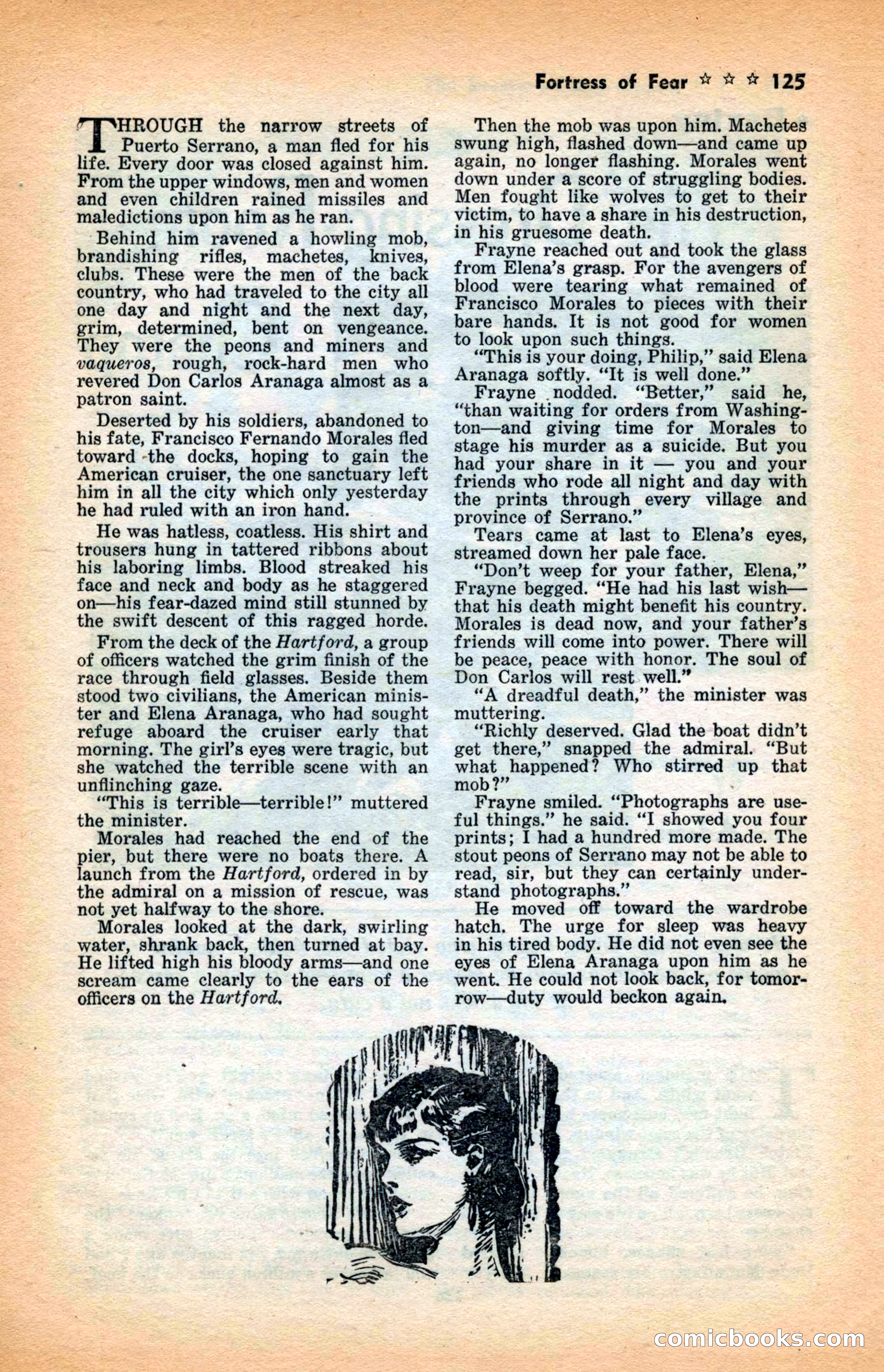
A restored page from Pulp Fiction, 1938. Page through the whole issue in the reader above.
📄 Transcribed text from this page (OCR, searchable)
Machine-transcribed from the original scan — historical spelling and the odd misread are preserved.
HROUGH the narrow streets of Puerto Serrano, a man fled for his life. Every door was closed against him. From the upper windows, men and women and even children rained missiles and maledictions upon him as he ran. ‘Behind him ravened a howling mob, brandishing rifles, machetes, knives, clubs. These were the men of the back country, who had traveled to the city all one day and night and the next day, grim, determined, bent on vengeance. They were the peons and miners and vaqueros, rough, rock-hard men who revered Don Carlos Aranaga almost as a patron saint. Deserted by his soldiers, abandoned to his fate, Francisco Fernando Morales fled toward -the docks, hoping to gain the American cruiser, the one sanctuary left him in all the city which only yesterday he had ruled with an iron hand. He was hatless, coatless. His shirt and trousers hung in tattered ribbons about his laboring limbs. Blood streaked his face and neck and body as he staggered on—his fear-dazed mind still stunned by the swift descent of this ragged horde. From the deck of the Hartford, a group of officers watched the grim finish of the race through field glasses. Beside them stood two civilians, the American minis- ter and Elena Aranaga, who had sought refuge aboard the cruiser early that morning. The girl’s eyes were tragic, but she watched the terrible scene with an unflinching gaze. “This is terrible—terrible!” muttered the minister. Morales had reached the end of the pier, but there were no boats there. A launch from the Hartford, ordered in by the admiral on a mission of rescue, was not yet halfway to the shore. Morales looked at the dark, swirling water, shrank back, then turned at bay. He lifted high his bloody arms—and one scream came clearly to the ears of the officers on the Hartford, Fortress of Fear woe 125 Then the mob was upon him. Machetes swung high, flashed down—and came up again, no longer flashing. Morales went down under a score of struggling bodies. Men fought like wolves to get to their victim, to have a share in his destruction, in his gruesome death. Frayne reached out and took the glass from Elena’s grasp. For the avengers of blood were tearing what remained of Francisco Morales to pieces with their bare hands. It is not good for women to look upon such things. “This is your doing, Philip,” said Elena Aranaga softly. “It is well done.” Frayne nodded. “Better,” said he, “than waiting for orders from Washing- ton—and giving time for Morales to stage his murder as a suicide. But you had your share in it — you and your friends who rode all night and day with the prints through every village and province of Serrano.” Tears came at last to Elena’s eyes, streamed down her pale face. “Don’t weep for your father, Elena,” Frayne begged. “He had his last wish— that his death might benefit his country. Morales is dead now, and your father’s friends will come into power. There will be peace, peace with honor. The soul of Don Carlos will rest. well.” “A dreadful death,” the minister was muttering. “Richly deserved. Glad the boat didn’t get there,” snapped the admiral. “But what happened? Who stirred up that mob?” Frayne smiled. “Photographs are use- ful things.” he said. “I showed you four prints; I had a hundred more made. The stout peons of Serrano may not be able to read, sir, but they can certainly under- stand photographs,” He moved off toward the wardrobe hatch. The urge for sleep was heavy in his tired body. He did not even see the eyes of Elena Aranaga upon him as he went. He could not look back, for tomor- row—duty would beckon again, (E0) 0(0)(0)|<