
Pulp Fiction, 1938 · page 103 of 148
10 Short Novels Magazine — page 103: what you’re looking at
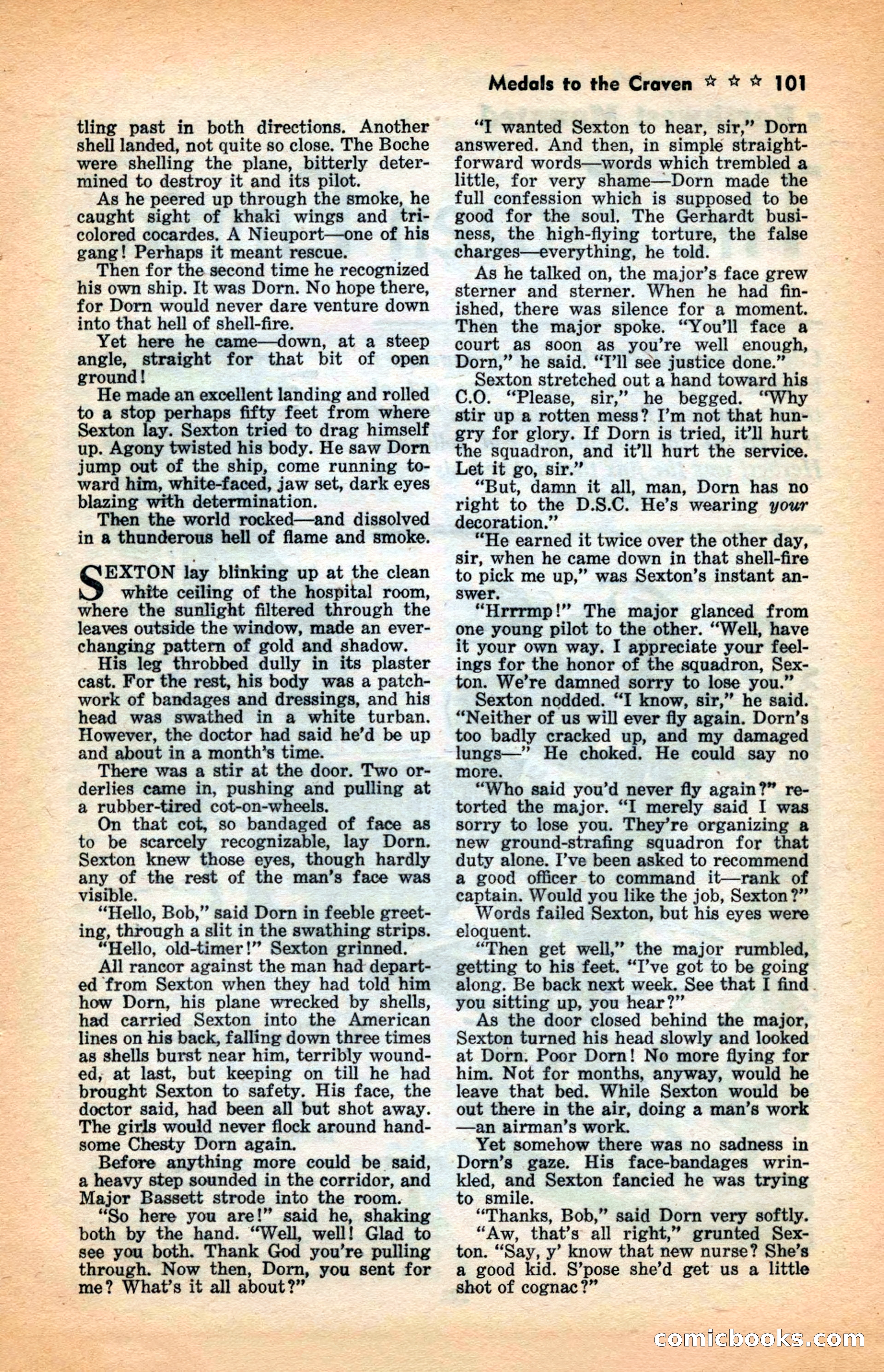
A restored page from Pulp Fiction, 1938. Page through the whole issue in the reader above.
📄 Transcribed text from this page (OCR, searchable)
Machine-transcribed from the original scan — historical spelling and the odd misread are preserved.
tling past in both directions. Another shell landed, not quite so close. The Boche were shelling the plane, bitterly deter- mined to destroy it and its pilot. As he peered up through the smoke, he caught sight of khaki wings and tri- colored cocardes. A Nieuport—one of his gang! Perhaps it meant rescue. Then for the second time he recognized his own ship. It was Dorn. No hope there, for Dorn would never dare venture down into that hell of shell-fire. Yet here he came—down, at a steep angle, straight for that bit of open ground! He made an excellent landing and rolled toas perhaps fifty feet from where Sexton lay. Sexton tried to drag himself up. Agony twisted his body. He saw Dorn jump out of the ship, come running to- ward him, white-faced, jaw set, dark eyes blazing with determination. Then the world rocked—and dissolved in a thunderous hell of flame and smoke. EXTON lay blinking up at the clean J white ceiling of the hospital room, where the sunlight filtered through the leaves outside the window, made an ever- changing pattern of gold and shadow. _ His leg throbbed dully in its plaster cast. For the rest, his body was a patch- work of bandages and dressings, and his head was swathed in a white turban. However, the doctor had said he’d be up and about in a month’s time. here was a stir at the door. Two or- derlies came in, pushing and pulling at a rubber-tired cot-on-wheels. On that cot, so bandaged of face as to be scarcely recognizable, lay Dorn. Sexton knew those eyes, though hardly any of the rest of the man’s face was visible. “Hello, Bob,” said Dorn in feeble greet- ing, through a slit in the swathing strips. “Hello, old-timer!” Sexton grinned. All rancor against the man had depart- ed from Sexton when they had told him how Dorn, his plane wrecked by shells, had carried Sexton into the American lines on his back, falling down three times as shells burst near him, terribly wound- ed, at last, but keeping on till he had brought Sexton to safety. His face, the doctor said, had been all but shot away. The girls would never flock around hand- some Chesty Dorn again. Before anything more could be said, a heavy step sounded in the corridor, and Major Bassett strode into the room. “So here you are!” said he, shaking both by the hand. “Well, well! Glad to see you both. Thank God you’re pulling through. Now then, Dorn, you sent for _ me? What’s it all about?” Medals to the Craven * * * 101 “T wanted Sexton to hear, sir,” Dorn answered. And then, in simple straight- forward words—words which trembled a little, for very shame—Dorn made the full confession which is supposed to be good for the soul. The Gerhardt busi- ness, the high-flying torture, the false charges—everything, he told. As he talked on, the major’s face grew sterner and sterner. When he had fin- ished, there was silence for a moment. Then the major spoke. “You’ll face a court as soon as you’re well enough, Dorn,” he said. “I'll see justice done.” Sexton stretched out a hand toward his C.0. “Please, sir,” he begged. “Why stir up a rotten mess? I’m not that hun- gry for glory. If Dorn is tried, itll hurt the squadron, and it’ll hurt the service. Let it go, sir.” “But, damn it all, man, Dorn has no right to the D.S.C. He’s wearing your decoration.” “He earned it twice over the other day, sir, when he came down in that shell-fire to pick me up,” was Sexton’s instant an- swer. “Hrrrmp!” The major glanced from one young pilot to the other. “Well, have it your own way. I appreciate your feel- ings for the honor of the squadron, Sex- ton. We’re damned sorry to lose you.” Sexton nodded. “I know, sir,” he said. “Neither of us will ever fly again. Dorn’s too badly cracked up, and my damaged lungs—”’ He choked. He could say no more. ; “Who said you’d never fly again?” re- torted the major. “I merely said I was sorry to lose you. They’re organizing a new ground-strafing squadron for that duty alone. I’ve been asked to recommend a good officer to command it—rank of captain. Would you like the job, Sexton?” Words failed Sexton, but his eyes were eloquent. “Then get well,” the major rumbled, getting to his feet. “I’ve got to be going along. Be back next week. See that I find. you sitting up, you hear?” As the door closed behind the major, Sexton turned his head slowly and looked at Dorn. Poor Dorn! No more flying for him. Not for months, anyway, would he leave that bed. While Sexton would be out there in the air, doing a man’s work —an airman’s work. Yet somehow there was no sadness in Dorn’s gaze. His face-bandages wrin- kled, and Sexton fancied he was trying to smile. “Thanks, Bob,” said Dorn very softly. “Aw, that’s all right,” grunted Sex- ton. “Say, y’ know that new nurse? She’s _. a good kid. S’pose she’d get us a little shot of cognac?” (€(0) ,OO S E