
Pulp Fiction, 1938 · page 135 of 148
10 Short Novels Magazine — page 135: what you’re looking at
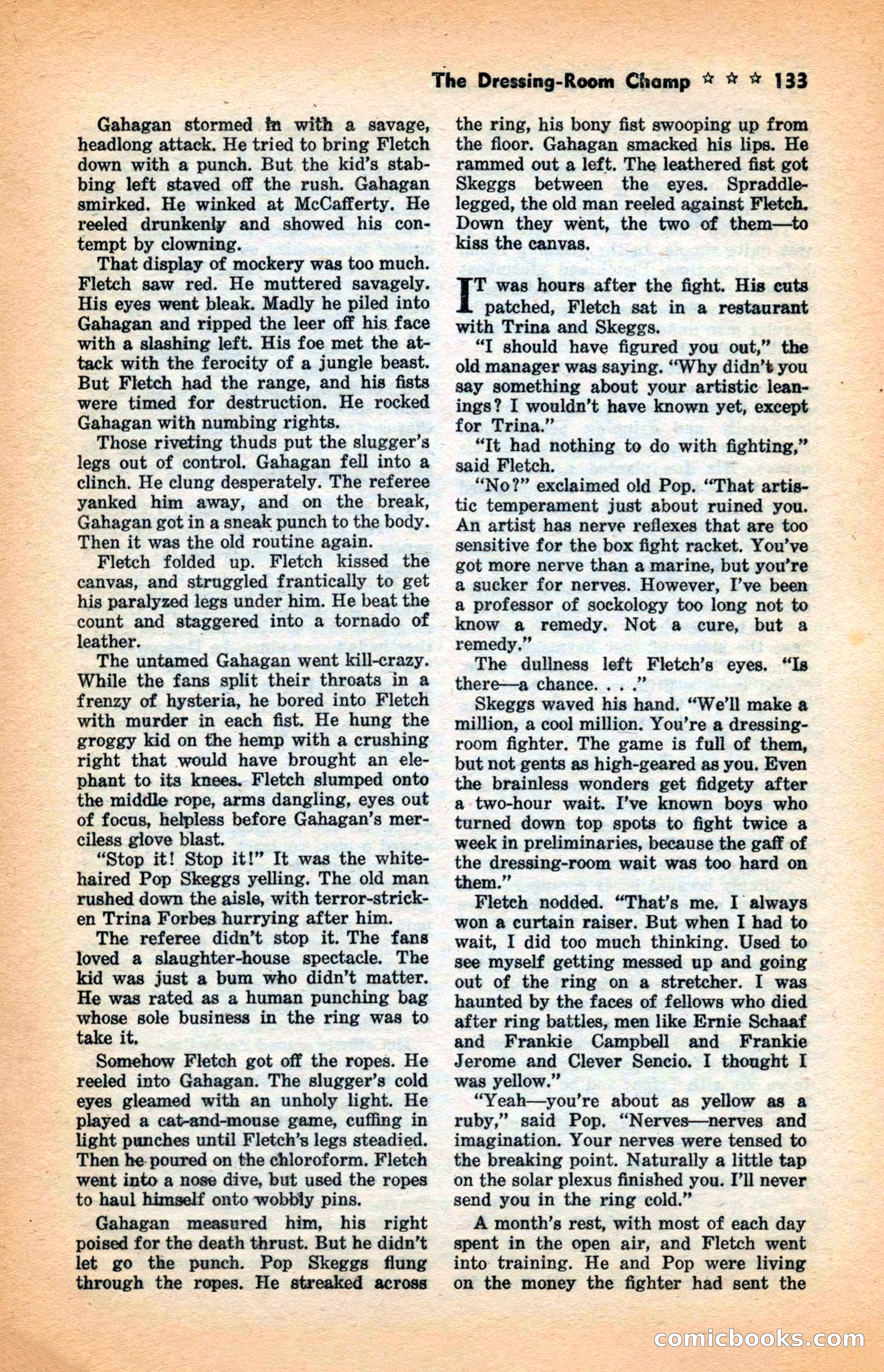
A restored page from Pulp Fiction, 1938. Page through the whole issue in the reader above.
📄 Transcribed text from this page (OCR, searchable)
Machine-transcribed from the original scan — historical spelling and the odd misread are preserved.
Wa \y v sh SANE Cone, rab 4 th BP 7 : Gahagan stormed im with a savage, headlong attack. He tried to bring Fletch down with a punch. But the kid’s stab- bing left staved off the rush. Gahagan smirked. He winked at McCafferty. He reeled drunkenly and showed his con- tempt by clowning. That display of mockery was too much. Fletch saw red. He muttered savagely. His eyes went bleak. Madly he piled into Gahagan and ripped the leer off his face with a slashing left. His foe met the at- tack with the ferocity of a jungle beast. But Fletch had the range, and his fists were timed for destruction. He rocked Gahagan with numbing rights. Those riveting thuds put the slugger’s legs out of control. Gahagan fell into a clinch. He clung desperately. The referee yanked him away, and on the break, Gahagan got in a sneak punch to the body. Then it was the old routine again. Fletch folded up. Fletch kissed the canvas, and struggled frantically to get his paralyzed legs under him. He beat the count and staggered into a tornado of leather. The untamed Gahagan went kill-crazy. While the fans split their throats in a frenzy of hysteria, he bored into Fletch with murder in each fist. He hung the groggy kid on the hemp with a crushing right that would have brought an ele- phant to its knees. Fletch slumped onto the middle rope, arms dangling, eyes out of focus, helpless before Gahagan’s mer- ciless glove blast. “Stop it! Stop it!” It was the white- haired Pop Skeggs yelling. The old man rushed down the aisle, with terror-strick- en Trina Forbes hurrying after him. The referee didn’t stop it. The fans loved a slaughter-house spectacle. The kid was just a bum who didn’t matter. He was rated as a human punching bag whose sole business in the ring was to take it, Somehow Fletch got off the ropes. He reeled into Gahagan. The slugger’s cold eyes gleamed with an unholy light. He _ played a cat-and-mouse game, cufling in light punches until Fletch’s legs steadied. Then he poured on the chloroform, Fletch went into a nose dive, but used the ropes to haul himself onto wobbly pins. Gahagan measured him, his right poised for the death thrust. But he didn’t let go the punch. Pop Skeggs flung through the ropes. He streaked across — The Dressing-Room Champ * * * 133 the ring, his bony fist swooping up from the fioor. Gahagan smacked his lips. He rammed out a left. The leathered fist got Skeggs between the eyes. Spraddle- legged, the old man reeled against Fletch. Down they went, the two of them—to kiss the canvas. T was hours after the fight. His cuts patched, Fletch sat in a restaurant with Trina and Skeggs. “T should have figured you out,” the old manager was saying. “Why didn’t you say something about your artistic lean- ings? I wouldn’t have known yet, except for Trina.” “It had nothing to do with fighting,” said Fletch. “No?” exclaimed old Pop. “That artis- tic temperament just about ruined you. An artist has nerve reflexes that are too sensitive for the box fight racket. You’ve got more nerve than a marine, but you’re a sucker for nerves. However, I’ve been a professor of sockology too long not to know a remedy. Not a cure, but a remedy.” The dullness left Fletch’s eyes. “Is there—a chance... .” Skeggs waved his hand. “We'll make a million, a coo] million. You’re a dressing- room fighter. The game is full of them, but not gents as high-geared as you. Even the brainless wonders get fidgety after a two-hour wait. I’ve known boys who turned down top spots to fight twice a week in preliminaries, because the gaff of the dressing-room wait was too hard on them.” Fletch nodded. “That’s me. I always won a curtain raiser. But when I had to wait, I did too much thinking. Used to see myself getting messed up and going out of the ring on a stretcher. I was haunted by the faces of fellows who died after ring battles, men like Ernie Schaaf and Frankie Campbell and Frankie Jerome and Clever Sencio. I thought I was yellow.” “Yeah—you’re about as yellow as a ruby,” said Pop. “Nerves—nerves and imagination. Your nerves were tensed to the breaking point. Naturally a little tap on the solar plexus finished you. I’ll never send you in the ring cold.” A month’s rest, with most of each day spent in the open air, and Fletch went into training. He and Pop were living on the money the fighter had sent the Gomichooks