
Pulp Fiction, 1938 · page 142 of 148
10 Short Novels Magazine — page 142: what you’re looking at
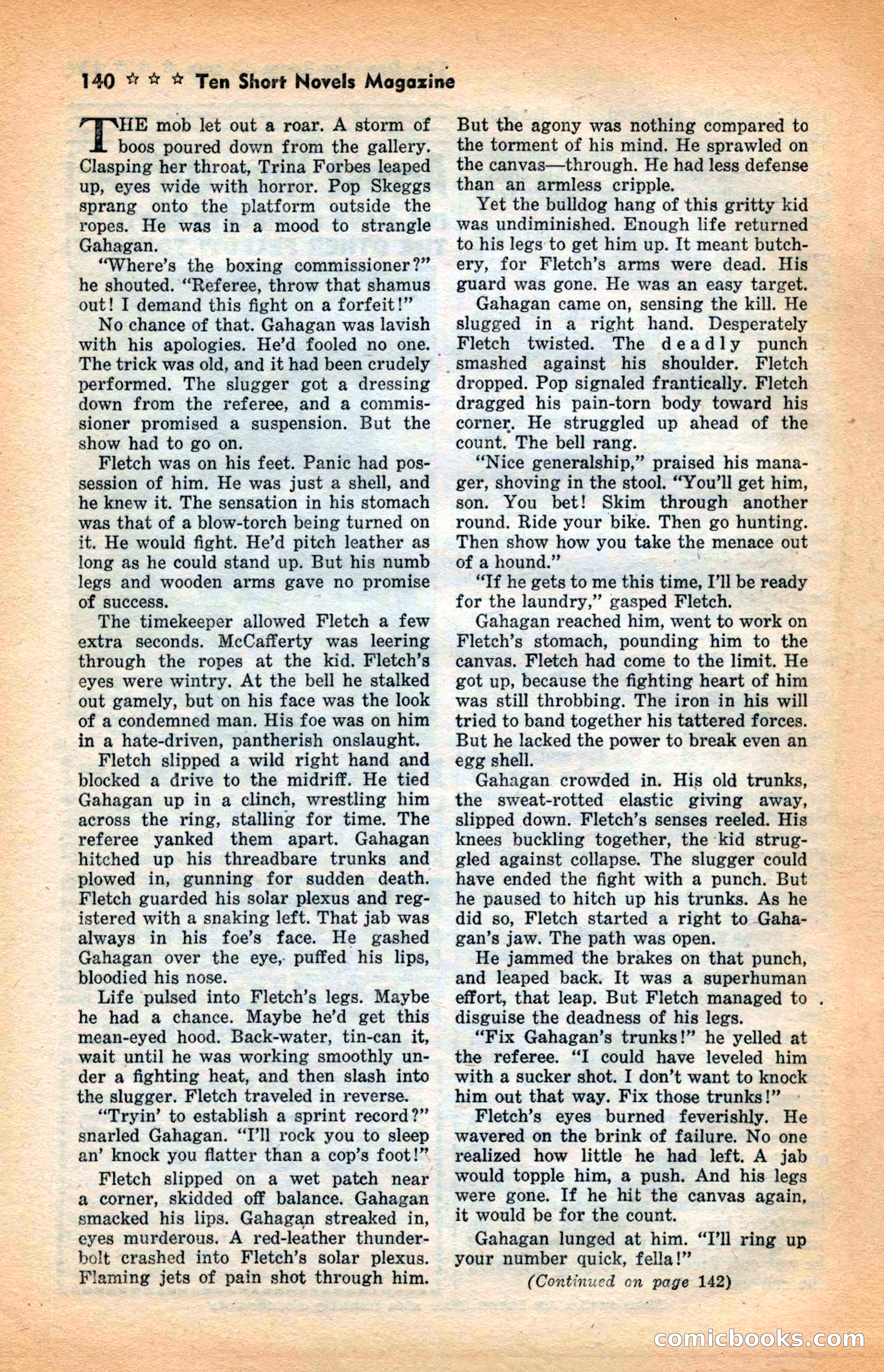
A restored page from Pulp Fiction, 1938. Page through the whole issue in the reader above.
📄 Transcribed text from this page (OCR, searchable)
Machine-transcribed from the original scan — historical spelling and the odd misread are preserved.
140 * % © Ten Short Novels Magazine HE mob let out a roar. A storm of boos poured down from the gallery. Clasping her throat, Trina Forbes leaped up, eyes wide with horror. Pop Skeggs sprang onto the platform outside the ropes. He was in a mood to strangle Gahagan. “Where’s the boxing commissioner?” he shouted. “Referee, throw that shamus out! I demand this fight on a forfeit!” No chance of that. Gahagan was lavish with his apologies. He’d fooled no one. The trick was old, and it had been crudely performed. The slugger got a dressing down from the referee, and a commis- sioner promised a suspension. But the show had to go on. Fletch was on his feet. Panic had pos- session of him. He was just a shell, and he knew it. The sensation in his stomach was that of a blow-torch being turned on it. He would fight. He’d pitch leather as long as he could stand up. But his numb legs and wooden arms gave no promise of success. The timekeeper allowed Fletch a few extra seconds. McCafferty was leering through the ropes at the kid. Fletch’s eyes were wintry. At the bell he stalked out gamely, but on his face was the look of a condemned man. His foe was on him in a hate-driven, pantherish onslaught. Fletch slipped a wild right hand and blocked a drive to the midriff. He tied Gahagan up in a clinch, wrestling him across the ring, stalling for time. The referee yanked them apart. Gahagan hitched up his threadbare trunks and plowed in, gunning for sudden death. Fletch guarded his solar plexus and reg- istered with a snaking left. That jab was always in his foe’s face. He gashed Gahagan over the eye, puffed his lips, bloodied his nose. Life pulsed into Fletch’s legs. Maybe he had a chance. Maybe he’d get this mean-eyed hood. Back-water, tin-can it, wait until he was working smoothly un- der a fighting heat, and then slash into the slugger. Fletch traveled in reverse. “Tryin’ to establish a sprint record?” snarled Gahagan. “TI’ll rock you to sleep an’ knock you flatter than a cop’s foot!” Fletch slipped on a wet patch near a corner, skidded off balance. Gahagan smacked his lips. Gahagan streaked in, eyes murderous. A red-leather thunder- bolt crashed into Fletch’s solar plexus. Flaming jets of pain shot through him. But the agony was nothing compared to the torment of his mind. He sprawled on the canvas—through. He had less defense than an armless cripple. Yet the bulldog hang of this gritty kid was undiminished. Enough life returned to his legs to get him up. It meant butch- ery, for Fletch’s arms were dead. His guard was gone. He was an easy target. Gahagan came on, sensing the kill. He slugged in a right hand. Desperately Fletch twisted. The deadly punch © - smashed against his shoulder. Fletch dropped. Pop signaled frantically. Fletch dragged his pain-torn body toward his corner. He struggled up ahead of the count. The bell rang. “Nice generalship,” praised his mana- ger, shoving in the stool. “You’ll get him, son. You bet! Skim through another round. Ride your bike. Then go hunting. Then show how you take the menace out of a hound.” 3 “Tf he gets to me this time, I’ll be ready for the laundry,” gasped Fletch. Gahagan reached him, went to work on Fletch’s stomach, pounding him to the canvas, Fletch had come to the limit. He got up, because the fighting heart of him was still throbbing. The iron in his will tried to band together his tattered forces. But he lacked the power to break even an egg shell. Gahagan crowded in. His old trunks, the sweat-rotted elastic giving away, slipped down. Fletch’s senses reeled. His knees buckling together, the kid strug- gled against collapse. The slugger could have ended the fight with a punch. But he paused to hitch up his trunks. As he did so, Fletch started a right to Gaha- gan’s jaw. The path was open. He jammed the brakes on that punch, and leaped back. It was a superhuman effort, that leap. But Fletch managed to . disguise the deadness of his legs. “Fix Gahagan’s trunks!” he yelled at | the referee. “I could have leveled him with a sucker shot. I don’t want to knock him out that way. Fix those trunks!” Fletch’s eyes burned feverishly. He wavered on the brink of failure. No one realized how little he had left. A jab would topple him, a push. And his legs were gone. If he hit the canvas again, it would be for the count. Gahagan lunged at him. “T’ll ring up your number quick, fella!” (Continued on page 142) Serer