
A complete issue · 104 pages · 1911
Life — January 5, 1911
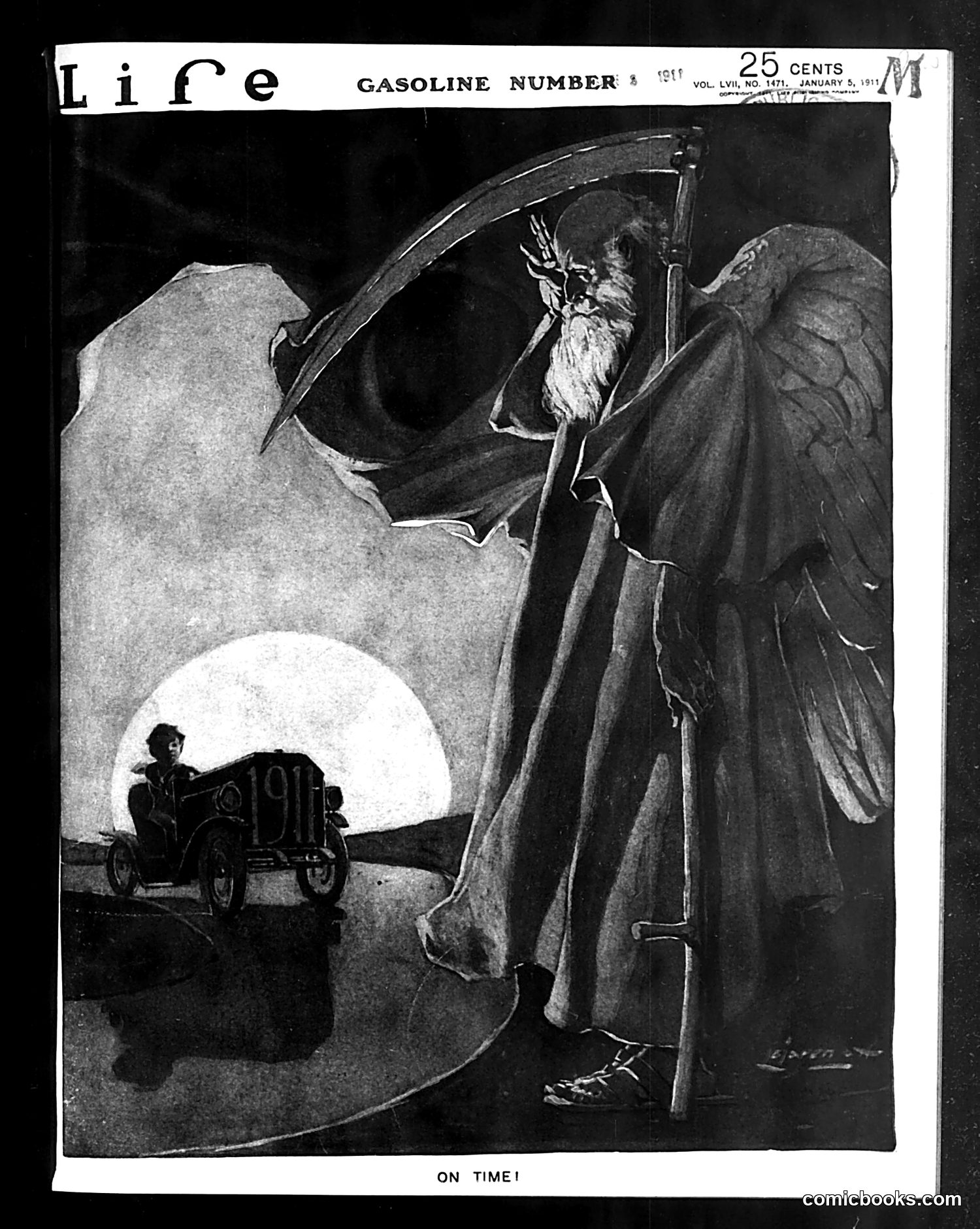
This is a satirical cover illustrating concerns about automotive reliability and punctuality in the early 1910s. The image depicts Death (the Grim Reaper, identifiable by his scythe and skull-faced appearance) looming over a moonlit landscape where an early automobile speeds along. The juxtaposition suggests that cars—despite their modern promise of efficiency and being "on time"—are dangerously fast and potentially lethal. The "Gasoline Number" subtitle indicates this issue focused on automobiles. The satire critiques how motorists prioritize speed and schedule-keeping over safety, with Death waiting as an inevitable consequence of reckless driving. This reflects early-1910s anxieties about automobiles as new, uncontrolled, and genuinely dangerous machines on public roads.
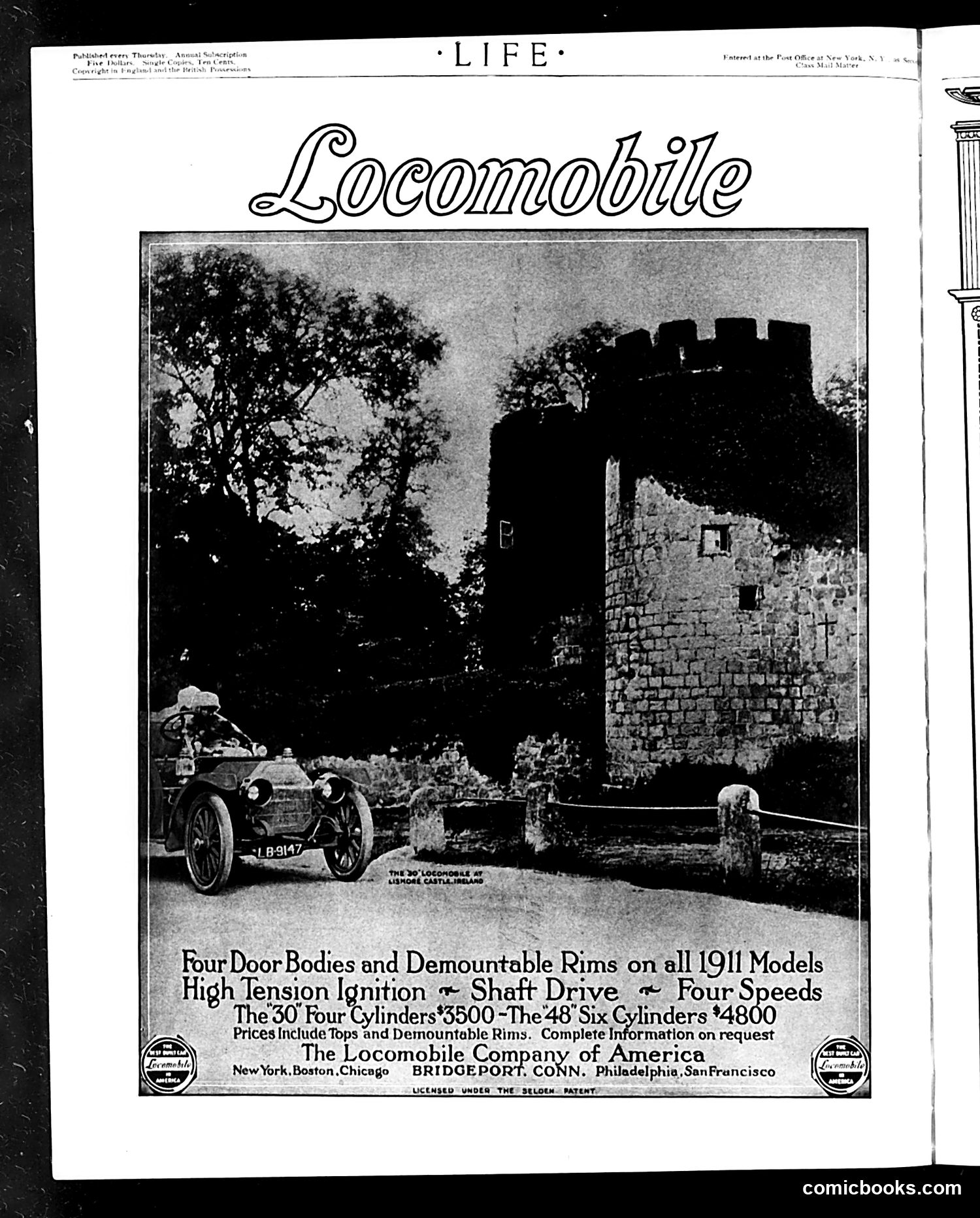
This page is **primarily an automobile advertisement**, not satirical content. It promotes the Locomobile, a luxury car manufactured by The Locomobile Company of America. The image shows a 1911 Locomobile parked before what appears to be a medieval castle (likely Warwick Castle in England, based on the caption visible in the photo). The advertisement emphasizes prestige features: four-door bodies, demountable rims, high-tension ignition, shaft drive, and four speeds. Two models are listed—the "30" Four Cylinder at $3,500 and the "48" Six Cylinder at $4,800. This is a typical early automotive advertisement emphasizing both technical specifications and aspirational lifestyle imagery (the castle setting suggesting wealth and sophistication). There is no political satire or cartoon commentary present on this page.
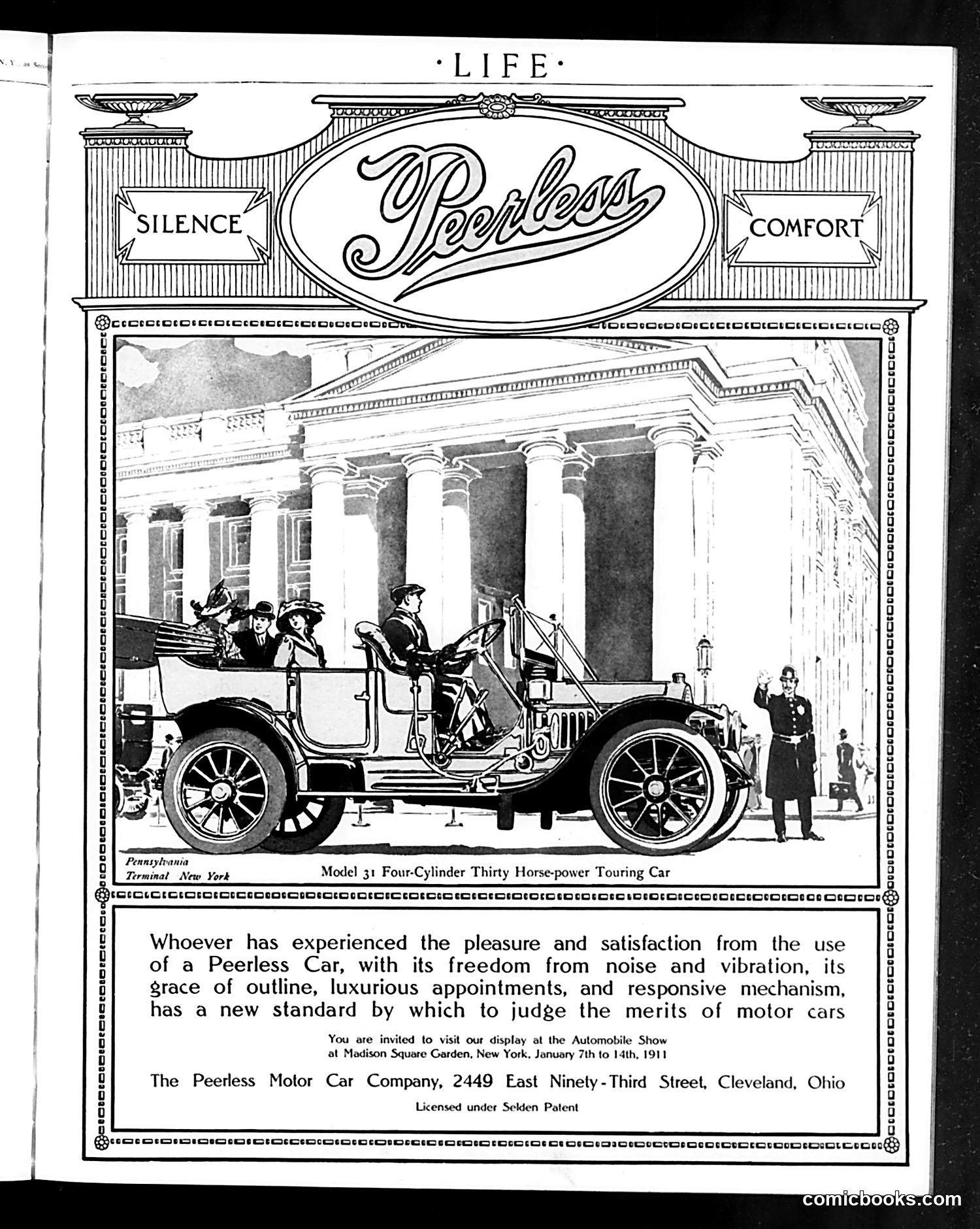
This is primarily a **Peerless automobile advertisement**, not satirical content. The page appeared in *Life* magazine around 1911 and promotes the Peerless Motor Car Company's Model 31 touring car. The advertisement emphasizes luxury and prestige rather than humor or satire. The classical architectural setting (with columns labeled "Silence" and "Comfort") and well-dressed passengers suggest the car appeals to wealthy, refined consumers. The Pennsylvania Terminal and reference to the New York Automobile Show indicate this targets an affluent urban audience. The tagline about establishing "a new standard by which to judge the merits of motor cars" positions Peerless as a premium competitor in the emerging automotive market. This is straightforward period advertising, not political commentary or cartoonish satire.
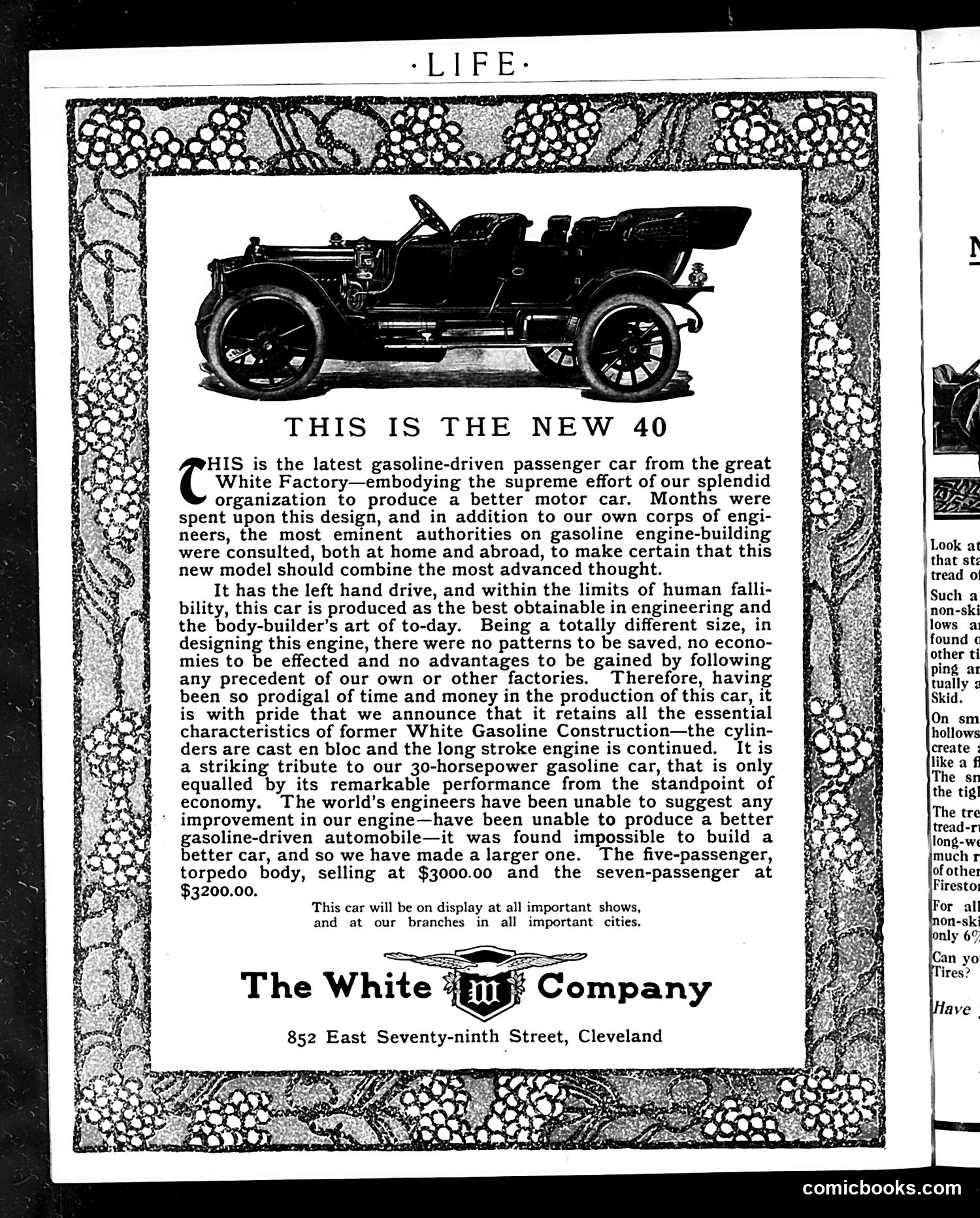
This page is **primarily an advertisement**, not satirical content. It promotes The White Company's new automobile model, the "40." The ad emphasizes the car's advanced engineering, claiming it represents the pinnacle of gasoline-engine automobile design. It highlights features like left-hand drive and notes the company spent considerable time and money developing the engine without borrowing from competitors' designs. The ad mentions two models: a two-passenger torpedo body at $3,000 and a seven-passenger version at $3,200—substantial prices for the era, suggesting this was a luxury vehicle. There is no political satire or cartoon humor here. This is straightforward early-automotive marketing in *Life* magazine, leveraging the publication's circulation to reach affluent readers interested in new technology.
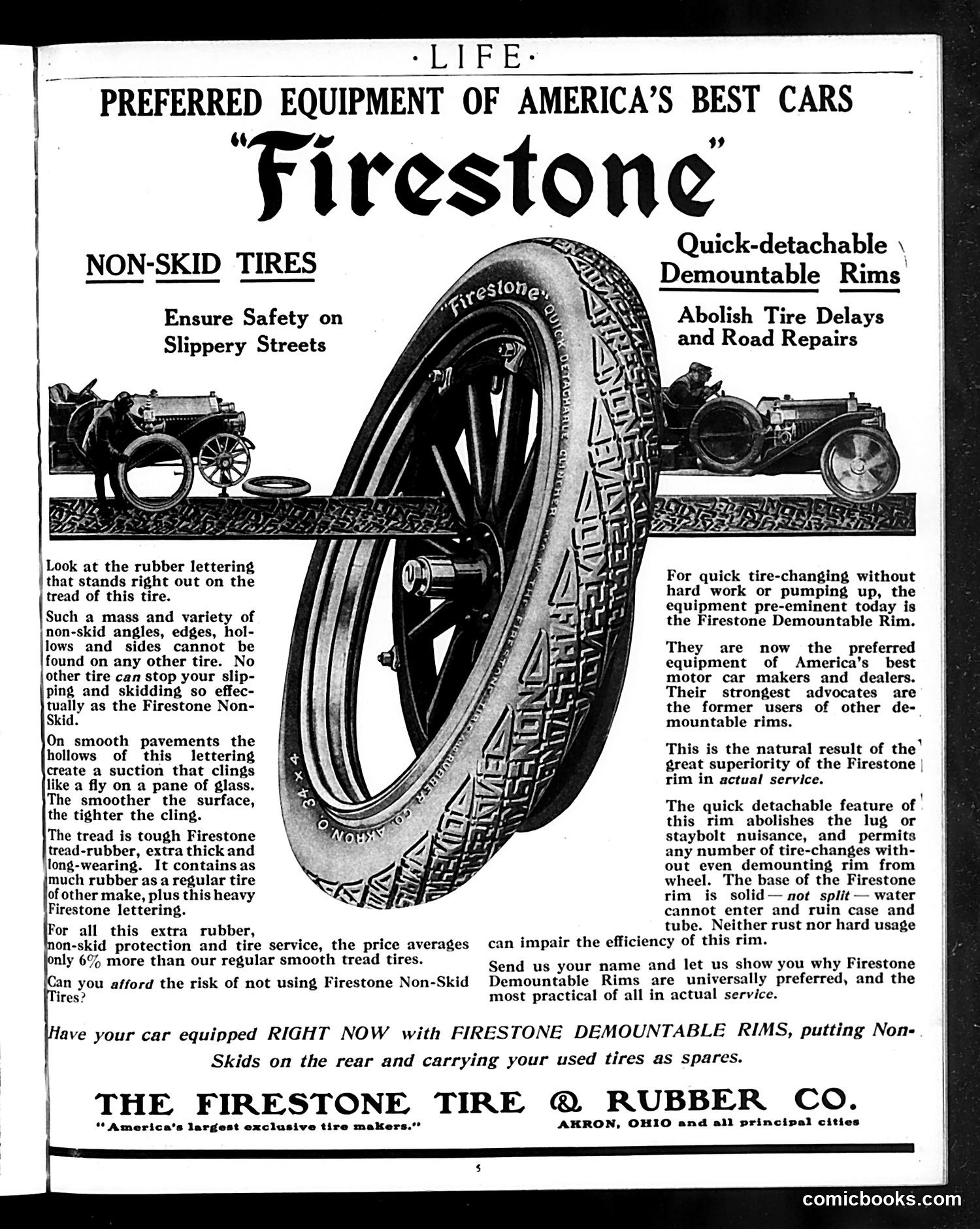
This page is primarily a **Firestone Tire & Rubber Company advertisement**, not satire or political commentary. The ad promotes two Firestone products: Non-Skid Tires (for safety on slippery surfaces) and Quick-detachable Demountable Rims (for faster tire changes). The visual shows a large tire in cross-section with detailed tread patterns, flanked by early automobiles. The text emphasizes Firestone's superiority over competitors, claiming their tires contain more rubber and their rims are "universally preferred" by car makers and dealers. The ad targets car owners concerned with safety and convenience—practical appeals for the era when tire changes were labor-intensive and road conditions unpredictable. There is no political satire here; this is straightforward product marketing from early 20th-century *Life* magazine.
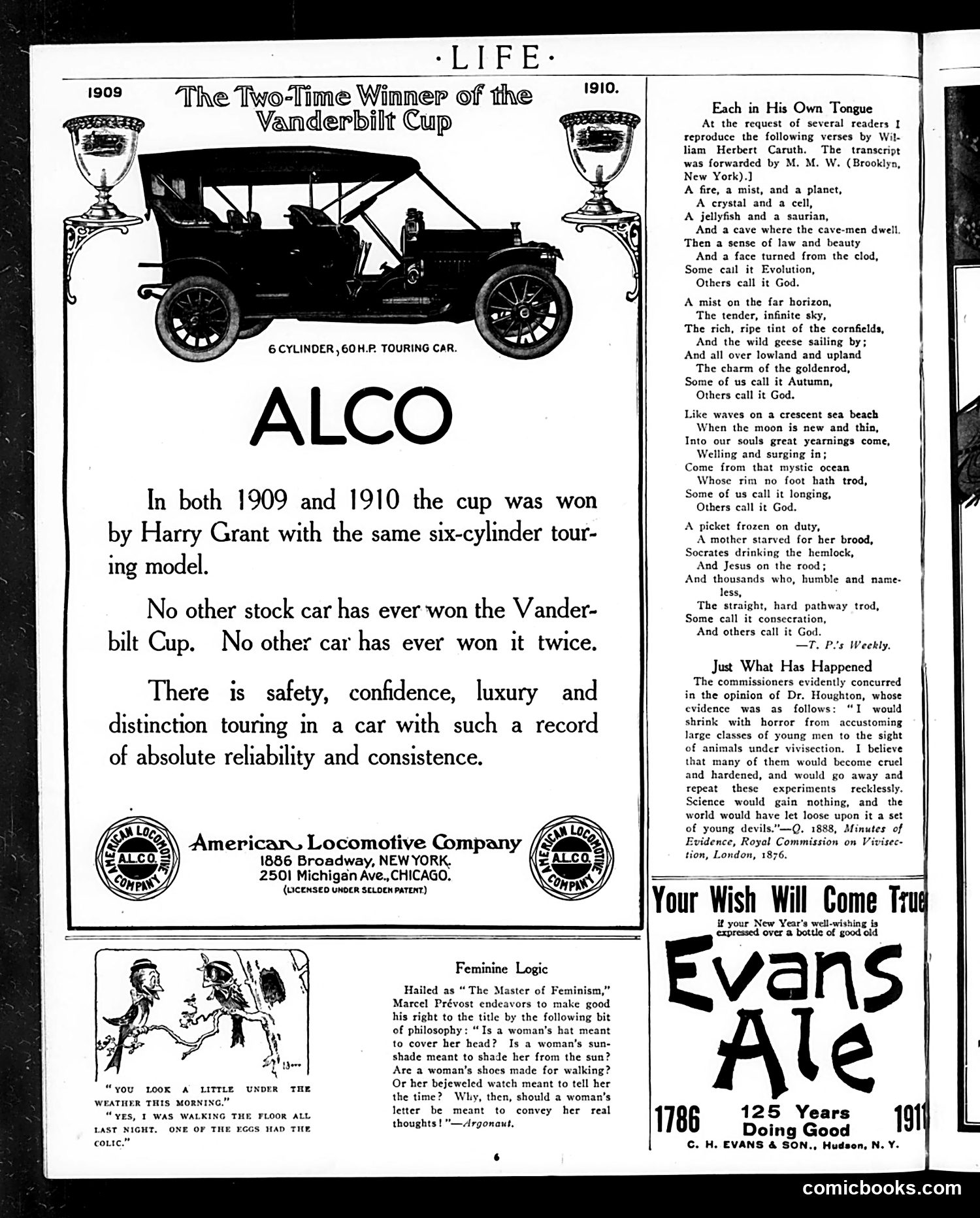
This page is primarily **advertising and literary content** rather than political satire. The dominant feature is an **ALCO automobile advertisement** celebrating the car's two consecutive Vanderbilt Cup victories (1909-1910), won by driver Harry Grant. The ad emphasizes reliability and luxury as selling points. Below is a small cartoon titled "Feminine Logic" mocking women's reasoning, with a joke about eggs and colic—typical period sexist humor. The right column contains **"Each in His Own Tongue,"** a philosophical poem by William Herbert Caruth reflecting on nature and belief, followed by a brief satirical item about Dr. Houghton's vivisection experiments. The **Evans Ale advertisement** occupies the lower right, celebrating 125 years in business.
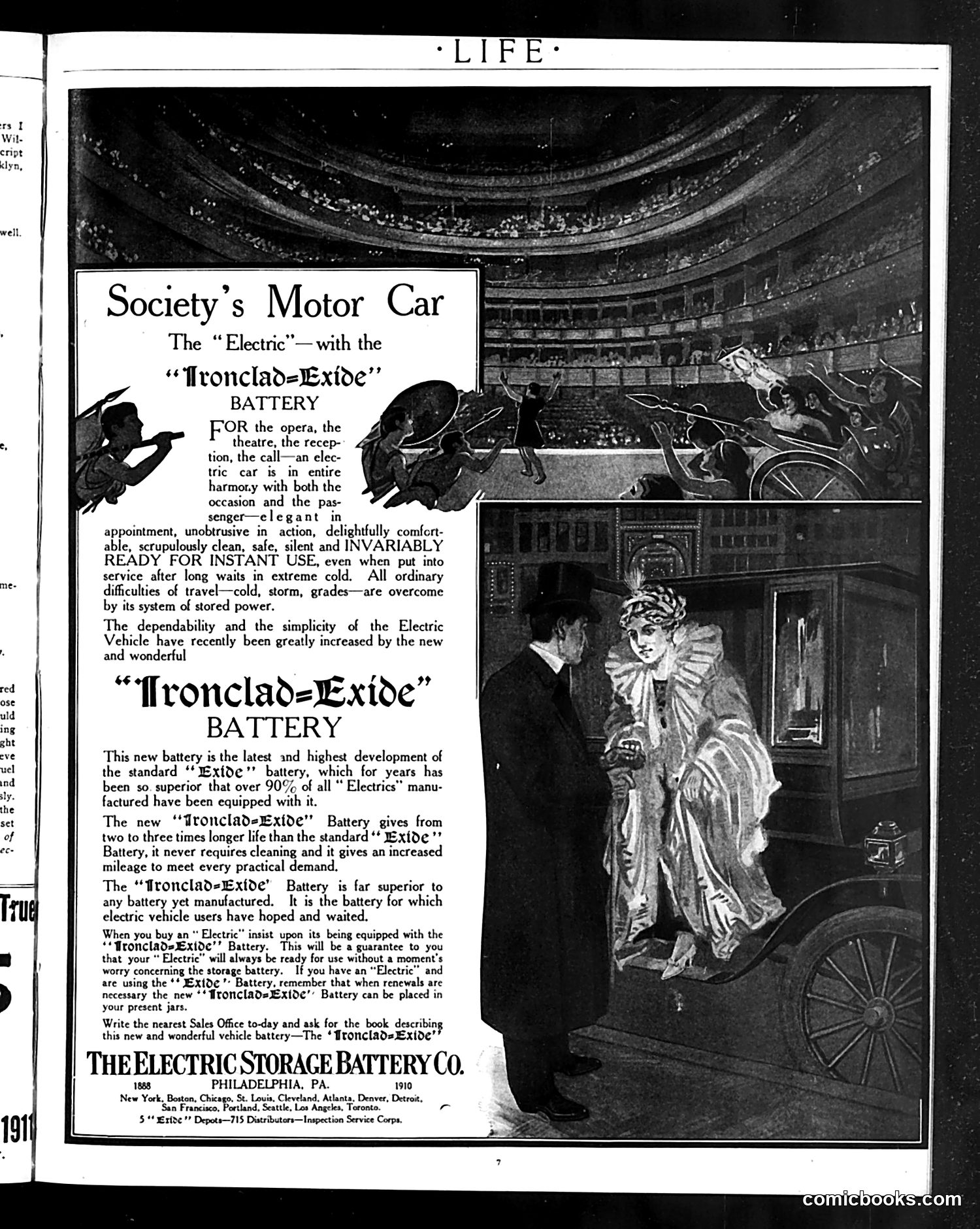
This is primarily a **full-page advertisement**, not satire or political commentary. It promotes the "Ironclad-Exide" battery for electric automobiles, published by The Electric Storage Battery Co. of Philadelphia. The ad features decorative illustrations of well-dressed passengers (appearing to be wealthy socialites) enjoying electric vehicles at what looks like an opera house or theater. The imagery associates electric cars with sophistication and leisure—targeting affluent buyers. The text emphasizes the battery's reliability, claiming it gives "two to three times longer life" than standard batteries and requires no cleaning. This was genuine advertising for early 1910s electric vehicle technology, which competed with gasoline cars before internal combustion engines became dominant. The page reflects the era's optimism about electric vehicles as convenient, elegant transportation for the wealthy.
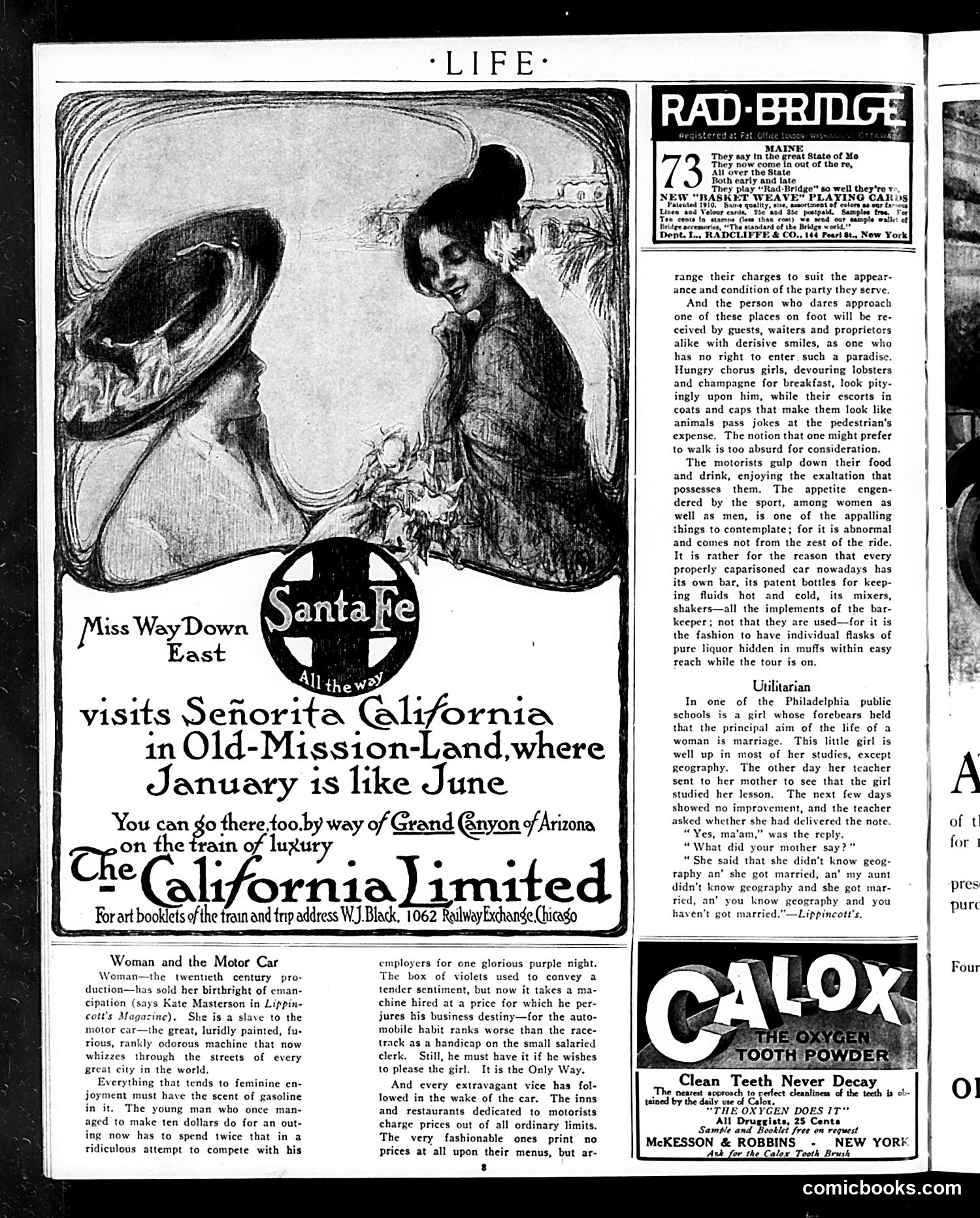
This page is primarily **advertising** rather than political satire. The dominant left-side illustration advertises the Santa Fe Railway's "California Limited" train service, showing a well-dressed woman visiting "Señorita California in Old-Mission-Land" where "January is like June." The art promotes luxury train travel to Arizona and California. The right column contains two unrelated pieces: a "Rad-Bridge" card game advertisement (top) and text discussing social commentary about motorists and restaurant culture ("Woman and the Motor Car"), followed by a "Galo" tooth powder advertisement (bottom). There is **no political cartoon** on this page. The content reflects early 20th-century American consumer culture and travel promotion.
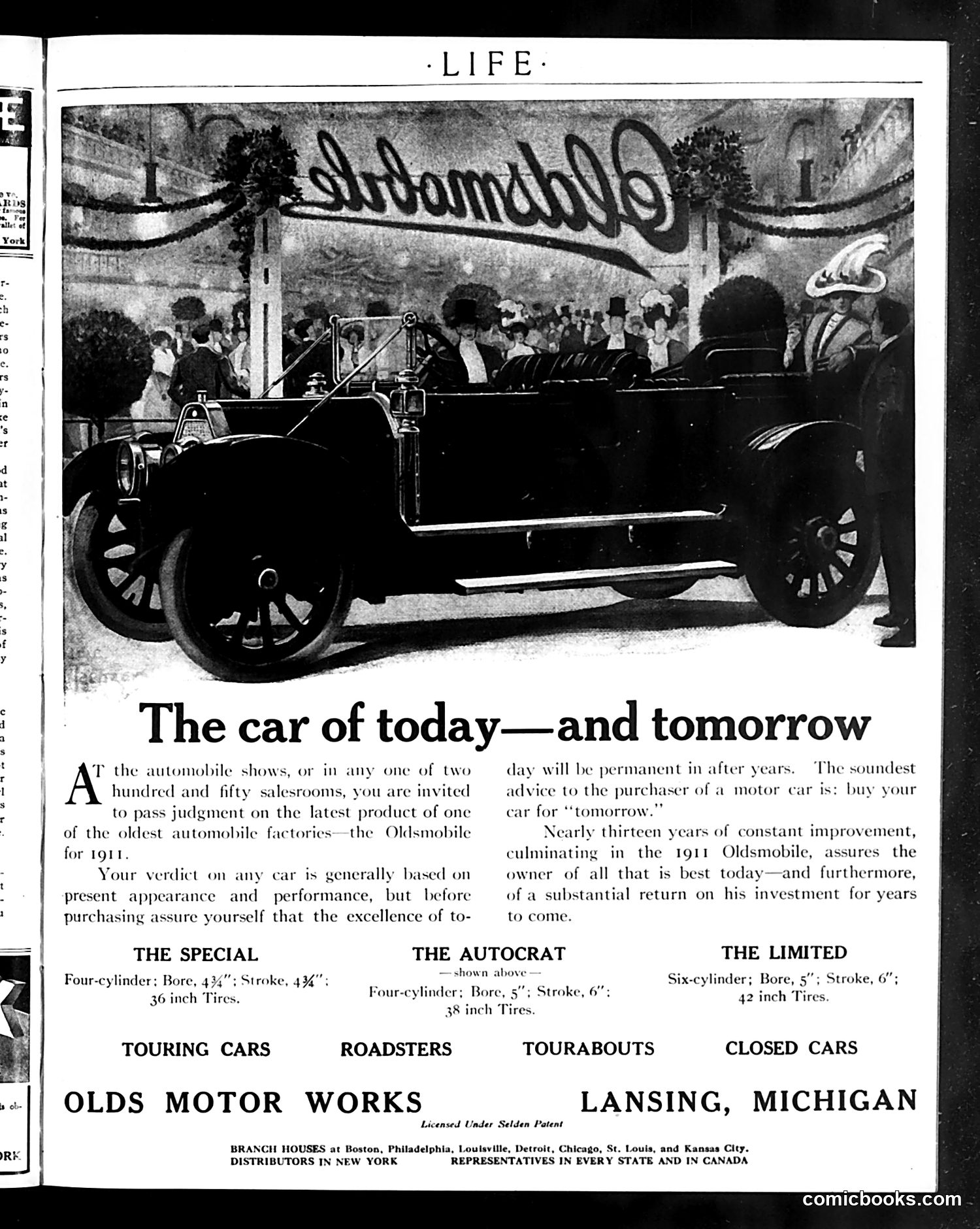
This is primarily an **Oldsmobile automobile advertisement**, not political satire. The page features a luxury car displayed at what appears to be an upscale social gathering or automobile show, with well-dressed attendees in the background beneath a "Cadillac" banner (likely indicating the venue). The advertisement's headline—"The car of today—and tomorrow"—appeals to buyers by suggesting the 1911 Oldsmobile represents both current sophistication and future-proof value. The text emphasizes "thirteen years of constant improvement," positioning the vehicle as a sound investment. The image uses aspirational imagery common to early automotive advertising: affluent social settings, elegant clothing, and implicit status association. This reflects pre-WWI consumer marketing strategies targeting wealthy buyers. This is **not a satirical cartoon** but a straightforward commercial appeal.
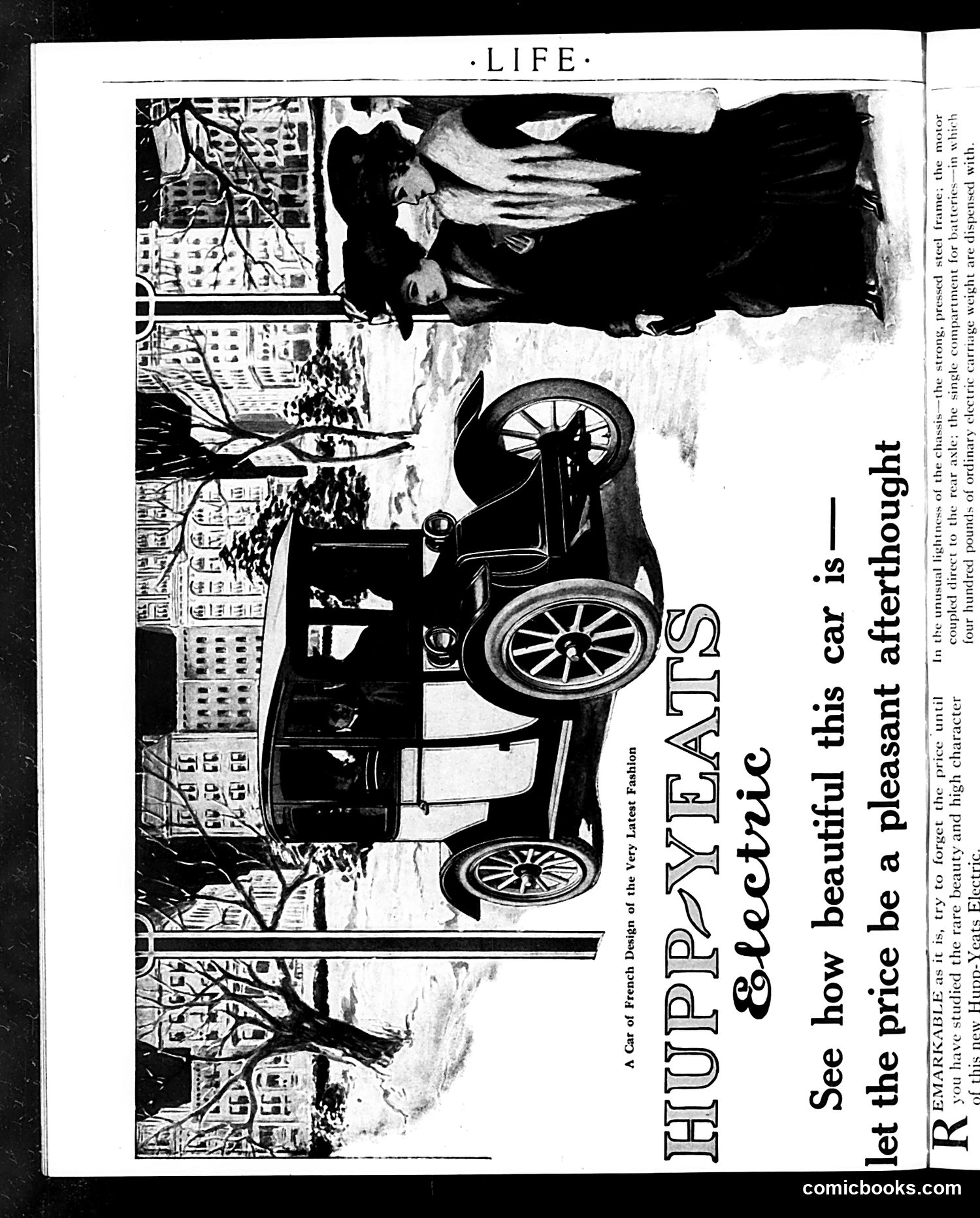
This is a Hupmobile automobile advertisement positioned as editorial content in Life magazine. The ad shows a car in an urban street scene (rotated 90 degrees in the layout) with well-dressed passengers. The headline "See how beautiful this car is — let the price be a pleasant afterthought" makes the central pitch: the Hupmobile's aesthetic appeal should impress potential buyers before they learn the cost, implying the price is surprisingly affordable for such an attractive vehicle. The subheading credits "A Car of French Design by Very Larsen Faulden," suggesting European styling was a selling point for American automobiles of this era. This represents early automotive advertising's emphasis on design appeal and value proposition to emerging middle-class car buyers.
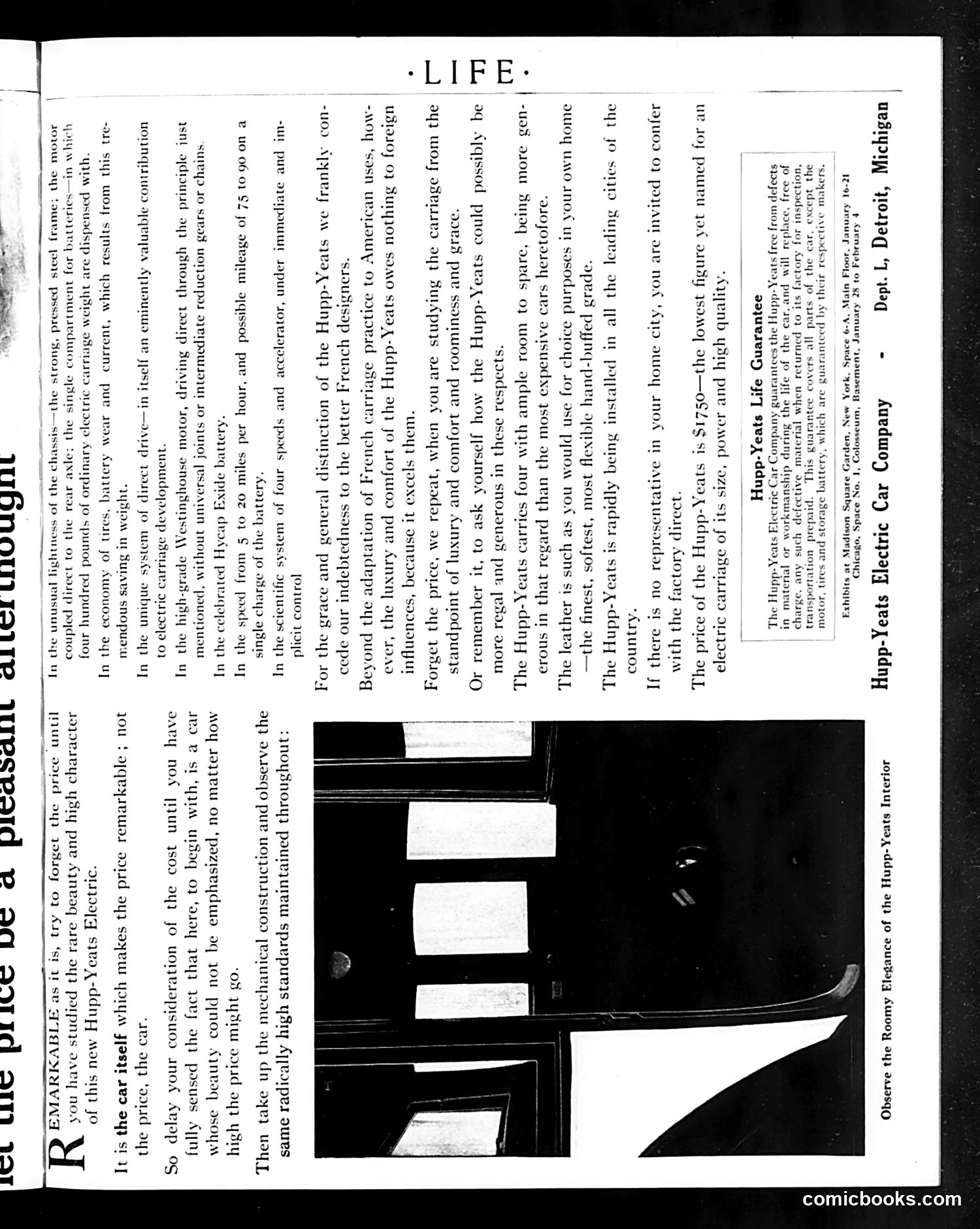
This page contains an article titled "A Peasan Autograph" discussing the price of electric cars. The text emphasizes that the new Hupp-Yeats Electric automobile offers exceptional value—affordable pricing combined with high-quality construction and materials. The accompanying illustration shows the interior of an electric car, displaying its elegant design and spacious passenger compartment with multiple windows. The article argues that electric vehicles provide practical transportation without the expense and maintenance demands of gasoline-powered cars. It highlights the Hupp-Yeats as a competitive option for consumers seeking reliable, economical personal transportation. This appears to be straightforward automotive advertising and marketing copy rather than political satire or social commentary typical of Life's satirical content.
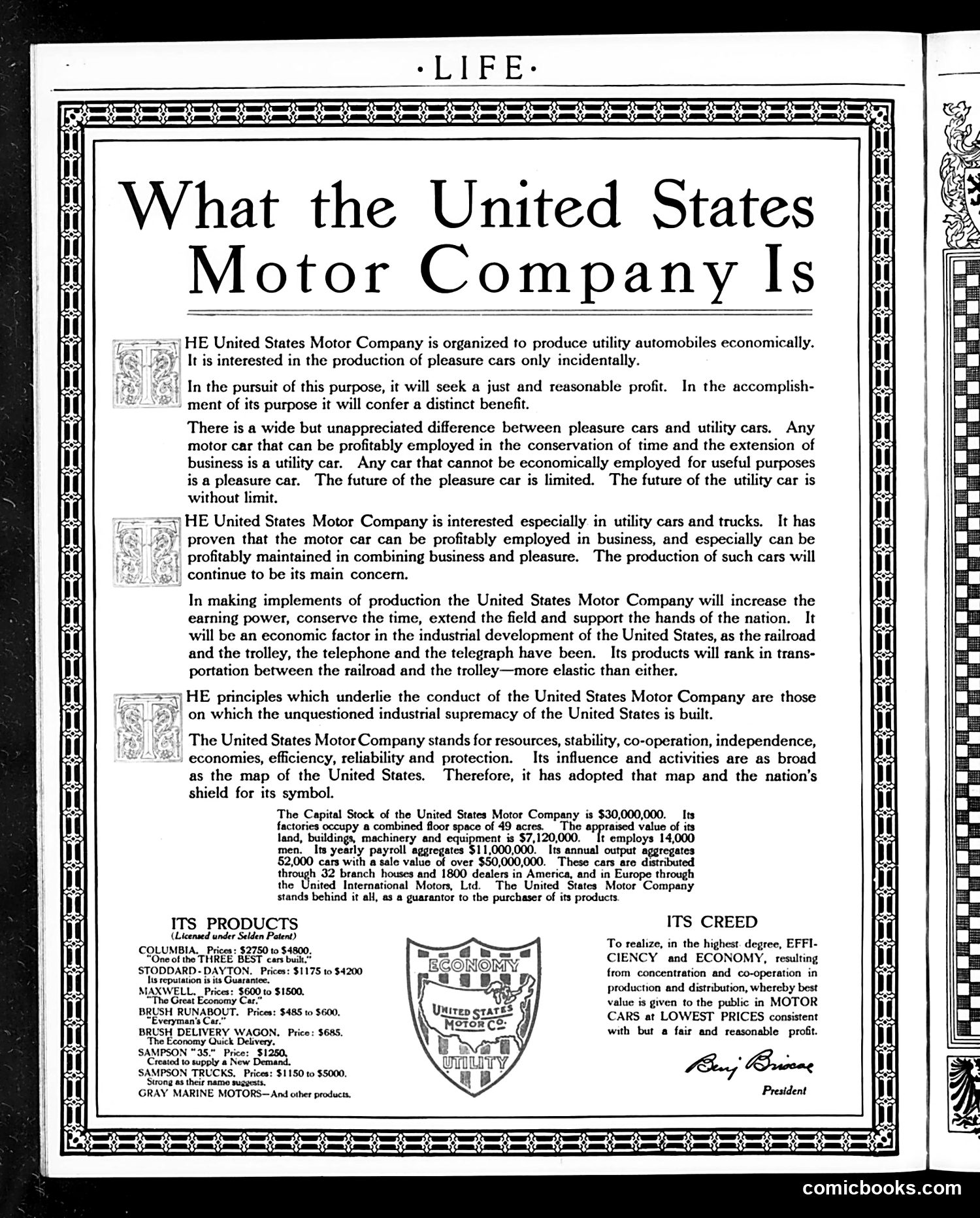
This is **not a cartoon or satire page**, but rather a **straight corporate advertisement** for the United States Motor Company, disguised as editorial content in *Life* magazine. The page promotes the company's philosophy and product line (various car models like the Studebaker and Brush Runabout, priced $150-$4200). The text emphasizes the company's focus on "utility" vehicles for business rather than luxury "pleasure cars," positioning motorcars as practical tools for economic development. The company's creed, signed by the President, stresses "efficiency, economy" and "lowest prices." There is **no satirical content or political commentary** here—this appears to be paid advertising presenting itself as magazine editorial, a common early 20th-century marketing practice.
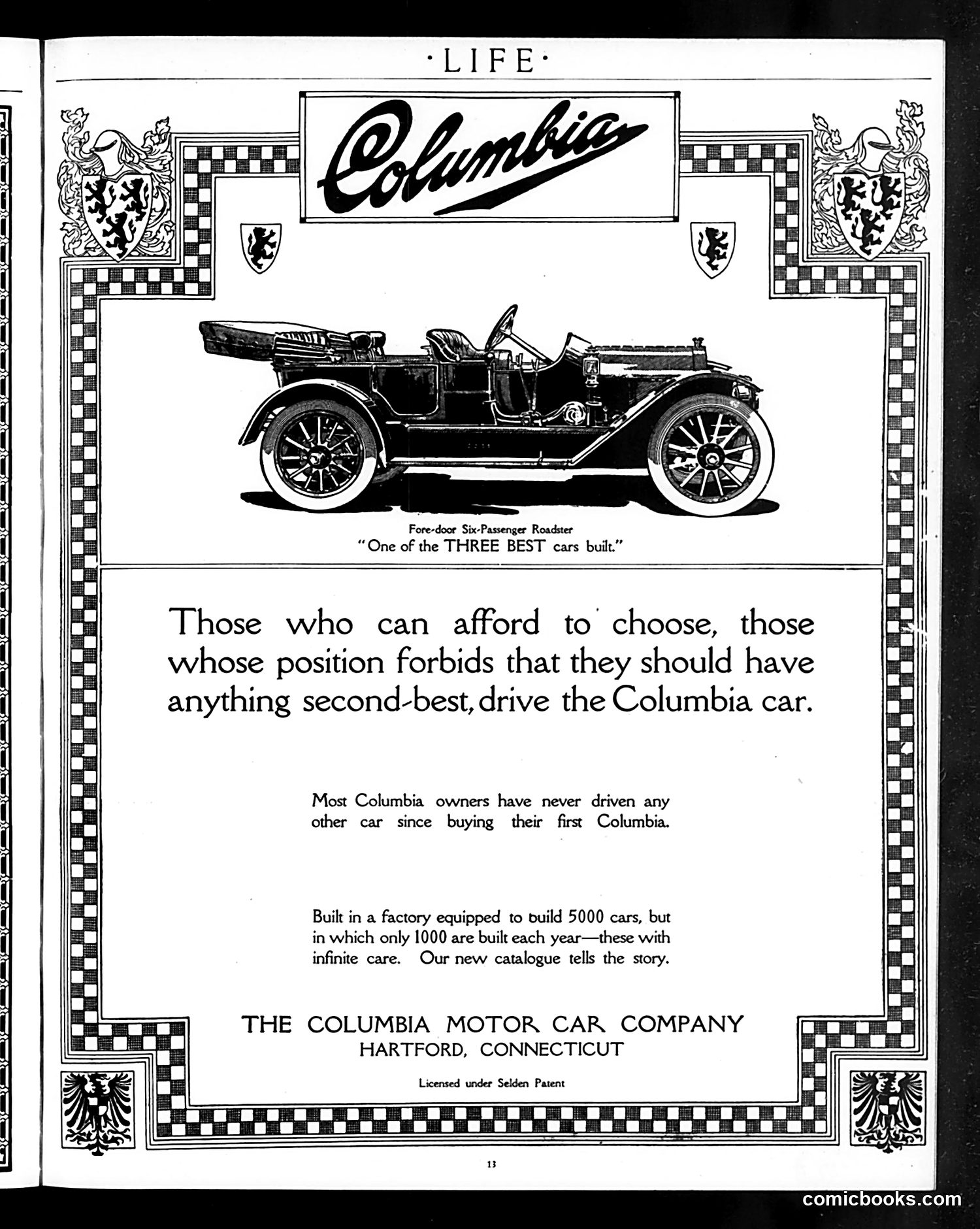
This is a **Columbia Motor Car Company advertisement**, not satire or political commentary. The page promotes the Columbia as a luxury automobile for wealthy, discerning buyers. The ad's main argument is that those of sufficient means and social standing should drive only the best—the Columbia, described as "one of the THREE BEST cars built." It claims most Columbia owners never drive any other car afterward, suggesting exceptional quality and loyalty. The advertisement emphasizes exclusivity: the factory builds only 1,000 cars annually despite capacity for 5,000, implying careful craftsmanship and scarcity value. The decorative heraldic shields and formal layout reinforce the car's association with prestige and aristocratic taste. The company was based in Hartford, Connecticut.
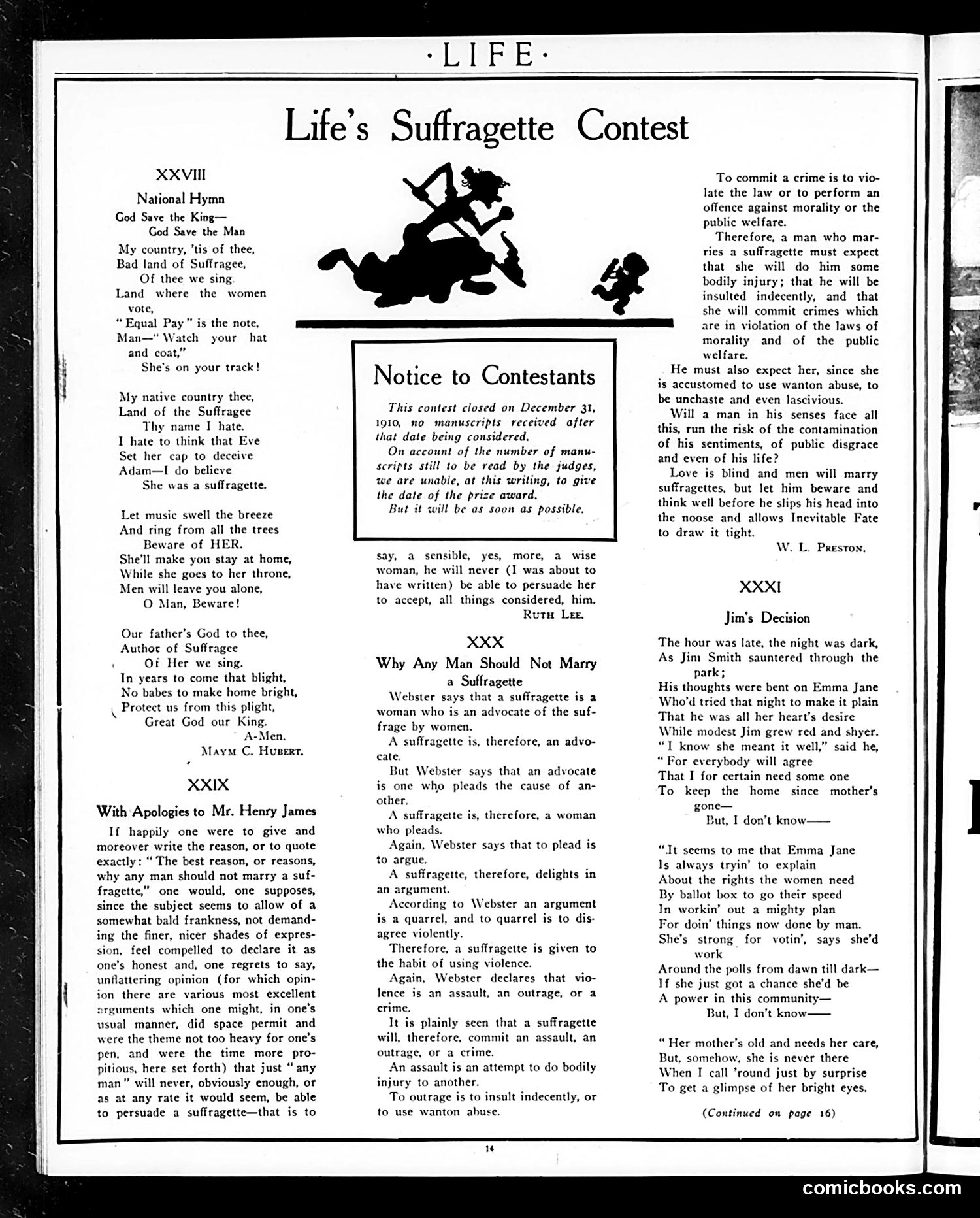
This page satirizes the women's suffrage movement through mock parodies and deliberately absurd arguments. The "contest" invites submissions ridiculing suffragettes—women advocating voting rights. The content includes: **Parody hymns** rewriting patriotic songs to mock women voters ("Bad land of Suffragee," warnings that women will leave home and abandon domesticity). **A logical fallacy piece** titled "Why Any Man Should Not Marry a Suffragette" that uses dictionary definitions to absurdly "prove" suffragettes are violent criminals—connecting advocate → pleads → argues → quarrels → violent → criminal. **"Jim's Decision"** (continued on page 16), a narrative where a man struggles with whether his girlfriend's suffrage activism justifies breaking their engagement. The satire assumes readers will find the very idea of women voting laughable and that suffragettes are dangerous threats to marriage and domesticity. This reflects pre-1920 anti-suffrage sentiment, when women's political participation was genuinely controversial in mainstream American discourse.
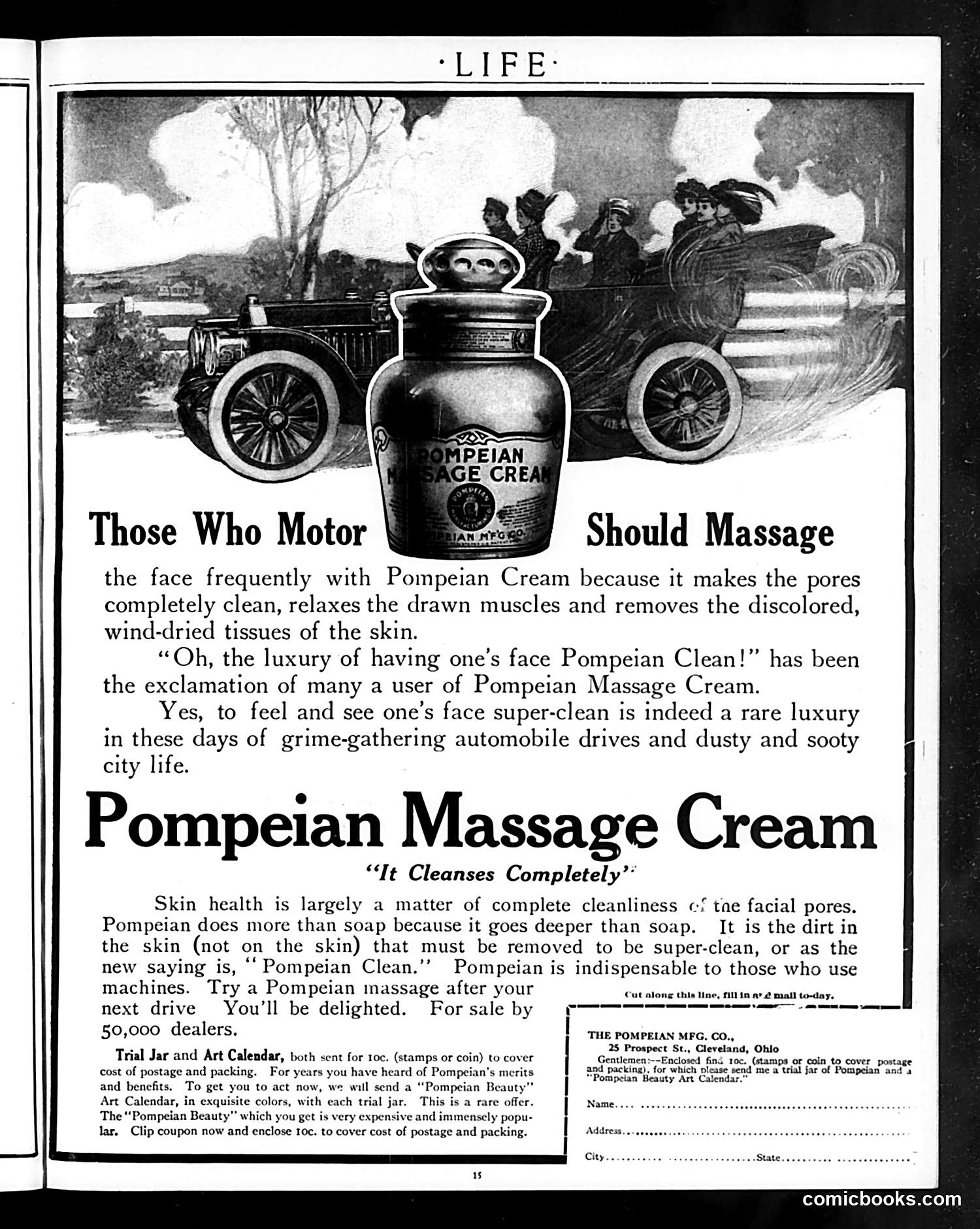
This is a **straightforward product advertisement**, not political satire. It promotes Pompeian Massage Cream to early automotive-era consumers. The image depicts a touring car full of passengers, establishing the social context: automobile driving was a new leisure activity causing visible skin damage. The ad's pitch targets this modern problem—that cars expose faces to "grime-gathering" and "dusty and sooty" conditions. The sales strategy emphasizes that Pompeian penetrates deeper than soap, removing embedded dirt from pores rather than just surface grime. This was a genuine selling point in an era before widespread understanding of skincare science. The "luxury" angle appeals to affluent motorists; the trial jar offer (10¢ plus postage) was a common early advertising technique. The inclusion of an "Art Calendar" as incentive reflects period marketing conventions. There is no satire here—this is period advertising reflecting genuine consumer anxieties about automotive-age pollution and emerging beauty standards.
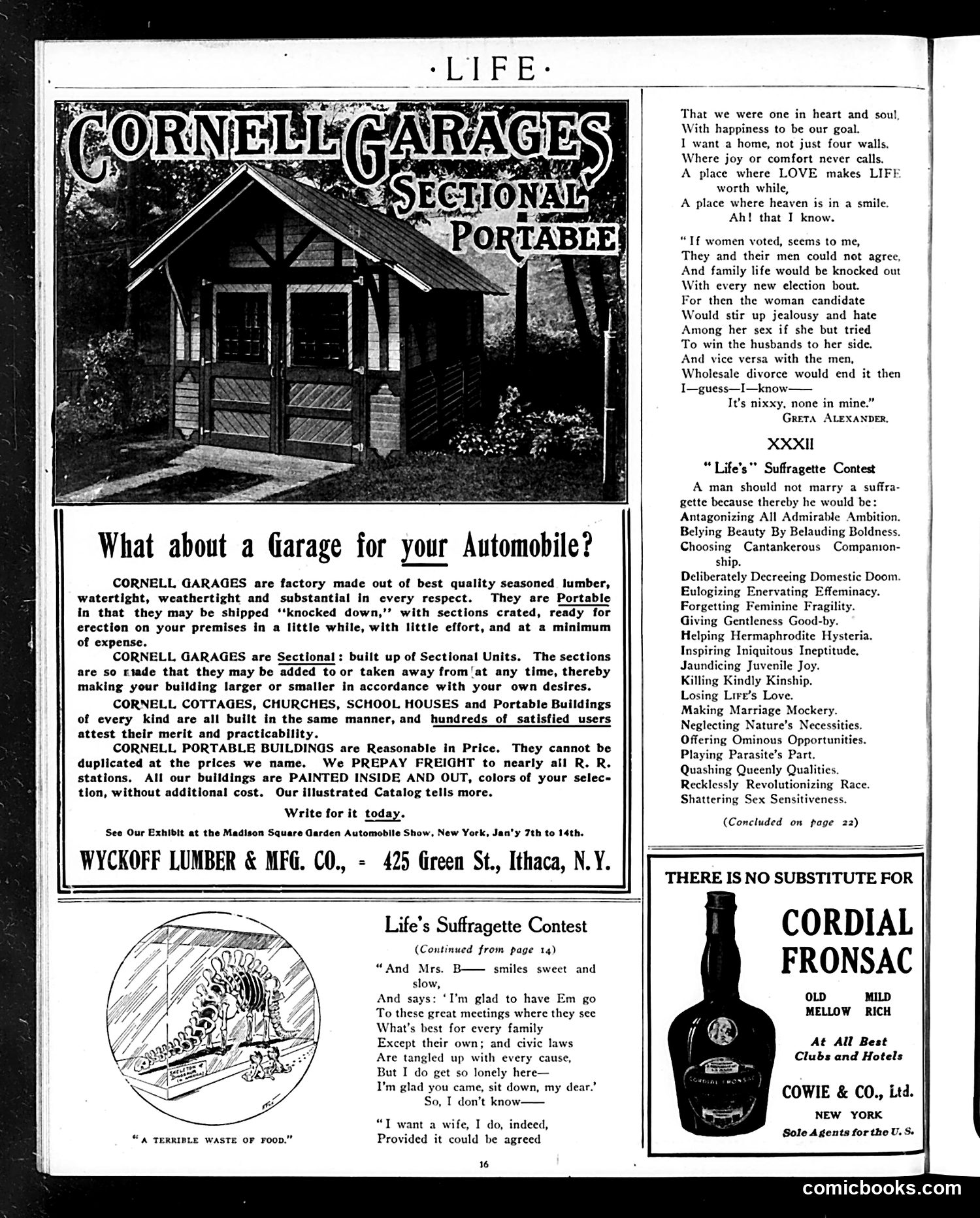
This page mocks the women's suffrage movement through "Life's Suffragette Contest"—a satirical feature listing absurd reasons why men shouldn't marry suffragettes. The humor relies on alliterative alphabet wordplay ("Antagonizing All Admirable Ambition," "Belying Beauty By Belauding Boldness," etc.). The accompanying poem by Greta Alexander presents anti-suffrage arguments: if women voted, husbands and wives would quarrel over elections, causing jealousy, divorce, and family destruction. One section shows a woman at a meeting, lonely at home while neglecting domestic duties. The cartoon labeled "A Terrible Waste of Food" (bottom left) appears to criticize suffragettes for abandoning household responsibilities. This content reflects early 20th-century opposition to women's voting rights, portraying suffragettes as threats to marriage, family stability, and traditional gender roles. The satire assumes readers share these anti-feminist views—today it reads as period documentation of sexist arguments used against women's equality.
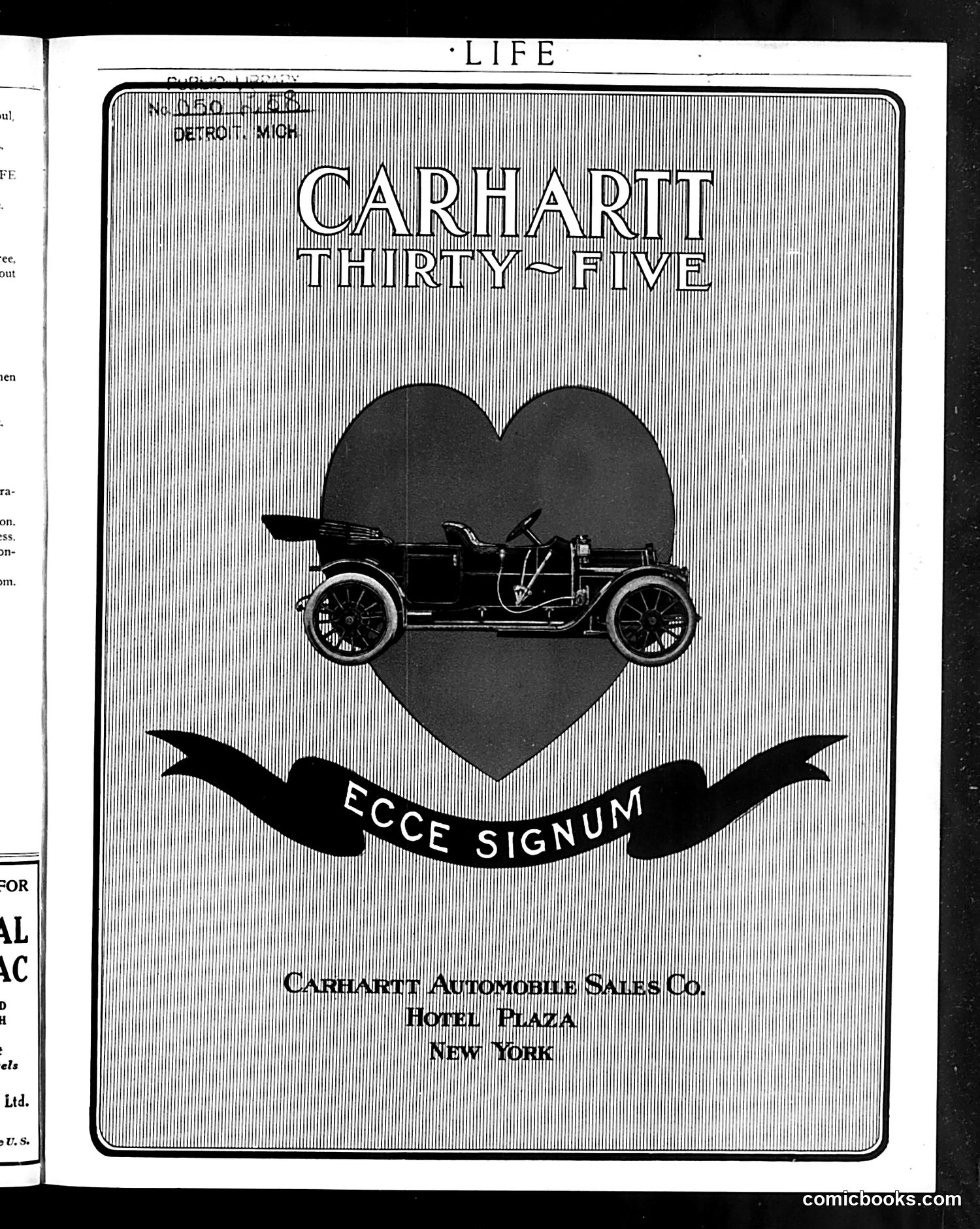
This is a full-page advertisement for the Carhartt automobile, appearing in *Life* magazine. The design features a large heart shape containing an early 1900s touring car, with the Latin motto "Ecce Signum" ("Behold the Sign") on a banner below. The advertisement uses romantic imagery—the heart symbol—to suggest that owning a Carhartt automobile is a sign of love or affection, likely appealing to buyers as a desirable, prestigious purchase. The classical Latin phrase adds sophistication to the pitch. The ad is placed by Carhartt Automobile Sales Co., located at Hotel Plaza in New York. This represents early automotive advertising targeting wealthy urban consumers through a lifestyle and emotional appeal rather than technical specifications.
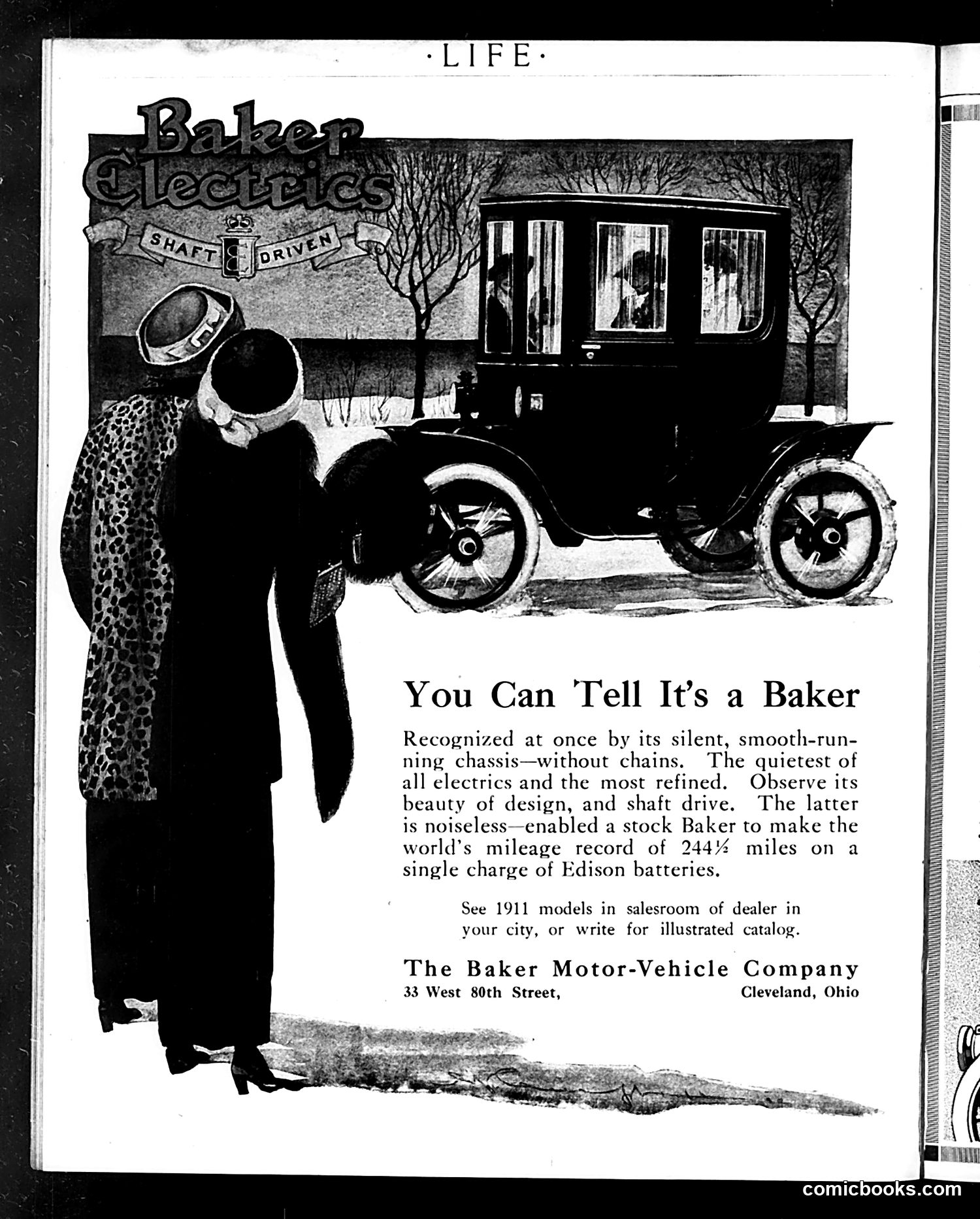
This is primarily a **product advertisement**, not satire or political commentary. It promotes the Baker Electric automobile, manufactured in Cleveland, Ohio around 1911. The image shows two fashionably dressed women in period clothing examining a Baker electric vehicle. The advertisement emphasizes the car's appeal to affluent buyers—particularly women—highlighting qualities like quietness, refinement, and smooth operation without chains (a feature of gasoline vehicles). The key selling point is the vehicle's impressive range: 244½ miles on a single Edison battery charge, which was a notable achievement for early electric cars. The "shaft drive" mentioned refers to the silent transmission system. **Context for modern readers**: This reflects a historical moment when electric vehicles competed with gasoline cars. Early electrics were considered sophisticated, quiet, and suitable for urban driving—particularly marketed toward women. The advertisement's focus on elegance and lack of noise reflects how electrics positioned themselves as superior to noisy, chain-driven gasoline automobiles of the era.
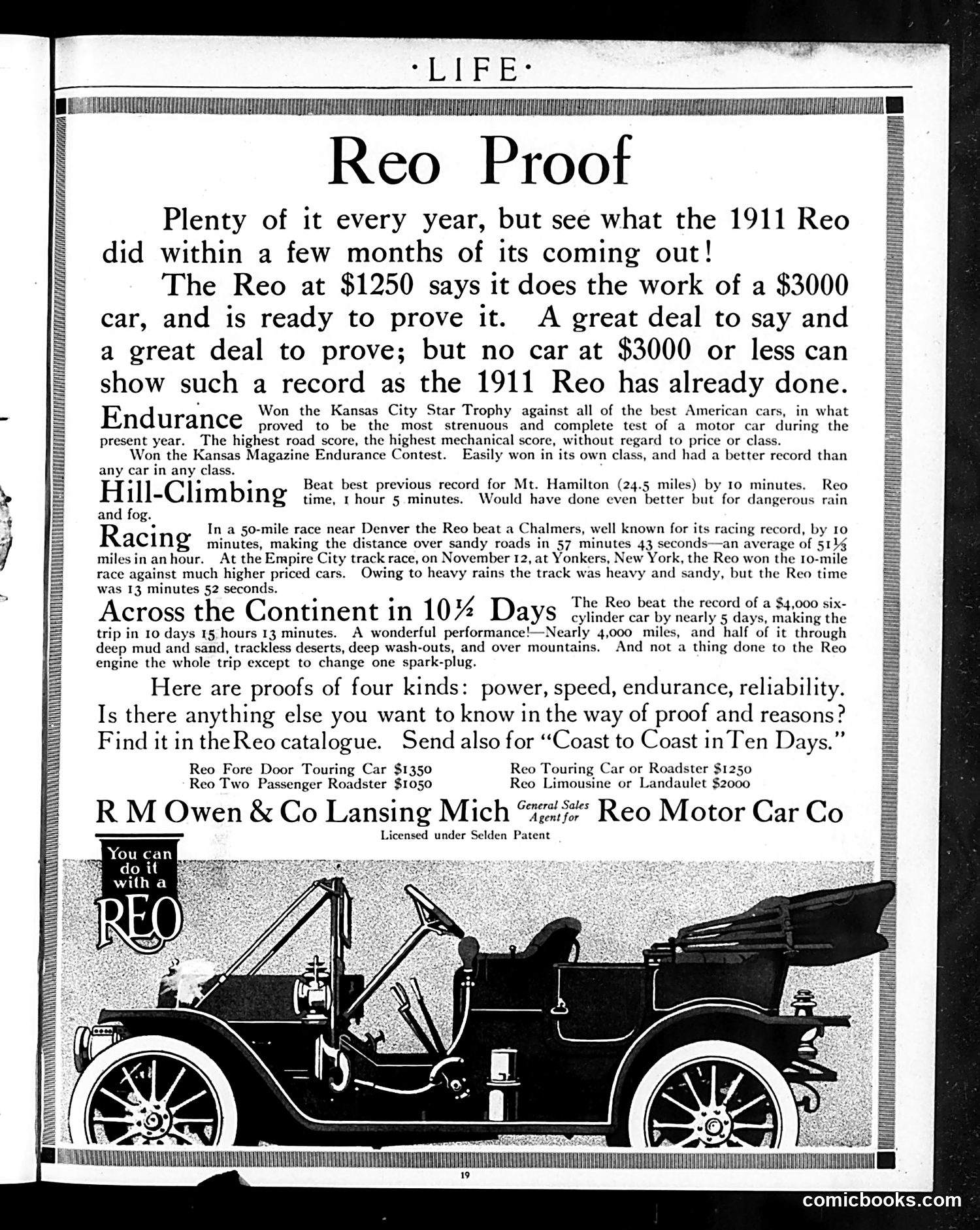
This is a **automobile advertisement**, not political satire. The 1911 Reo Motor Car Company uses this Life magazine page to promote their vehicles by listing competitive achievements. The ad makes a value claim: a $1,250 Reo performs like a $3,000 car. To substantiate this, it catalogs racing victories (winning against higher-priced competitors), endurance tests (Kansas City Star Trophy), hill-climbing records (Mt. Hamilton), and a cross-continental journey completed in 10.5 days with minimal engine maintenance. The illustration shows a simple side-view of an open-air touring car typical of the era—no caricature or satire present. The "proof" structure (power, speed, endurance, reliability) attempts to make an emotional, competitive sales pitch by positioning the Reo as economical yet performance-competitive. This reflects early 1910s automotive marketing, when manufacturers legitimized purchases through documented racing and endurance records rather than technical specifications alone.
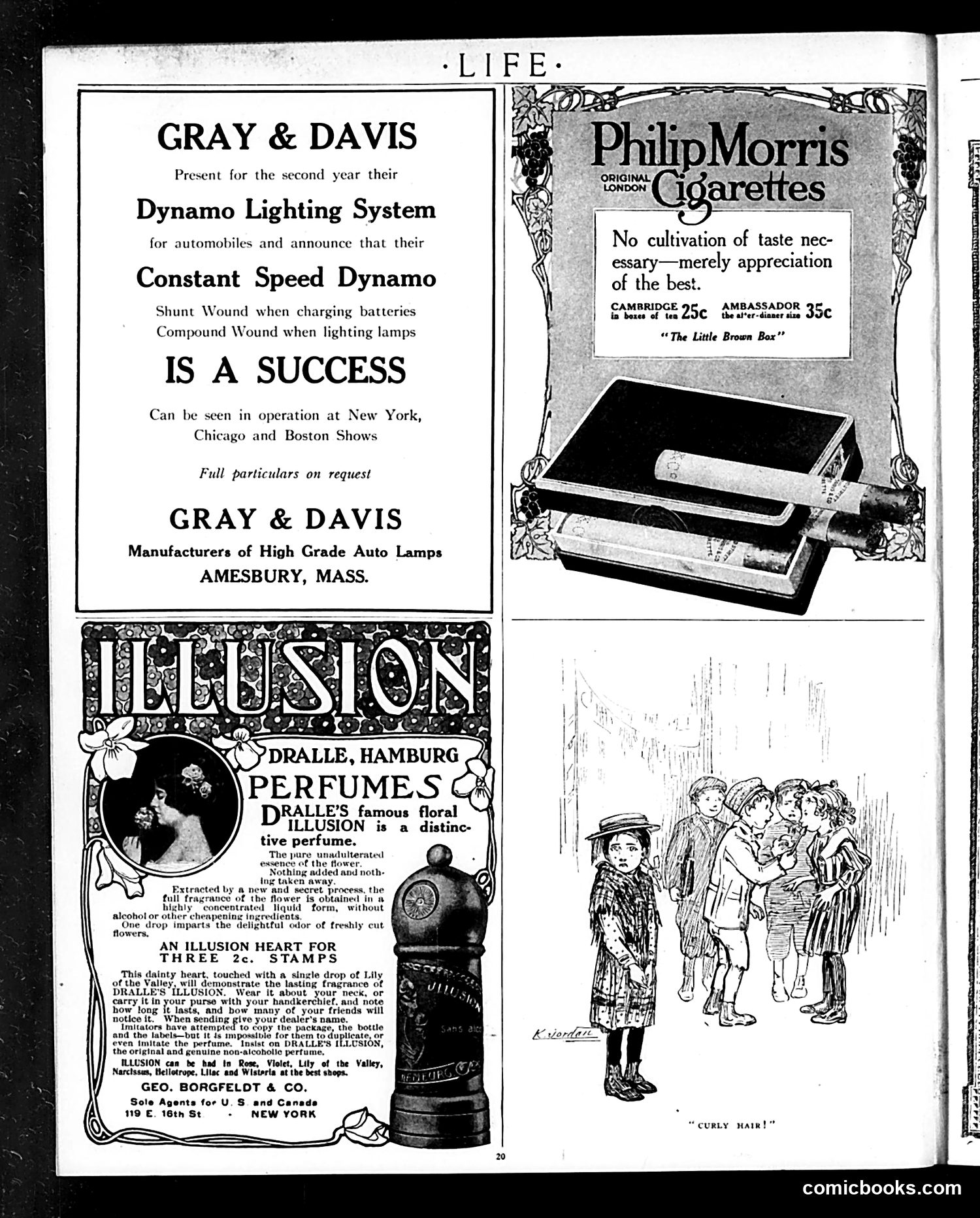
This page is primarily **advertising**, not political satire. It contains four commercial advertisements typical of early 20th-century magazines: 1. **Gray & Davis** (top left): Promotes an automotive electrical system—a "Constant Speed Dynamo" for car lighting, presented as successfully demonstrated at major auto shows. 2. **Philip Morris Cigarettes** (top right): Features their product with the tagline "No cultivation of taste necessary—merely appreciation of the best," emphasizing quality over pretension. 3. **Dralle's Illusion Perfume** (bottom left): Advertises a floral fragrance with an ornate bottle image, offering a sample heart-shaped item for stamps. 4. **Cartoon vignette** (bottom right): Titled "Curly Hair!"—shows children in period dress, illustrating a social scene rather than political commentary. The page reflects consumer culture and product marketing of the era, with no apparent political satire or social commentary.
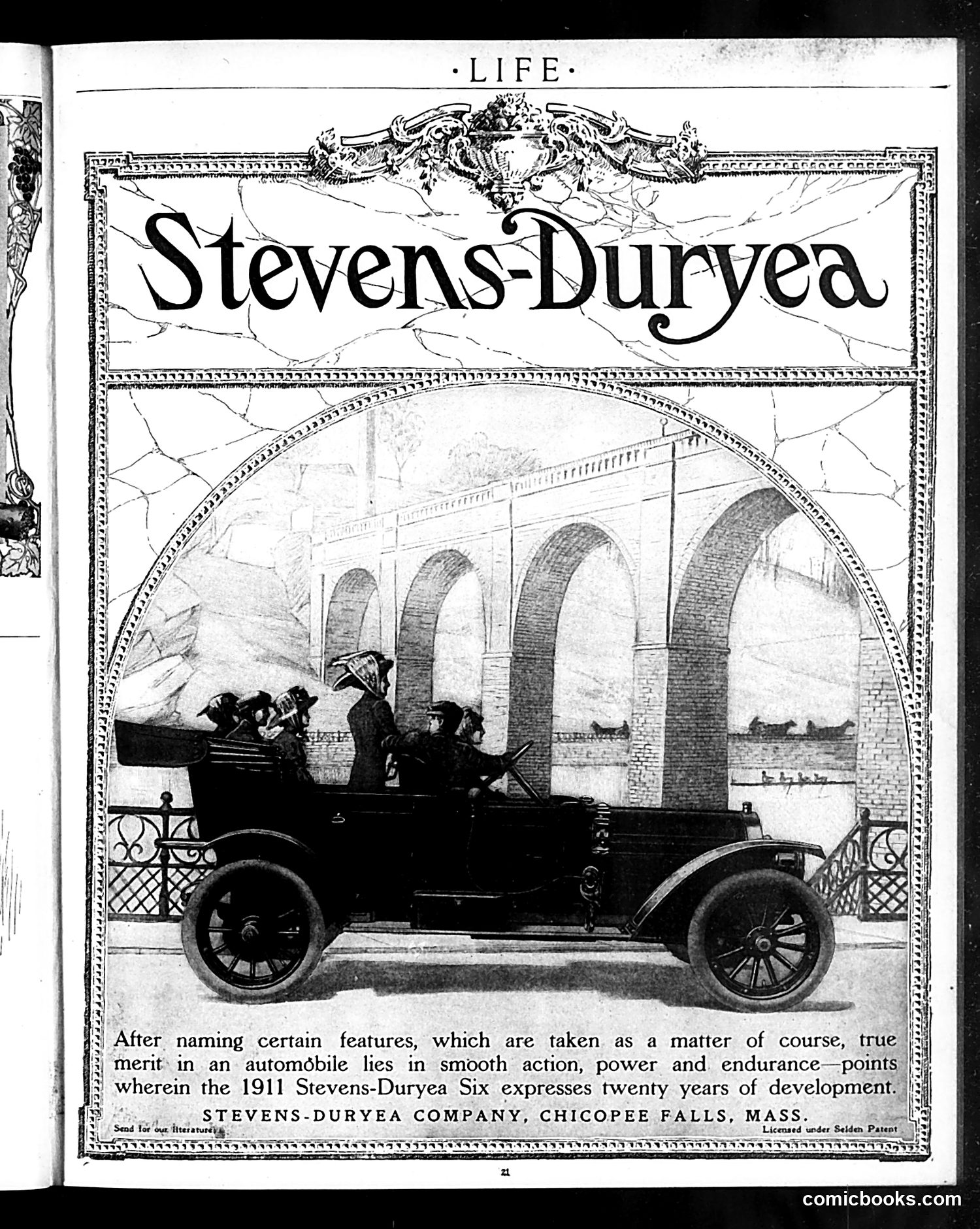
This is **not a cartoon or satirical content** — it's a full-page advertisement for the Stevens-Duryea automobile, appearing in *Life* magazine (1911). The ad features a photograph of a luxury car with passengers driving across an elegant arched stone bridge. The text argues that true automobile merit lies in "smooth action, power and endurance," claiming the 1911 Stevens-Duryea Six represents "twenty years of development." The ornate decorative border and placement in *Life* (which mixed advertising with satirical content) suggest this was premium advertising space. The reference to the "Selden Patent" at bottom indicates a legal licensing agreement — the Selden patent was a contentious early automotive patent that controlled much of the industry. For modern readers: this showcases early 1900s luxury car marketing emphasizing engineering credibility rather than speed, plus the legal/patent disputes that shaped the nascent auto industry.
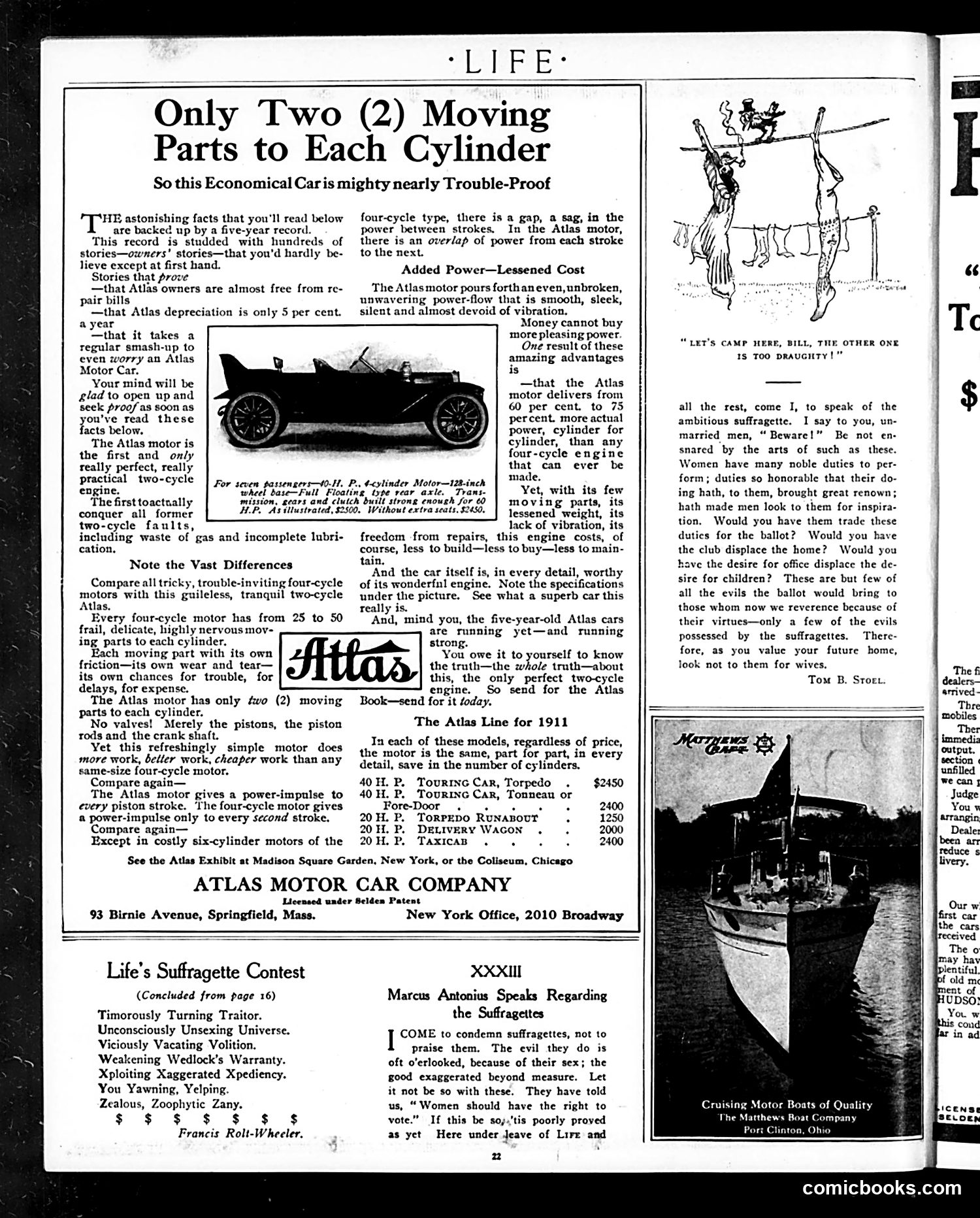
This page is primarily a **product advertisement** for the Atlas Motor Car Company, but includes a small cartoon in the upper right that offers social satire. The cartoon shows two men camping outdoors. One says to the other: "Let's camp here, Bill, the other one is too draughty!" The joke appears to reference **suffragette activism** — the "draughty" location likely alludes to the common practice of suffragettes being force-fed in prison, where air was deliberately blown into their mouths during the procedure. The cartoon sarcastically suggests men are as fussy and complaining as suffragettes, inverting the stereotype to mock male fragility. Below this appears text beginning "Marcus Antonius Speaks Regarding the Suffragettes," though the full article is cut off. The dominant content remains the Atlas advertisement, emphasizing the engine's simplicity (only 2 moving parts per cylinder versus 25-50 in competitors) and reliability, targeting buyers concerned about repair costs and durability.
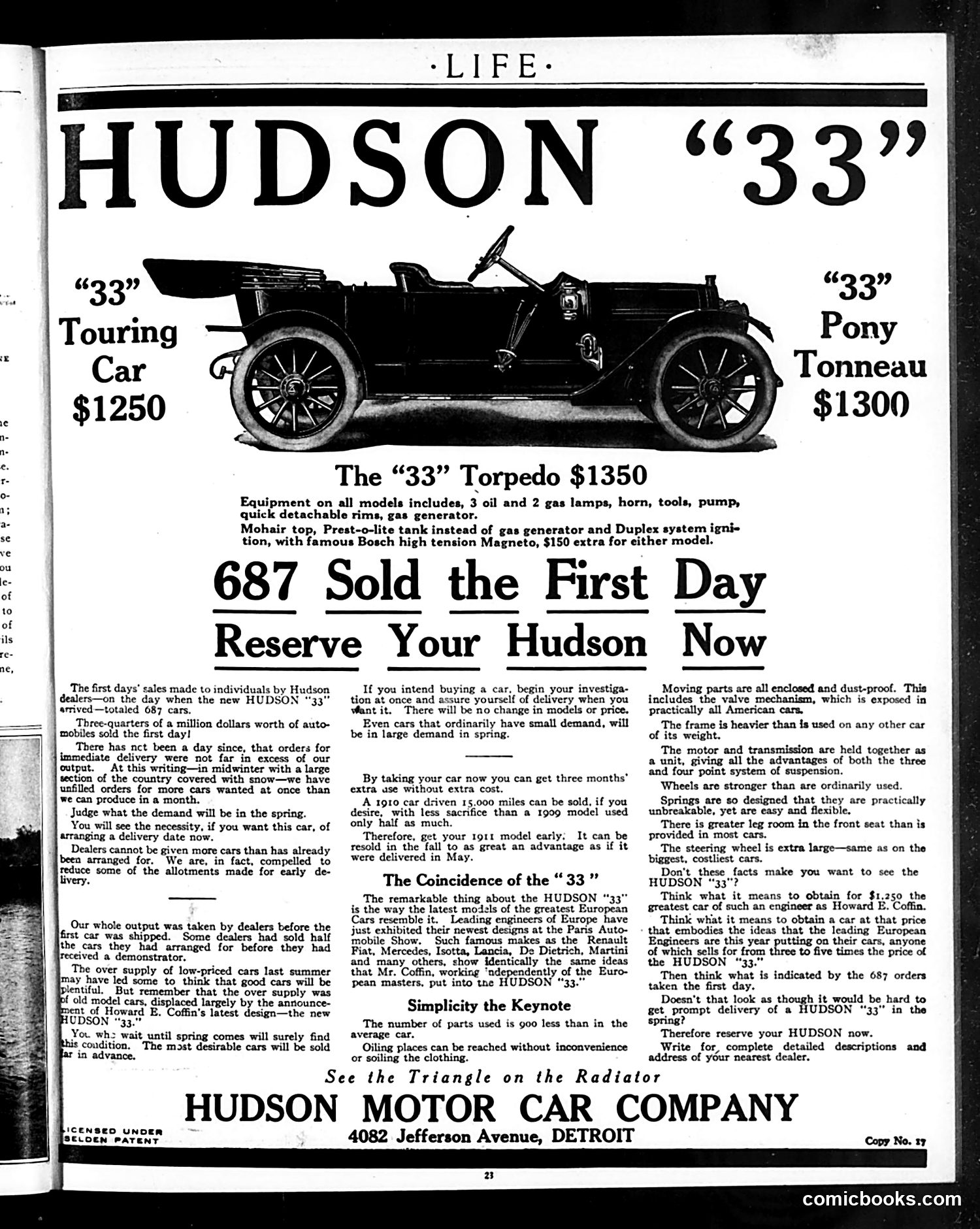
This is **not a cartoon or satire**, but rather a straightforward automobile advertisement from Life magazine, likely from 1910-1911. The page announces the Hudson Motor Car Company's new "33" model, highlighting its commercial success: 687 units sold on the first day. The advertisement emphasizes several selling points: 1. **Exceptional demand** — orders exceed production capacity even in winter 2. **Engineering credibility** — the design coincidentally mirrors recent European luxury cars (Renault, Fiat, Mercedes), suggesting sophisticated engineering 3. **Practical advantages** — simplicity (fewer parts), enclosed moving parts, stronger wheels, and better leg room than competitors 4. **Value proposition** — buyers can use the car for three months "free" and resell it in fall with minimal loss The ad targets middle-class buyers worried about depreciation and reliability, positioning the Hudson "33" as both accessible ($1,250-$1,350) and well-engineered. The emphasis on pre-ordering reflects genuine production constraints of the era.
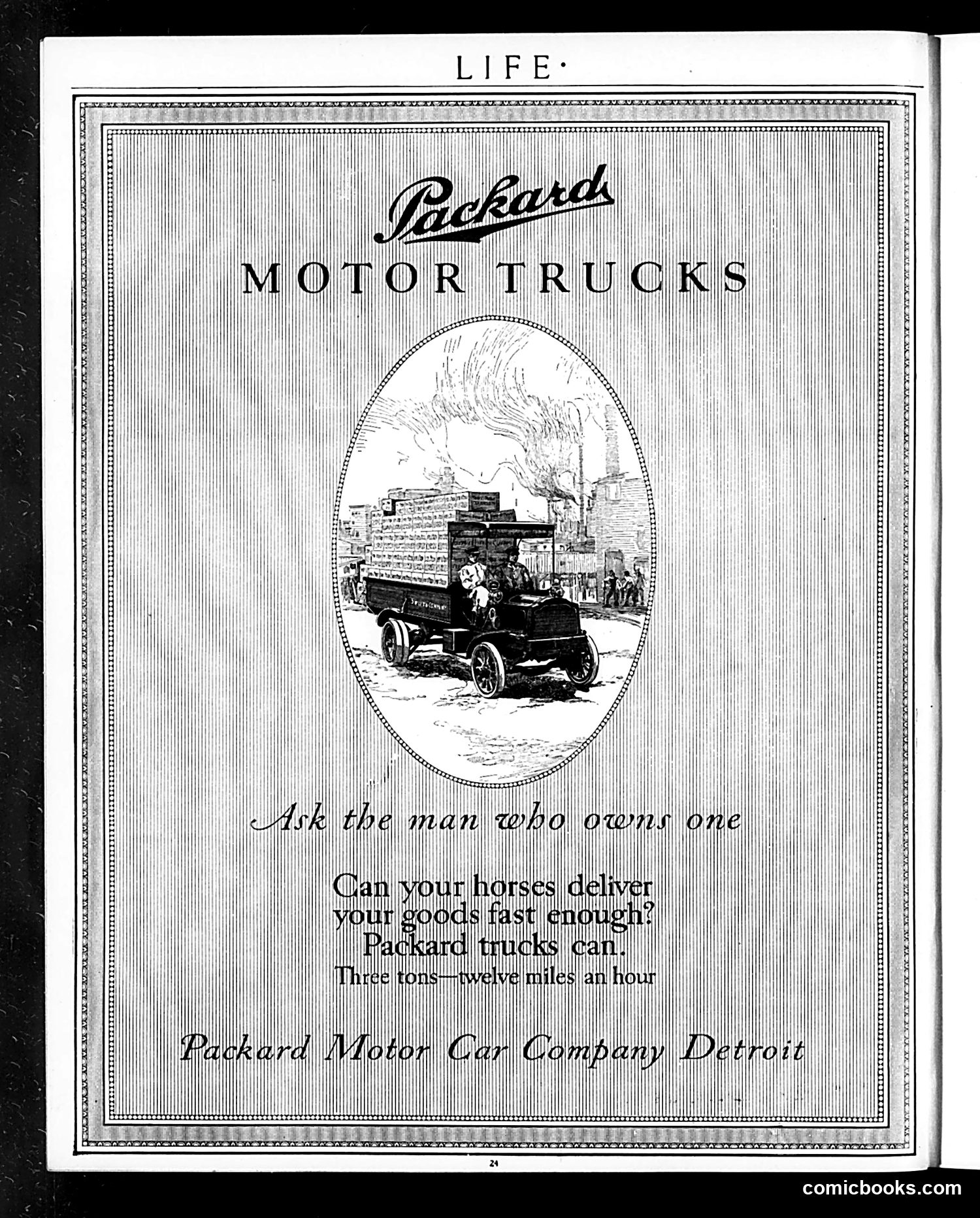
This is a **Packard Motor Truck advertisement** from Life magazine, not a political cartoon or satire. It's a straightforward commercial page promoting Packard's commercial vehicles. The ad features an illustrated motor truck loaded with cargo in an urban setting, positioned as superior to horse-drawn transport. The copy compares truck performance to horses: "Can your horses deliver your goods fast enough? Packard trucks can. Three tons—twelve miles an hour." The appeal is to business owners and merchants considering modernization. By emphasizing speed and cargo capacity advantages over traditional horse-drawn wagons, Packard positions motor trucks as the modern, efficient solution for commercial delivery—a practical sales argument during the early automotive era when such vehicles were still novel replacements for established transportation methods.
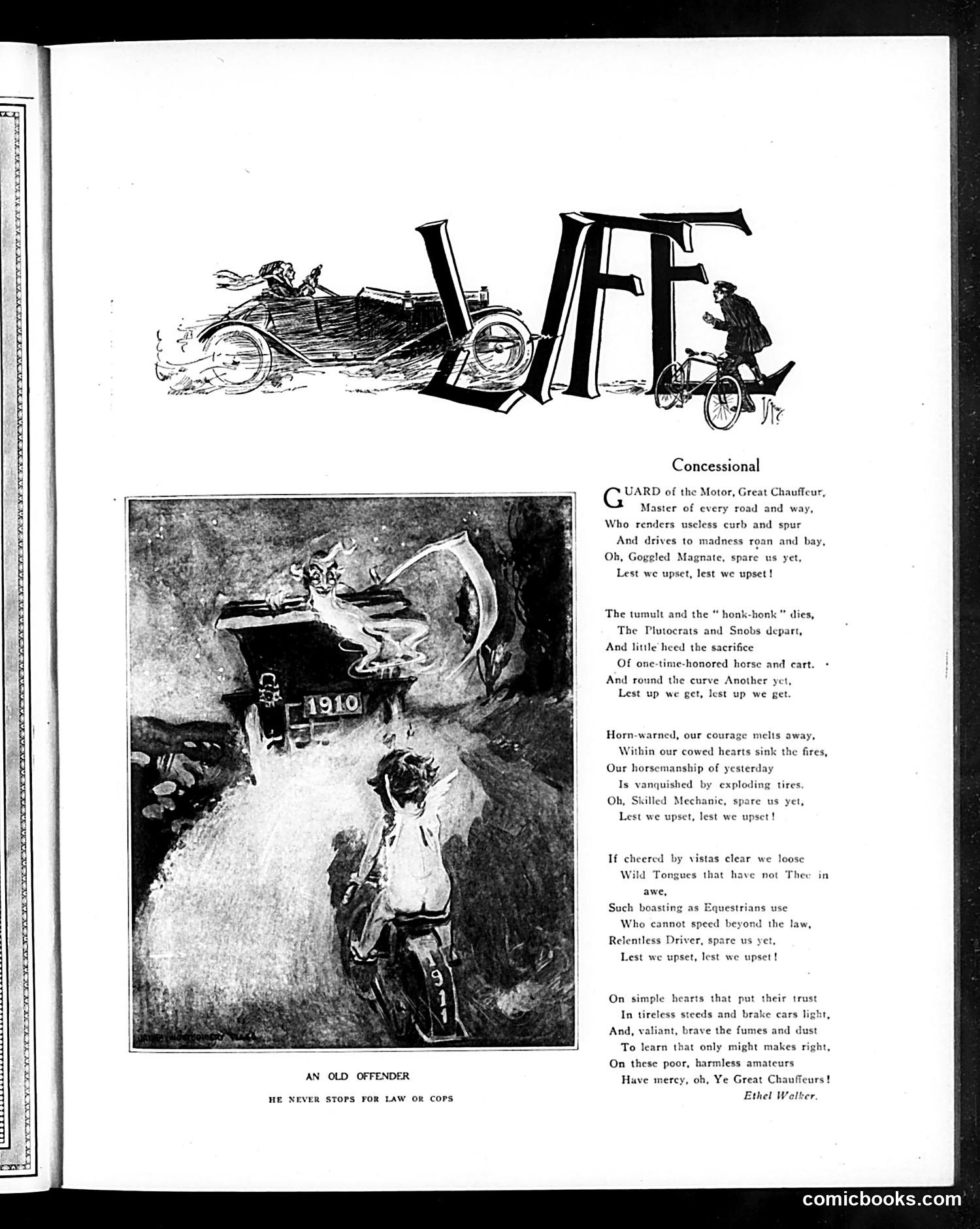
This 1910-era Life magazine page mocks the social disruption caused by automobiles and reckless wealthy drivers ("Goggled Magnate," "Plutocrats"). **The satire:** The poem, credited to Ethel Walker, presents automobile drivers as menacing forces destroying traditional horse-and-carriage culture. It depicts wealthy motorists as arrogant, lawless "Great Chauffeurs" who terrify ordinary people and their horses with "honk-honks" and "exploding tires." **Key references:** The illustration labeled "An Old Offender—He Never Stops for Law or Cops" shows a speeding 1910 vehicle evading police, embodying the complaint that rich drivers ignored traffic laws with impunity. **The point:** This reflects genuine Progressive-Era anxiety about automobiles—their danger, noise, and the perception that wealthy owners drove recklessly while ordinary citizens suffered. The poem's ironic plea for mercy satirizes class inequality and the automobile's disruptive social impact.
This page discusses Andrew Carnegie's $10 million donation to trustees for abolishing international war—and afterward, unspecified "degrading evils." The satirical commentary suggests the real challenge isn't changing war policy but identifying what evil should come next (rum, women's suffrage, prohibition, etc.). The piece also critiques the paradox: America spends heavily on military preparedness while claiming poverty prevents peace. It jokingly suggests hiring Theodore Roosevelt ("Peace Maker of Oyster Bay"—a reference to his 1906 Nobel Peace Prize for mediating the Russo-Japanese War) as a permanent peace consultant. The second section discusses declining birth rates among college graduates, particularly at Harvard and Yale, using marriage records to show fewer children per graduate over time. The implication is that educated men produce insufficient offspring to replace themselves, a concern reflecting early-20th-century anxieties about demographic decline among the educated classes.
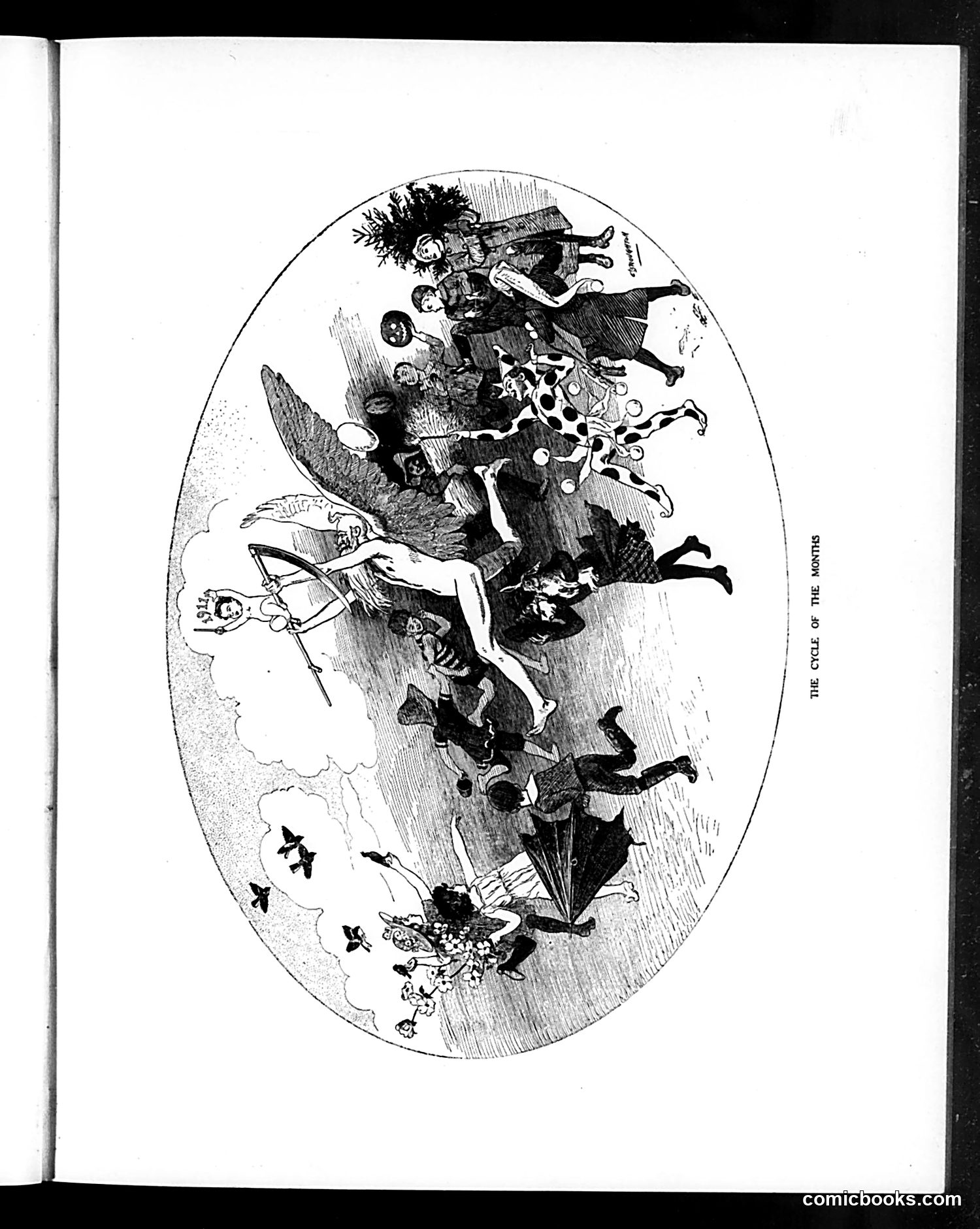
This appears to be a Victorian-era satirical illustration titled "The Cycle of the Months," showing various figures and activities arranged in a circular composition within an oval frame. The image uses the common 19th-century satirical device of personifying months or seasons through human activity and behavior. The engraving depicts people engaged in different seasonal pursuits—what appears to include winter activities (bottom), spring/summer social activities (sides), and autumn scenes (top). The style is characteristic of Life magazine's social commentary, likely satirizing how society cycles through predictable behaviors and fashions tied to seasons and calendar conventions. Without clearer visibility of specific details, the precise satirical targets remain somewhat unclear, though it likely mocks seasonal social rituals of the period.
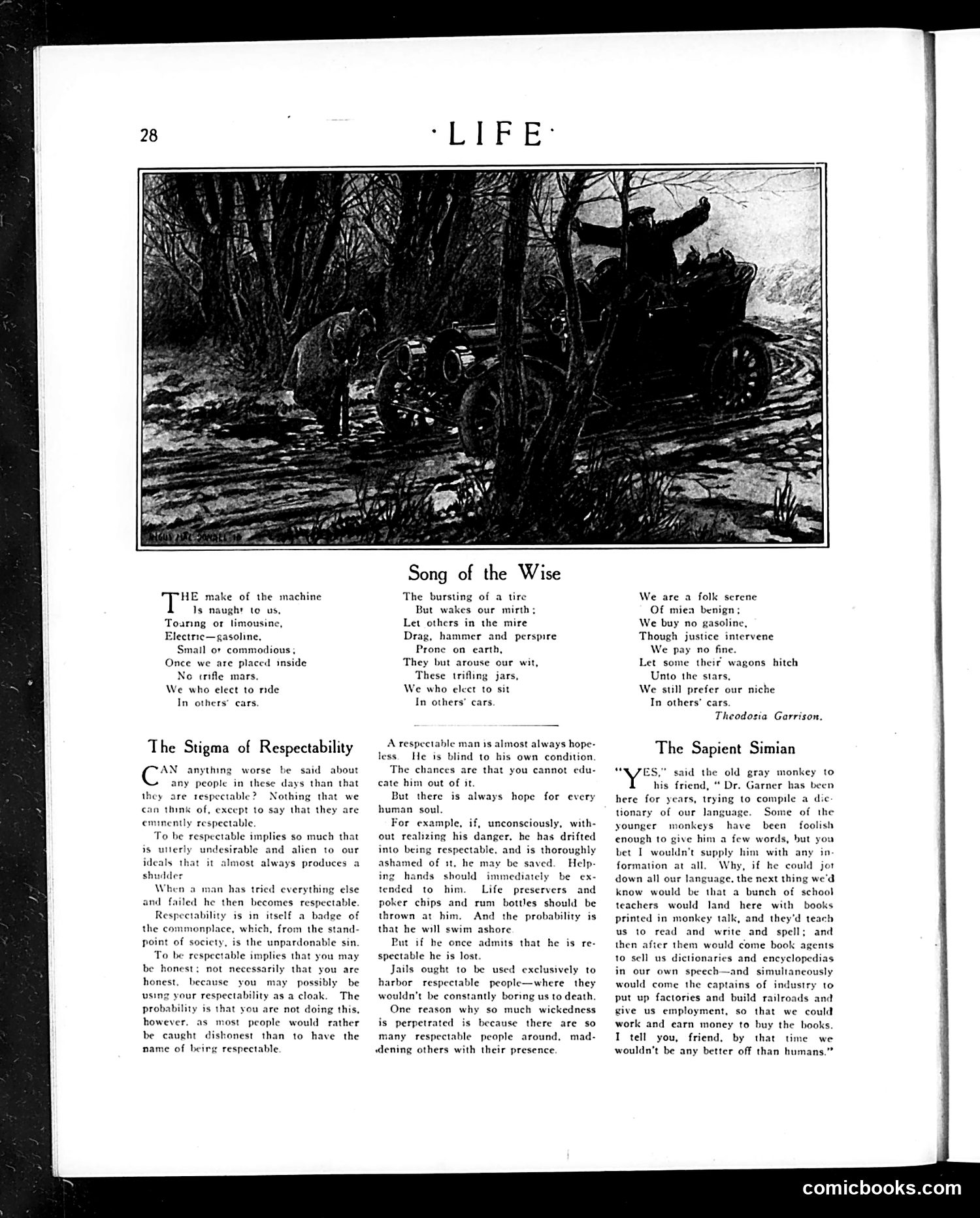
This page satirizes early automotive culture and respectability through three pieces. **"Song of the Wise"** mocks wealthy car owners who enjoy motoring while remaining detached from mechanical concerns or social responsibility. The poem's speaker boasts of sitting comfortably in cars while others struggle with repairs—a jab at class indifference and conspicuous leisure. **"The Stigma of Respectability"** argues that respectability itself is contemptible—a badge of the commonplace and conformist. The piece suggests respectable people are hopeless, blind to their condition, and tediously boring. Respectability is presented as worse than dishonesty. **"The Sapient Simian"** uses a monkey character to satirize progress. A monkey warns against teaching apes human language, fearing it would lead to schools, factories, employment, and capitalism—ultimately making monkeys "no better off than humans." This expresses skepticism about industrialization and modernization as genuine improvement. Together, these pieces critique wealth, conformity, and blind faith in progress—typical early 20th-century satirical concerns.
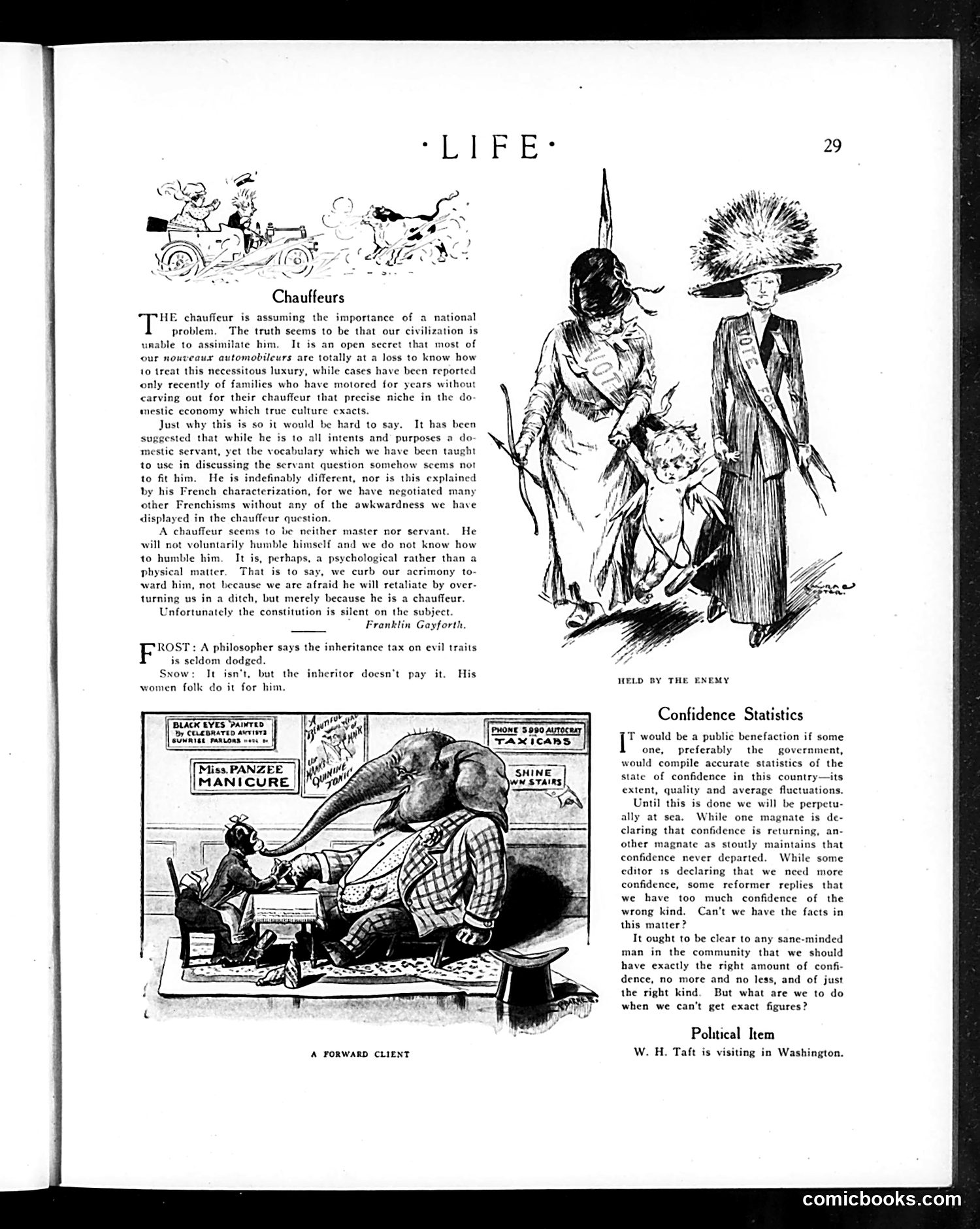
This page contains three distinct pieces of satire: **"Chauffeurs"** (top): A social commentary by Franklin Gayfarth on the awkward class position of automobile chauffeurs in early 20th-century America. The essay argues that chauffeurs occupy an undefined social status—neither true servants nor equals—creating psychological discomfort for their employers. This reflects anxieties about new technology and changing domestic hierarchies as automobiles became common among the wealthy. **"A Forward Client"** (bottom left): A cartoon mocking manicure and beauty services. A client with exaggerated features sits while workers attend to her nails and other grooming tasks. The joke appears to satirize women's vanity and the commercialization of beauty treatments. **"Confidence Statistics"** (right): Political commentary (attributed to a "Political Item" about W.H. Taft) criticizing vague public discourse about "confidence" in the economy. The writer sarcastically argues we need exact statistics on confidence levels—highlighting how politicians and editors make contradictory claims without evidence. The page reflects Progressive-era concerns about class, consumerism, and political rhetoric.
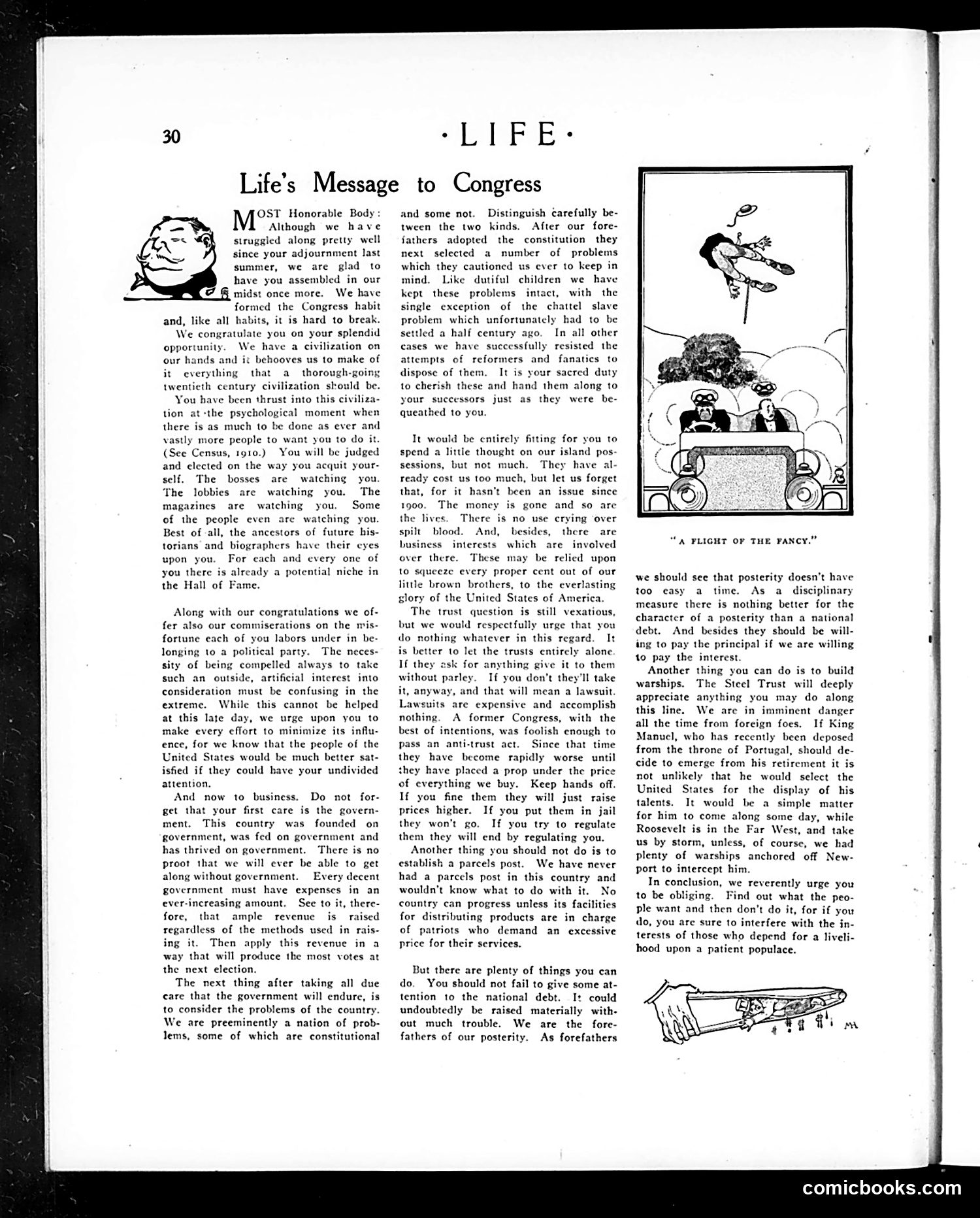
This satirical piece mocks Congress through faux-respectful advice. The cartoon labeled "A FLIGHT OF THE FANCY" depicts congressmen in a car, likely satirizing their reckless or frivolous nature. The text uses ironic praise to criticize major issues: **Political pressure**: Congress is urged to minimize party loyalty, though the author knows it's impossible—exposing how partisan interests corrupt governance. **Colonial exploitation**: The passage cynically dismisses American imperial possessions ("little brown brothers"), acknowledging their cost in money and lives while endorsing business interests' profit-extraction as "glory." **Trust monopolies**: Congress is advised to do *nothing* about trusts, sarcastically suggesting inaction protects corporate interests. **Constitutional problems**: The piece mockingly celebrates Congress's success in preserving old constitutional problems (like slavery's aftermath) rather than solving them. The overall message: Congress serves political machines, lobbies, and business interests rather than the public good—all wrapped in mock-patriotic language that exposes the hypocrisy.
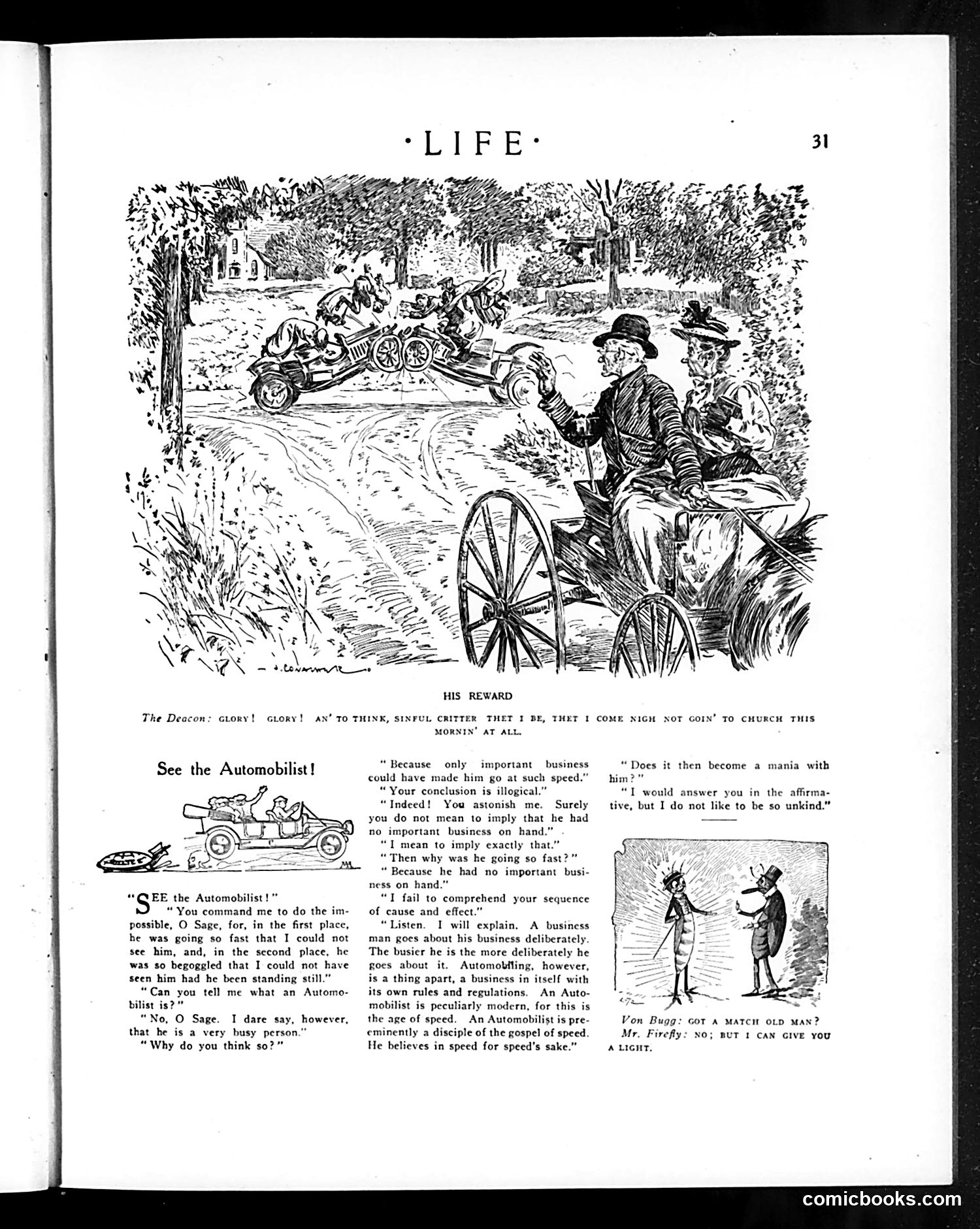
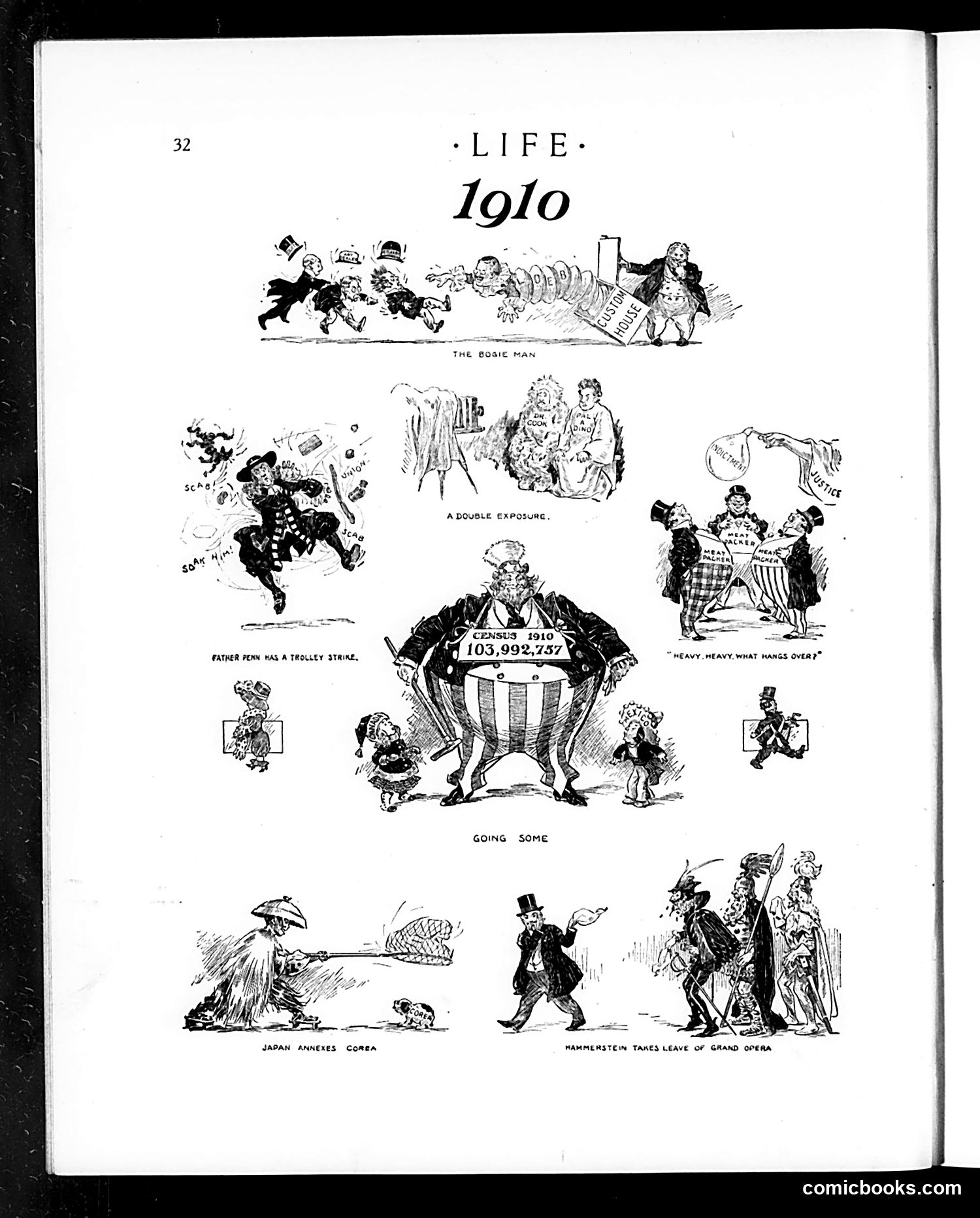
This Life magazine page titled "1910" satirizes major events of that year through cartoon vignettes. The central figure labeled "CENSUS 1910" with the number 103,992,737 represents America's growing population burden. Surrounding cartoons mock contemporary issues: "Japan Annexes Corea" depicts Japanese imperial expansion in Asia; "Hammerstein Takes Leave of Grand Opera" references the impresario's departure from opera management; "A Double Exposure" and "Heavy, Heavy, What Hangs Over?" appear to address social/political anxieties. "The Bogie Man," "Father Penn Had a Trolley Strike," and "Scar Tissue" reference specific 1910 incidents—likely labor unrest and public safety concerns. The overall effect ridicules how Americans faced mounting domestic and international challenges simultaneously, portraying the year as chaotic and burdensome.
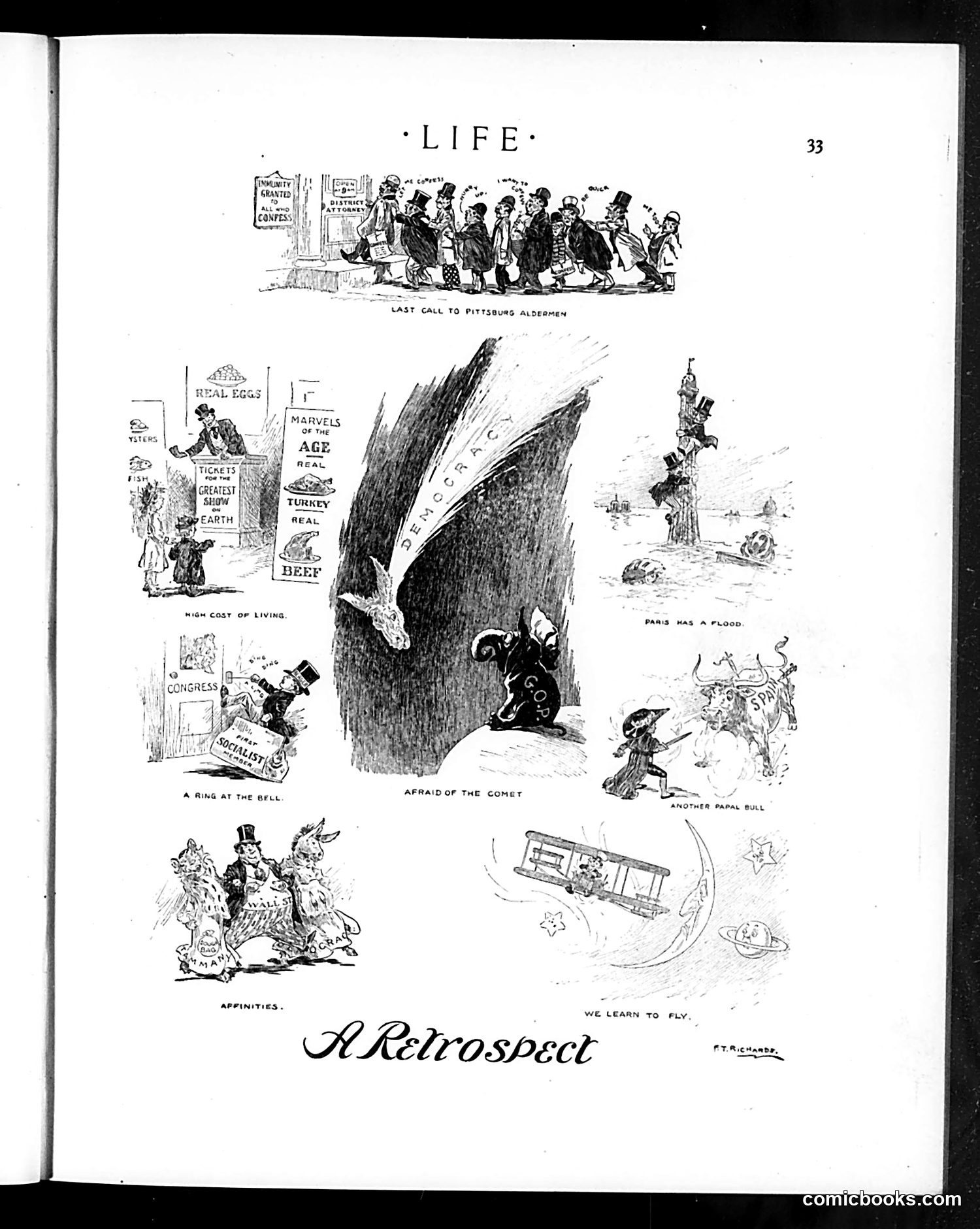
This *Life* magazine page titled "A Retrospect" uses cartoons to satirize contemporary American concerns. Notable sketches include: - **"Last Call to Pittsburgh Aldermen"**: A line of politicians appear to be departing, likely mocking local corruption or incompetence. - **"High Cost of Living"**: Shows inflation concerns through stacked price signs. - **"Afraid of the Comet"**: References early 1900s panic about Halley's Comet (1910), when some feared Earth's collision with it. - **"Paris Has a Flood"**: References a major Seine flooding. - **"We Learn to Fly"**: Celebrates early aviation progress (Wright Brothers era). - **"Affinities"** and **"Another Papal Bull"**: Appear to reference social or religious topics. The overall tone mocks American anxieties—economic hardship, scientific fears, and political scandals—typical of Progressive Era humor.
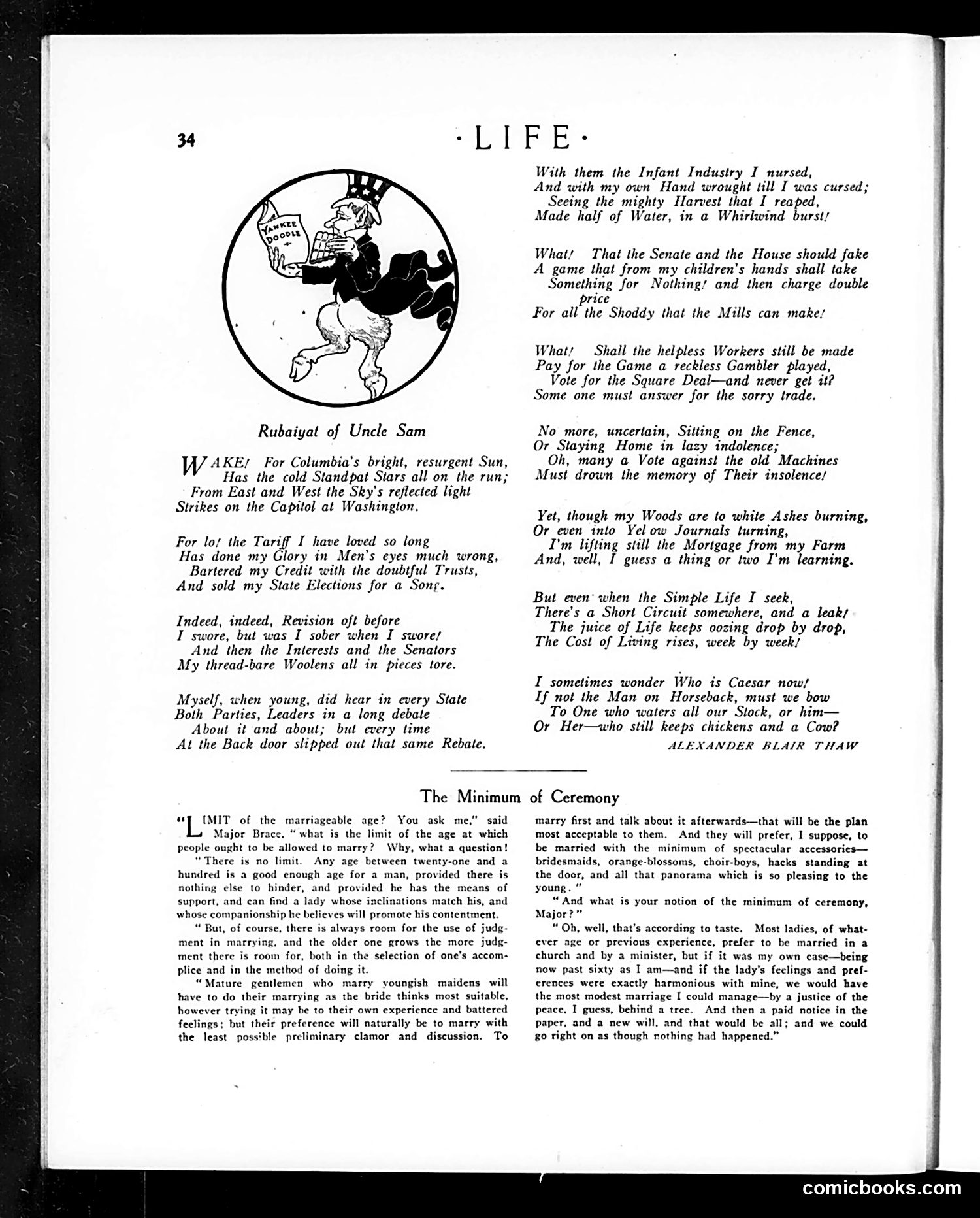
This political satire parodies Omar Khayyam's *Rubaiyat*, reimagining America ("Uncle Sam") as a disillusioned figure. The cartoon depicts Uncle Sam as a caricatured fool, supporting the poem's tone of regret and anger. The satire attacks: - **Protective tariffs** that harmed America's global reputation and credit - **Corporate corruption**: senators and "Interests" favoring big business over workers - **False prosperity**: "shoddy" goods and watered-down value from mills - **Political betrayal**: promises of tariff reform repeatedly broken via "rebates" and backroom deals - **Worker exploitation**: ordinary people paying for "reckless" corporate gambling while promised a "Square Deal" they never receive - **Rising costs of living** despite economic activity The author (Alexander Blair Thaw) expresses frustration with political machines, corporate control of elections, and economic inequality—themes of early 20th-century American progressivism. The imagery of burning woods and mortgages suggests widespread economic hardship.
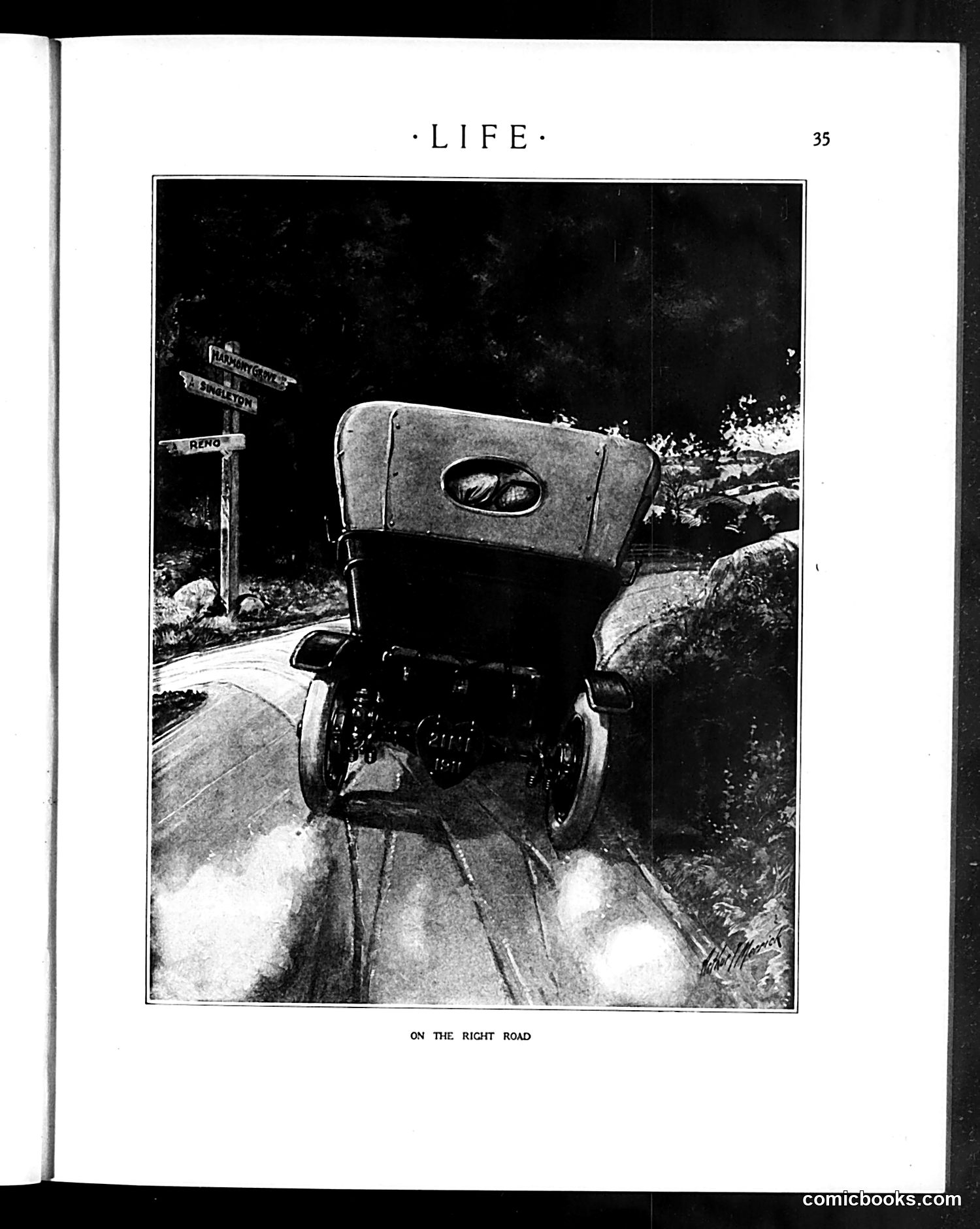
This photograph shows the rear view of an early automobile on a country road, with directional signs visible in the background. The image appears to be a straightforward documentary photograph rather than a political cartoon or satirical illustration. The caption "On the Right Road" suggests optimism about progress or direction, possibly referencing early 20th-century American confidence in automobile technology and modernization. Without additional context from surrounding articles or advertisements on this Life magazine page, the specific satirical intent remains unclear. The photograph may accompany an editorial commentary on transportation, infrastructure, or American advancement, but the exact target of any satire is not evident from the image alone.
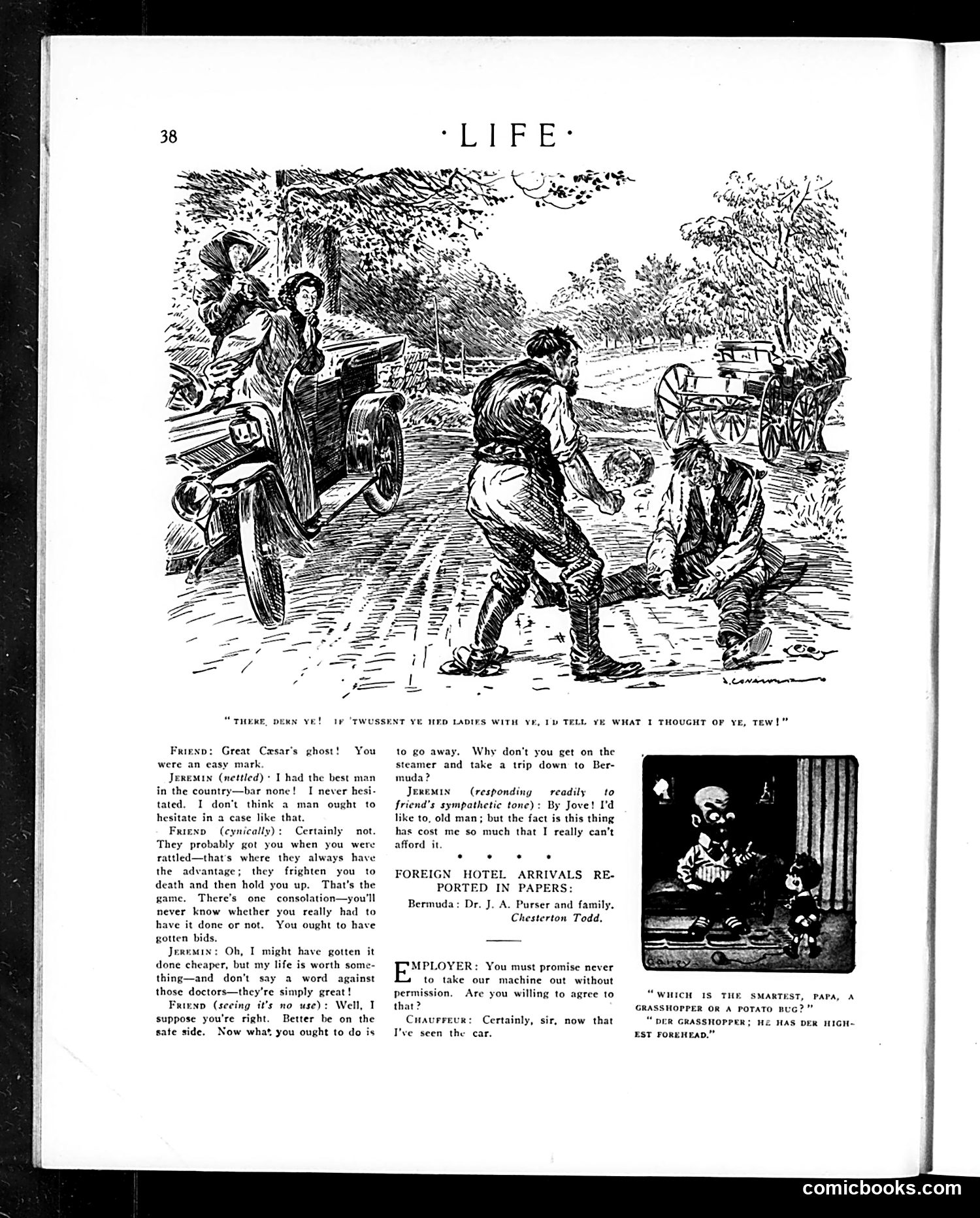
This two-act satirical play mocks the early 20th-century medical establishment's casual approach to surgery. **Act I** depicts Mr. Jeremin, a suburban gentleman with mild fever symptoms, being alarmed by Dr. Purser's mysterious examination and vague diagnosis of possible appendicitis requiring immediate surgery by a specialist named Jington. **Act II** reveals the con: Doctors Purser and Jington are business partners engaged in a kickback scheme. They casually discuss their patient as a profit opportunity, haggling over how much to charge and how to split fees. Jington asks "how much can he stand?"—meaning how much money can they extract, not medical capacity. The satire exposes unnecessary surgery and corruption in medicine: doctors collaborating to perform lucrative operations on healthy patients, with financial motivation trumping actual medical need. This reflects genuine Progressive Era concerns about surgical overtreatment by physicians prioritizing profit over patient welfare.
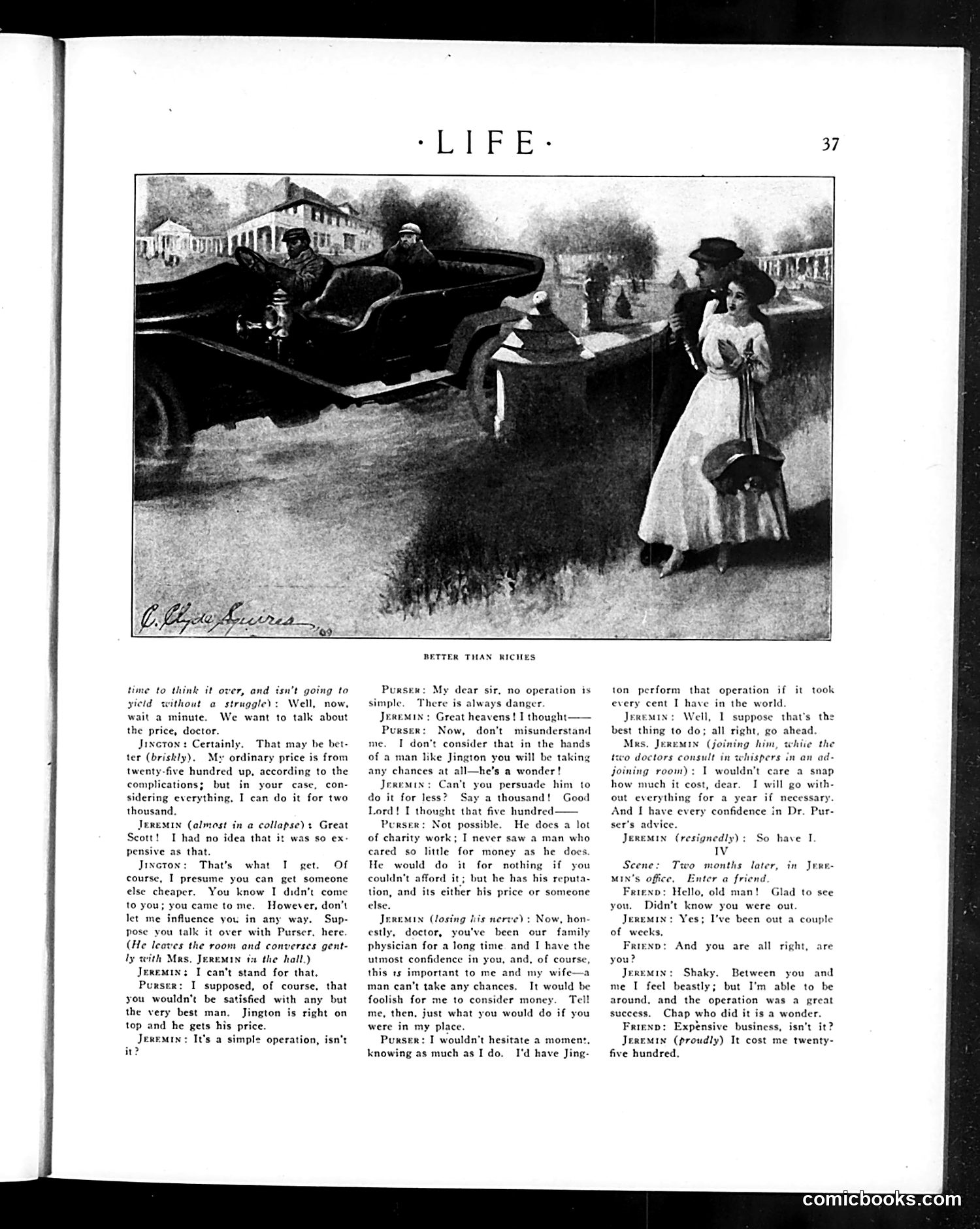
This comic depicts a classic confidence scheme disguised as medical advice. A patient (Jeremy) needs surgery and consults Dr. Jington, an expensive surgeon. A middleman named Purser acts as both the doctor's associate and the patient's supposed advocate, manipulating Jeremy through flattery and emotional appeals. The satire targets gullible wealth-anxiety: Purser convinces Jeremy that Jington's high fee ($2,500, later negotiated from an initial $5,000) reflects elite quality, not greed. He appeals to Jeremy's vanity ("the very best man") and fear for his wife's wellbeing. Jeremy and his wife accept the inflated price rather than risk inferior care. The punchline: months later, Jeremy admits feeling "beastly" but *proudly* reports the cost, having internalized that the expense itself proves quality. The scheme succeeded—the patient now equates high price with success, unable to objectively assess whether the surgery actually worked. The satire critiques both professional exploitation and middle-class insecurity about status and medical care.
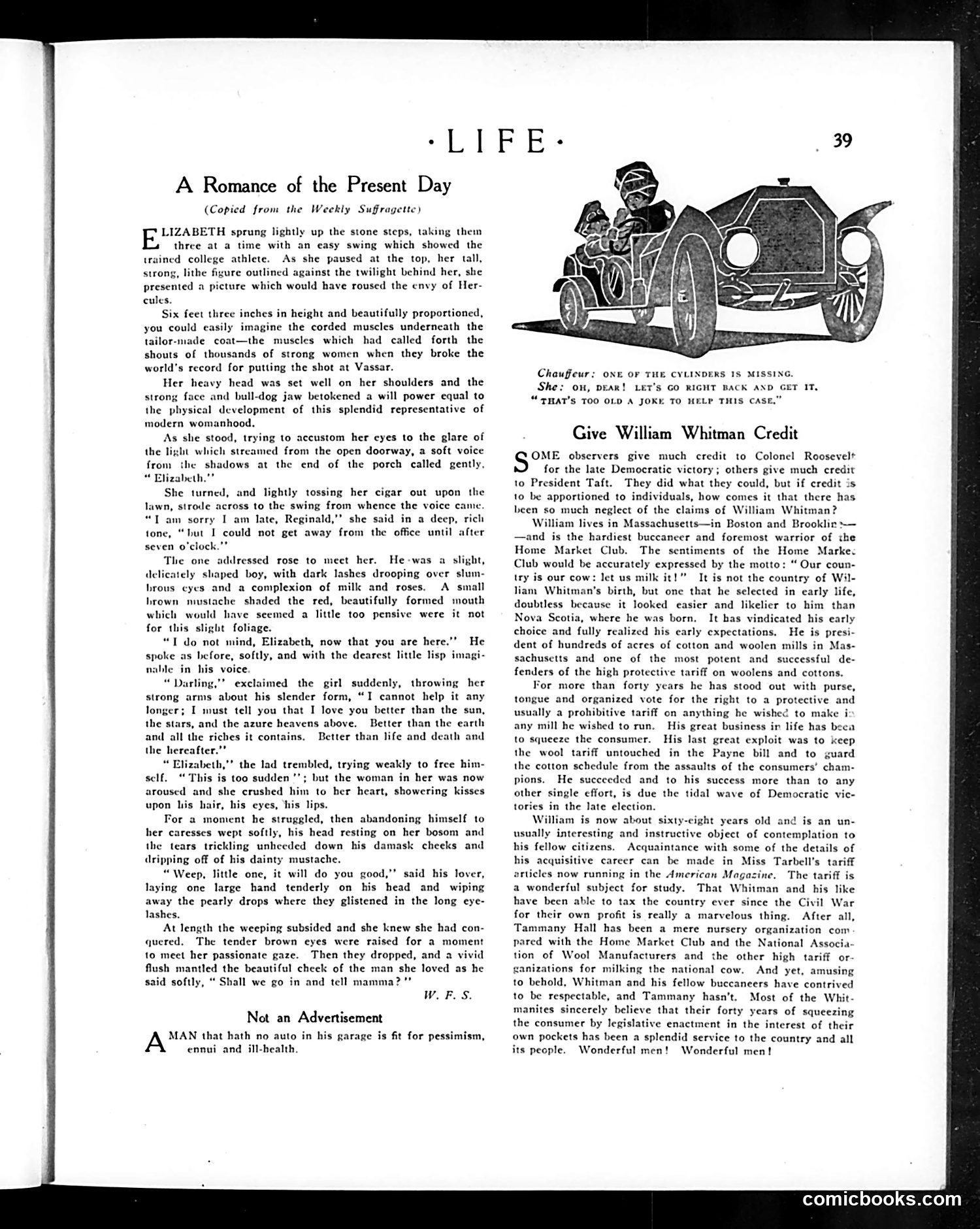
This is satirical fiction mocking the "New Woman" movement of the early 1900s. The story inverts traditional gender roles: Elizabeth is a tall, muscular athlete (shot-putter at Vassar) with a deep voice who smokes cigars and works late at the office, while her suitor Reginald is delicate, feminine, with "milk and roses" complexion and a lisp—he weeps easily and asks "Shall we go in and tell mamma?" The satire targets early feminism and women's education by depicting role-reversal as absurd. The exaggerated descriptions ("six feet three inches," "bull-dog jaw," "strong arms") and the credited source—"the Weekly Suffragette"—indicate this mocks suffragette aspirations. The illustration shows a couple in a car where the female chauffeur announces a missing cylinder; the woman's eager response to "get it" represents another joke about women's mechanical incompetence or absurd priorities. The accompanying article praises William Whitman's labor advocacy, providing contrasting serious political content on the same page.
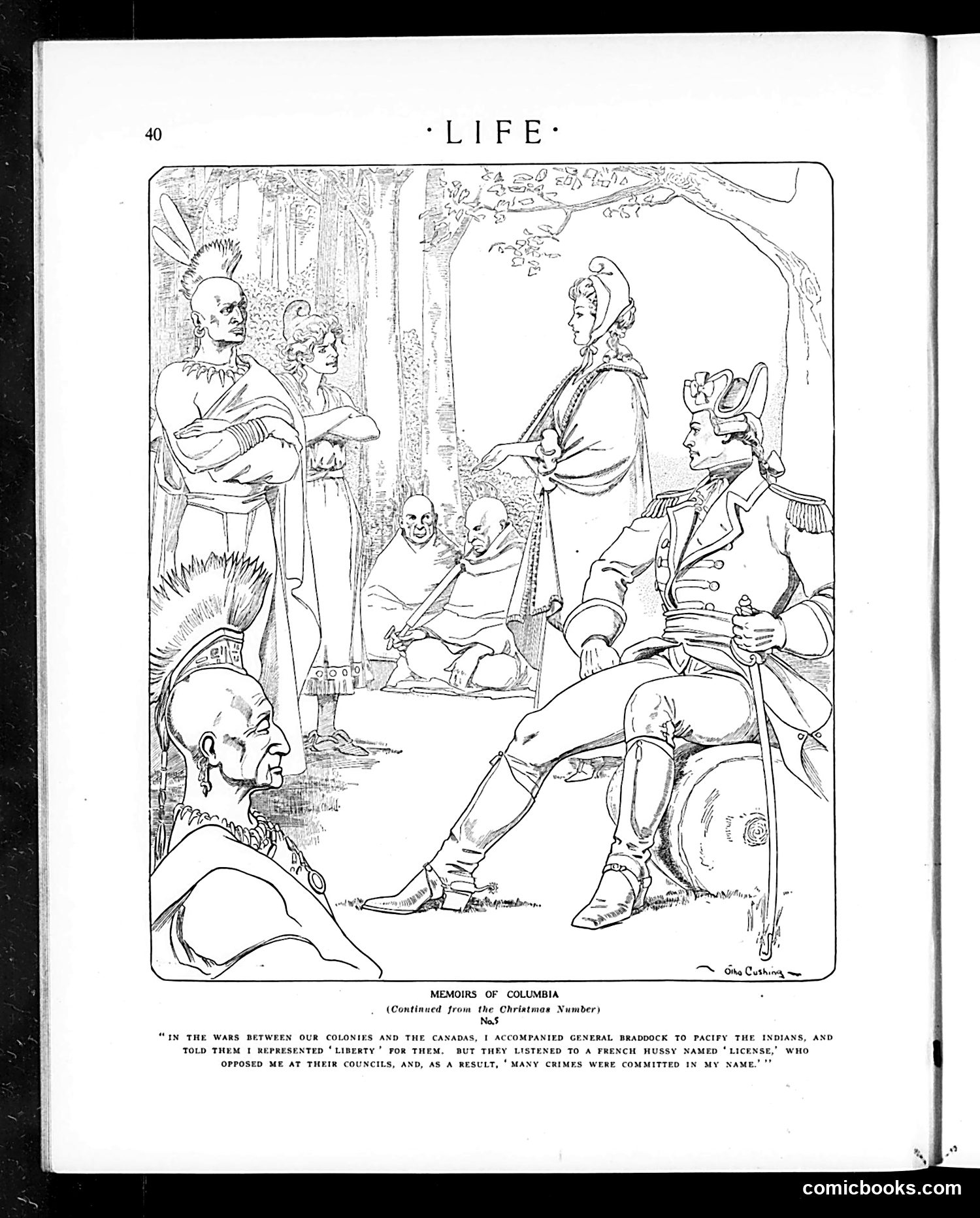
This satirical cartoon depicts an allegorical scene from American colonial history. The figure on the left appears to be "Columbia" (personification of America), speaking to military/political figures about conflicts with Native Americans during the French and Indian War era. The satire contrasts "Liberty" (Columbia's claimed representation) with "License" (a French-influenced concept), suggesting that indigenous peoples rejected American promises of freedom in favor of French interests. The complaint that "many crimes were committed in my name" ironically critiques how colonial powers justified violence and exploitation under the banner of liberty. The cartoon satirizes the hypocrisy of colonial rhetoric—claiming to represent freedom while committing atrocities. It's part of a serialized "Memoirs of Columbia" feature examining America's founding contradictions through historical allegory.
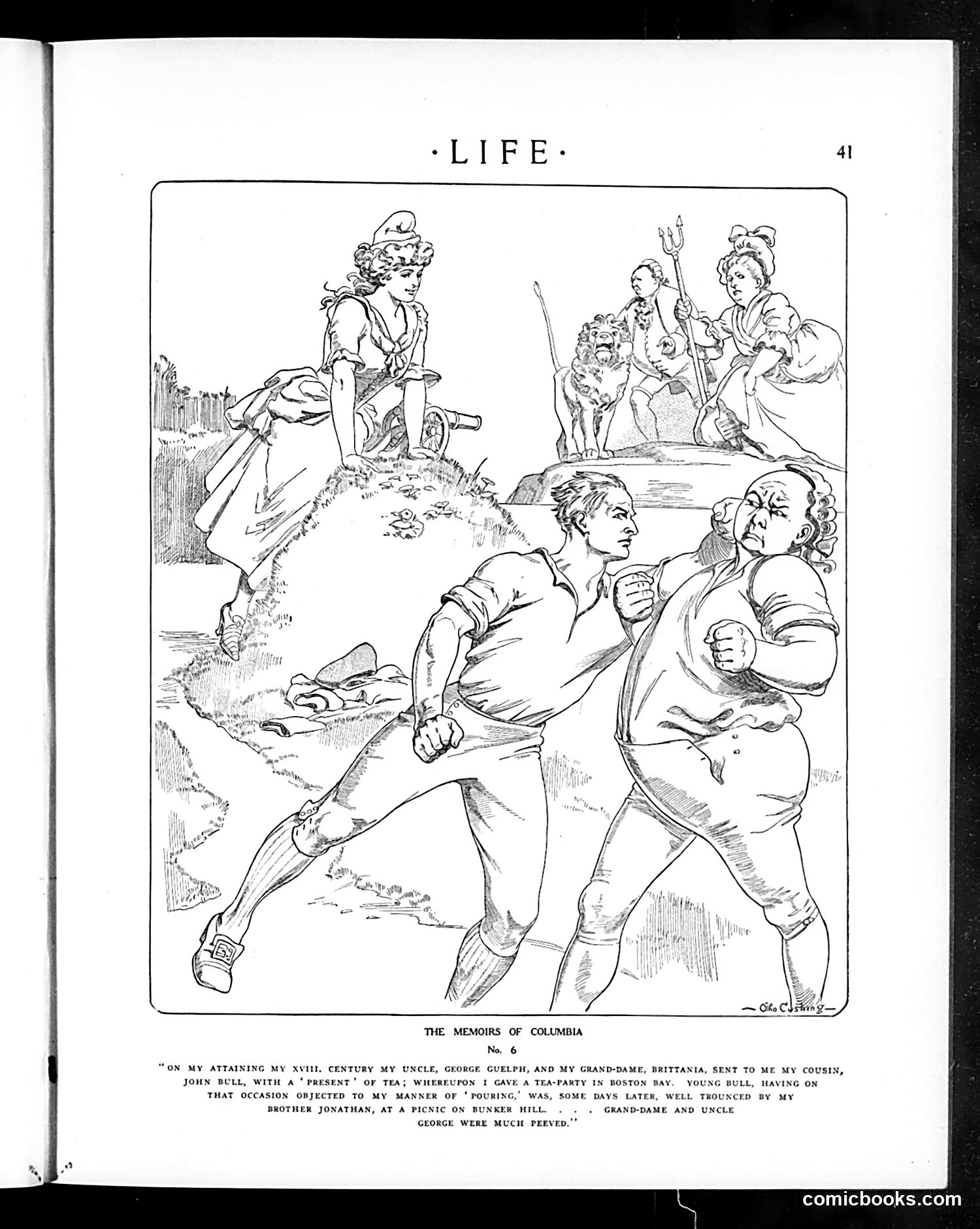
This satirical cartoon from *Life* magazine depicts the Boston Tea Party through personified national characters. "Columbia" (representing America) is the central female figure recounting her "memoirs." The text references her Uncle "George Guelph" (King George III of Britain), Grandmother "Britannia" (Britain), and Cousin "John Bull" (England). The joke centers on a family conflict: John Bull gave Columbia a "present" of tea, which she objected to—a satirical reference to the British Tea Act and colonists' refusal to accept it. The cartoon shows two rotund male figures (appearing to represent American colonists or patriots) actively dumping or resisting the tea, with upper-class British observers watching from above in apparent shock. The humor lies in recasting the revolutionary conflict as a family dispute over unwanted gifts and "manner," mocking British aristocratic sensibilities while celebrating American resistance to taxation without representation.
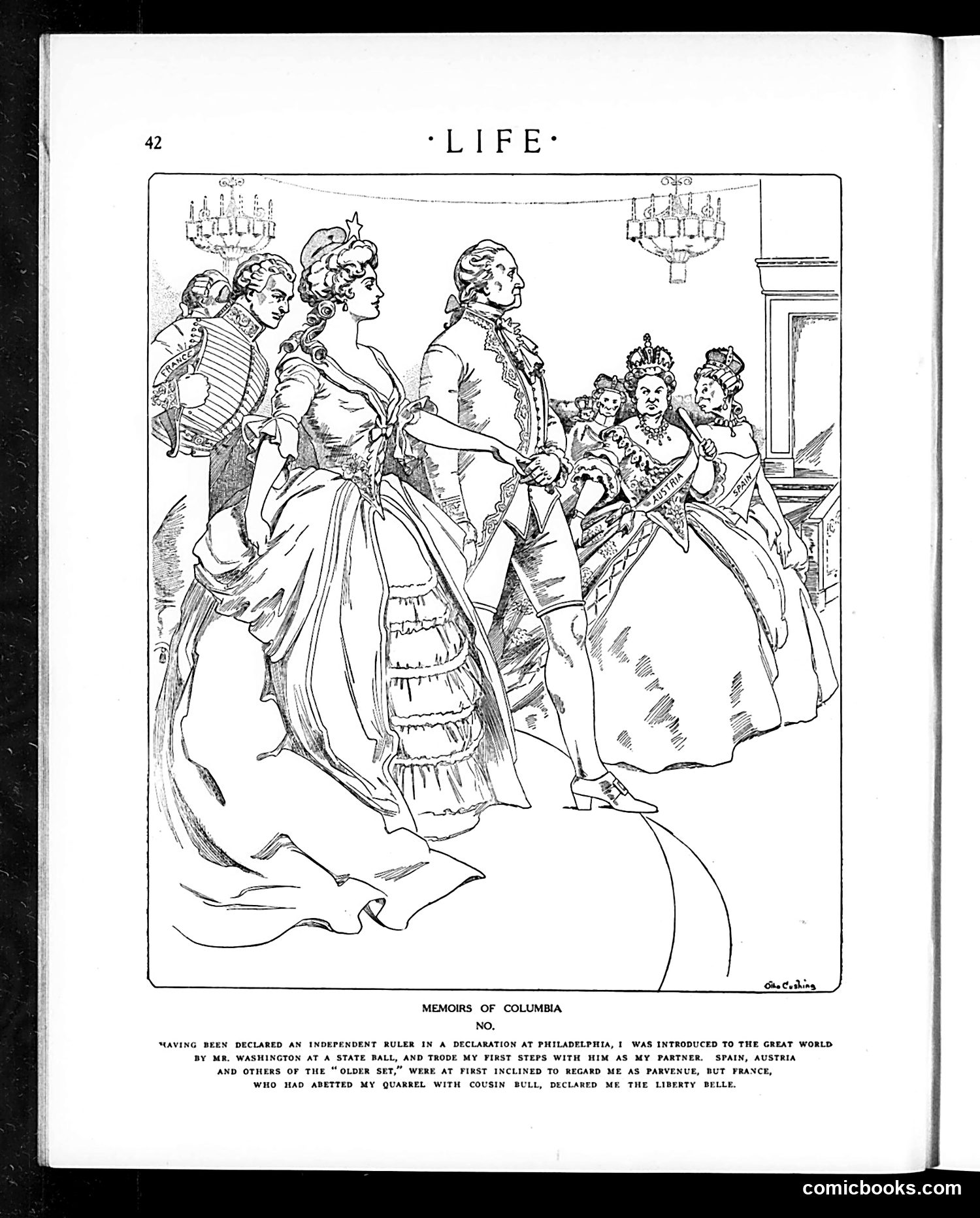
This satirical cartoon personifies America ("Columbia," the feminine national allegory) at a formal ball, narrating her debut into international society. The figure in the center represents the newly independent United States being introduced by George Washington. The satire mocks the young nation's social standing among European powers. Spain and Austria regard Columbia as a "parvenue" (social climber), reflecting their skepticism of American legitimacy. France, positioned favorably, is credited as her supporter—a reference to French assistance during the Revolutionary War against "Cousin Bull" (Britain). The "Older Set" represents established European monarchies viewing the upstart American republic with disdain. The cartoon humorously frames American independence through the lens of social etiquette and aristocratic hierarchies, suggesting Europe's condescension toward this new nation seeking acceptance among traditional powers.
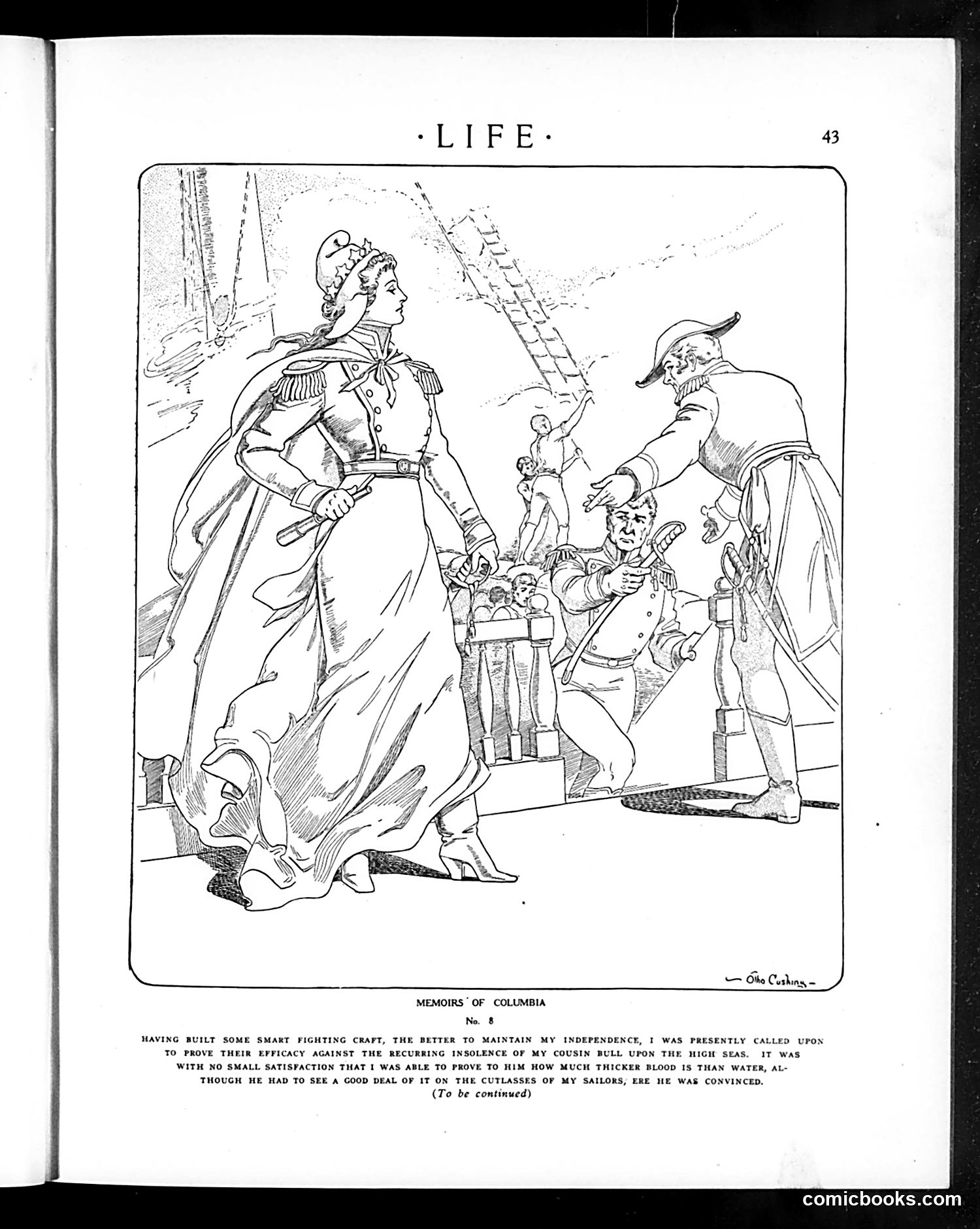
This is a political allegory depicting the American Revolution. "Columbia" (the female figure, personification of America) confronts "Cousin Bull" (Britain, represented by the British officers). The cartoon illustrates America's naval conflict with Britain, showing Columbia proving American independence through military force. The satire references the Revolutionary War's naval battles, where American ships challenged British naval supremacy. The text's phrase about proving "thicker blood is than water" is ironic—cousins should share kinship, yet Columbia must demonstrate her strength violently to convince Britain of American sovereignty. Drawn by Cibo Cushing, this appears part of a serialized historical commentary ("Memoirs of Columbia") in *Life* magazine. The satirical tone suggests American pride in naval victories while mocking Britain's reluctance to accept American independence without bloodshed.
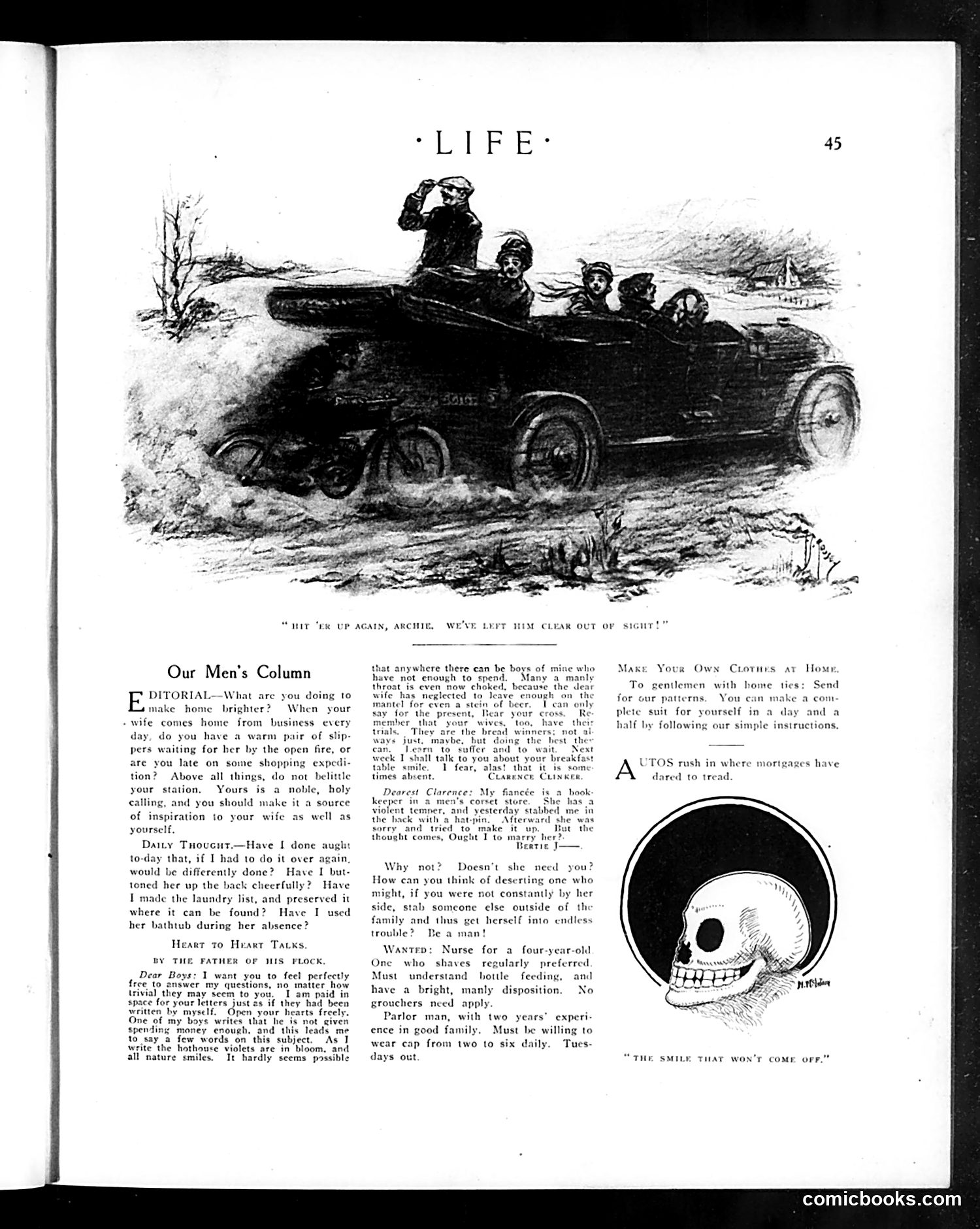
This page from *Life* magazine combines satirical advice columns with comic illustrations mocking early 20th-century domestic life and gender relations. **The top cartoon** shows a car stuck in mud with passengers, captioned "He's up again, Archie, we've left him clear out of sight"—likely satirizing the unreliability of early automobiles and the chaos of motoring adventures. **"Our Men's Column"** ironically addresses husbands as noble providers, sarcastically praising domestic duties (preparing slippers, doing laundry) while subtly criticizing male neglect of home life. **"Heart to Heart Talks"** parodies advice columns, featuring absurd letters: a woman who stabs her fiancé with a hat pin; wanted ads for nurses and parlor men with oddly specific (and ridiculous) qualifications. **The right illustration**, "The Smile That Won't Come Off," shows a grotesque grinning face—likely mocking forced cheerfulness or artificial social graces expected of women. The overall satire targets conventional gender expectations, marital dynamics, and the earnest self-help literature proliferating in the era.
This is satirical fiction about a (fictional) organization offering Christmas refuge for husbands escaping their wives. The narrative ridicules both marital discord and the women's suffrage movement of the early 1900s. The joke operates on multiple levels: A bureau advertises a husband-only Christmas dinner with no wives, relatives, or gift-giving—presented as appealing escapism. When wives discover this (led by "one of the most prominent suffragettes"), they march en masse to retrieve their husbands, depicted as cowardly and terrified. The satire mocks both sides: husbands for needing escape, and suffragettes for being aggressive "renegades." The "resolution" (feeding the wives dinner and sending them away without their husbands) suggests wives are easily mollified by hospitality—a dismissive characterization typical of anti-feminist satire from this era. The piece reflects early 1900s anxieties about changing gender roles and marriage dynamics.
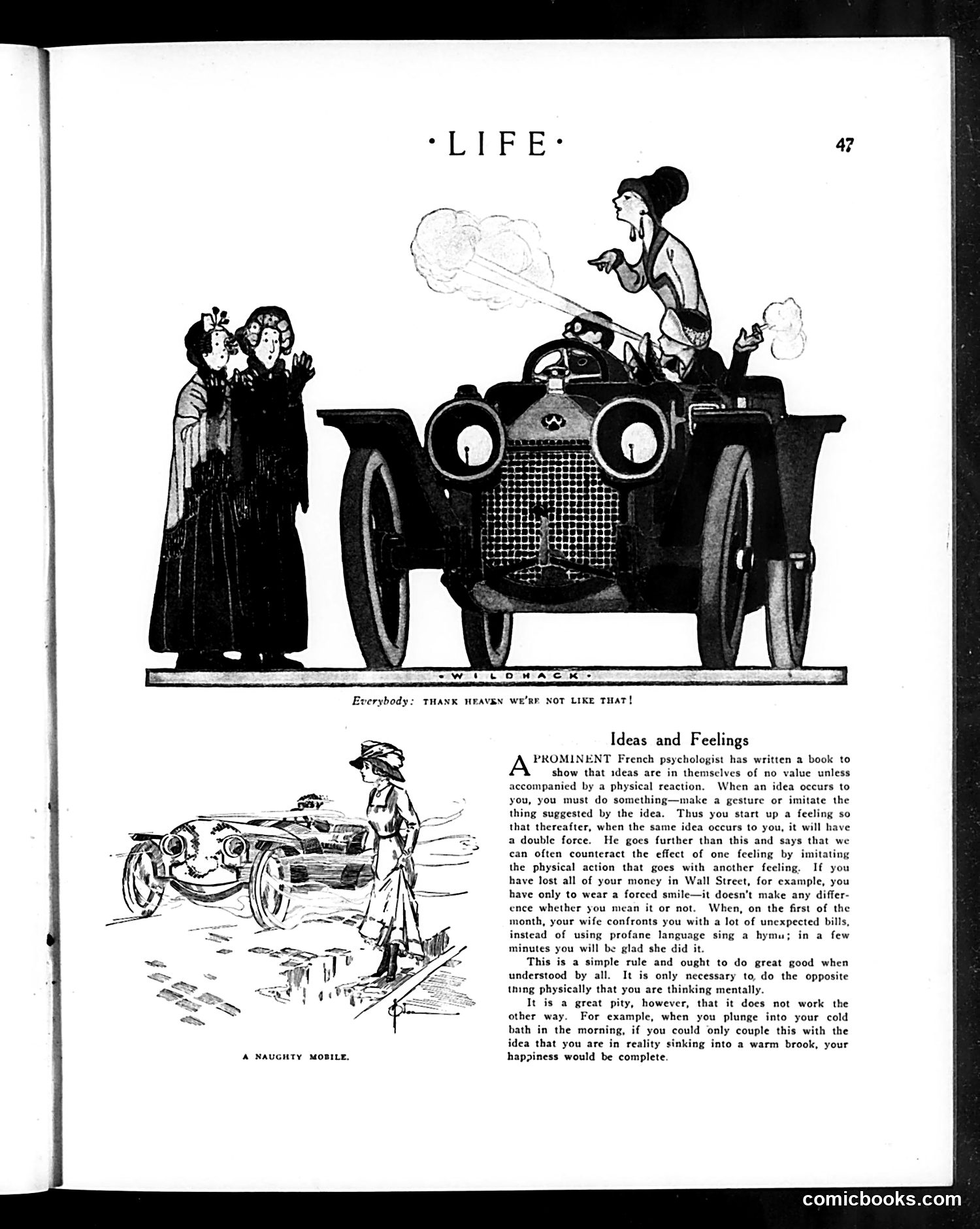
This Life magazine page contains two satirical cartoons about early 1920s automobiles and reckless driving. The top cartoon "Wildhack" depicts a speeding race car with passengers standing unsafely on it, throwing what appears to be exhaust or smoke. Two well-dressed women on the left react with shock, saying "Thank heaven we're not like that!"—the satire being that reckless, dangerous driving was apparently fashionable among young people despite obvious safety hazards. The bottom cartoon "A Naughty Mobile" shows a similar unsafe vehicle with a woman driver, suggesting women drivers were viewed as particularly reckless or careless—a common stereotype of the era. The accompanying article about French psychology is separate, discussing how physical actions influence emotions—unrelated to the car cartoons except as page filler. Together, the cartoons mock both dangerous driving practices and the generational divide between conservative observers and thrill-seeking motorists of the Jazz Age.
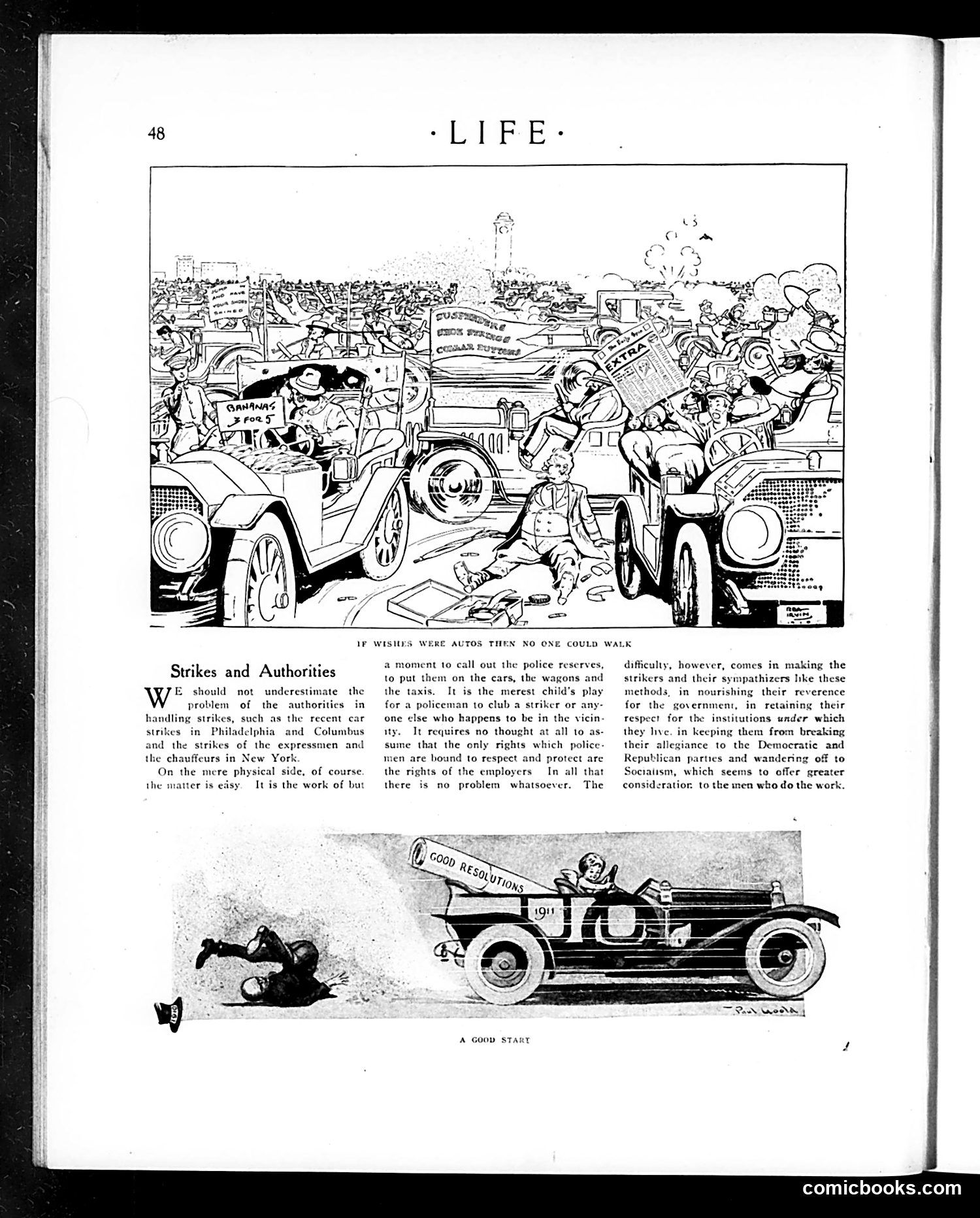
This page critiques police handling of labor strikes in Philadelphia, Columbus, and New York involving car workers, expressmen, and chauffeurs. The top cartoon satirizes the absurdity of using automobiles (then relatively new) as police vehicles to suppress strikes—showing chaotic street scenes where police deploy cars against workers. The article argues that while authorities easily *can* use force to club strikers and protect employers' interests, doing so creates a deeper problem: it breeds resentment and pushes workers away from Democratic and Republican parties toward radical alternatives (likely socialism or anarchism). The bottom cartoon, "A Good Start," shows a vehicle labeled "Good Resolutions" running over a fallen worker—suggesting that official declarations of fairness are meaningless without genuine reform. The satire's point: brutal strike suppression may win tactical victories but strategically undermines political stability by radicalizing the working class.
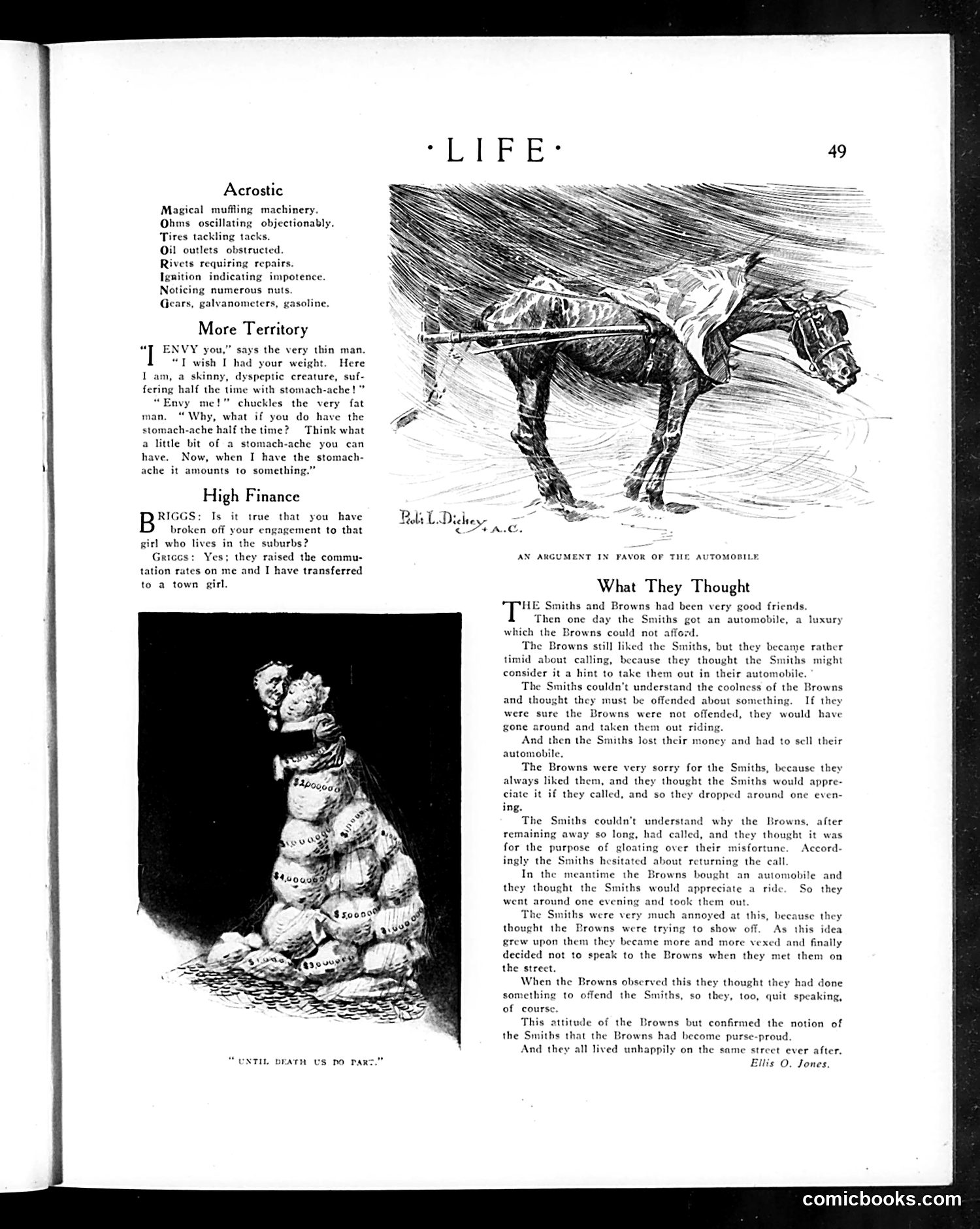
This page satirizes early-20th-century anxieties around automobiles and class. The main story, "What They Thought," depicts two neighboring families whose friendship collapses due to automobile ownership—a symbol of wealth disparity. When the Smiths buy a car, the Browns avoid them from shame. Later, when positions reverse and the Browns acquire an auto, the Smiths suspect mockery. Both families misinterpret each other's motives, ultimately severing ties over a luxury item. The sketch at top illustrates a horse pulling an automobile, captioned "An Argument in Favor of the Automobile"—sarcastically suggesting horses outlast cars mechanically (the "Acrostic" lists common auto failures: faulty ignition, broken rivets, etc.). The page mocks how automobiles, despite promised progress, actually damaged social bonds by creating resentment and suspicion based on consumer status—a common Progressive-era critique of materialism and class consciousness.
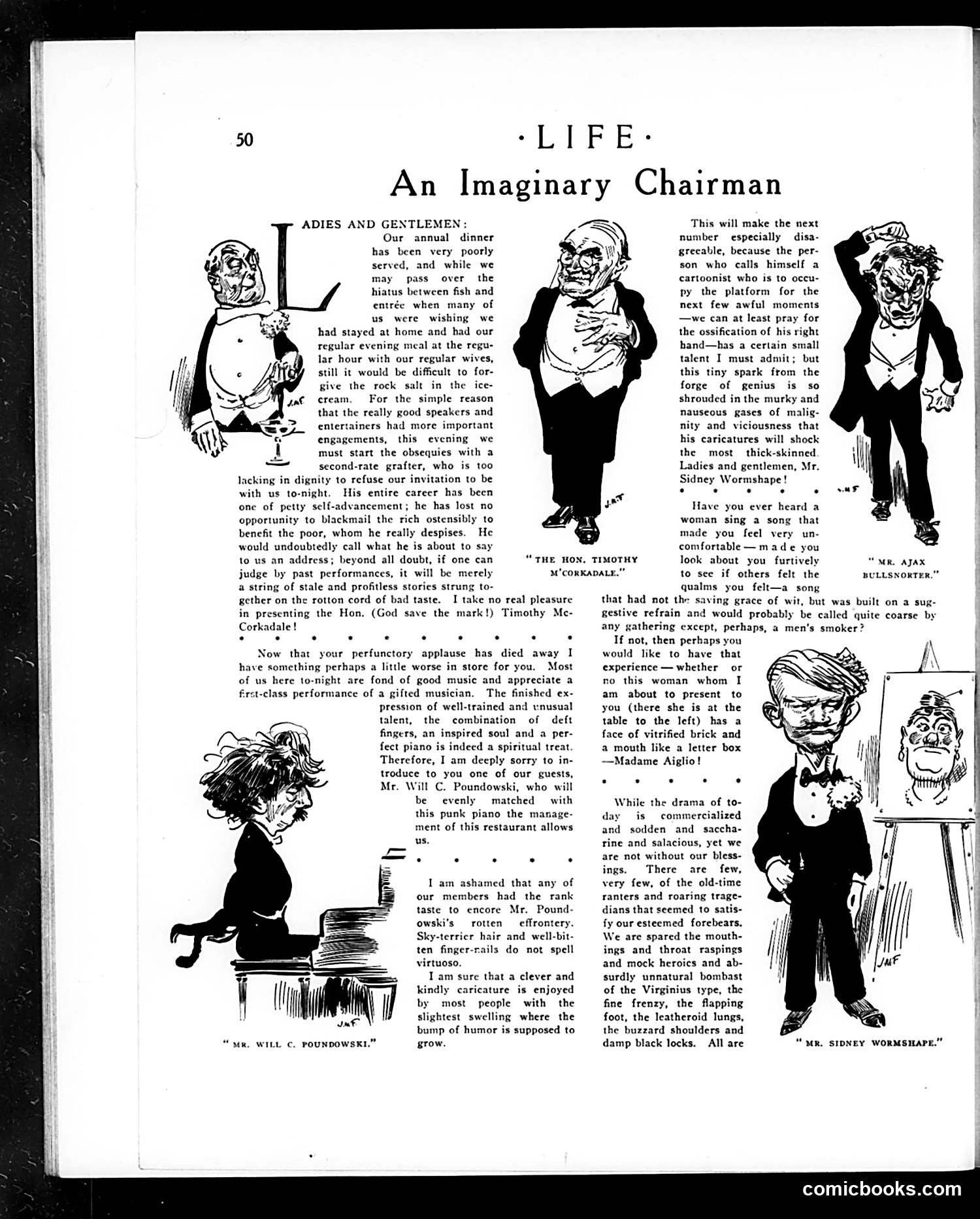
This page satirizes a formal dinner event through a fictional chairman's brutally honest introductions. The chairman (Timothy McCorkdale, labeled "THE HON.") delivers backhanded introductions to performers, insulting each while ostensibly presenting them. The targets include: - **Mr. Will C. Poundowski**: A mediocre pianist with poor grooming ("sky-terrier hair") - **Mr. Sidney Wormshape**: A cartoonist whose talent is obscured by "malignity and viciousness" - **Mr. Ajax Bullsnorter**: An unidentified figure (purpose unclear from image) - **Madame Aiglio**: A female performer described as having an unattractive face The satire mocks both the pompous dinner convention and the low quality of available entertainment. The chairman's contemptuous tone—calling speakers "second-rate grafters" and entertainers mediocre—reflects turn-of-century cynicism about cultural institutions and hired performers at society events. The elaborate insults frame the joke: polite society must endure terrible entertainment while maintaining false civility.
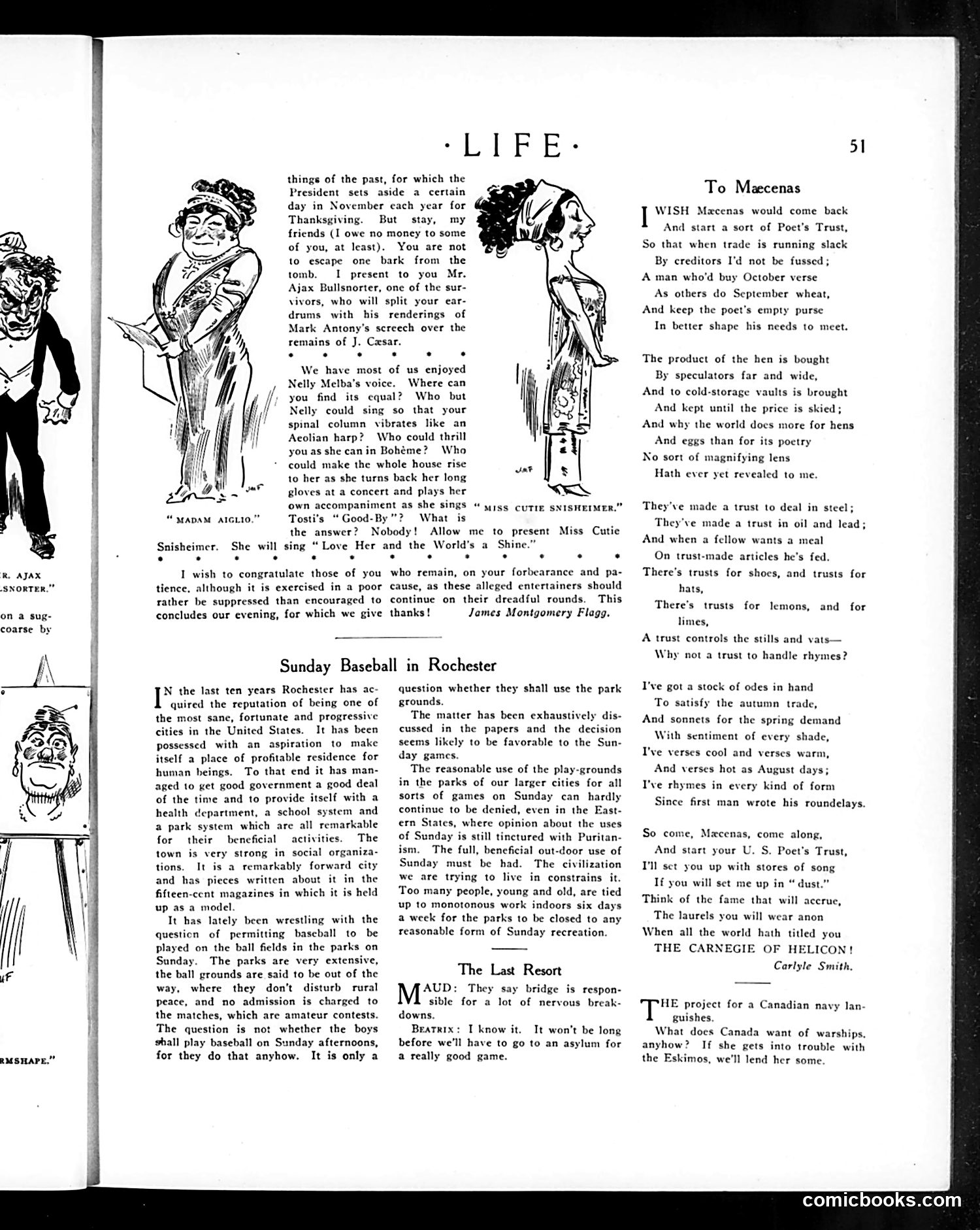
This page contains several satirical pieces typical of early 20th-century *Life* magazine: **The Caricatures (left side):** Labeled "R. AJAX SNORTER" and others, these appear to be mocking amateur theatrical performers or singers of the era. The text by James Montgomery Flagg sarcastically "congratulates" readers who endure these performers' "dreadful rounds"—the humor lies in pretending these mediocre entertainers are torture to sit through. **"Sunday Baseball in Rochester":** This discusses a real civic debate about permitting amateur baseball on Sundays in public parks. The piece argues *for* allowing Sunday recreation, challenging strict Puritan attitudes that reserved Sundays for religious observance only. It frames this as a progressive position for a "sane, fortunate" modern city. **"To Maecenas":** A poem addressing an imaginary wealthy patron, satirizing poets' financial struggles during economic downturns and their dependence on rich sponsors. **"The Last Resort":** A brief joke about bridge playing as a form of escape/distraction. The overall tone is urbane social commentary on entertainment, religion, and modern life.
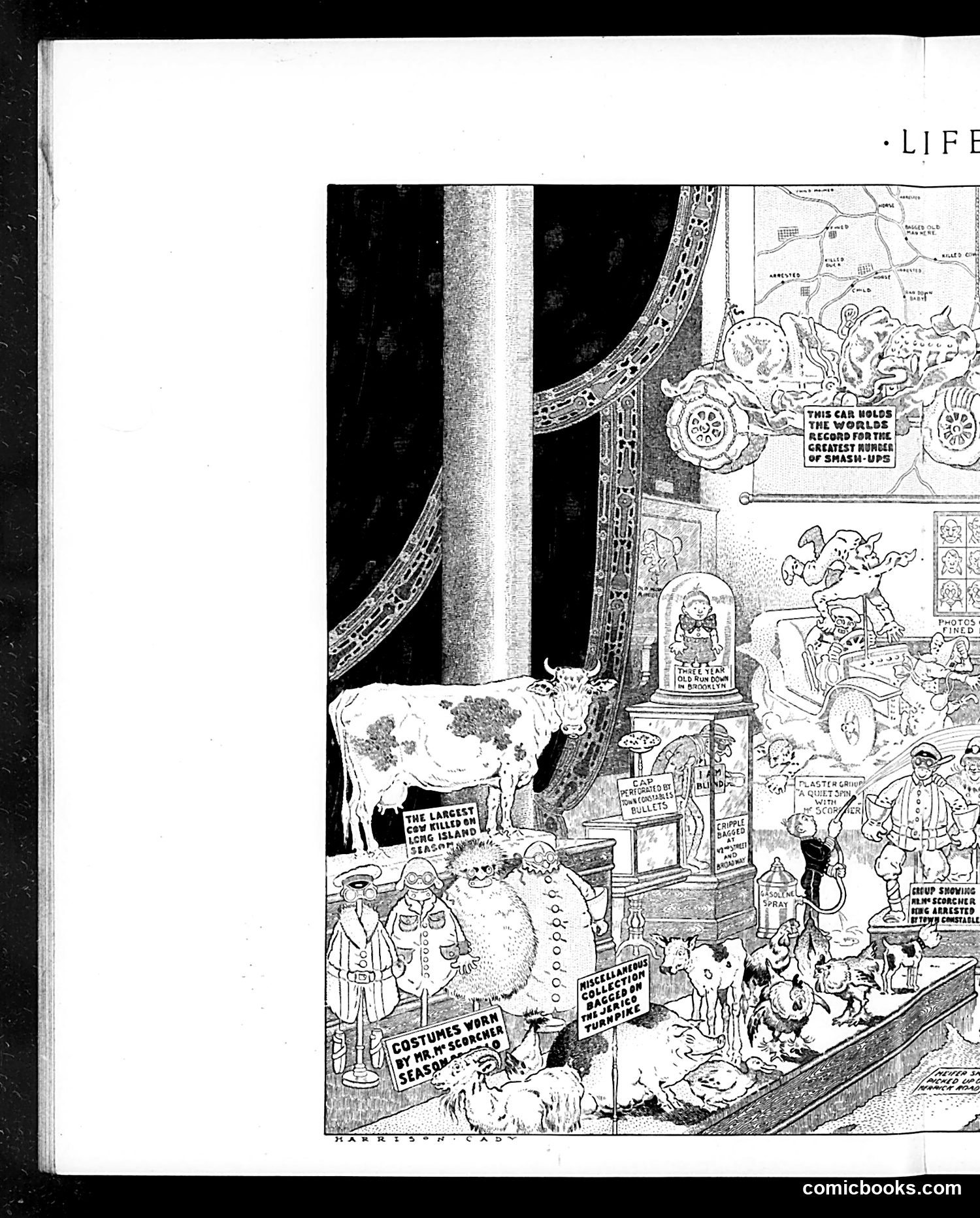
This appears to be a satirical cartoon from Life magazine's early era, depicting a chaotic street scene. The central focus shows an enormous cow being driven through what looks like a busy urban street or fair, with various signs advertising record-breaking incidents—a car holding "the world's record for the greatest number of smash-ups" and "costumes worn in one season." The cartoon satirizes early 20th-century American culture's obsession with sensationalism and record-breaking. The absurd juxtaposition of a massive cow in an urban setting, combined with the competing signs for different "world records," mocks the era's tendency to celebrate trivial or destructive achievements as newsworthy spectacles. The dense, crowded composition reflects the magazine's satirical take on modern life's overwhelming pace and commercialism.
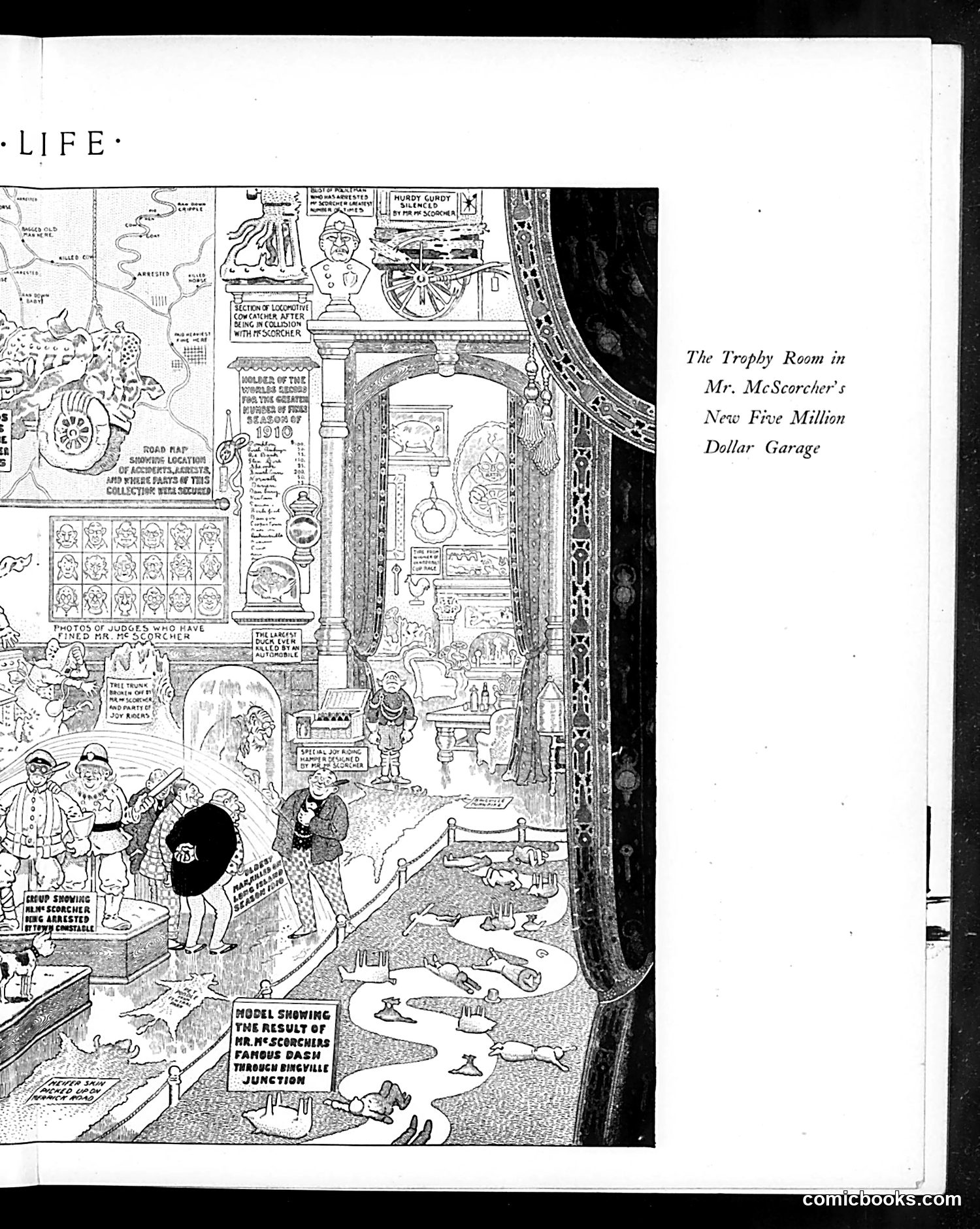
This is a satirical illustration of "Mr. McScorcher's New Five Million Dollar Garage," featuring an elaborate trophy room display. The cartoon mocks wealth and reckless driving through detailed visual gags: there's a wrecked locomotive section labeled as resulting from a collision, photographs of "jurors who have tried Mr. McScorcher," and a model showing the aftermath of his "famous dash through Bingville Junction." The satire targets a wealthy industrialist whose dangerous driving has caused multiple accidents, which he apparently displays as trophies. The elaborate, ornate garage suggests nouveau riche ostentation, while the collection of wreckage and legal consequences parodies how the wealthy can escape accountability for harmful behavior. The humor derives from treating catastrophic collisions as prestigious achievements worthy of display.
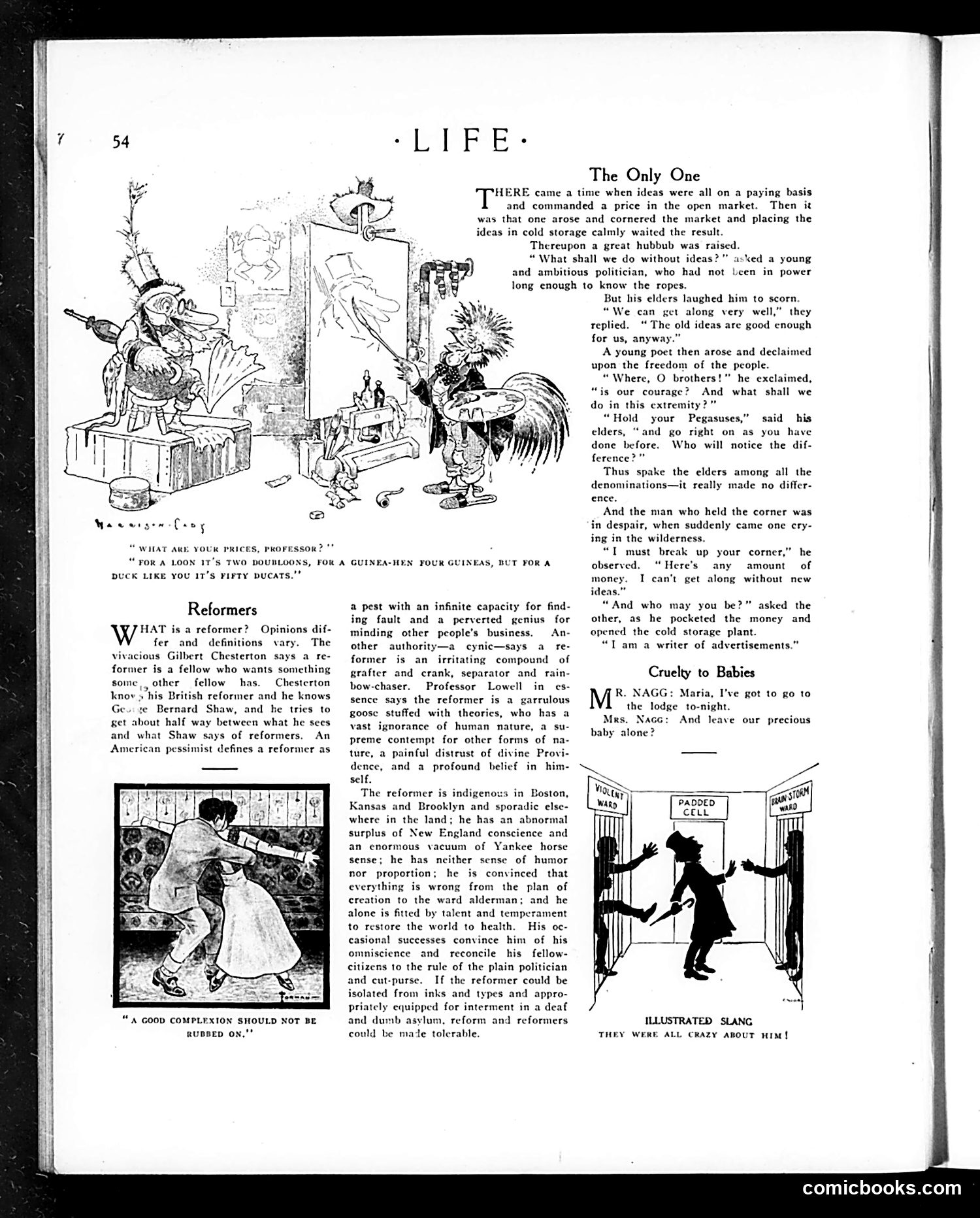
**"The Only One"** satirizes the commodification of ideas. A figure corners the market on ideas, storing them like goods. When a young politician and poet seek new ideas to address social problems, they're rebuffed by elders defending "old ideas." The satirist mocks society's resistance to innovation—until an advertiser arrives with money, revealing that practical commerce, not idealism, drives change. The joke: ideas only matter when there's profit in them. **"Reformers"** is a lengthy essay-cartoon mocking do-gooder activists. The text catalogs unflattering definitions: reformers are fault-finding busybodies, cranks, theorists ignorant of human nature, concentrated in Boston/Brooklyn with excessive conscience but no common sense. They meddle in others' affairs while convinced only they can "fix" society. The accompanying illustration shows a woman scrubbing a face, captioned "A good complexion should not be rubbed on"—suggesting reformers' aggressive, counterproductive methods. **"Cruelty to Babies"** is a brief domestic joke about a husband dodging childcare by claiming lodge obligations.
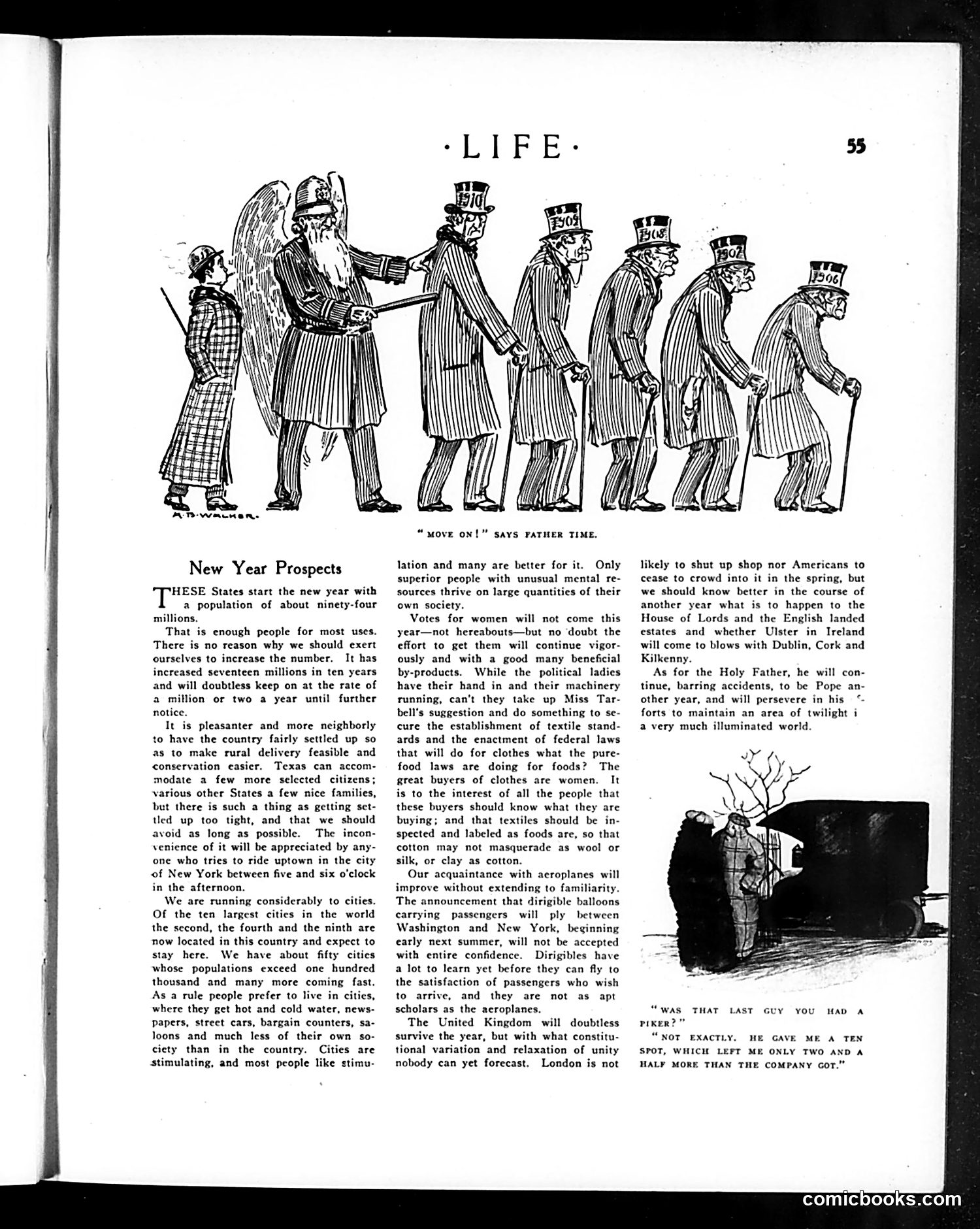
This satirical cartoon depicts **Father Time** (the winged, bearded figure) pushing along a line of hunched, elderly gentlemen in top hats, representing **aging politicians or the old guard of society**. The caption suggests time's inevitable passage and generational change. The accompanying article discusses early 1910s American concerns: **population growth** (94 million people), **urbanization**, **women's suffrage** efforts, **textile industry regulation** (referencing Ida Tarbell's consumer protection advocacy), **aviation technology**, and **British political upheaval** (regarding Irish Home Rule and the House of Lords). The cartoon's point: the old political establishment must yield to progress and modern reform movements. The figures being "moved along" represent entrenched conservative interests resisting change—particularly regarding labor standards, women's rights, and technological advancement. The satire suggests these outdated leaders should step aside for new ideas, much as Father Time relentlessly pushes history forward.
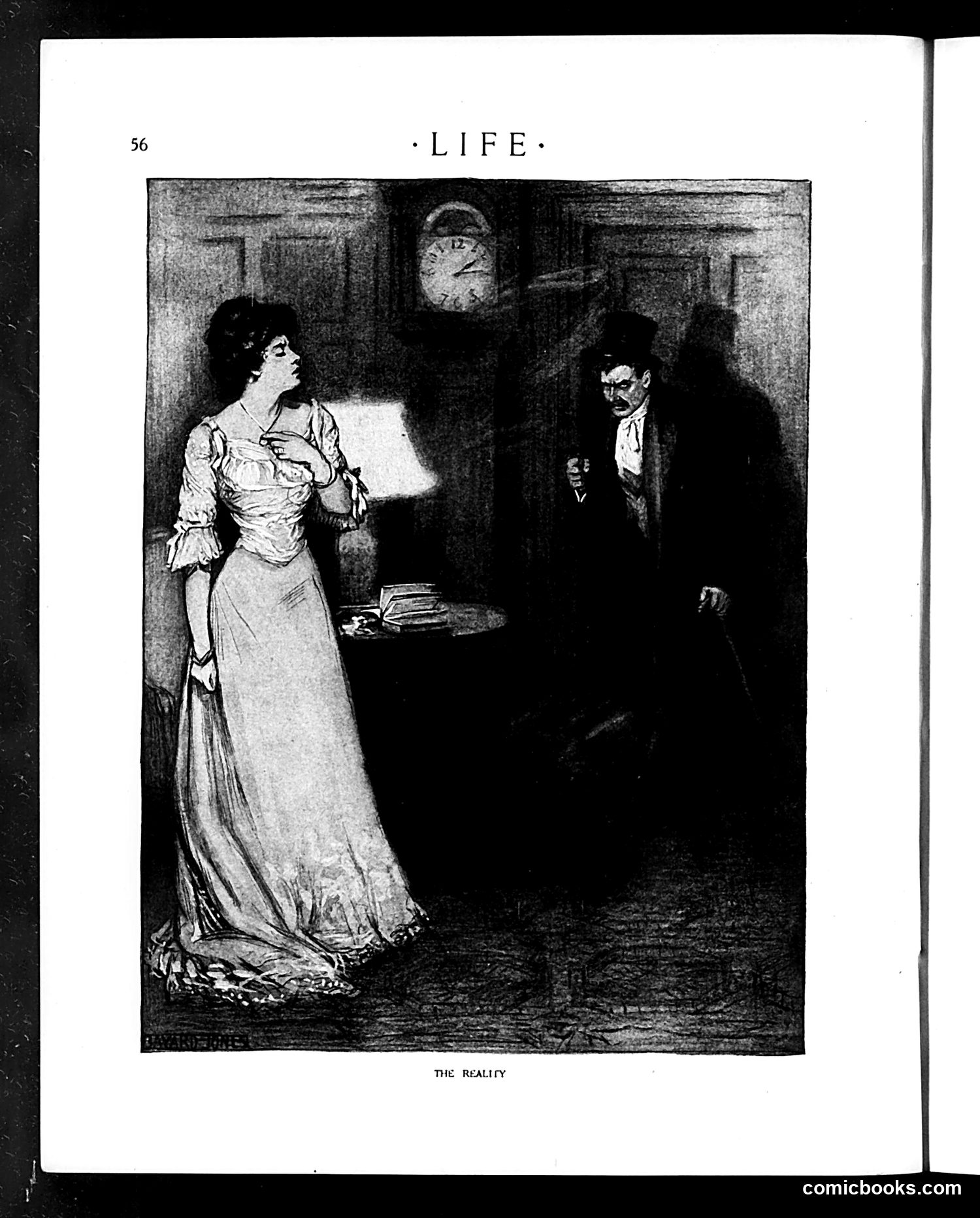
This cartoon depicts a social commentary on romantic idealization versus harsh truth. A elegantly dressed woman in an evening gown stands confronting two men in dark formal wear—one appears sinister or disreputable. A clock on the wall shows the late hour. The title "The Reality" suggests the cartoon contrasts romantic fantasy with unpleasant truth. The woman's refined appearance and posture suggest she may represent idealized femininity or romance, while the men—particularly the menacing figure on the right—embody the crude realities of actual human behavior or relationships. The late hour indicated by the clock adds to the sense of something illicit or degrading occurring. The satire likely critiques the gap between women's romantic expectations and actual male conduct.
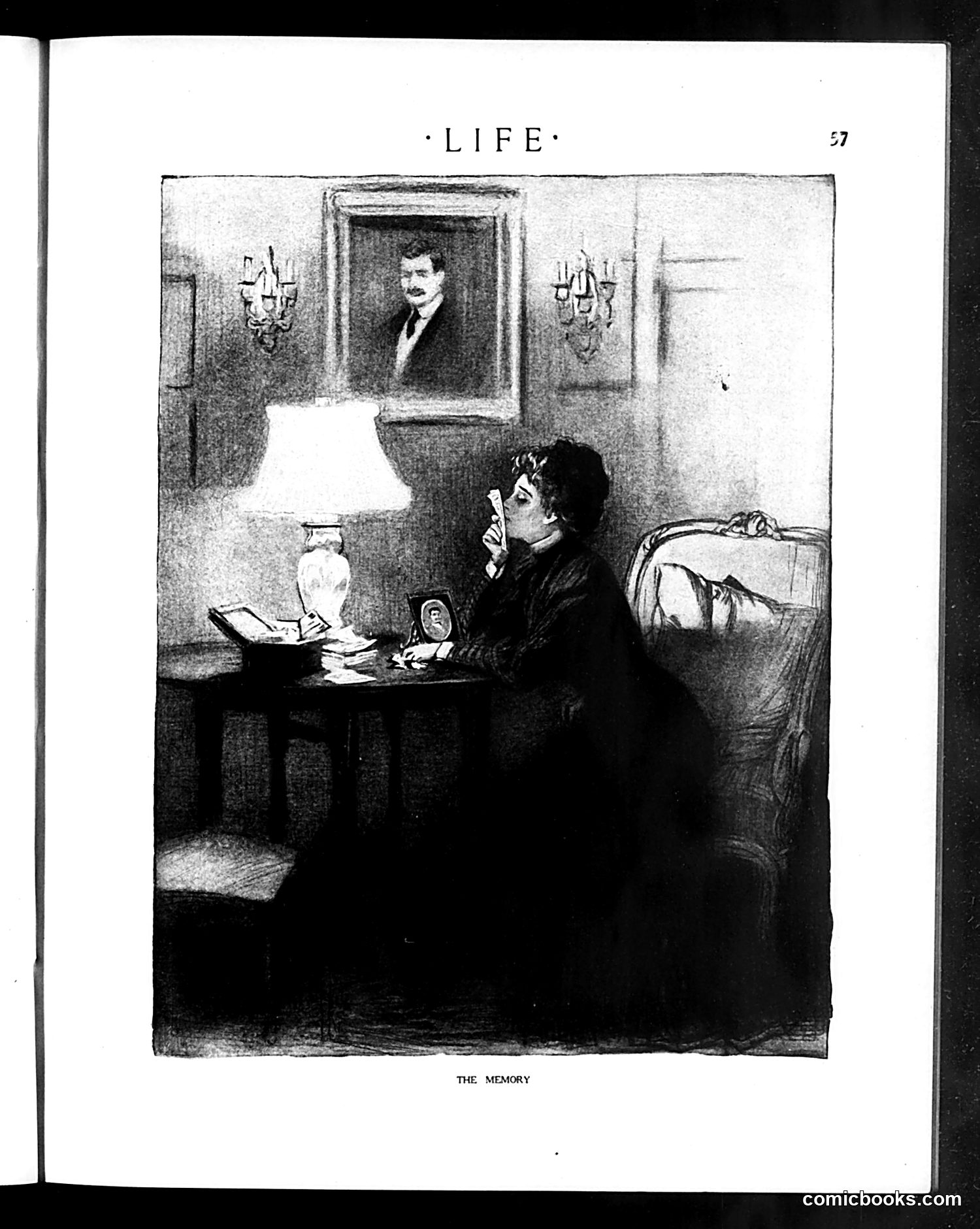
This cartoon depicts a man seated at a desk, apparently struggling with memory or concentration. He holds his head pensively while working by lamplight, with what appears to be writing materials before him. A portrait hangs on the wall behind him. The title "The Memory" suggests the cartoon satirizes forgetfulness or mental fatigue, likely commentary on a contemporary figure or situation. The formal interior setting and the subject's absorbed pose suggest this may reference intellectual work or professional responsibility. Without additional context about the specific date or historical figures involved, the precise satirical target remains unclear. The image appears to comment on the burdens of memory or the struggle with recollection, though the specific political or social reference cannot be definitively determined from the image alone.
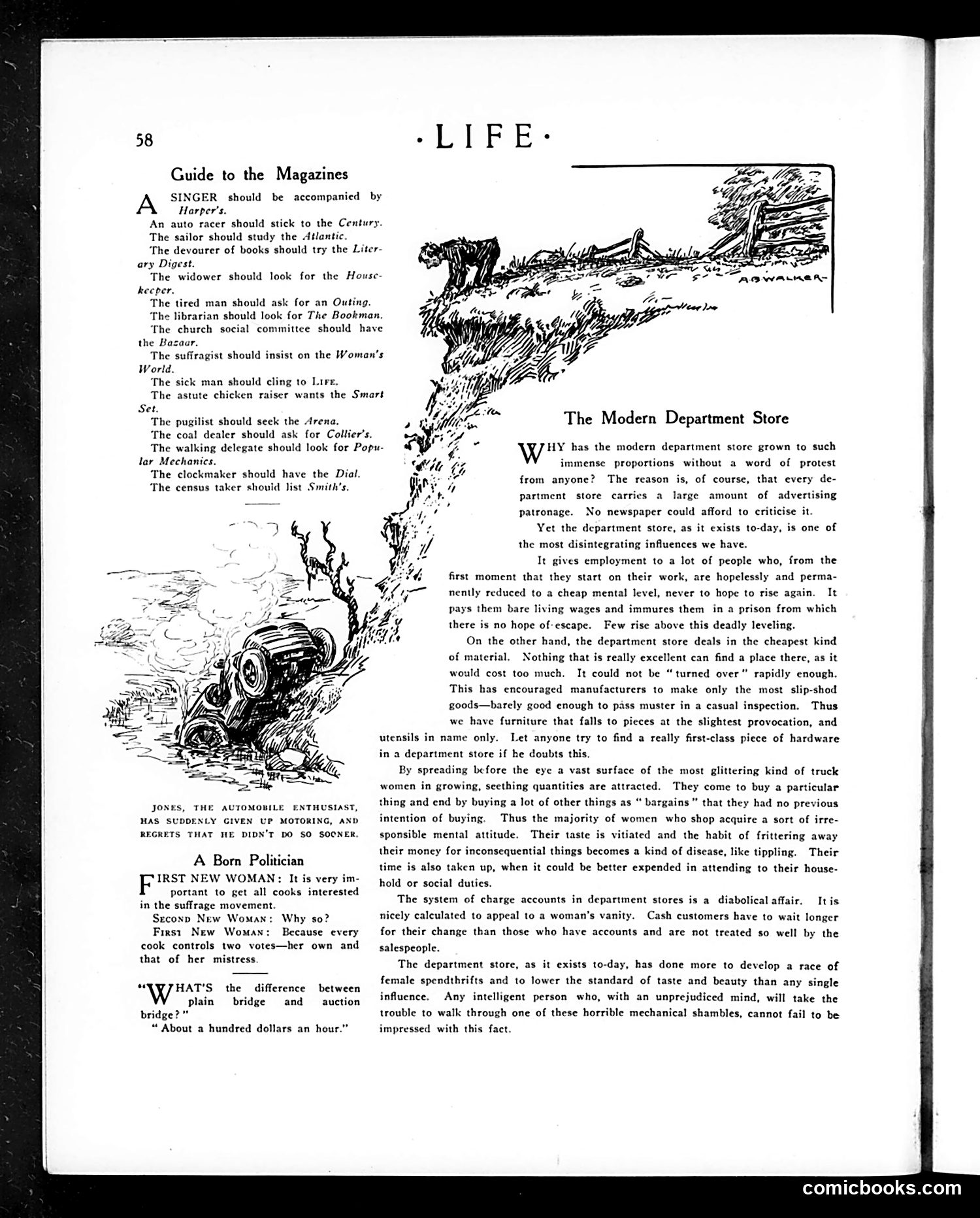
This page contains two main satirical pieces criticizing early 20th-century American institutions. **"Guide to the Magazines"** is a humorous matching game pairing magazine types with reader demographics—suggesting specific publications suit particular professions and interests (auto racers read Century, suffragists read Woman's World, etc.). **"The Modern Department Store"** is a serious critique attacking department stores as socially destructive forces. The author argues they: - Exploit workers with low wages and no advancement prospects - Sell inferior goods manufactured cheaply - Manipulate women consumers through visual display and credit systems, encouraging frivolous spending - Damage women's taste and judgment - Waste women's time better spent on household duties **"A Born Politician"** is a brief joke about suffrage: a woman argues cooks should support women's voting because each cook "controls two votes—her own and that of her mistress," implying domestic servants influence their employers' political views. The page reflects Progressive Era anxieties about consumer culture, women's economic behavior, and labor exploitation.
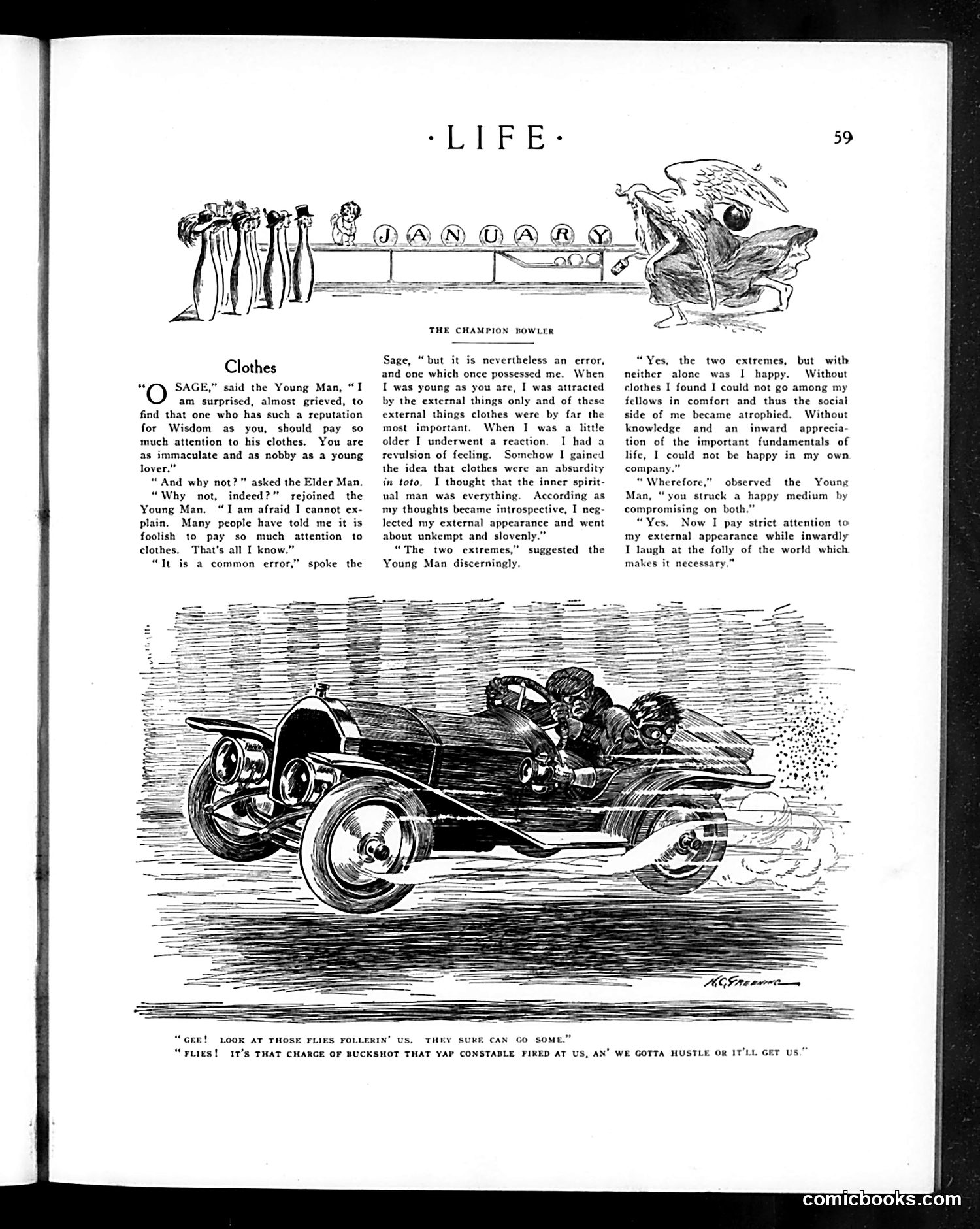
This page contains two distinct pieces: **Upper section ("Clothes"):** A philosophical dialogue between a Young Man and an Elder Man (labeled "Sage") about the proper balance between appearance and inner character. The Elder recounts moving from prioritizing external dress, to rejecting it entirely as superficial, to finally achieving a middle ground—maintaining neat appearance while recognizing its ultimate unimportance. The message reflects early 20th-century concerns about vanity versus substance. **Lower section ("The Champion Bowler"):** A humorous cartoon showing what appears to be criminals fleeing in a car, pursued by police gunfire. The caption suggests they're being chased by buckshot pellets from a constable's shotgun. The crude dialogue ("plies," likely "flies" or pursuers) and urgent tone create slapstick comedy around lawbreakers evading capture—typical of Life magazine's satirical humor of the era.
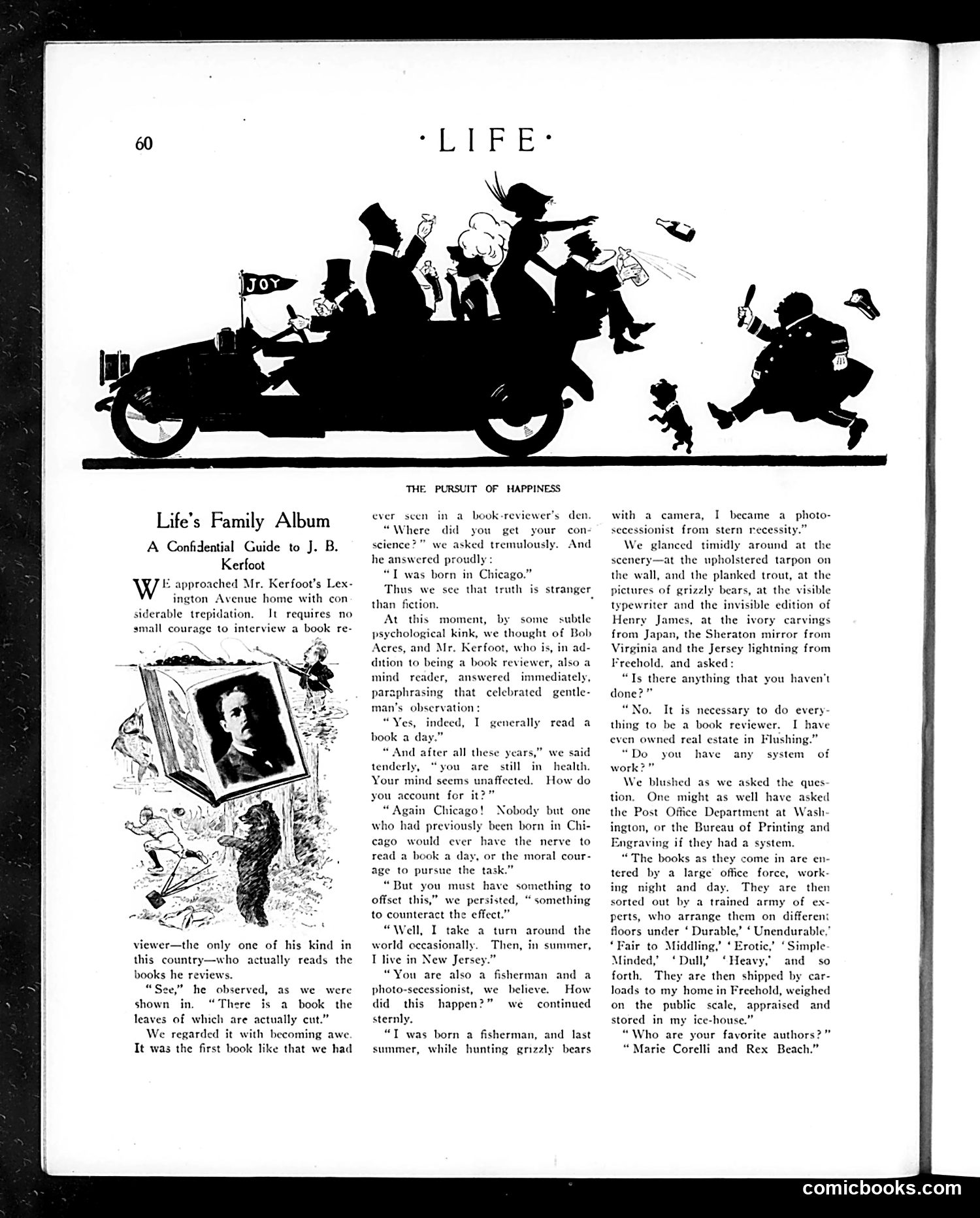
This is a satirical profile of **J.B. Kerfoot**, a book reviewer for *Life* magazine. The top cartoon—"The Pursuit of Happiness"—depicts carefree revelers in a car, contrasting with the article's humorous examination of Kerfoot's obsessive, joyless book-reviewing life. The satire's core joke: Kerfoot claims to read a book daily and maintains elaborate systems for cataloging and storing thousands of books in his Freehold, New Jersey home. The interviewer feigns amazed admiration while gently mocking his compulsive habits—suggesting that true "happiness" (the cartoon's theme) requires *not* drowning in literature. References include **Bob Acres** (a nervous character from Sheridan's play, used to mock Kerfoot's psychological quirks) and his taste in "favorite authors": **Marie Corelli and Rex Beach** (popular but critically dismissed writers), further ridiculing his literary judgment. The humor relies on exaggeration: a man so committed to reading that he's catalogued books under categories like "Erotic" and "Simple Minded."
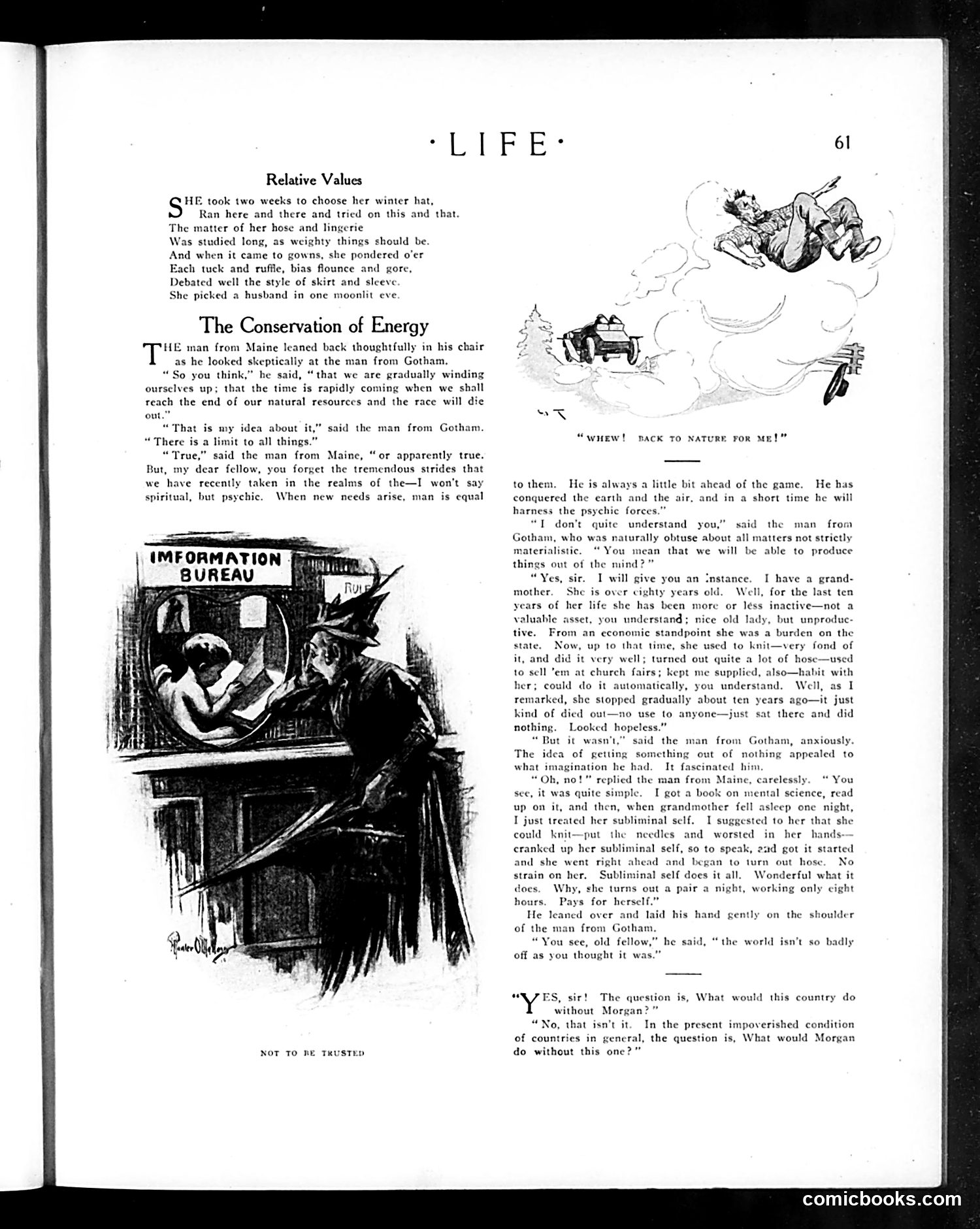
This page contains three distinct satirical pieces: **"Relative Values"** mocks women's priorities, contrasting the weeks spent deliberating over hat details versus the impulsive decision to marry—suggesting women are frivolous in material choices but reckless in life-altering ones. **"The Conservation of Energy"** features two characters debating resource depletion: a skeptical man from Maine and a credulous man from Gotham (New York). The Maine man boasts of harnessing "psychic forces" to rejuvenate his elderly grandmother through mental science, making her productive again via knitting. This satirizes both pseudo-scientific fads (like New Thought/mental science movements popular in early 20th century) and the era's obsession with economic productivity. **The final cartoon** depicts someone at an "Information Bureau" marked "Not To Be Trusted," parodying either journalism or government information sources as unreliable. The closing dialogue references **Morgan**—likely J.P. Morgan, the powerful banker—suggesting dependency on wealthy financiers, with ironic commentary on national economic reliance on individual moguls.
This is a book review section from Life magazine (page 62), not a political cartoon. It discusses several newly published books: **Main content:** A lengthy review of Katherine G. Busbey's *Home Life in America*, praising it as comprehensive journalism but noting that English reviewers were shocked by the author's willingness to state "disagreeable truths" bluntly—something American readers would accept as routine. **Secondary reviews** cover: - May Sinclair's *The Creators*, satirizing London literary circles obsessed with their own artistic immortality - Edgar Allen Forbes's *The Land of the White Helmet*, a travel book about colonial Africa The page demonstrates Life's role as a literary periodical offering sophisticated cultural criticism alongside humor. The "Confidential Book Guide" section provides brief notices of additional titles. There are no political cartoons visible on this page.
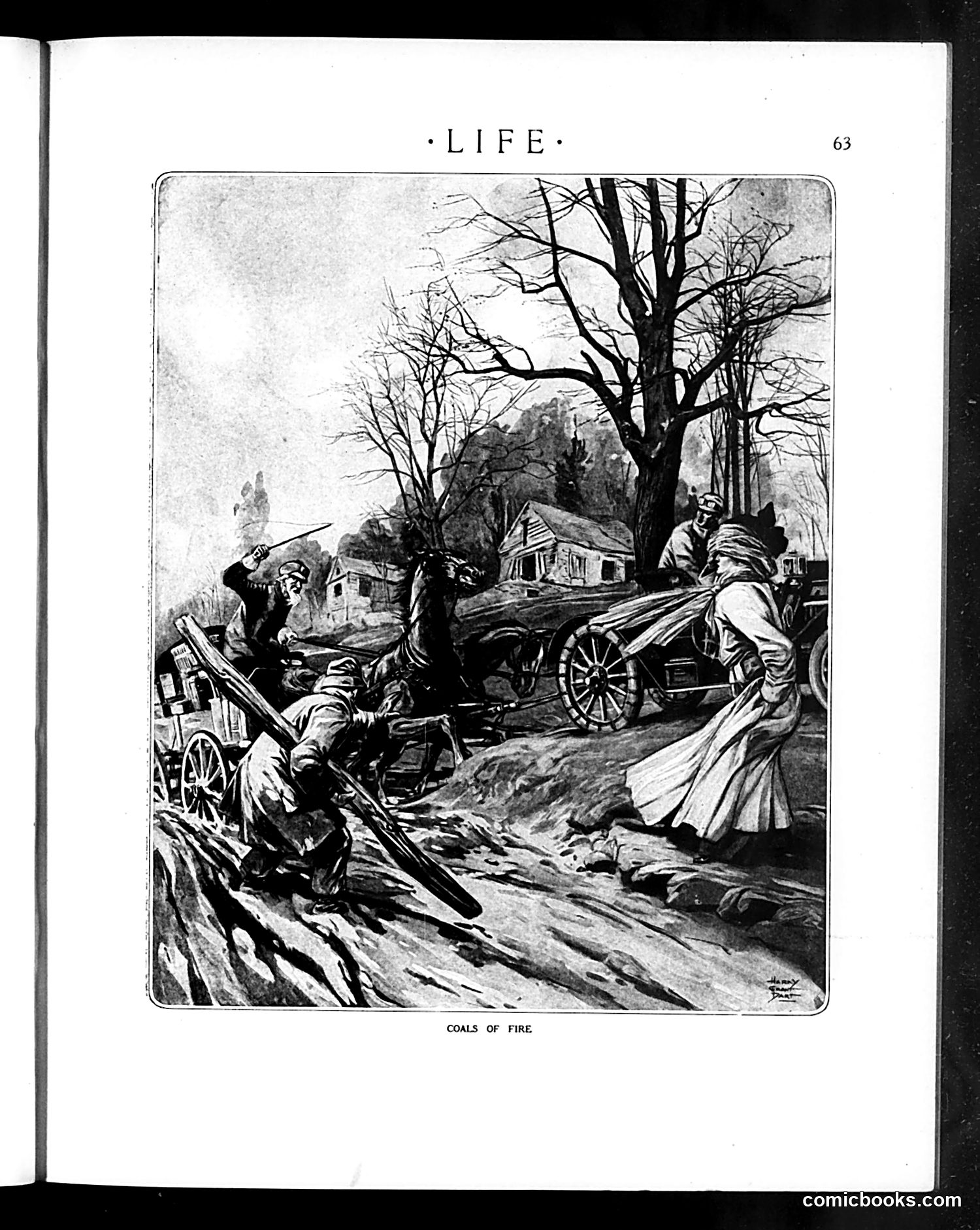
This illustration depicts a rural scene where what appears to be wealthy or well-dressed figures in a carriage encounter poorer people on a muddy road near modest houses. The title "Coals of Fire" references the biblical phrase about returning good for evil (Romans 12:20). The satire likely critiques class disparities and social hypocrisy—contrasting the comfort of the privileged (traveling by carriage) with the hardship of rural poor. The "coals of fire" reference suggests ironic commentary on whether the wealthy reciprocate kindness or charity to those less fortunate, or conversely, whether the poor's suffering rebukes the indifference of the privileged. The bare trees and muddy conditions emphasize rural poverty, common satirical subjects in early 20th-century Life magazine.
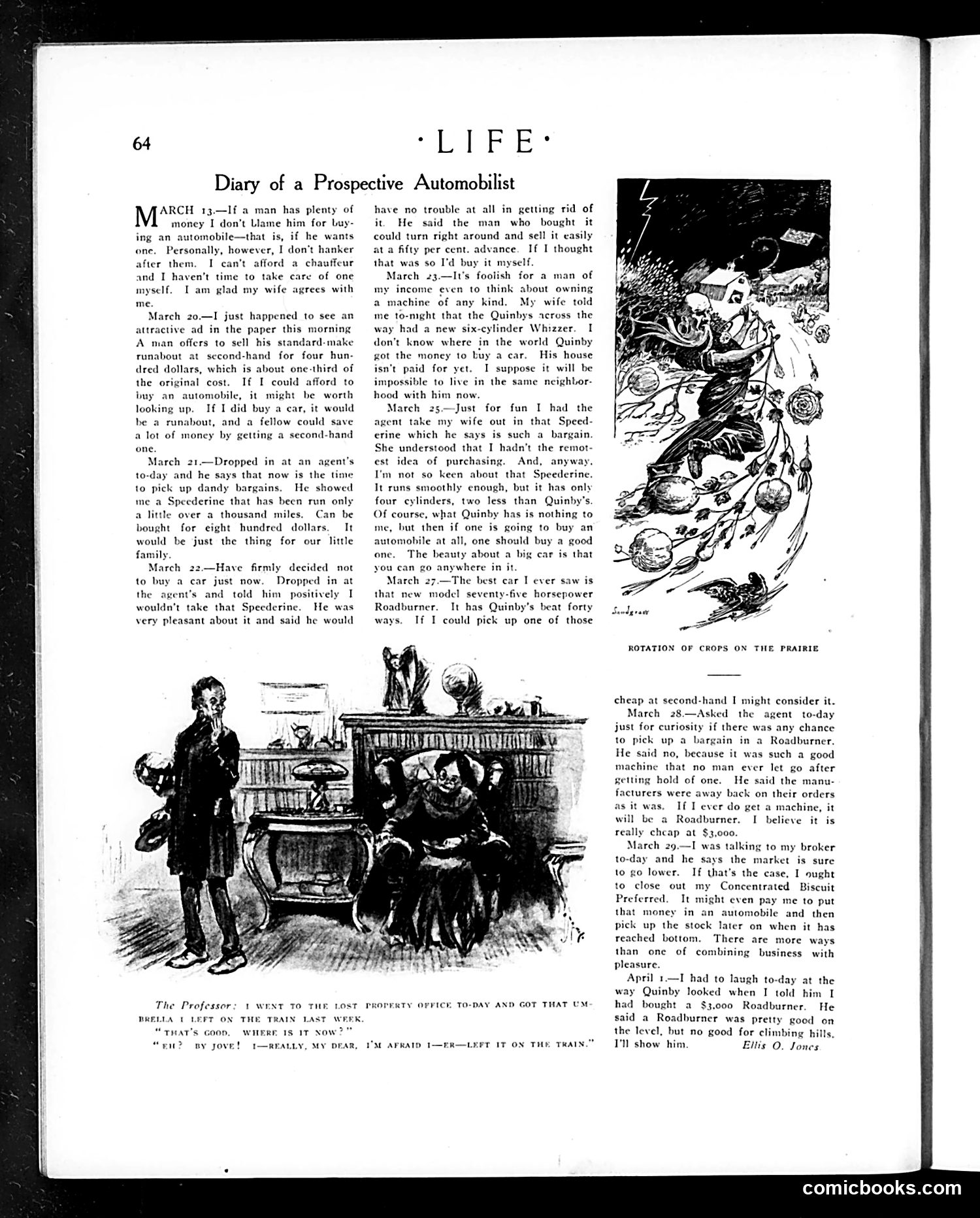
This page satirizes the psychology of consumer desire and rationalization, specifically around early-1900s automobiles. The diary entry follows a man who repeatedly claims he cannot afford a car, yet progressively talks himself into buying an expensive one through increasingly elaborate justifications. The satire works through escalating rationalization: he notices a cheap used car, then a slightly better one, then obsesses over neighbor Quinby's fancier model. Each entry shows him reconsidering, always finding reasons why *this* particular car is actually a necessity. By April, he's purchased a $3,000 Roadburner—expensive for the era. The accompanying cartoon (bottom left) shows a man leaving a woman on a train, humorously illustrating absent-minded distraction—possibly suggesting the protagonist's preoccupation with cars over domestic life. The satire targets how people rationalize luxury purchases through comparison, perceived bargains, and financial reworking, suggesting human nature hasn't changed much regarding consumer temptation and self-deception.
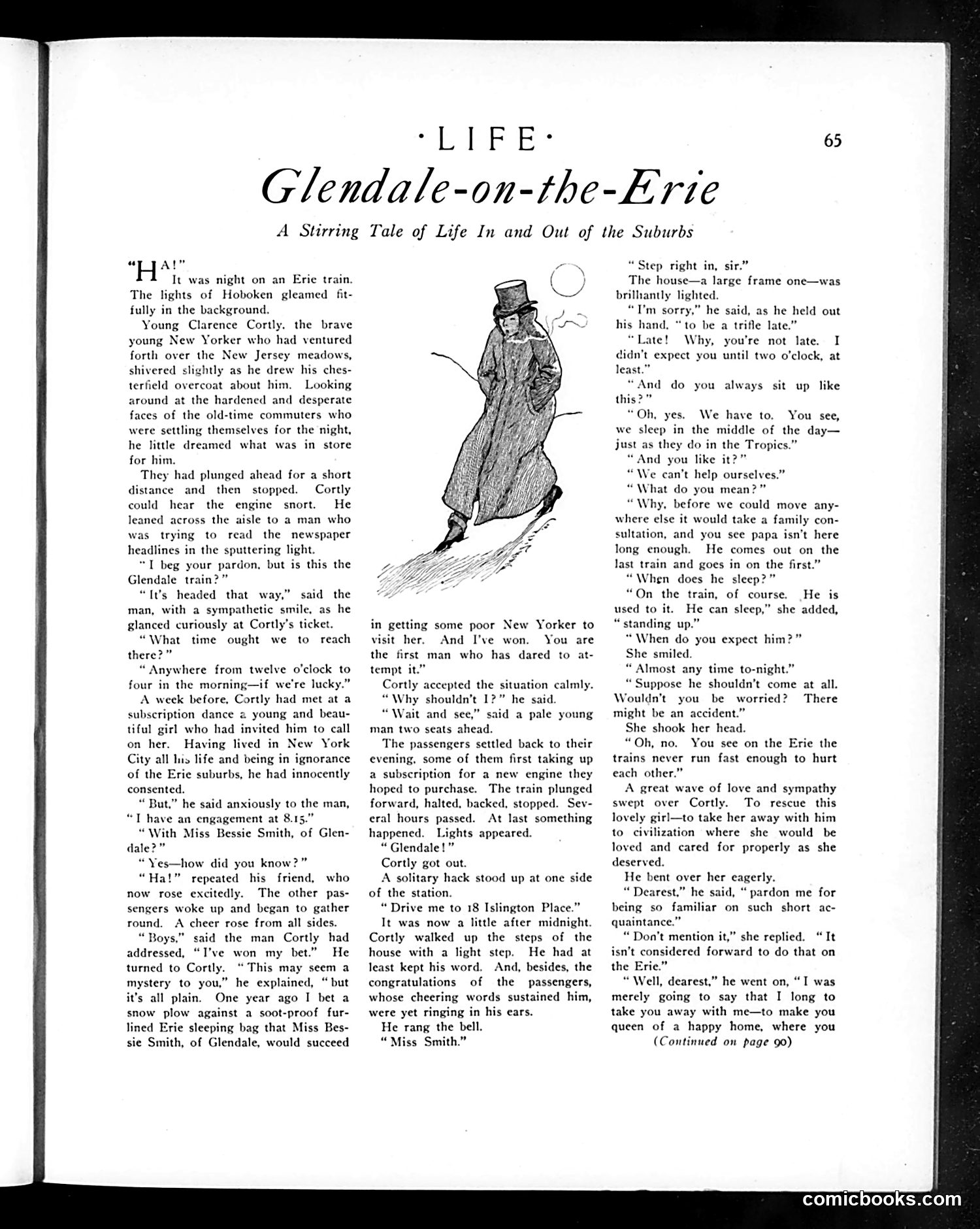
This is a humorous short story satirizing the Erie Railroad's notoriously unreliable service to suburban New Jersey. The protagonist, a naive Manhattan bachelor named Clarence Cortly, accepts a dinner invitation from a Glendale girl without understanding the logistical nightmare involved. The joke centers on the Erie train's legendary delays and unpredictability—passengers bet whether any New Yorker would actually attempt the journey. The story mocks suburban commuting culture: families surviving on reversed sleep schedules (sleeping midday, awake at night), fathers commuting so frequently they sleep standing up on trains, and the expectation that women stay up past midnight waiting for delayed arrivals. The illustration shows a man in a topcoat boarding the notoriously problematic Erie train. This appears to target early 20th-century frustrations with suburban rail service and the growing absurdity of commuter life.
This page contains two satirical pieces: **Left column:** A humorous poem by David Law Proudfit depicts a prehistoric man with a tail lamenting that modern humans have lost theirs due to fashion. He argues that tails are necessary for proper emotional expression ("How can one / Set forth, in words that drag, / The best emotions of the soul, / Without a wag?"). The joke mocks evolutionary "progress" and blind adherence to fashion—until Mrs. Smith appears, whereupon he immediately "wagged his tail," suggesting that courtship instincts override his philosophical complaints. **Right column:** An article praising Connecticut's (specifically Massachusetts's) historical and cultural importance, particularly regarding the Pilgrims and their descendants. It humorously notes that the Pilgrims' Massachusetts vowels make civic pronouncements like "Commonwealth of Massachusetts" sound impressively grand, causing citizens to sit up straighter in church pews. The satire gently mocks regional pride and rhetorical bombast. Both pieces use exaggeration and absurdist humor typical of Life's satirical style.
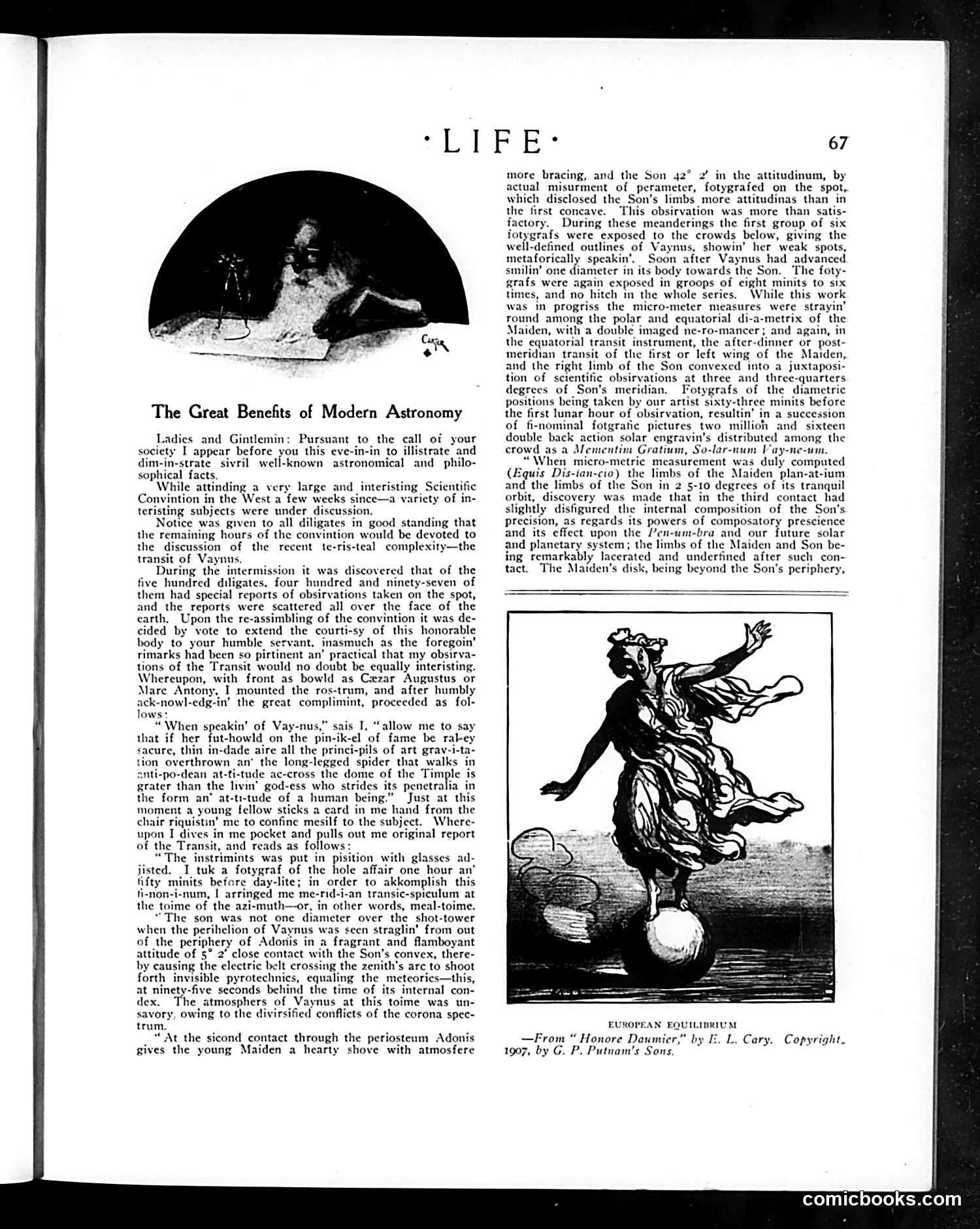
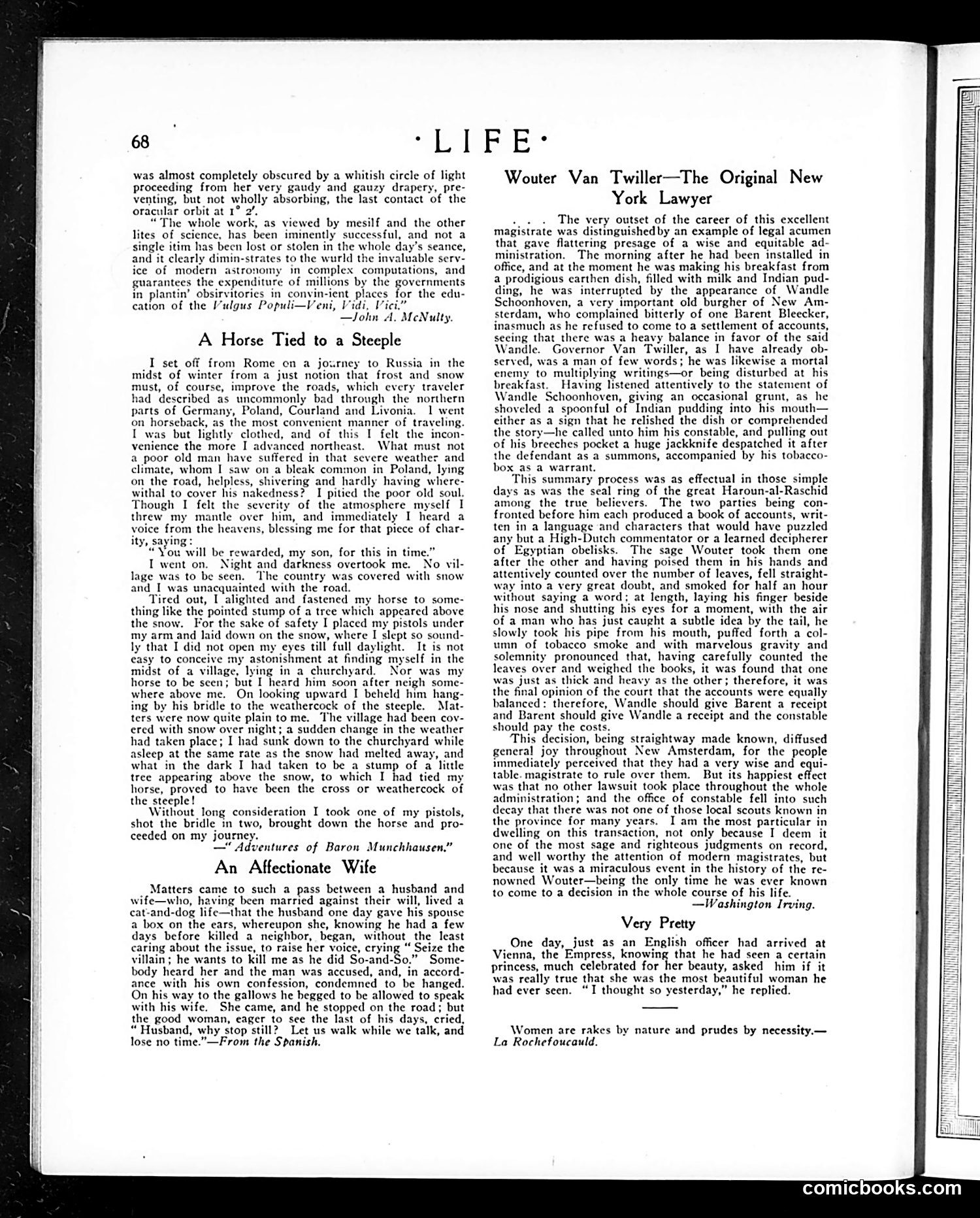
This is a satirical lecture transcript mocking pseudo-scientific pretension and incomprehensible jargon. The speaker—appearing to be an Irish immigrant (indicated by phonetic dialect spelling like "speakin'" and "rimarks")—presents himself as an astronomy expert reporting on observations of Venus's transit. The satire works on multiple levels: the speaker mangles scientific terminology deliberately ("azi-muth," "perameter," "fotygraf"), invents nonsensical instruments ("meal-toime"), and constructs absurd poetic metaphors about Venus. The humor targets both pompous scientists who obscure meaning through complexity and the credulous audiences who accept incomprehensible expertise without question. The accompanying illustration shows a figure in impossible contortions, visually reinforcing the absurdity. The joke: modern astronomy's technical language becomes indistinguishable from complete gibberish when filtered through an unpretentious speaker—questioning whether the experts themselves understand what they're saying.
This page from *Life* magazine contains three unrelated satirical stories rather than political cartoons: 1. **"A Horse Tied to a Steeple"** (attributed to Baron Munchhausen tales): A tall tale about a traveler who unknowingly ties his horse to a church steeple's weathercock during a snowstorm, then discovers it when the snow melts overnight. 2. **"An Affectionate Wife"**: A darkly comedic Spanish anecdote about a quarreling married couple where a wife falsely accuses her husband of murder to escape blame for her own provocation, leading to his execution. 3. **"Wouter Van Twiller—The Original New York Lawyer"** and **"Very Pretty"**: Brief humorous sketches about historical figures and romantic encounters. The page exemplifies *Life*'s 19th-century satirical format: mixing absurdist humor, folk-tale adaptations, and social commentary through short, witty narratives rather than visual cartoons.
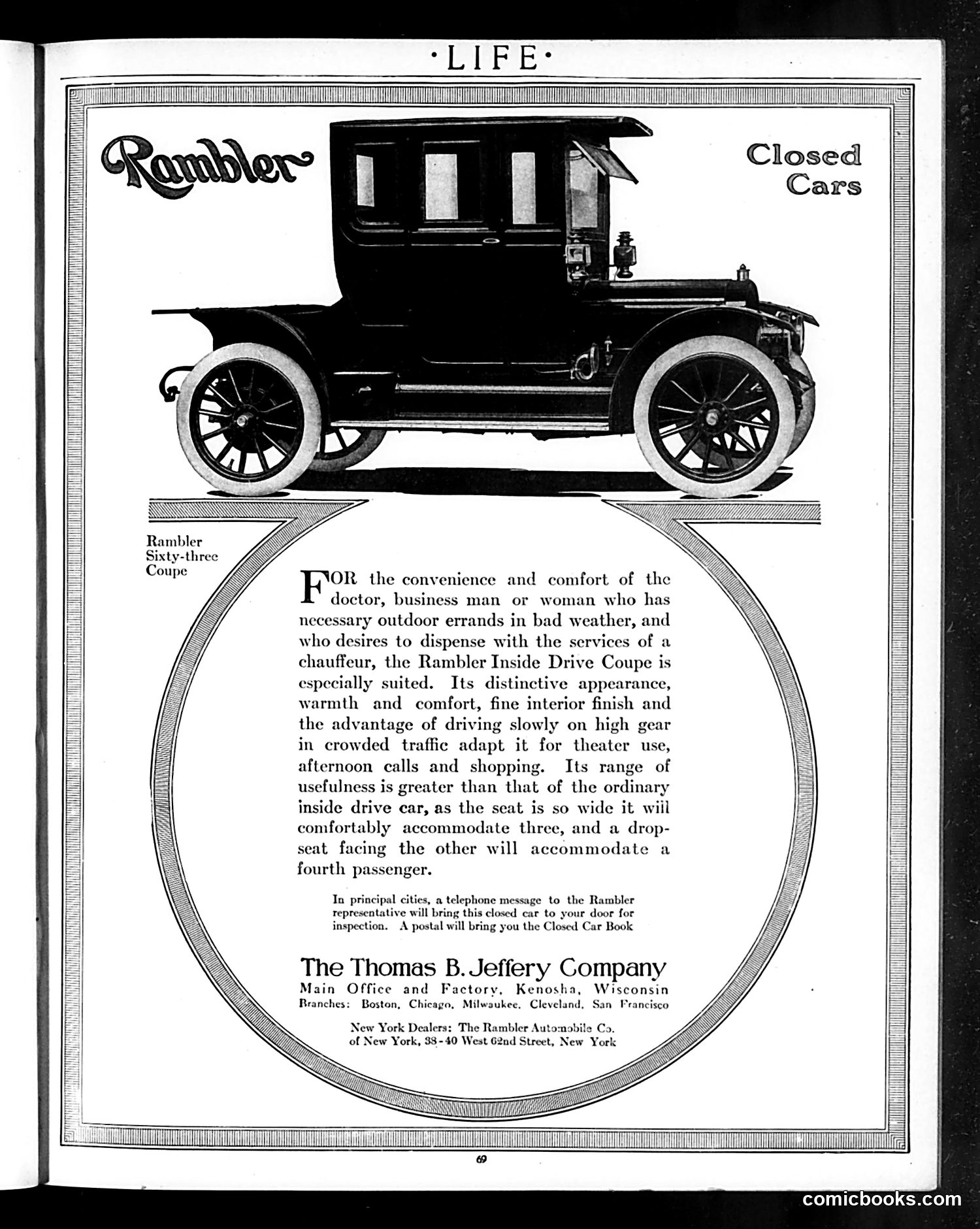
This is **not a cartoon or satire**—it's a straightforward automobile advertisement from Life magazine's early 1900s era. The page advertises the **Rambler Sixty-three Coupe**, a closed-body automobile manufactured by the Thomas B. Jeffery Company of Kenosha, Wisconsin. The ad targets professional and business-class readers (doctors, businesspeople) who need personal transportation in bad weather without hiring a chauffeur. Key selling points emphasized: the car's enclosed comfort, ability to accommodate three passengers plus a drop-seat for a fourth, and suitability for city driving (theater visits, shopping, afternoon calls). The ad notes potential buyers can request an inspection via telephone or obtain a "Closed Car Book" for more information. The multiple branch locations listed suggest this was a nationally distributed publication reaching a prosperous, urban readership during the early automobile era.
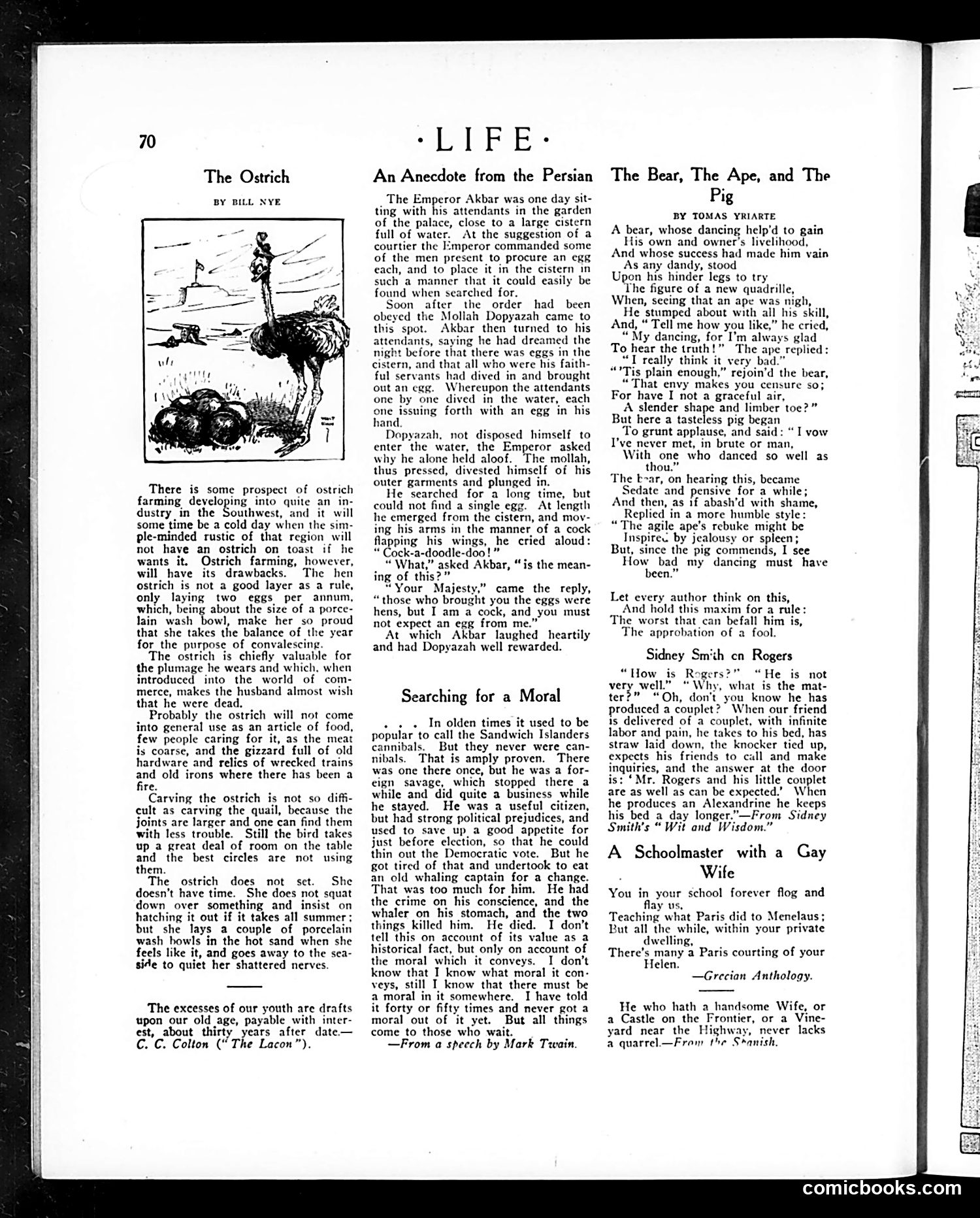
This page contains three separate pieces of satirical humor typical of Life magazine's format: **"The Ostrich" by Bill Nye** is humorous commentary on a potential new industry. Nye satirizes the impracticality of ostrich farming in the American Southwest, mocking both the bird (it lays only two eggs yearly and acts vain about it) and wealthy society's adoption of ostrich plumes in fashion. The joke centers on the bird's uselessness as food and fashion's absurd demands on husbands' wallets. **"An Anecdote from the Persian"** presents a clever court story where Emperor Akbar tests his courtiers' loyalty. The Mollah (Islamic scholar) outwits the emperor by honestly admitting he cannot produce an egg—he's a "cock, not a hen"—turning apparent failure into wisdom through wordplay. The emperor rewards his honesty and wit. **"Searching for a Moral"** appears to be incomplete text addressing cannibalism stereotypes about Pacific Islanders, debunking myths while satirizing political appetite (literally and figuratively). The page exemplifies Life's blend of American frontier humor, classical literature, and social commentary.
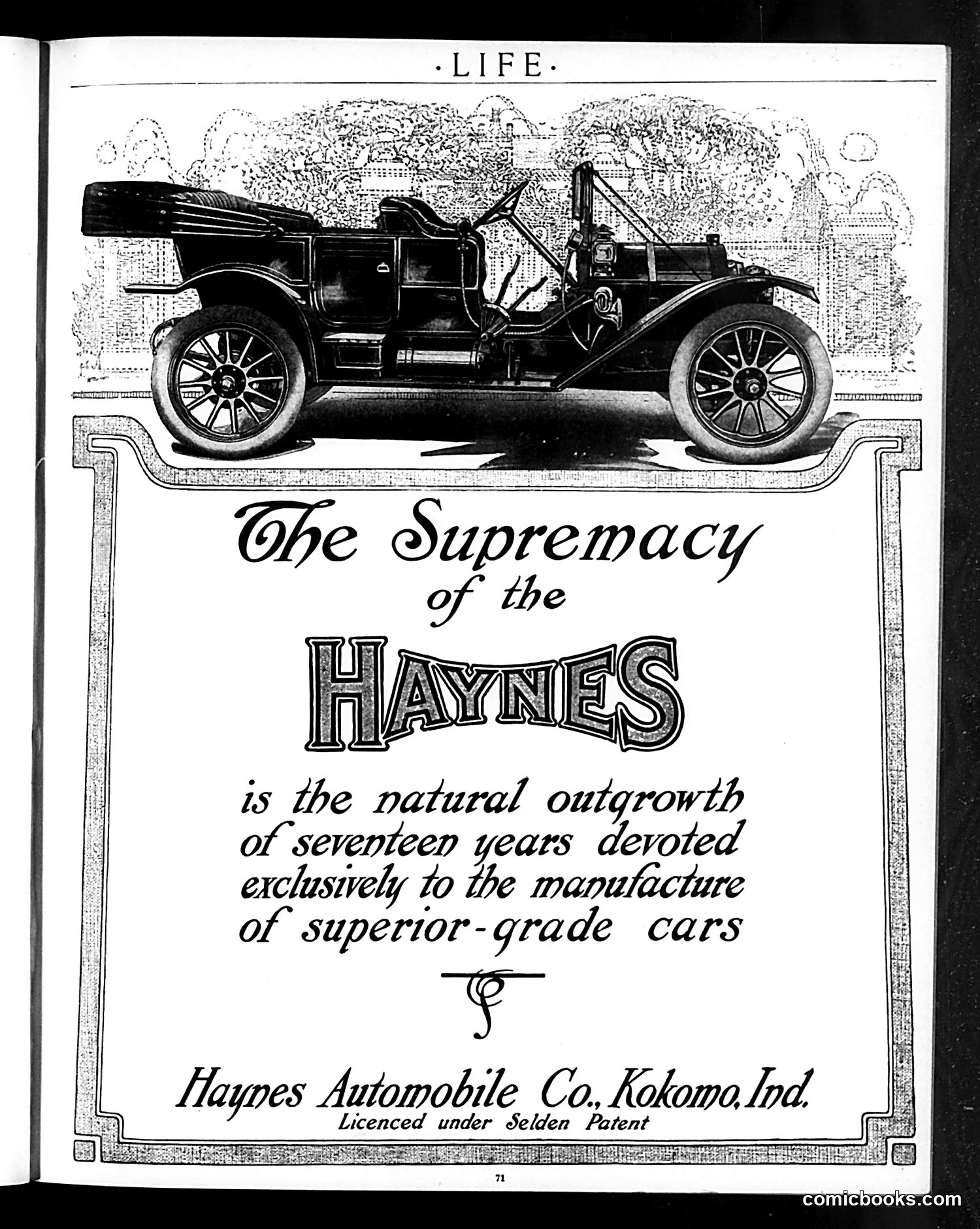
This is a **Haynes automobile advertisement**, not satire or political commentary. The page promotes the Haynes Automobile Company of Kokomo, Indiana, claiming "supremacy" in car manufacturing based on seventeen years of experience making "superior-grade cars." The illustration shows an early 1900s open-air automobile in profile. The ad emphasizes the company's established reputation and specialized focus on quality production. A notable detail: it mentions being "Licenced under Selden Patent," referring to a major early automotive patent that was hotly contested in the industry. This represents straightforward product advertising from Life magazine's commercial pages, not editorial content or satire.
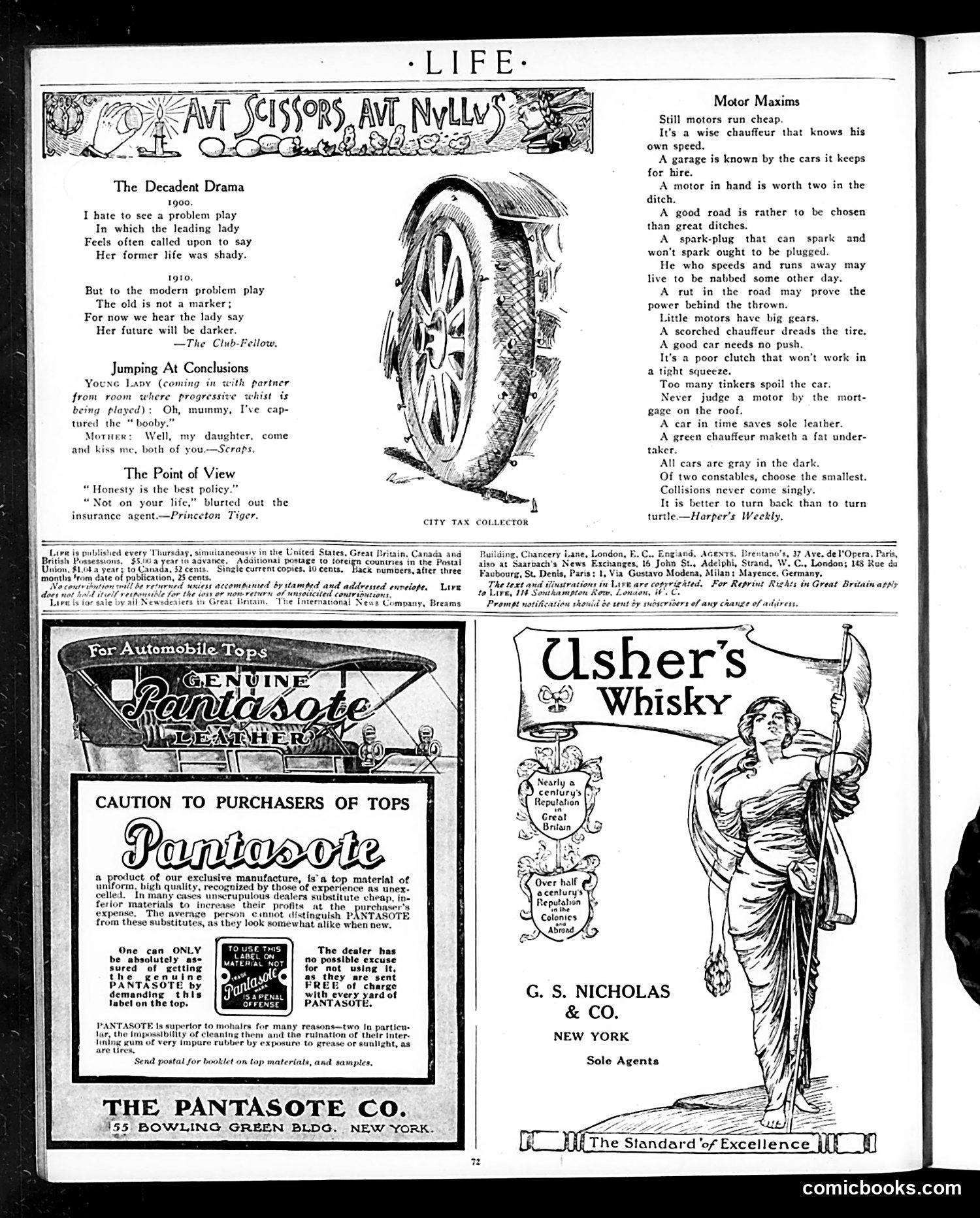
This page contains **three brief comic pieces** satirizing early 1900s social attitudes, plus advertisements. **"The Decadent Drama"** contrasts theatrical trends: in 1900, "problem plays" featured heroines with scandalous *pasts*; by 1910, the modern version has heroines with darker *futures*—mocking how progressive drama had simply shifted its moral anxiety forward rather than abandoning it entirely. **"Jumping At Conclusions"** plays on the double meaning of "booby" (the card game prize vs. a fool). A young lady announces she's "captured the booby" from a parlor game; her mother misinterprets this as romantic conquest and congratulates her, revealing outdated assumptions about courtship. **"The Point of View"** is a one-liner joke: an insurance agent cynically rejects the maxim "Honesty is the best policy"—his profession depending on skepticism about client claims. **Motor Maxims** offers mock-proverbs about automobiles, satirizing the era's automobile obsession by parodying biblical wisdom literature ("A car in time saves sole leather"). The advertisements below promote Pantasote leather automobile tops and Usher's Whisky.
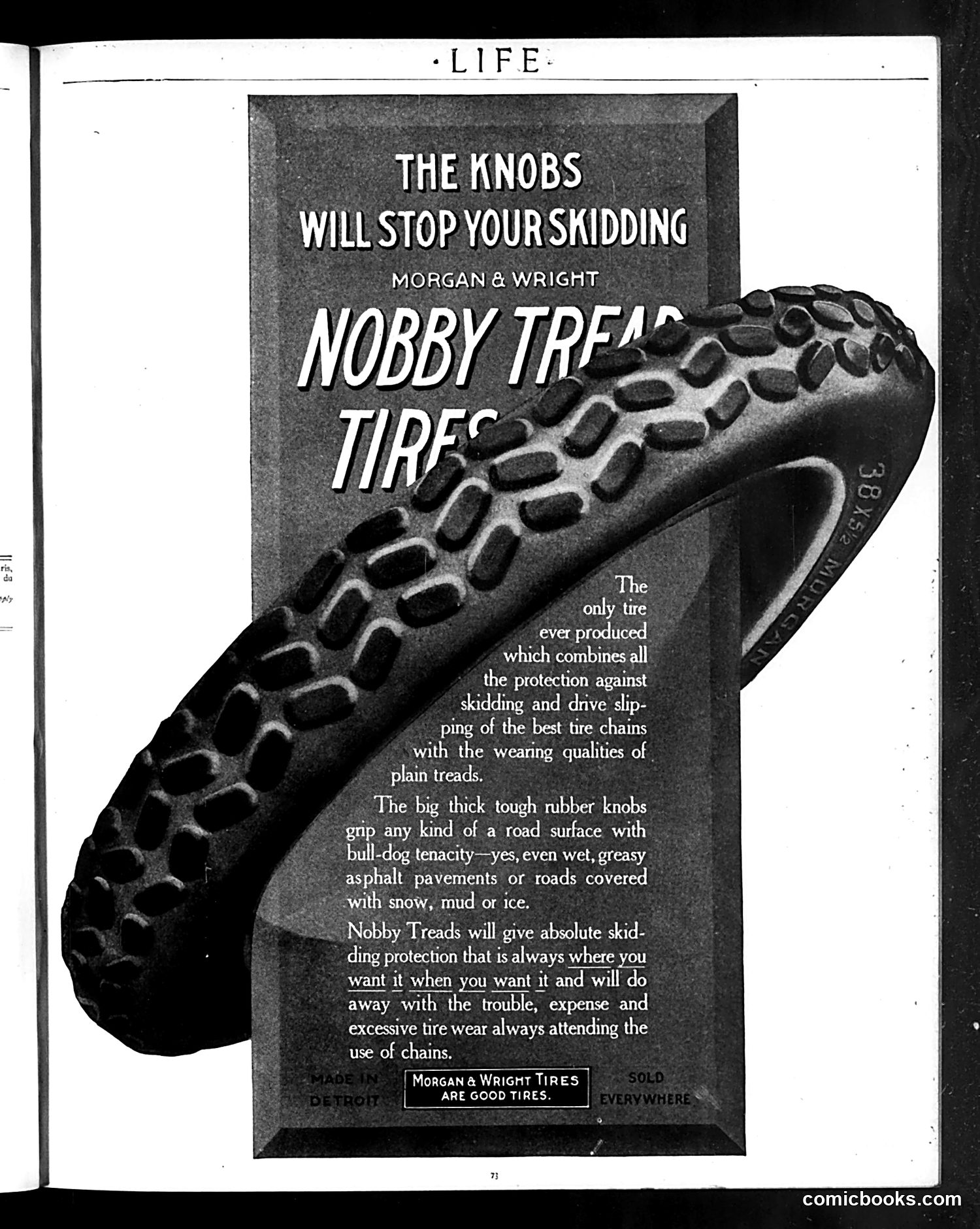
This is a **tire advertisement**, not a political cartoon. It promotes Morgan & Wright's "Nobby Tread" tires, marketed to early automobile owners (likely 1910s-1920s era based on style). The "joke" or selling point is visual: a large tire tread pattern is shown with prominent rubber "knobs" (the bumps visible on the tire surface). The headline's pun—"The Knobs Will Stop Your Skidding"—plays on both the literal knobs on the tire and the colloquial use of "knobs" as slang. **The sales pitch:** These knobs grip wet, icy, or muddy roads better than smooth tires, offering traction equivalent to tire chains but without chains' expense and wear. The ad emphasizes practical benefits: all-weather performance and durability. This is straightforward commercial advertising using a pun and product demonstration—not satire or political commentary. Modern readers might miss that tire traction was a genuine safety concern for early motorists without modern tire technology.
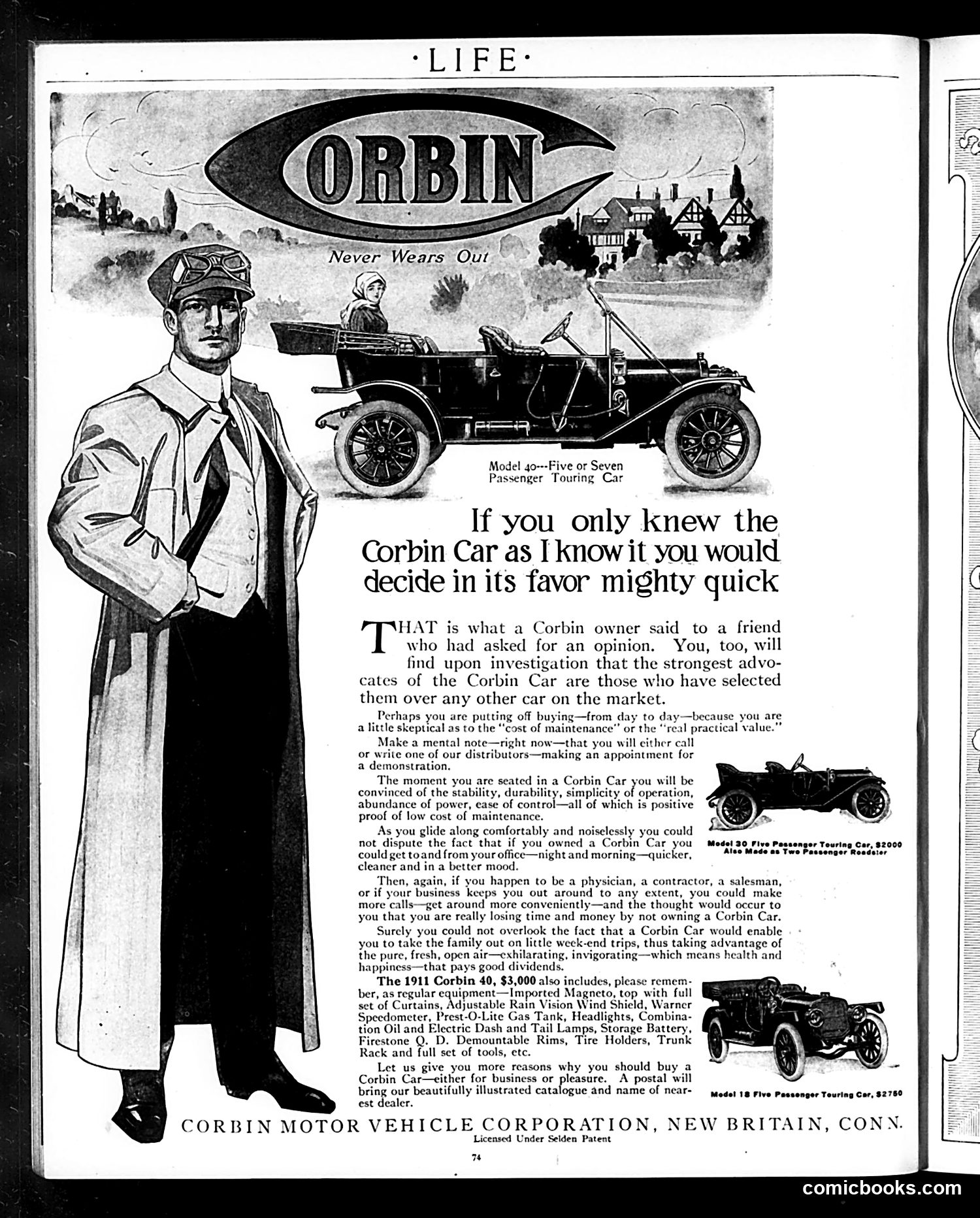
This is **not a cartoon or satire**—it's a straightforward automobile advertisement for the Corbin Motor Vehicle Corporation, circa 1911. The page features a well-dressed man in a coat and cap (representing an aspirational businessman/professional) alongside images of the Corbin Model 40 touring car. The ad uses testimonial-style persuasion: a satisfied owner vouches for the vehicle's quality to convince skeptical buyers. The appeal targets practical concerns of the era—maintenance costs, reliability, convenience for professionals (doctors, contractors, salesmen)—and leisure benefits (family outings). At $3,000, this was a luxury vehicle. The ad emphasizes features like the Magneto ignition, gas tank, and electric lights as premium innovations. The "Selden Patent" reference indicates ongoing patent licensing disputes in early automotive manufacturing. This is period advertising designed to overcome buyer hesitation about automobile reliability and cost, not satire or political commentary.
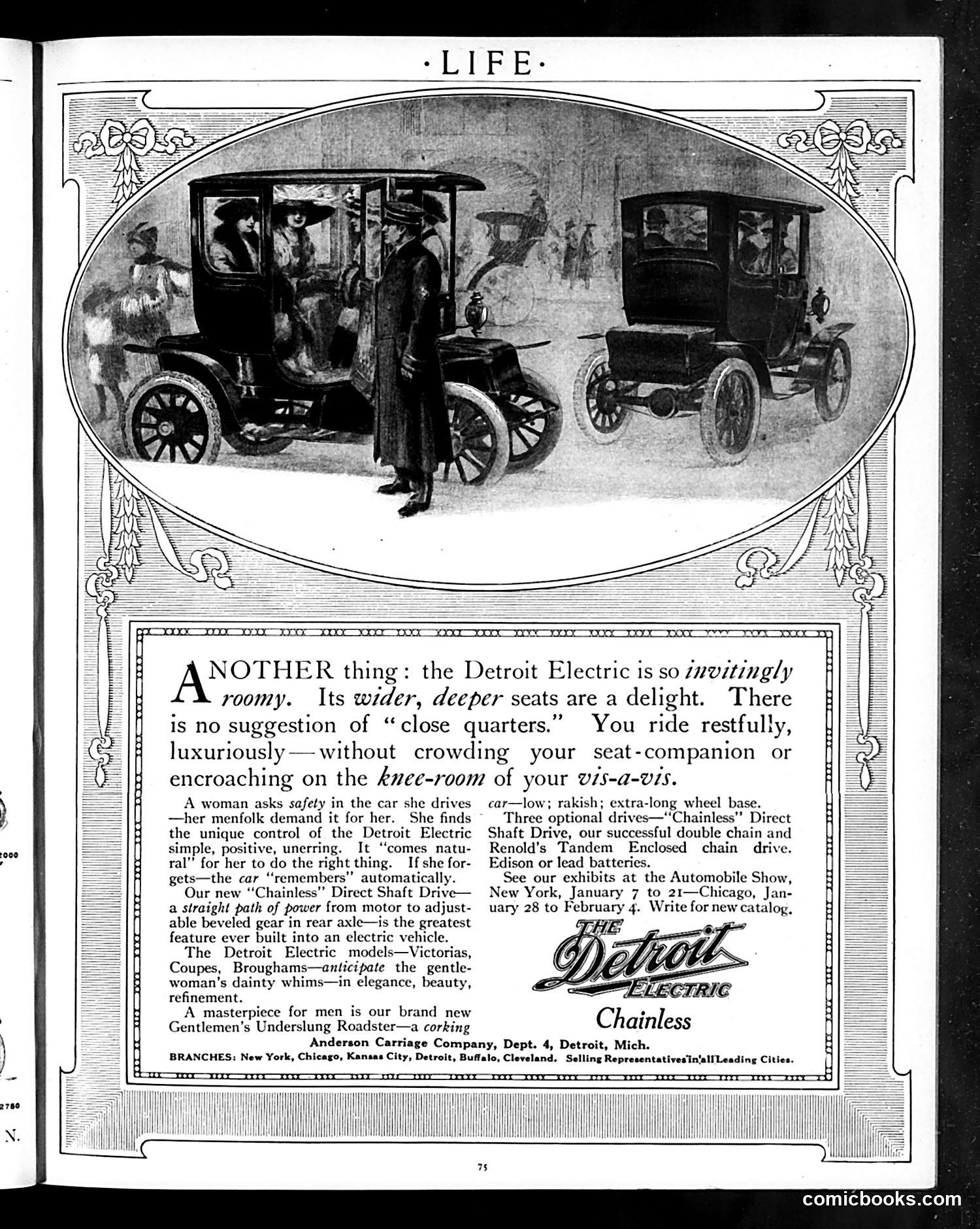
This is a full-page advertisement, not political satire. It promotes the Detroit Electric automobile, highlighting its spacious interior and safety features—particularly appealing to women drivers. The ad reflects early 1900s gender assumptions: women are portrayed as requiring safe, easy-to-operate vehicles with automatic safety features (the car "remembers" if the driver forgets), while men supposedly want performance in the "Underslung Roadster" model. The image shows two electric vehicles and well-dressed figures examining them, typical of automobile show marketing. The "Chainless" direct shaft drive is emphasized as a modern innovation. This represents the era when electric cars competed seriously with gasoline vehicles, before gasoline engines became dominant. The marketing strategy—targeting women as a distinct consumer market valuing safety and ease of use—was relatively progressive for the period, though deeply patronizing by modern standards.
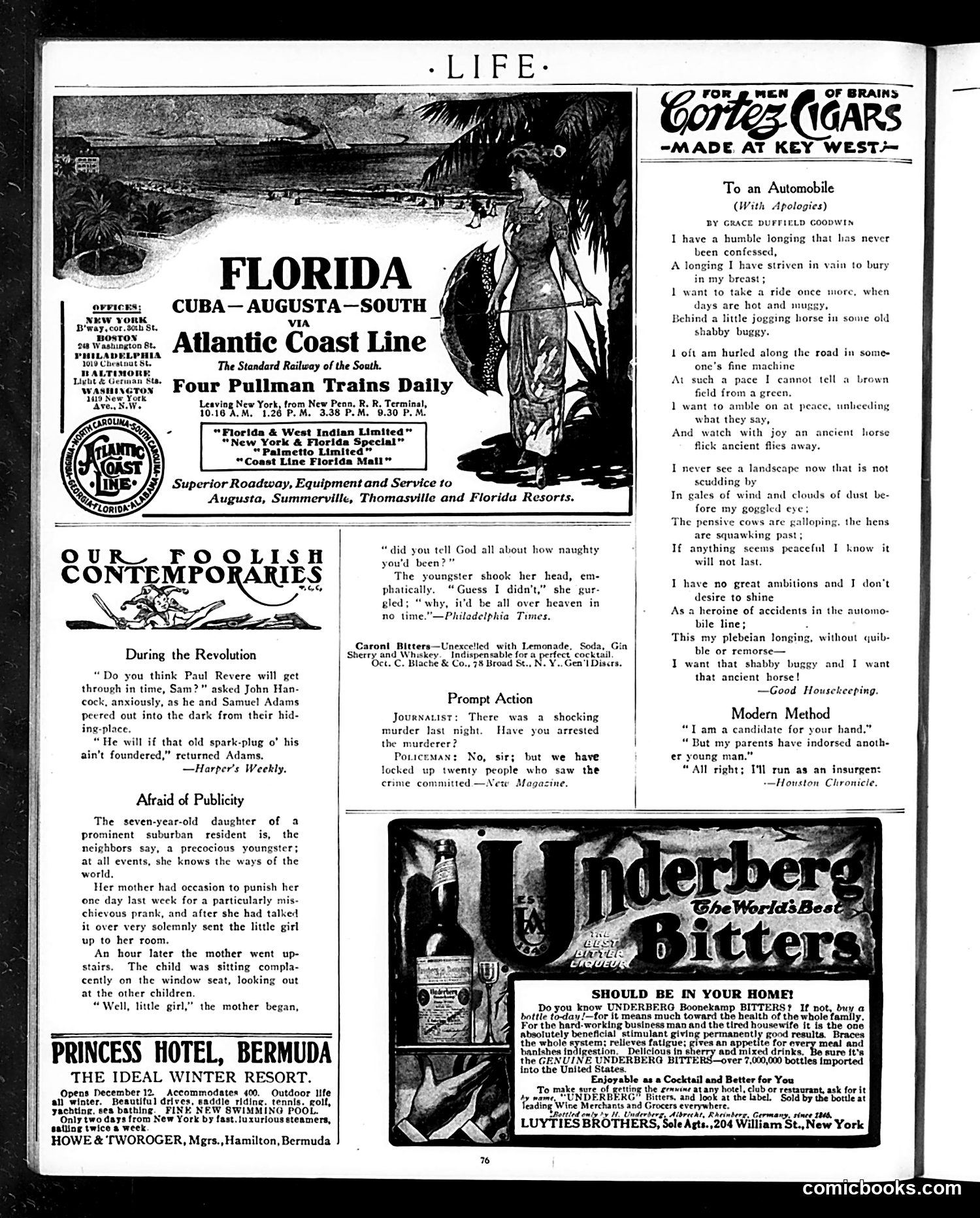
This page is primarily **advertising and light humor** rather than political satire. The content includes: **Main Features:** - A poem "To an Automobile" lamenting the loss of horse-and-buggy travel in favor of motorized vehicles—expressing nostalgia for a slower, simpler era - Brief humorous anecdotes mocking modern life: a precocious child refusing to confess sins to God (fearing heaven gossip), and a journalist's complaint about police arresting innocent bystanders instead of catching murderers - A joke about courtship where a suitor claims he'll "run as an insurgent" after being rejected **Advertisements:** - Atlantic Coast Line Railway promoting Florida travel - Cortes Cigars and Underberg Bitters (medicinal tonics) - Princess Hotel, Bermuda **Historical Context:** The automobile humor reflects genuine anxiety circa 1900-1920s about rapid technological change displacing traditional ways of life. The "insurgent" courtship joke likely references the Progressive Era's political insurgency movements. The page reflects early 20th-century concerns about modernization's pace.
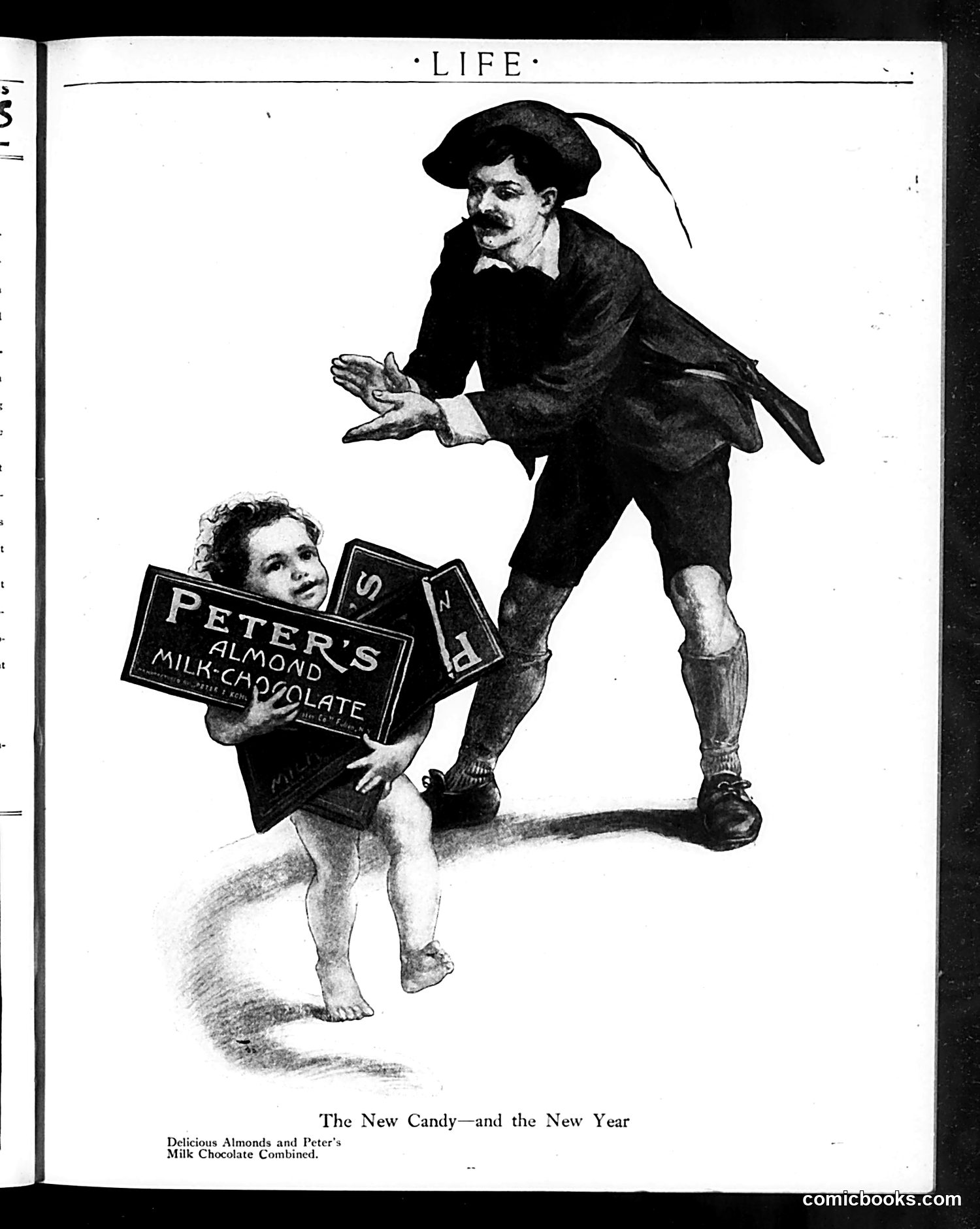
This is a **Life magazine advertisement** for Peter's Milk Chocolate, not political satire. The image shows a caricatured man in formal attire playfully chasing or interacting with a child holding a box of Peter's Almond Milk Chocolate. The caption "The New Candy—and the New Year" suggests a New Year's themed promotion. The humor appears to derive from the man's exaggerated, mischievous expression and the child's possession of the desirable candy—a lighthearted domestic scene meant to appeal to holiday shoppers. The figures are not identifiable political or historical persons; they appear to be generic characters used for commercial purposes in this early-20th-century advertisement.
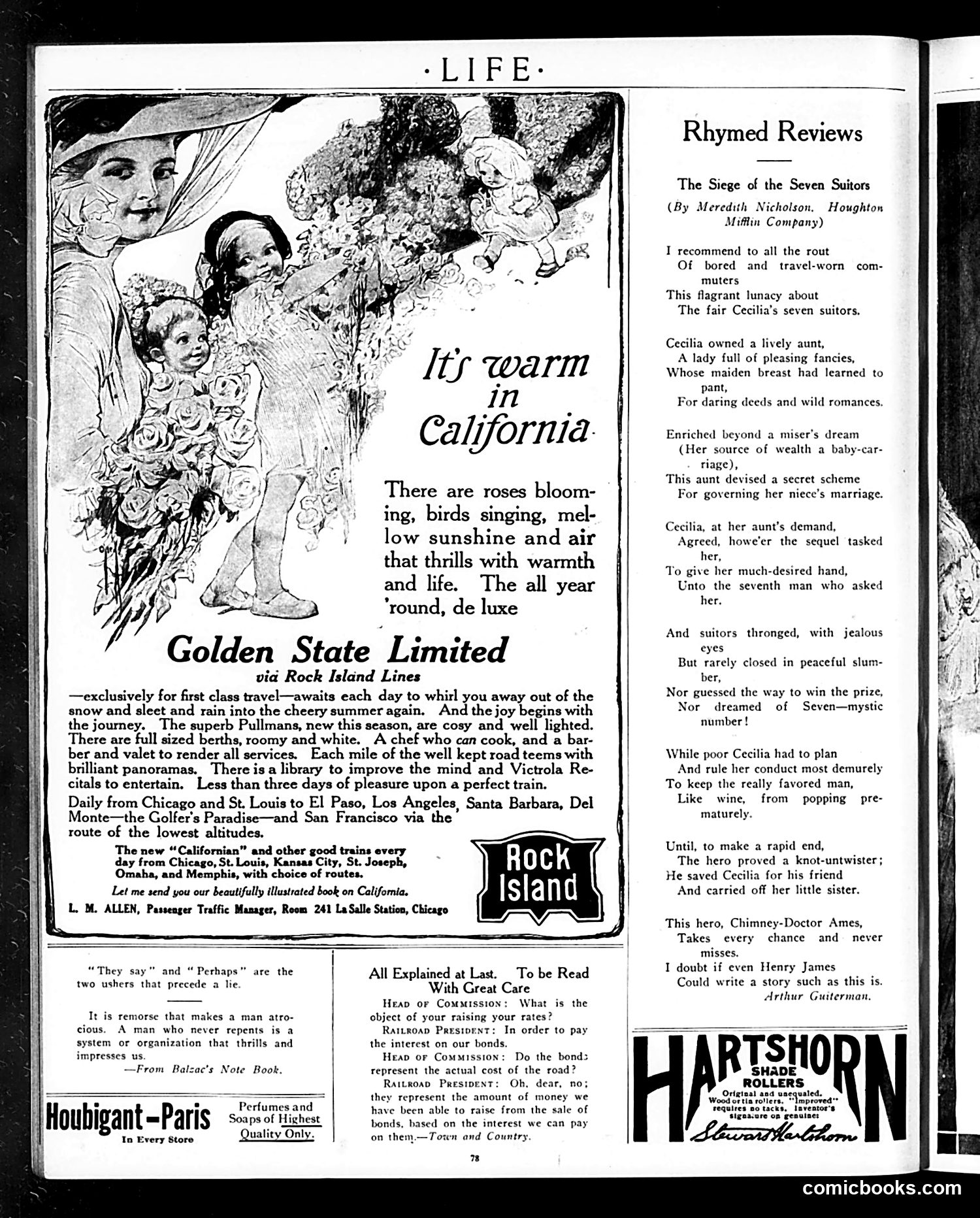
This page contains **advertisements and literary content**, not political satire. The dominant content is a **Rock Island Lines railroad advertisement** for the "Golden State Limited" train to California, emphasizing luxury travel (Pullman cars, chef service, library) and leisure destinations. This reflects early 20th-century advertising targeting affluent travelers seeking escape to warm climates. The **"Rhymed Reviews" section** is a humorous poem by Arthur Guiterman reviewing Meredith Nicholson's novel *The Siege of the Seven Suitors*—a romantic comedy about a woman whose eccentric aunt requires her to marry the seventh man who proposes. The verse mockingly summarizes the plot's absurdity. A small section titled **"All Explained at Last"** presents a satirical railroad commission dialogue mocking inflated bond prices and rate increases—suggesting railroads justify fares not by actual costs but by speculative financing needs. The page also includes period aphorisms and a perfume advertisement, typical of Life magazine's mixed editorial-advertising format from this era.
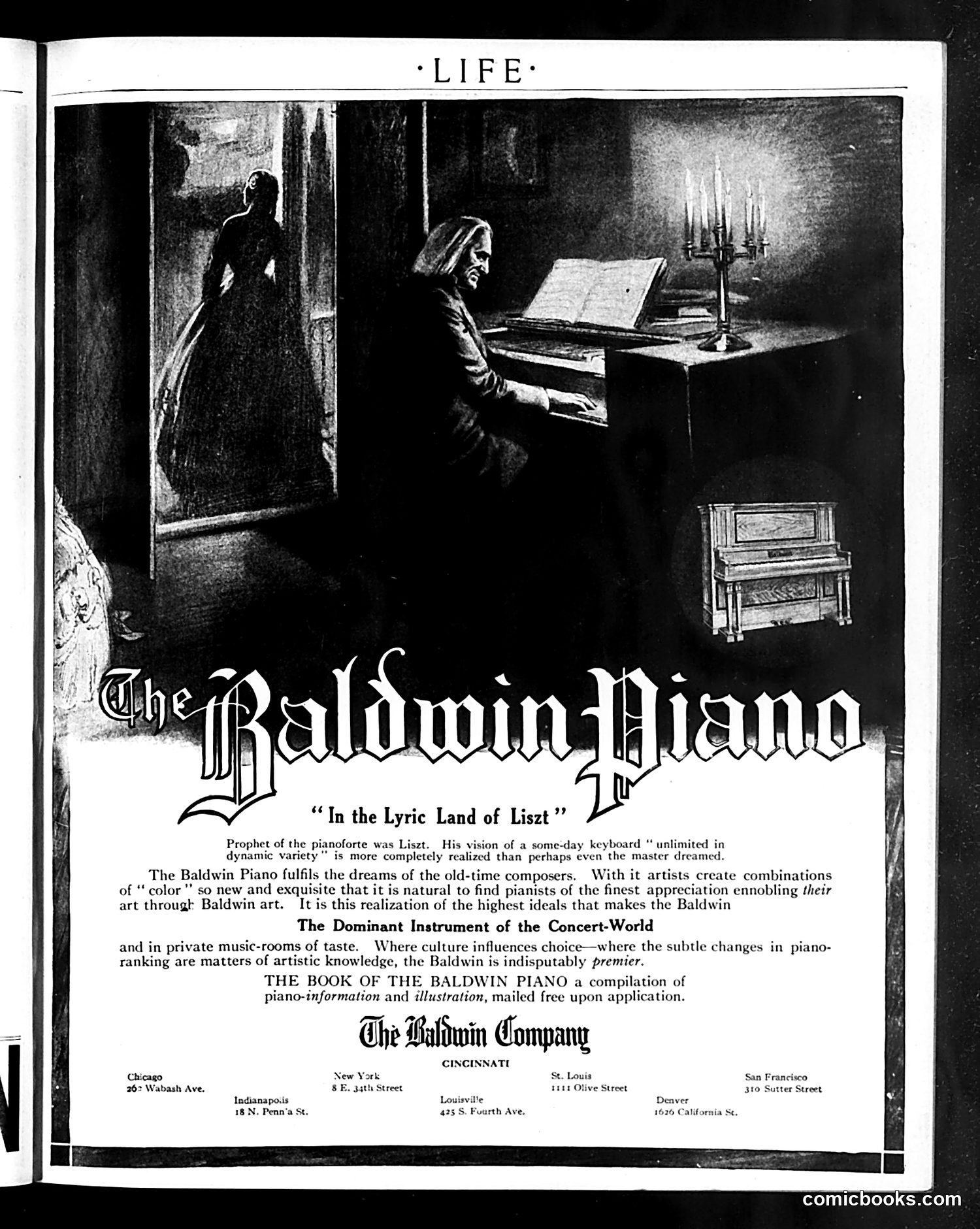
This is **not a cartoon or satire**—it's a **full-page advertisement** for Baldwin pianos, appearing in *Life* magazine. The image shows a romantic scene: a woman at a piano by candlelight while a man (likely her suitor) watches from a darkened doorway. This depicts the piano as a marker of refinement and cultured domesticity—standard advertising imagery of the era. The text invokes Franz Liszt, the 19th-century composer-virtuoso famous for pushing piano technique to extremes, to position Baldwin pianos as instruments that fulfill classical composers' artistic dreams. The ad claims Baldwin is "the Dominant Instrument of the Concert-World" and "indisputably premier" in circles where "culture influences choice." This is straightforward marketing that uses classical music prestige and gendered imagery (the accomplished woman pianist) to sell pianos to middle and upper-class households. No satire is present—this is genuine period advertising exploiting music and taste as status symbols.
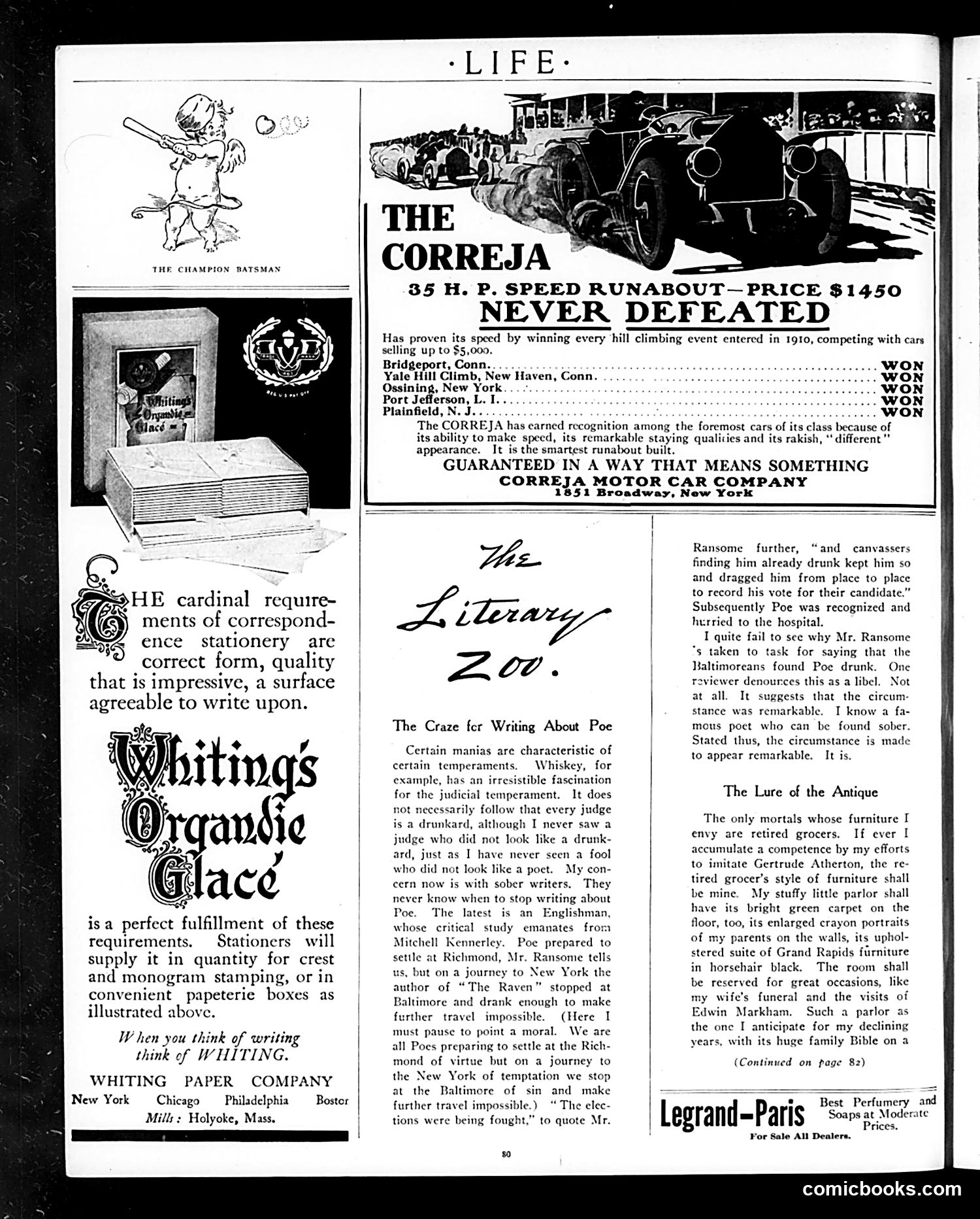
This page contains **primarily advertisements** interspersed with literary content, typical of early 1900s magazine layout. **The cartoons/imagery:** - Top left: "The Champion Batsman"—a simple cherub figure swinging a bat, likely a decorative sports illustration - Top right: The Correja automobile advertisement with racing imagery **The satirical content** appears in "The Craze for Writing About Poe," a brief essay mocking the obsessive scholarly attention to Edgar Allan Poe. The author sardonically compares Poe's weakness for alcohol to judges' fondness for whiskey, then criticizes an English scholar (Ransome) for documenting Poe's drunkenness in Baltimore. The satire suggests that literary critics manufacture scandal around famous writers unnecessarily—and that finding a sober poet would itself be remarkable. "The Lure of the Antique" humorously contrasts the author's envy of retired grocers' tasteless Victorian parlors (with their gaudy furniture and crayon portraits) against refined taste, poking fun at bourgeois aesthetic values. The advertisements for writing paper and automobiles anchor the page's commercial purpose.
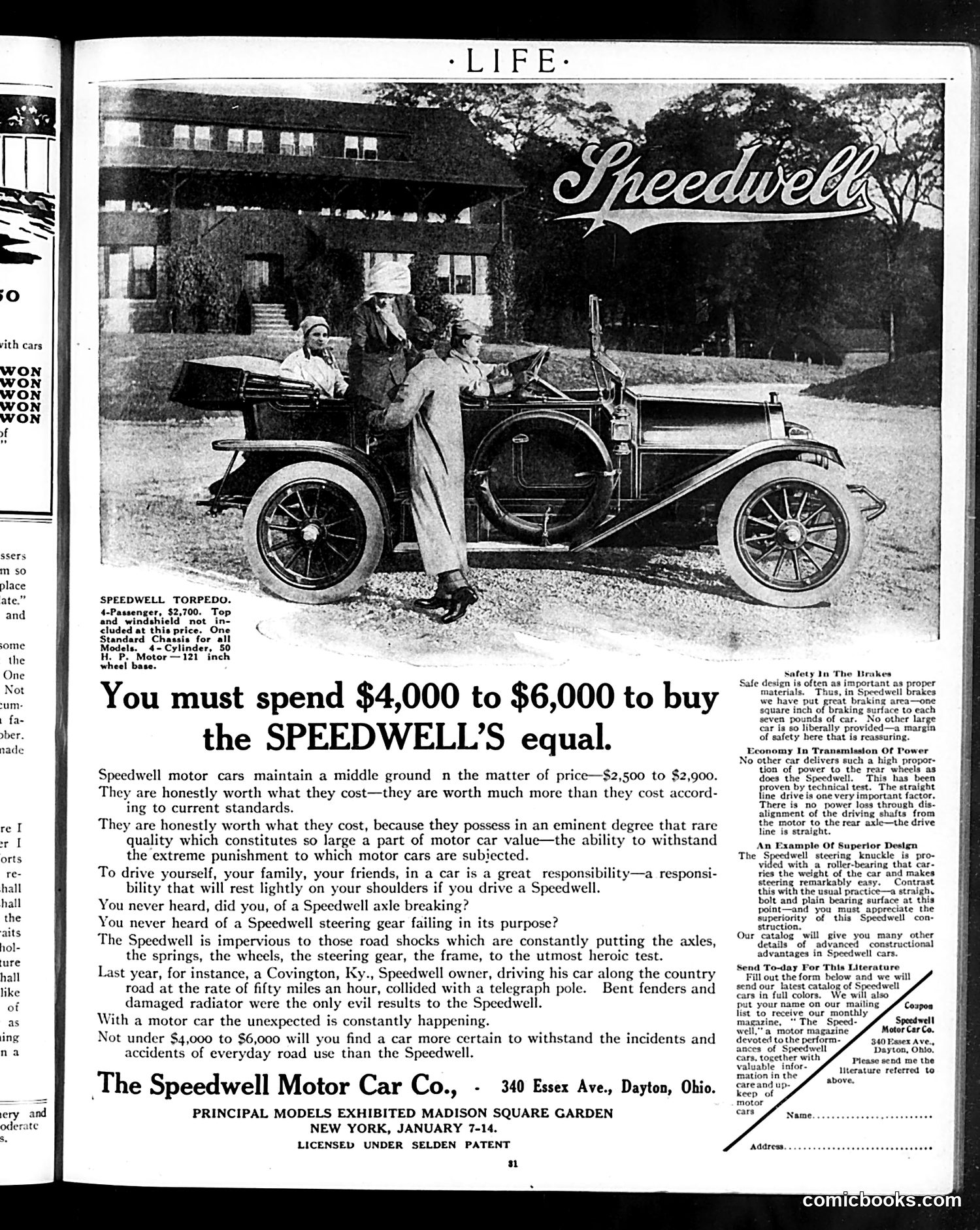
This is primarily a **car advertisement**, not political satire. The Speedwell Motor Car Company promotes their vehicles through claims of superior durability and value. The ad's central argument: you must spend $4,000–$6,000 to buy a car equal to Speedwell's, yet Speedwell costs only $2,500–$2,900. The company emphasizes reliability through anecdotes (a Speedwell survives hitting a telegraph pole with only bent fenders) and technical specifications (axles, steering gears, braking systems). The photograph shows a well-dressed couple with the "Speedwell Torpedo" model outside a substantial brick building, suggesting affluence and respectability. This reflects early 1900s automotive marketing: positioning a mid-priced car as offering exceptional value and engineering quality. The repeated emphasis on durability and safety addresses legitimate consumer concerns about new automobile technology's reliability.
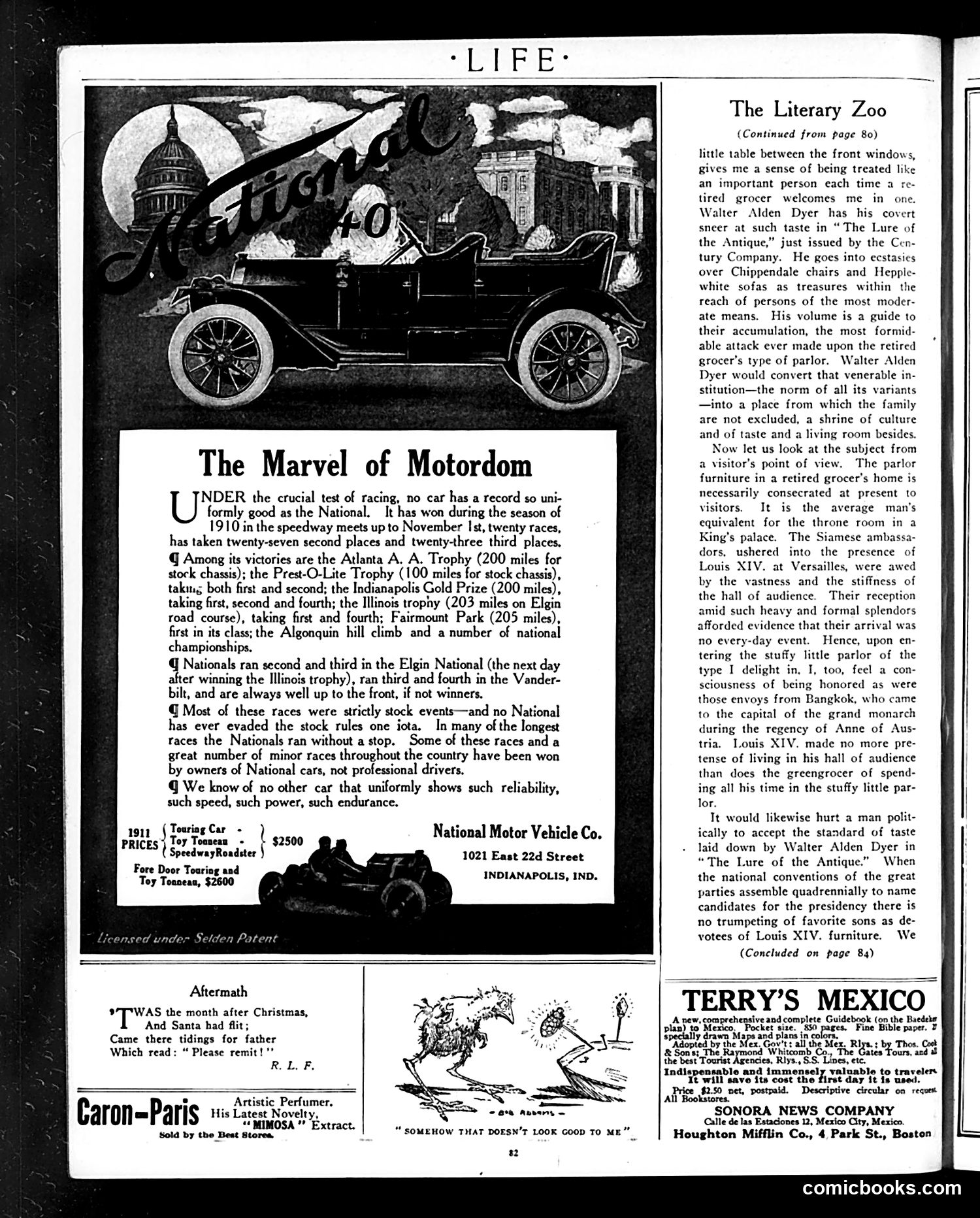
This page is primarily a **1910 automobile advertisement** for the National Motor Vehicle Company of Indianapolis. The large illustration shows an early racing car with classical architecture (the Capitol dome) in the background, emphasizing American industrial achievement. The ad promotes the National brand by listing its racing victories during the 1910 season—twenty wins across major competitions including the Indianapolis Gold Prize and Illinois Trophy. The text emphasizes that these victories used stock (unmodified) cars driven by ordinary owners, not professional racers, positioning the National as exceptionally reliable and durable for everyday consumers. The small cartoon below ("Somehow that doesn't look good to me") appears to be unrelated satirical content, likely commenting on holiday finances rather than automobiles. The remainder of the page contains literary criticism and separate advertisements for perfume and travel guides—typical Life magazine miscellany.
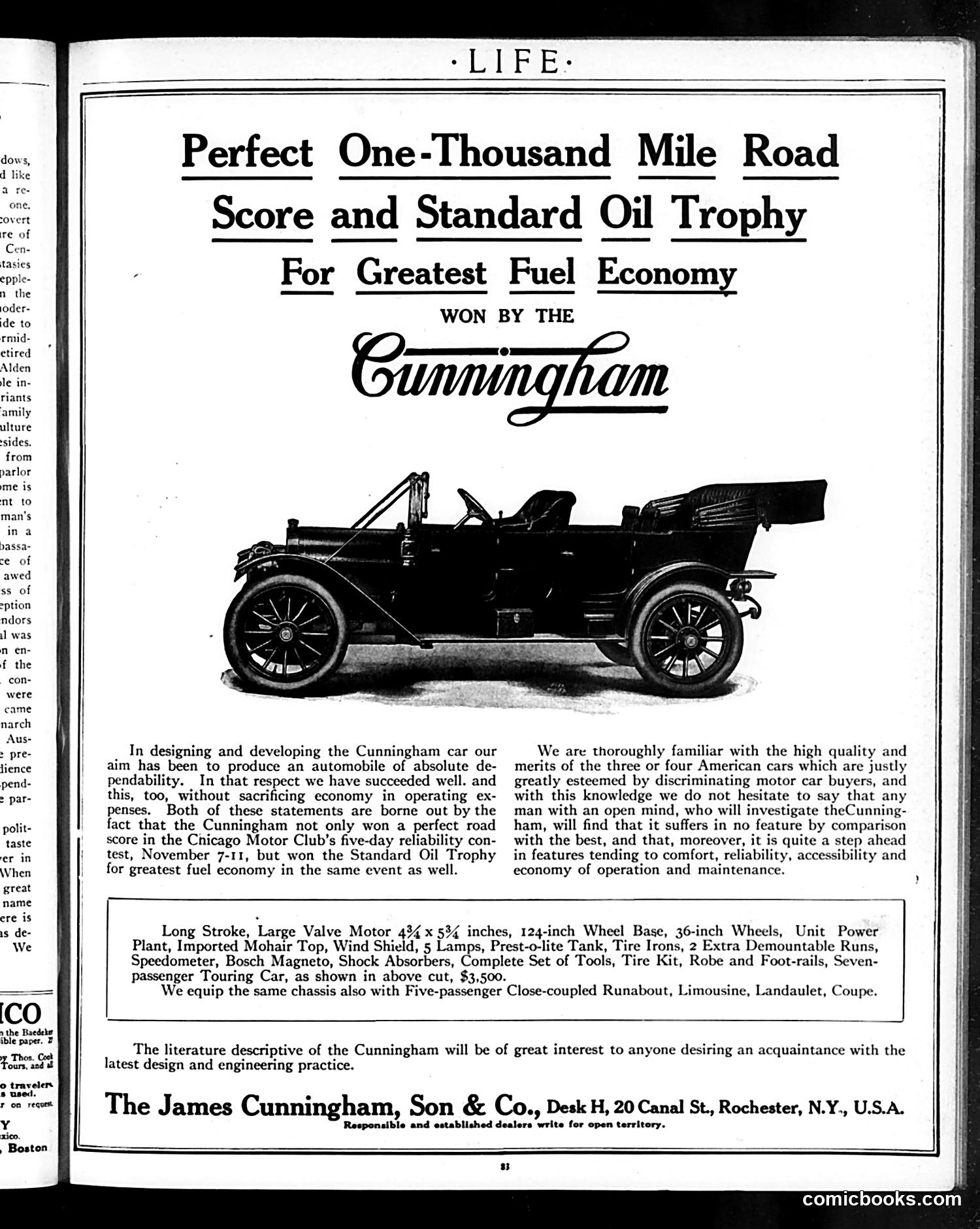
This is **not a satirical cartoon** but rather a **full-page automobile advertisement** for the Cunningham motor car, appearing in Life magazine. The page advertises that Cunningham won the "Perfect One-Thousand Mile Road Score" and the Standard Oil Trophy for fuel economy in a Chicago Motor Club reliability contest (November 7-11, year unclear from visible text). The advertisement includes: - A detailed illustration of the vehicle (a seven-passenger touring car) - Claims of superior dependability and fuel economy - Competitive positioning against "three or four American cars" of comparable reputation - Extensive technical specifications - The manufacturer's Rochester, New York address This represents **early automotive advertising**, where companies used prestige awards and technical claims to market luxury vehicles during the automobile industry's formative years. The $3,500 price tag indicates this was a high-end product. There is no satire present—this is straightforward commercial promotion.
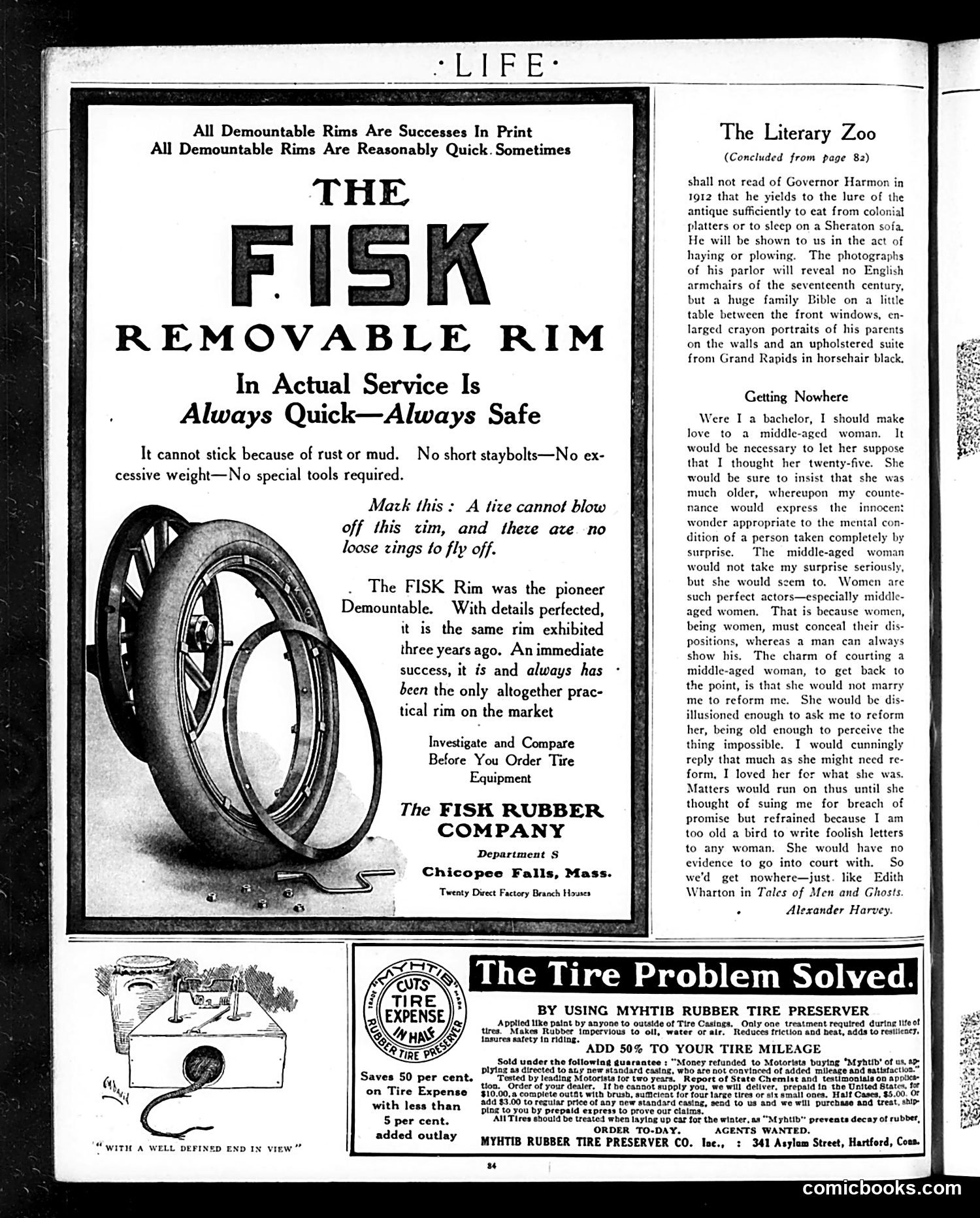
This page is primarily **advertising**, not political satire. The main content comprises three tire and automobile product advertisements from the early 1910s: 1. **Fisk Removable Rim** (top left): A tire rim manufacturer emphasizes their product's durability and ease of use—it won't stick due to rust or mud, requires no special tools, and won't lose rings. 2. **Mythtib Rubber Tire Preserver** (bottom): A paint-like coating applied to tire casings claiming to add 50% to tire mileage by making rubber impervious to oil, water, and air. A brief literary essay titled "Getting Nowhere" appears on the right, discussing romantic courtship with middle-aged women—unrelated to the advertisements. The page reflects early automotive-era concerns: tire durability, maintenance, and longevity were major consumer issues before modern tire technology.
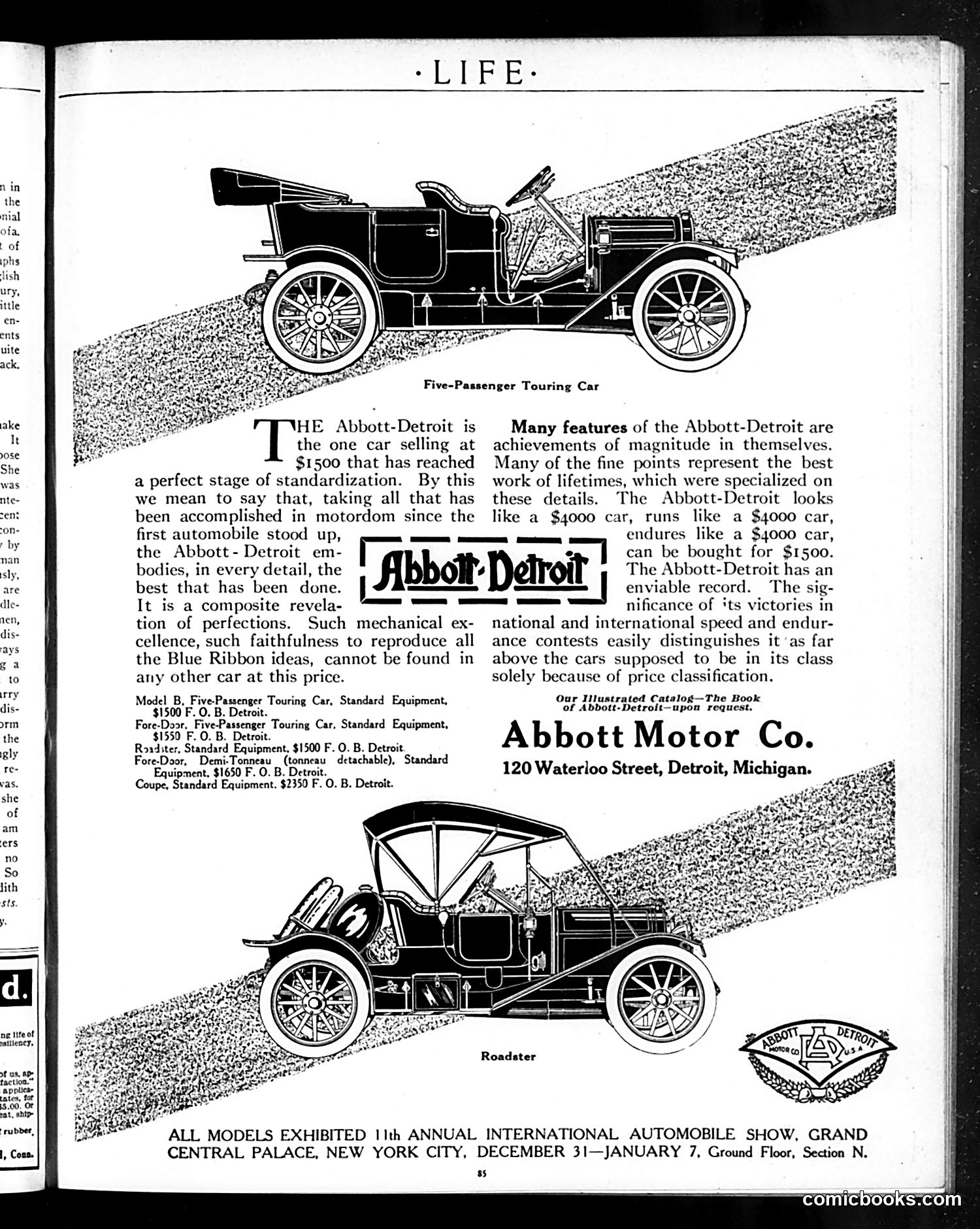
This is **not a cartoon or satire**—it's a straightforward automobile advertisement from *Life* magazine, likely from around 1911 (the 11th International Automobile Show is referenced). The page promotes the Abbott-Detroit motor car, a mid-priced vehicle ($1,500) competing in the emerging mass-market automobile industry. The advertisement claims the Abbott-Detroit achieves "perfect standardization"—a selling point emphasizing that this car incorporates the best engineering innovations developed since automobiles' invention, all at an affordable price point. Two vehicle illustrations showcase different models: a Five-Passenger Touring Car and a Roadster. The text boasts the car "looks like a $4000 car, runs like a $4000 car, endures like a $4000 car" while costing only $1,500—a value proposition aimed at middle-class buyers. The advertisement also highlights the car's racing credentials, mentioning victories in "national and international speed and endurance contests." There is no political satire or cartoon content present on this page.
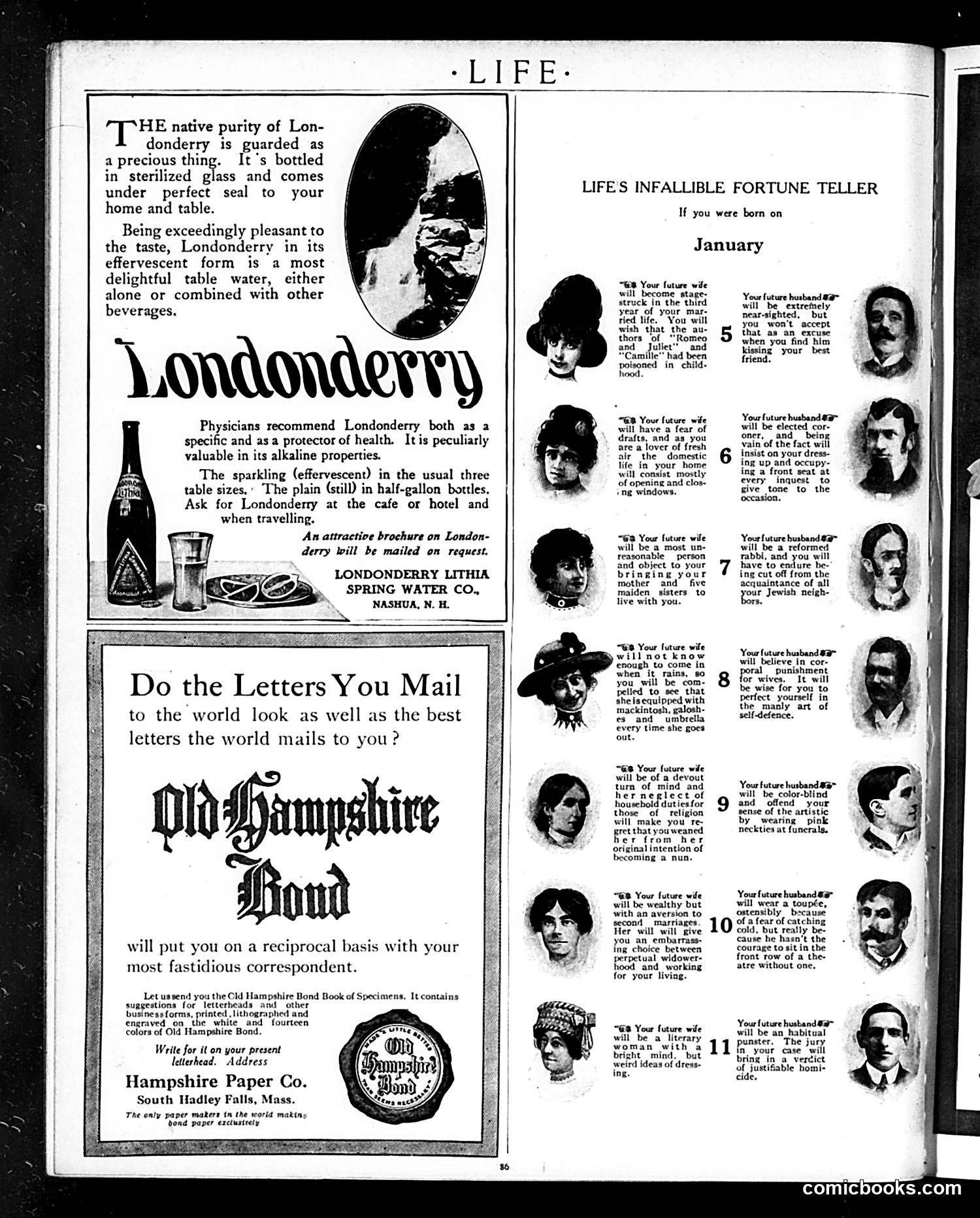
This page is primarily advertising with a humorous "fortune teller" feature mocking matrimonial prospects. The right column presents mock horoscopes for people born in January, paired with illustrated male faces representing "your future husband" numbered 1-11. The satire targets marriage itself: each "fortune" describes an undesirable wife (vain, neurotic, overly religious, wasteful, unfaithful) paired with an equally flawed husband (near-sighted, corrupt, reformed drunk, color-blind, toupee-wearer, coward). The jokes suggest that marriage is guaranteed disappointment—whichever numbered husband you get, you'll regret it. The left side advertises Londonderry lithia water and Old Hampshire Bond stationery. The water ad emphasizes "native purity" and alkaline health properties typical of early-20th-century patent medicine marketing. The humor reflects Era anxieties about matrimony as an inescapable, usually miserable social obligation.
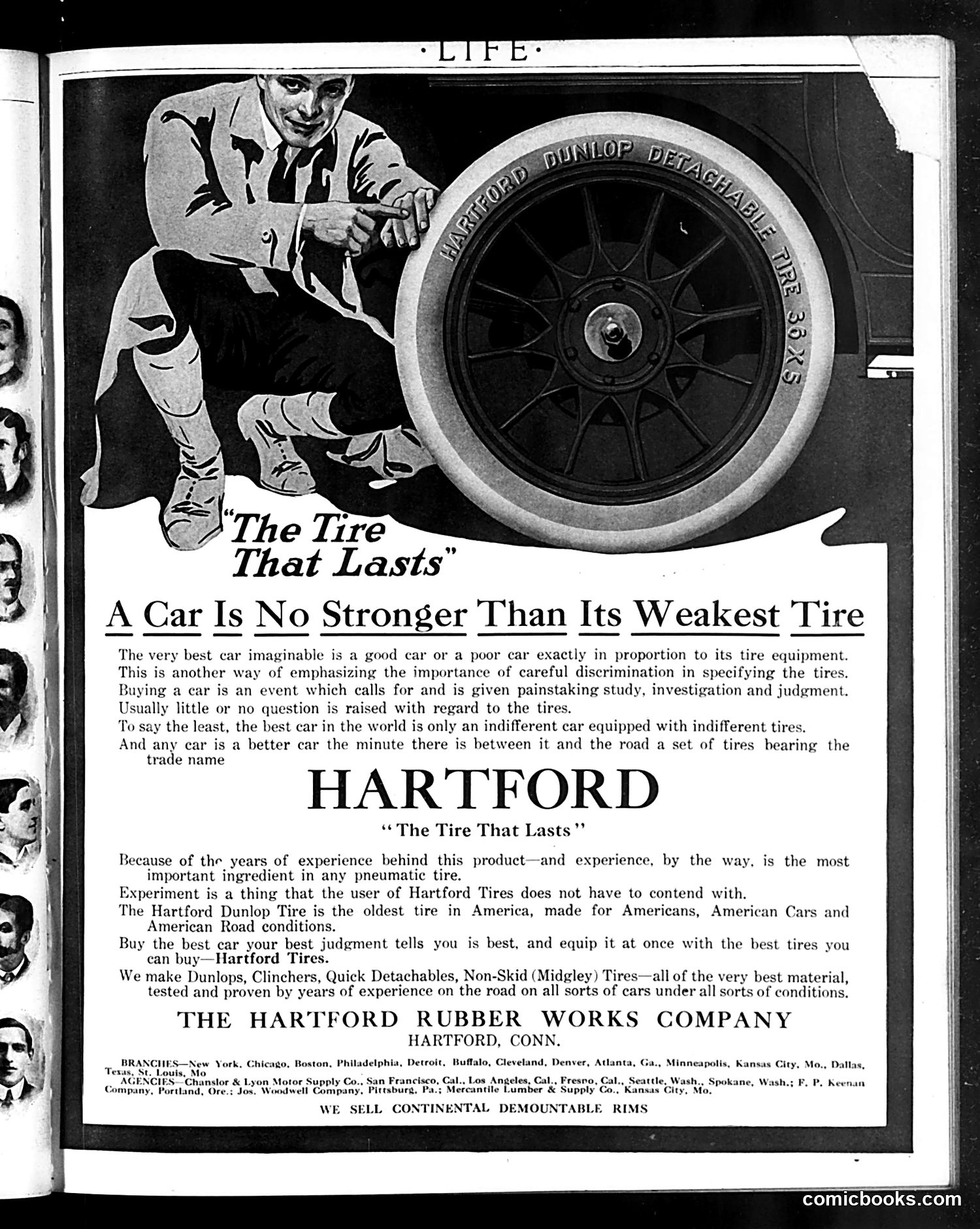
This is primarily a **product advertisement**, not political satire. It appears in *Life* magazine promoting Hartford Rubber Works Company tires from Hartford, Connecticut. The ad features a man crouching beside a large tire, smiling at the camera. The central message uses a metaphor: "A Car Is No Stronger Than Its Weakest Tire," arguing that even the best automobiles are only as good as their tire equipment. The advertisement emphasizes Hartford's experience and reliability—claiming to be "the oldest tire in America, made for Americans." It contrasts careful car selection with the common neglect of tire choice, positioning Hartford tires as the solution to this oversight. The extensive list of regional distributors at the bottom indicates this was a major national brand competing in the early automotive tire market. The mention of various tire types (Dunlops, Clinchers, Quick Detachables, Non-Skid) reflects the diverse tire technologies available during this era of automobile development.
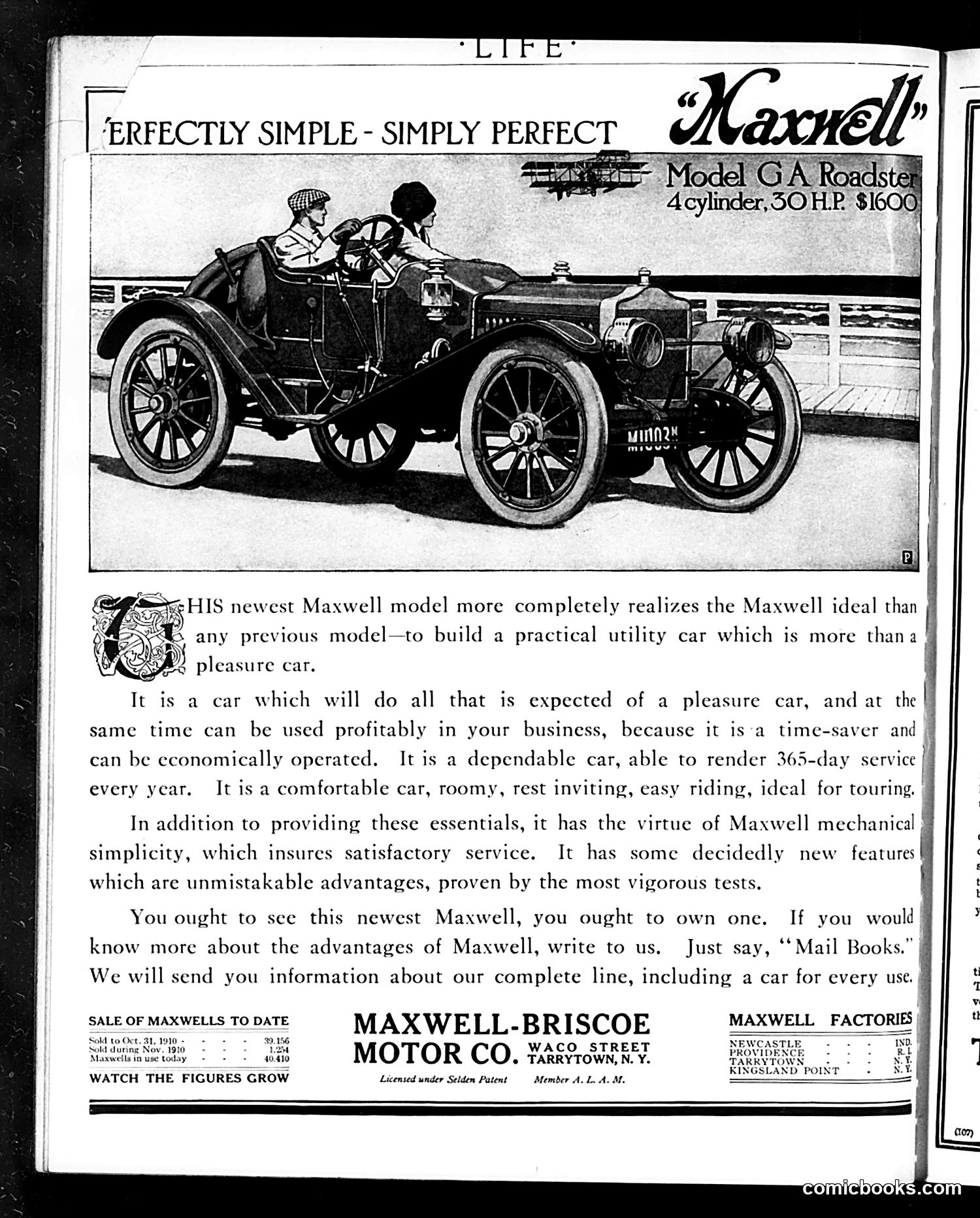
This is primarily a **car advertisement**, not political satire. It promotes the Maxwell-Briscoe Motor Company's Model GA Roadster (priced at $1600, 4-cylinder, 30 HP). The illustration shows two well-dressed people in the open-air roadster, conveying respectability and leisure. The ad copy emphasizes practical virtues: durability ("365-day service"), economy, comfort, and mechanical simplicity—selling the car as both pleasure vehicle and business tool. The phrase "WATCH THE FIGURES GROW" references sales data shown below, suggesting the vehicle's commercial success. This represents early 1900s automotive marketing: positioning cars as accessible, practical investments rather than luxury toys. No political cartoon or satire is present—this is straightforward commercial messaging typical of *Life* magazine's advertising content from this period.
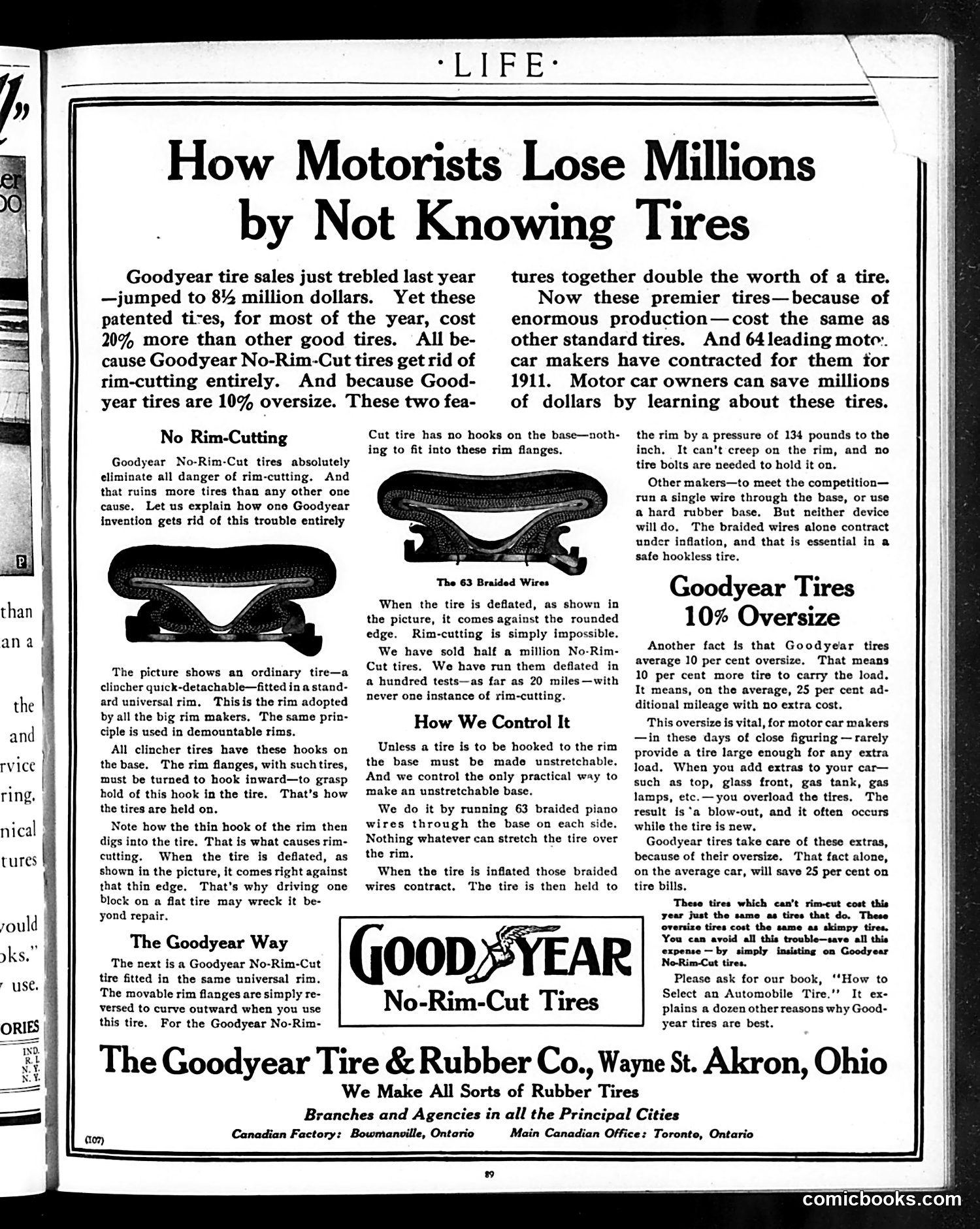
This is **not satire or a political cartoon**—it's a **straightforward advertisement** for Goodyear tires, disguised as educational journalism in *Life* magazine (a common advertising practice of that era). The page explains Goodyear's technical innovations: the "No-Rim-Cut" tire design (with diagrams showing how ordinary tire hooks dig into rims during deflation, causing damage) and the use of 63 braided piano wires to create an unstretchable base. It also highlights that Goodyear tires are 10% oversized, providing extra load capacity. The headline's claim that motorists "lose millions" by not knowing about tires is marketing hyperbole meant to convince readers that Goodyear's premium product (costing 20% more initially) saves money through durability and performance—a pitch supported by claims that 64 major automakers contracted for these tires in 1911. This represents early 20th-century advertorial content, where branded messaging mimicked editorial voice to appear credible.
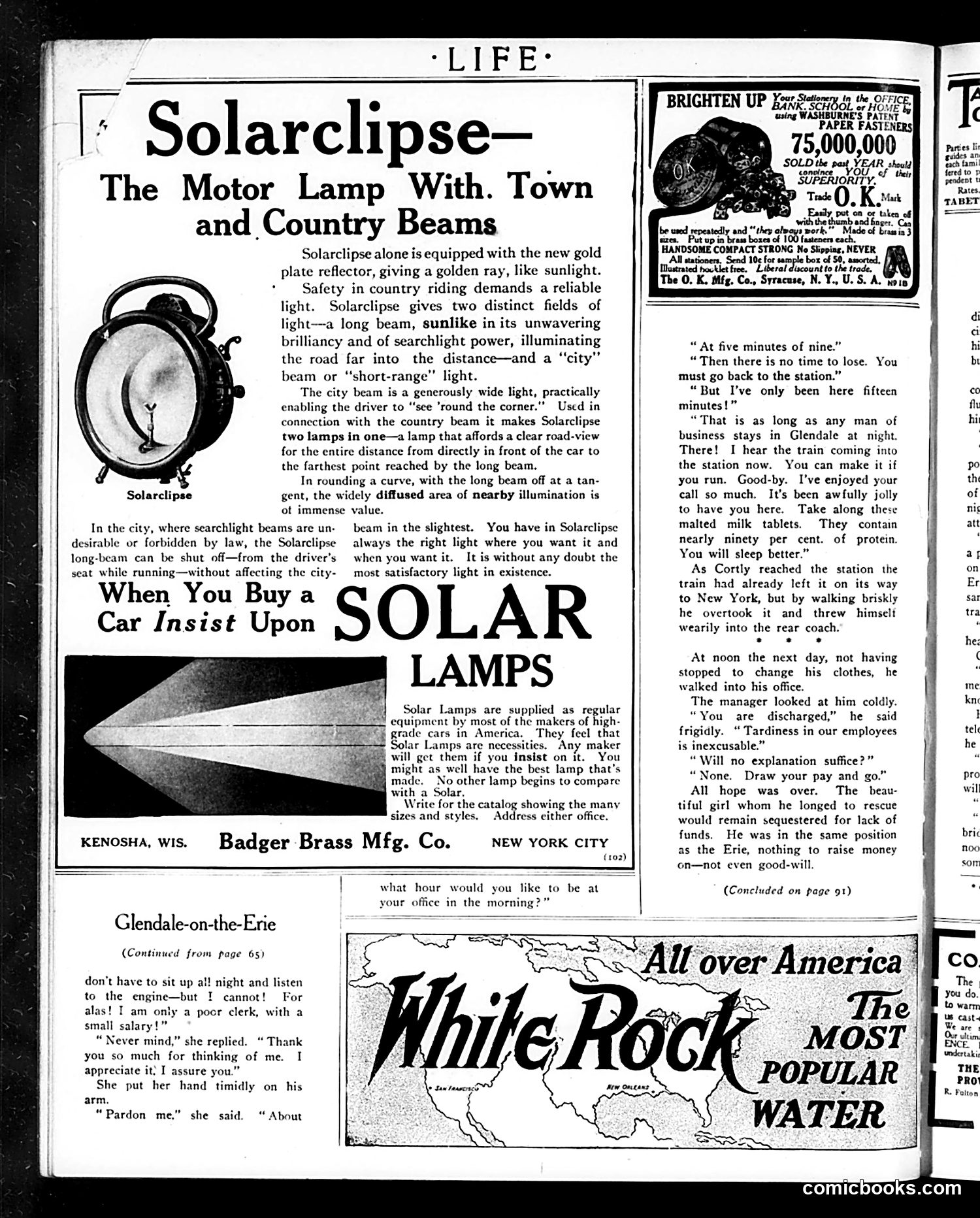
This page combines **advertising** with **serialized fiction**. ## The Advertisements The **Solarclipse motor lamp** ad dominates the upper left—a practical pitch for automobile headlights with dual "town and country beams." This reflects early 1900s car culture, when reliable lighting was a genuine safety concern for rural driving. The **O.K. washers ad** (upper right) and **White Rock water ad** (lower right) are standard period product placements. ## The Serialized Story: "Glendale-on-the-Erie" The right column and bottom continue a melodramatic romance narrative. A clerk named Cortly is desperately trying to catch a train after visiting a girl in Glendale. He misses it, arrives late to work the next day, and is immediately **fired** by his coldly unsympathetic manager for tardiness. The story's emotional stakes: Cortly's dismissal prevents him from raising money to help rescue "the beautiful girl" who is "sequestered for lack of funds"—likely hinting at financial hardship or family troubles. This reflects common **Edwardian serialized fiction** tropes: working-class struggle, romantic desperation, and harsh employer cruelty.
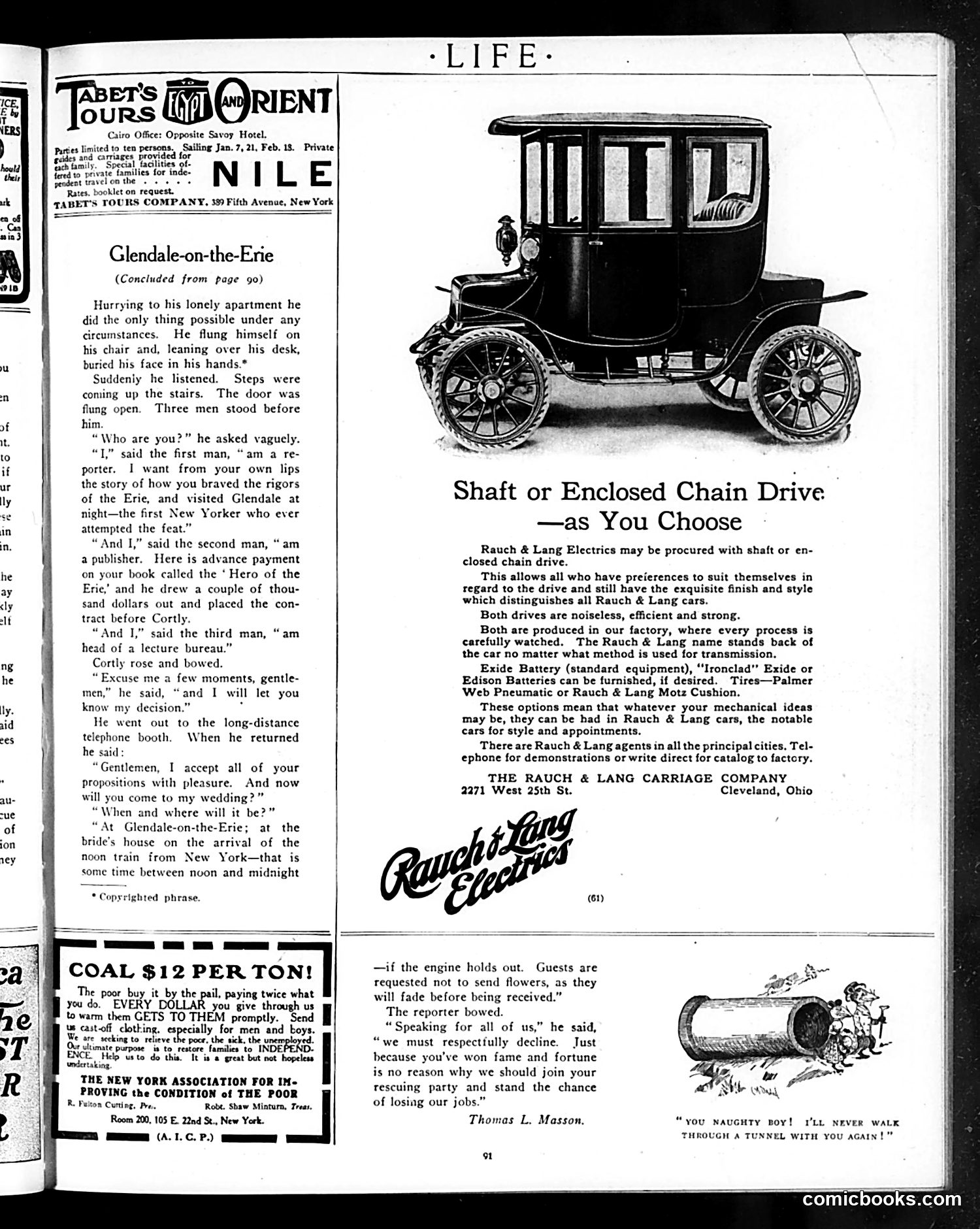
This page concludes a serialized humorous story about a man named Cortly who apparently completed some daring feat on Lake Erie. The satire mocks the sudden opportunism that fame attracts: three men—a reporter, publisher, and lecture bureau head—immediately appear at his door wanting to profit from his accomplishment by publishing his story, advancing him money, and booking speaking engagements. The joke's punchline: when Cortly invites them to his wedding at Glendale-on-the-Erie, they politely *refuse*, fearing they might lose their jobs attempting another dangerous Erie crossing. The satire targets both the mercenary nature of media/publishing and the self-interest underlying seemingly enthusiastic support. The page also contains period advertisements (Rauch & Lang electric automobiles, coal for the poor) typical of Life's mixed editorial-advertising format.
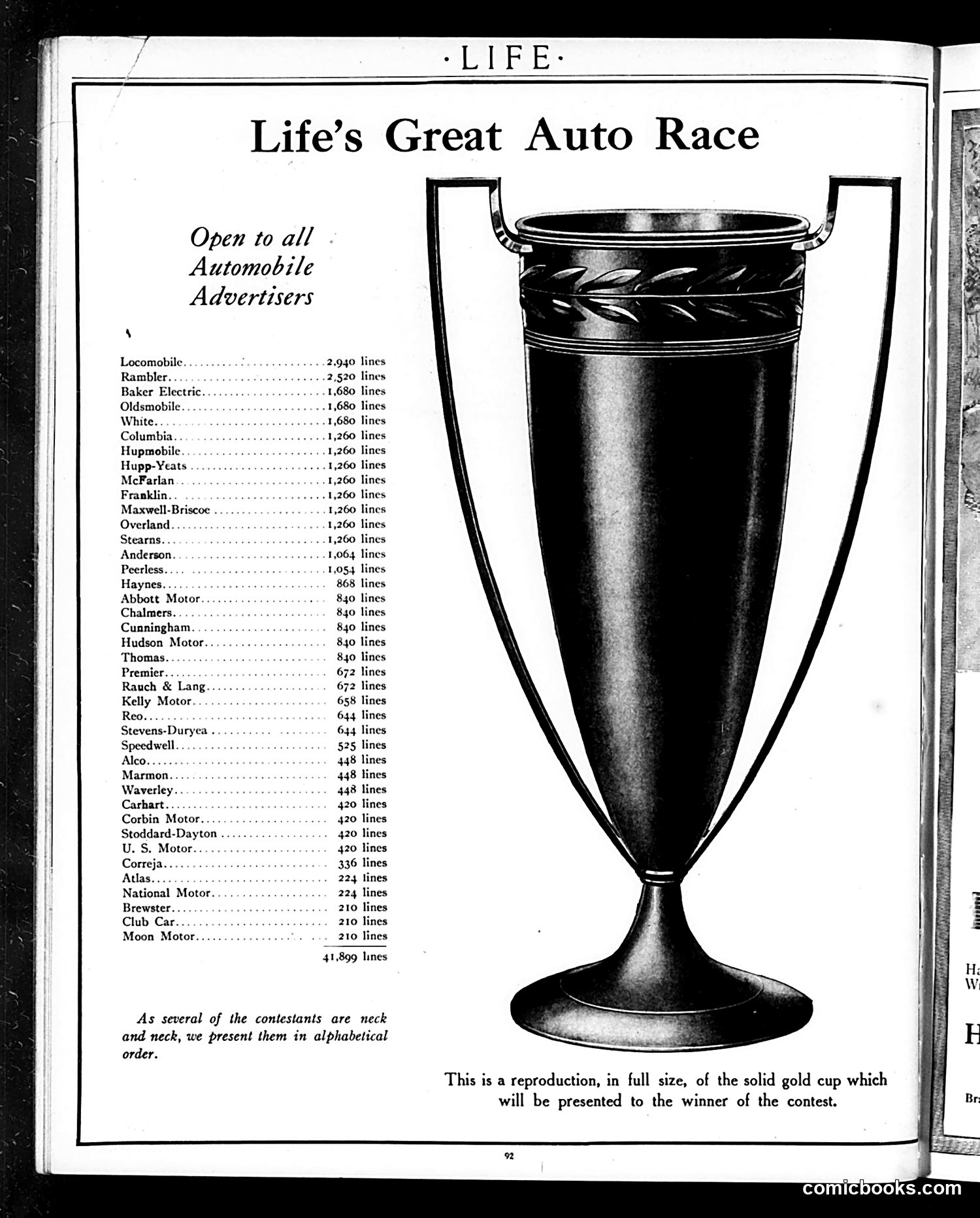
This page satirizes the intense competition among automobile manufacturers for advertising space in *Life* magazine itself. Rather than an actual racing competition, "Life's Great Auto Race" measures success by advertising volume—the number of printed lines each car company purchased. The elaborate trophy cup suggests this is a prestigious contest, but the joke is that winning depends entirely on spending: Locomobile "wins" with 2,940 lines, while smaller manufacturers like Moon Motor lag with only 210 lines. The note that contestants are "neck and neck" mockingly treats advertising expenditure as a sporting achievement. This is both self-promotion (showcasing *Life's* valuable advertising inventory) and satire of the booming early 1900s automobile industry's aggressive marketing wars. The alphabetical listing further emphasizes that commercial competition, not actual vehicle quality, determines the "winner."
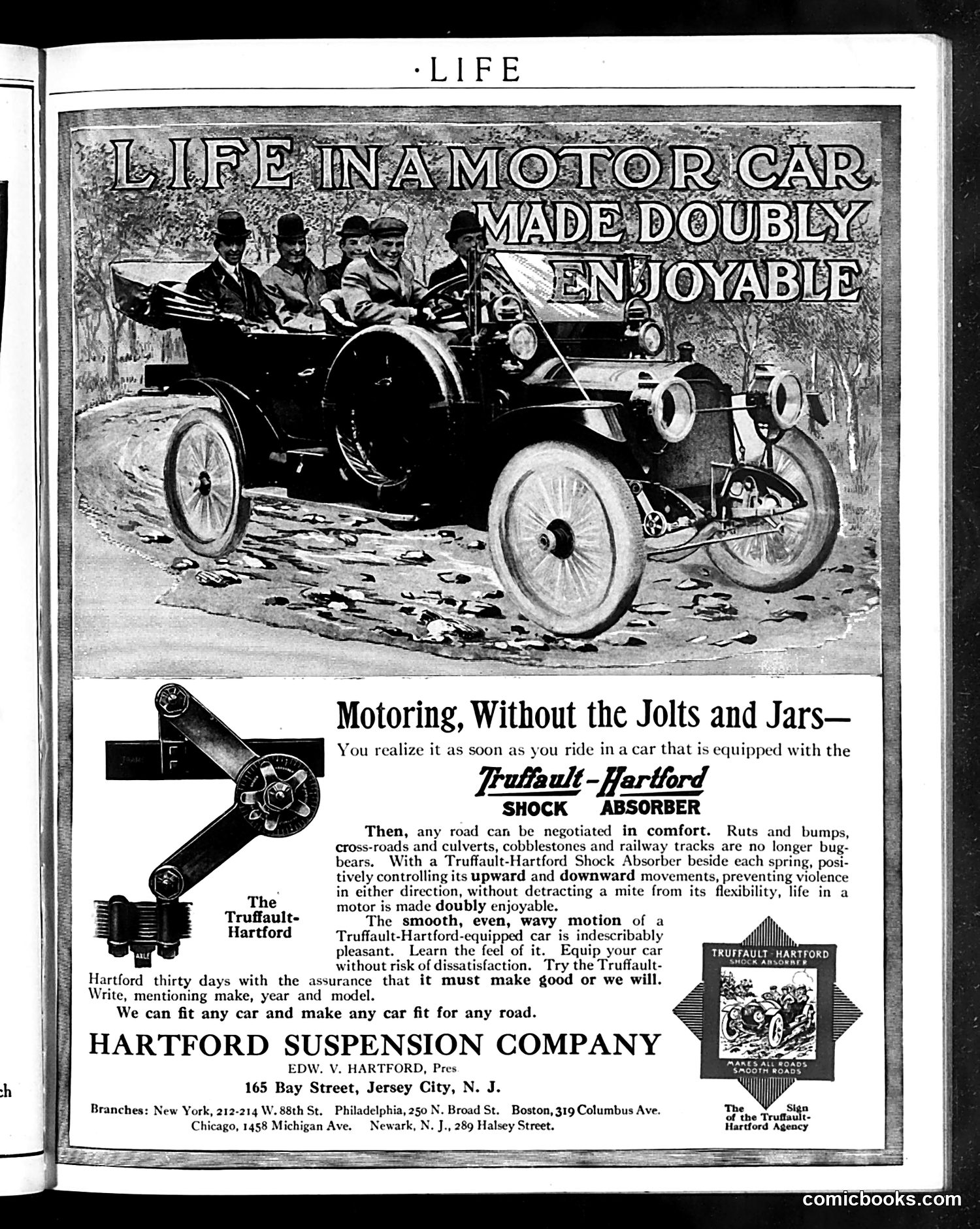
This is primarily an **advertisement**, not satire or political commentary. It promotes the Truffault-Hartford Shock Absorber for automobiles, a suspension technology innovation of the early automotive era. The image shows a early 1900s motorcar with well-dressed passengers enjoying a smooth ride. The ad's central claim: shock absorbers make motoring comfortable by eliminating the "jolts and jars" from poor road conditions (ruts, bumps, cobblestones, railway tracks). The pitch emphasizes smoothness and comfort as selling points—suggesting contemporary cars without this technology provided an unpleasant, physically jarring experience. The "thirty days" money-back guarantee and the claim "we can fit any car" indicate competitive marketing for what was then a relatively new automotive accessory. There is no evident satire or caricature here—this is straightforward period advertising targeting car owners seeking improved ride quality.
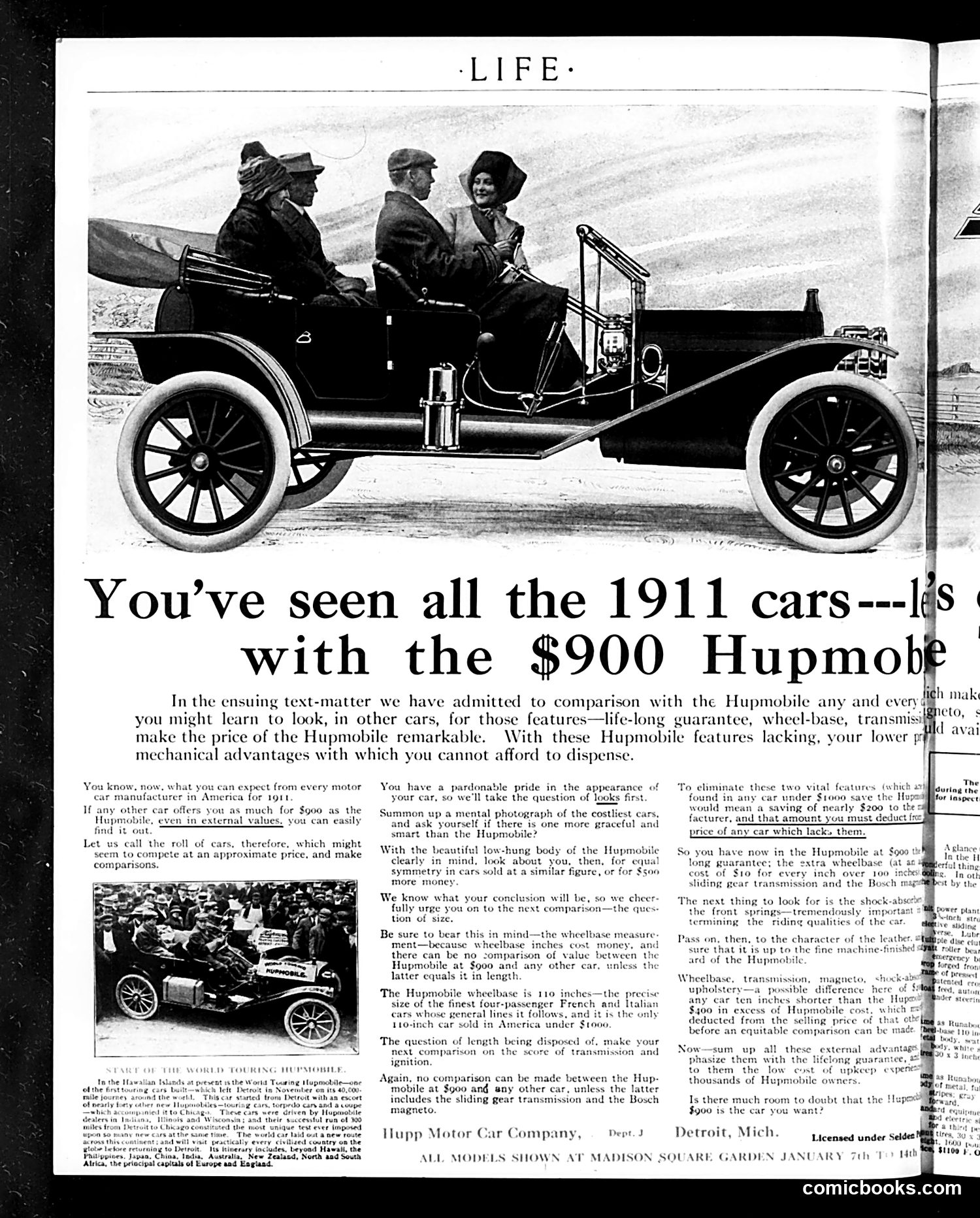
This is **not a cartoon or satire**—it's a straightforward automobile advertisement from *Life* magazine (January 1911). The page promotes the Hupmobile, a moderately priced car ($900), competing against other 1911 automobiles. The image shows three well-dressed passengers in an open-air Hupmobile touring car, suggesting comfort and respectability. The advertisement's strategy is to convince readers that the Hupmobile offers premium features—wheelbase measurement, transmission quality, Bosch magneto ignition, and graceful design—at a price undercutting competitors. The text methodically compares the Hupmobile's specifications (110-inch wheelbase, sliding gear transmission) against unnamed rivals, arguing buyers shouldn't sacrifice mechanical advantages for lower prices. This reflects early automotive marketing: before standardization, buyers needed education about technical features to justify purchasing decisions. The Hupp Motor Car Company address in Detroit, Michigan anchors this as legitimate commercial promotion in a respected publication.
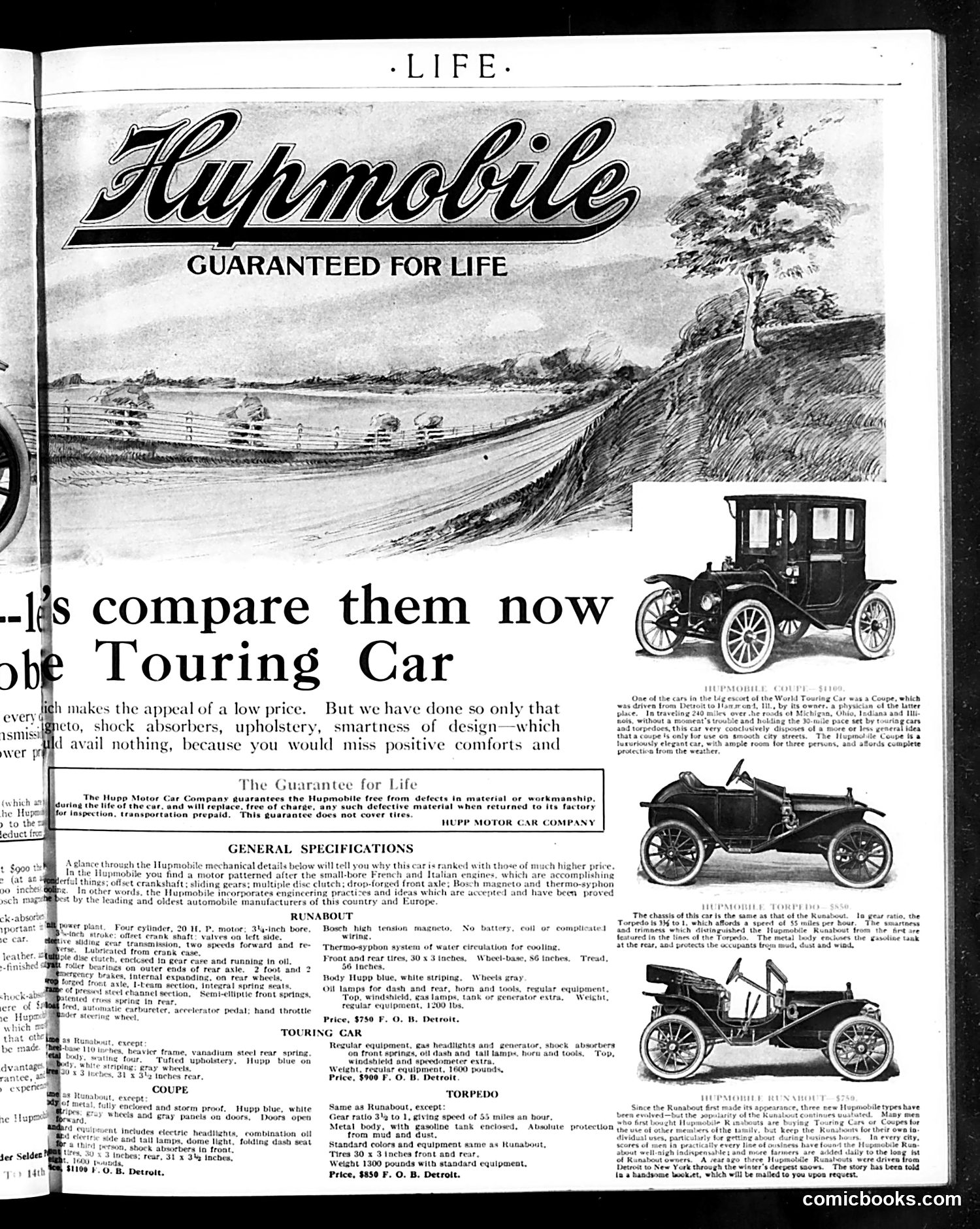
This is primarily a **car advertisement**, not satire or political commentary. The page promotes the Hupmobile automobile, a real early 1900s vehicle manufacturer. The ad compares three Hupmobile models—Runabout, Touring Car, and Torpedo—emphasizing their affordability ($750-$900) combined with quality features like shock absorbers, upholstery design, and a "Guarantee for Life" warranty. The headline "Let us compare them now" invites readers to evaluate Hupmobiles against competitors. The text stresses that despite the low price, buyers don't sacrifice comfort or positive features. Small illustrations show each vehicle model. The appeal was to middle-class buyers seeking reliability and value during the early automobile boom. This represents typical *Life* magazine advertising content from the era—not satirical editorial material.
This is **not a cartoon or satire**—it's a straightforward **advertisement** for B.F. Goodrich automobile tires, appearing in Life magazine. The image features a stylized globe wrapped with a tire band labeled "Goodrich," emphasizing the company's global reach. The ad's central claim is that Goodrich's service extends beyond manufacturing: they operate 100+ locations across North America and Europe, plus 32 "Tire Depots" stocked for immediate dealer delivery. The pitch targets both consumers and tire dealers, arguing that Goodrich's distribution network is superior to competitors'—you can get the right tire size anywhere, anytime, without delay. The advertisement reflects early 20th-century American commercial optimism about infrastructure and service standards. There is no satire or political commentary here; Life magazine's pages contained substantial advertising alongside editorial content.
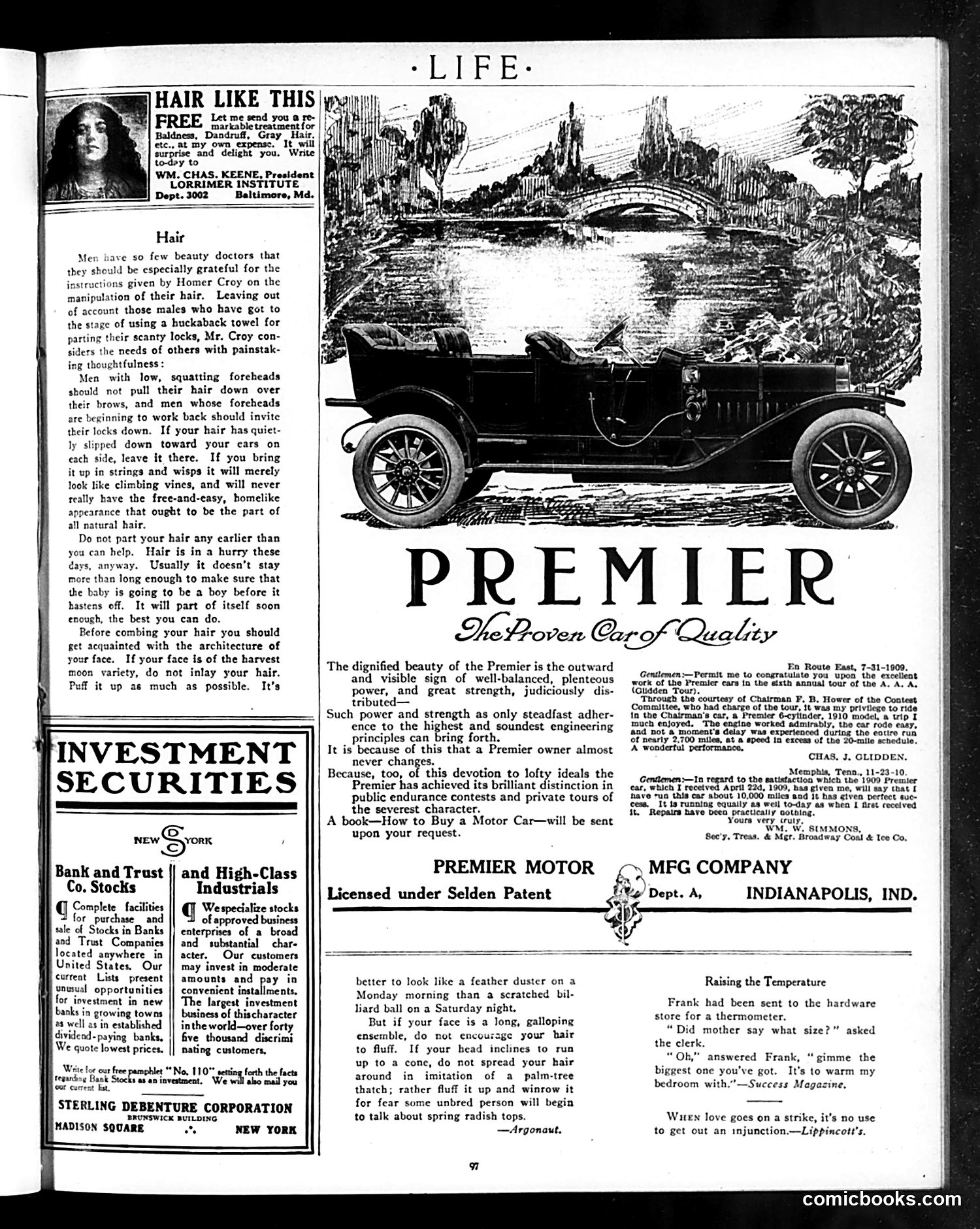
This page combines **practical advice** with **period advertising**. The main content is a humorous essay by Homer Croy on men's hairstyling, offering tongue-in-cheek guidance on how different face shapes should wear hair—advice that reflects early 1900s grooming concerns. The tone is gently mocking: the essay acknowledges male vanity while offering counterintuitive suggestions (e.g., don't part hair early, work *with* your hairline rather than against it). The page is dominated by a **Premier automobile advertisement** featuring a luxury car and endorsement letters praising its performance in A.A.A. touring competitions. This occupies most of the visual space. Secondary ads for investment securities and banking services fill the lower left—typical of Life's era, when the magazine served educated, affluent readers interested in both satire and financial opportunity. There is **no political cartoon** on this page—it's primarily commercial content interspersed with lifestyle humor.
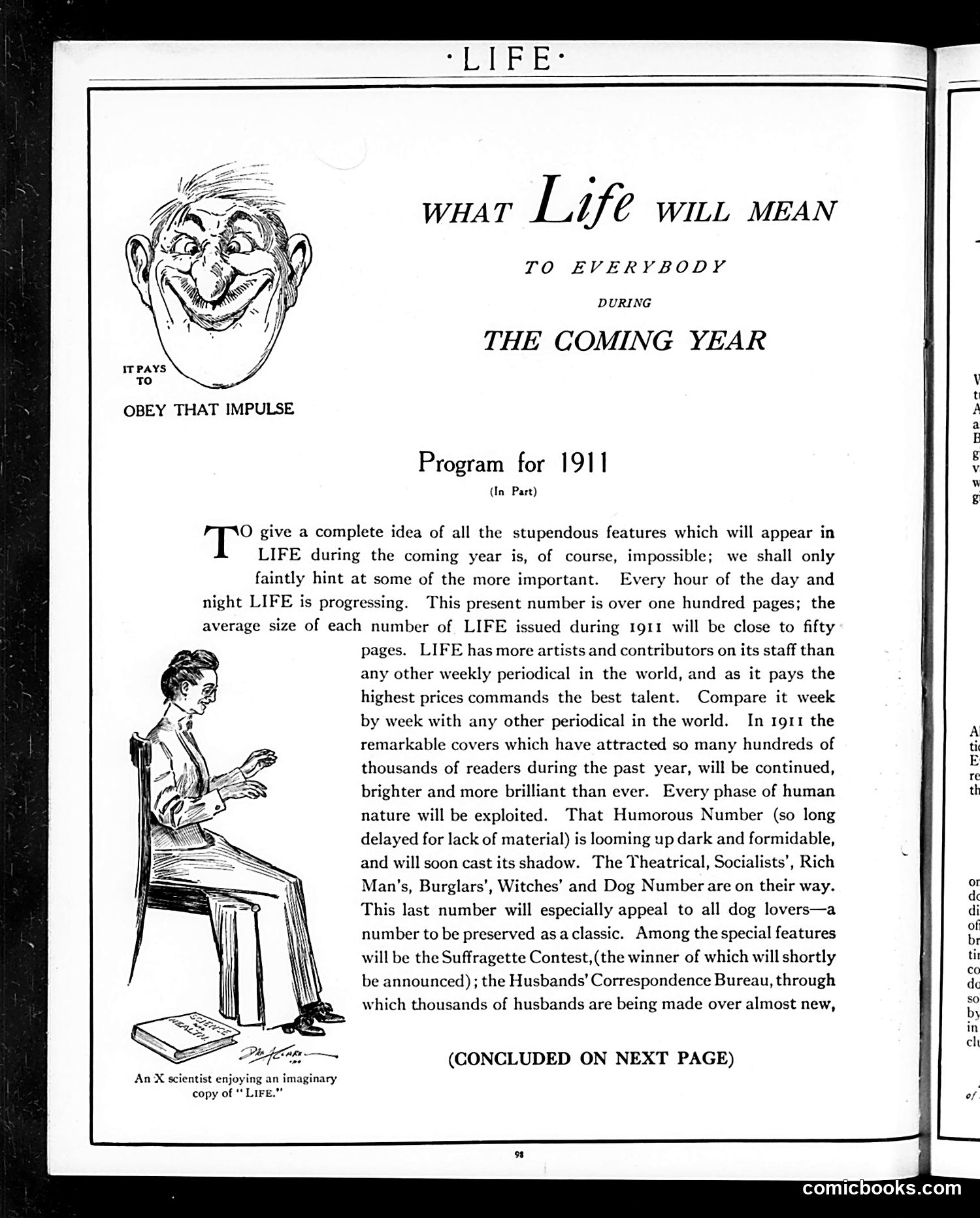
This is a promotional page for *Life* magazine's 1911 programming. The two cartoons illustrate the magazine's satirical approach to contemporary life. **The top cartoon** shows a grinning man's face captioned "IT PAYS TO OBEY THAT IMPULSE"—encouraging readers to follow their instincts, likely a jab at impulsive behavior or consumerism. **The bottom cartoon** depicts "An X scientist enjoying an imaginary copy of 'LIFE'"—satirizing either scientific pretension or the idea that reading *Life* requires intellectual sophistication. The text announces upcoming special issues targeting different demographics: Socialists, the wealthy ("Rich Man's"), Burglars, Witches, and notably a **Suffragette Contest**—referencing the active women's suffrage movement of 1911. The **"Husbands' Correspondence Bureau"** mocks marital relationships by suggesting husbands need professional "making over." The page positions *Life* as comprehensive, featuring "every phase of human nature," appealing to diverse readers through satirical, themed issues.
This page announces Life magazine's content and editorial direction for the coming year. The publication promises satirical coverage including humorous columns ("Sparks from Old Anvils," "Priscilla Jawbones"), a medical satire called "Halfbaker's Medical Institute," and dramatic criticism. The cartoons illustrate Life's self-deprecating humor: one shows a befuddled man studying papers—the visual joke suggesting readers seeking "No Information" (guaranteed statistics-free content). Another depicts a boy who attended Life's Fresh Air Farm charity program in Connecticut, where the magazine sent poor urban children for recuperation—a genuine charitable initiative. The page also advertises subscriptions at five dollars yearly (1,300+ pages annually) and promotes upcoming features including an automobile race and literary reviews. The tone blends humor with genuine social welfare work, typical of Life's mix of satire and progressive-era social consciousness.
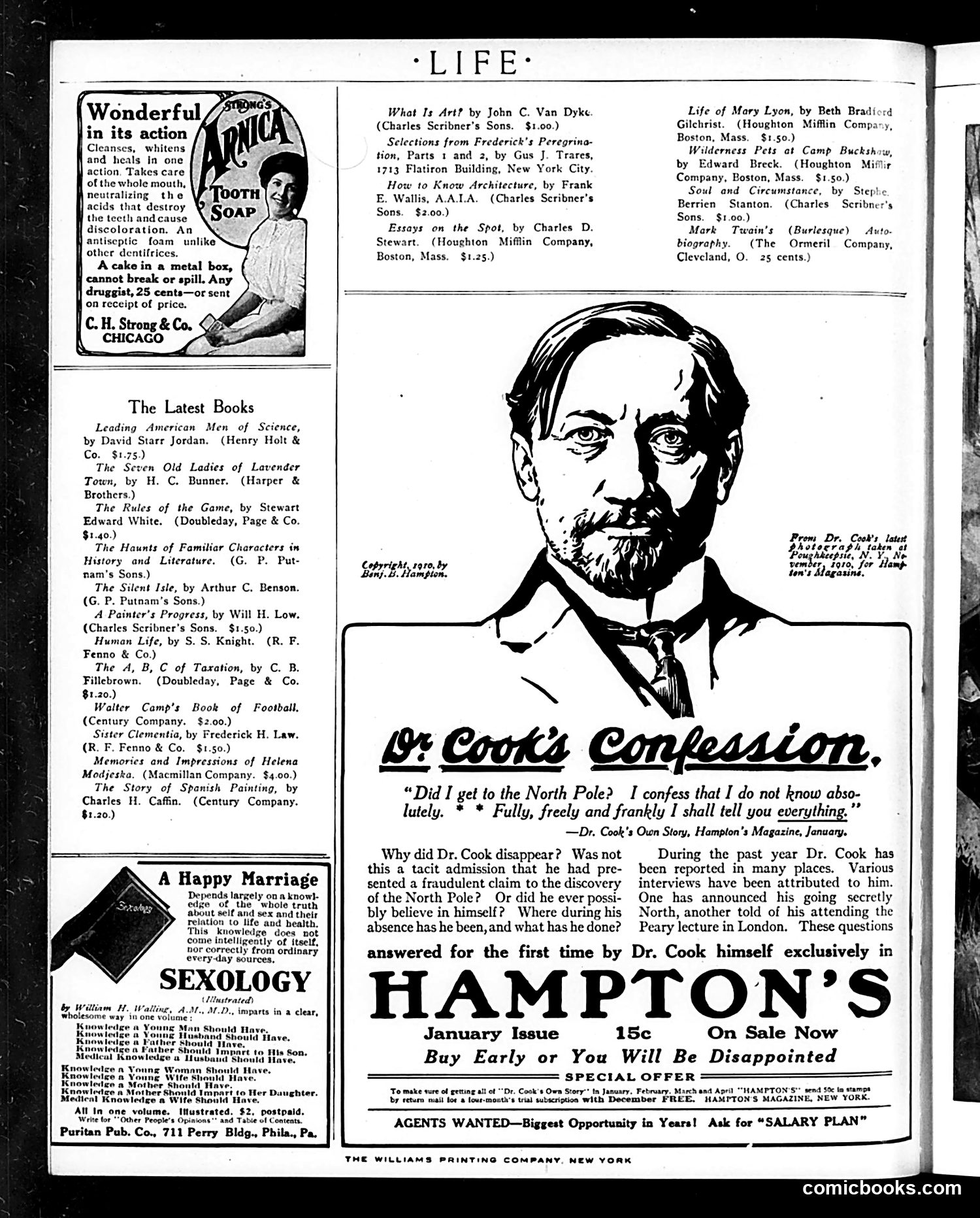
This page features a major advertisement for Hampton's Magazine promoting an exclusive confessional article by Dr. Frederick Cook about his disputed North Pole discovery claim. **The Context:** Cook had claimed to reach the North Pole in 1908, but his rival Robert Peary made the same claim, sparking a fierce public controversy over who actually reached it first. Cook's credibility deteriorated when he disappeared from public view, fueling suspicion he was admitting fraud. **The Satire/Point:** The advertisement capitalizes on public fascination with Cook's scandal, using his own hedging language ("I confess that I do not know absolutely") to promise sensational revelations. The dramatic photograph and promise that Cook will finally tell "everything" suggests both vindication-seeking and damage control—turning Cook's humiliation into profitable magazine sales. This reflects early 20th-century American media's exploitation of celebrity scandal for commercial gain.
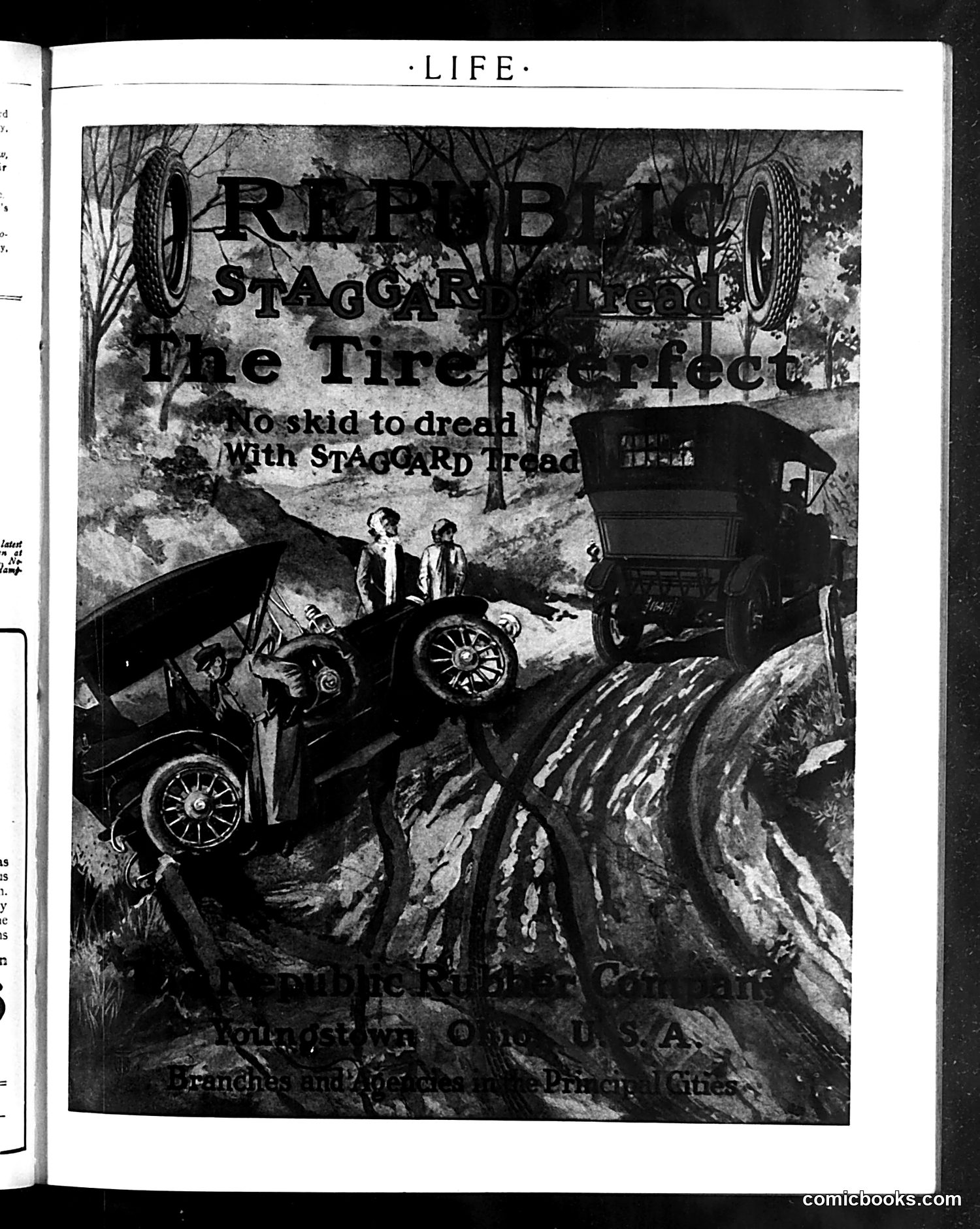
This is a **vintage tire advertisement** rather than political satire. The ad promotes "Staggard Tread" tires with the slogan "No skid to dread with Staggard Tread." The image depicts a dramatic accident scene: two automobiles have collided on a mountainous road, with one vehicle appearing to have skidded dangerously. Two men stand examining the wreckage between the vehicles. The advertisement's message is clear: Staggard tires prevent dangerous skidding, making them safer for treacherous road conditions. By showing the worst-case scenario (a serious accident), the ad uses fear to motivate purchasing decisions—a common early automotive advertising technique emphasizing vehicle safety features.
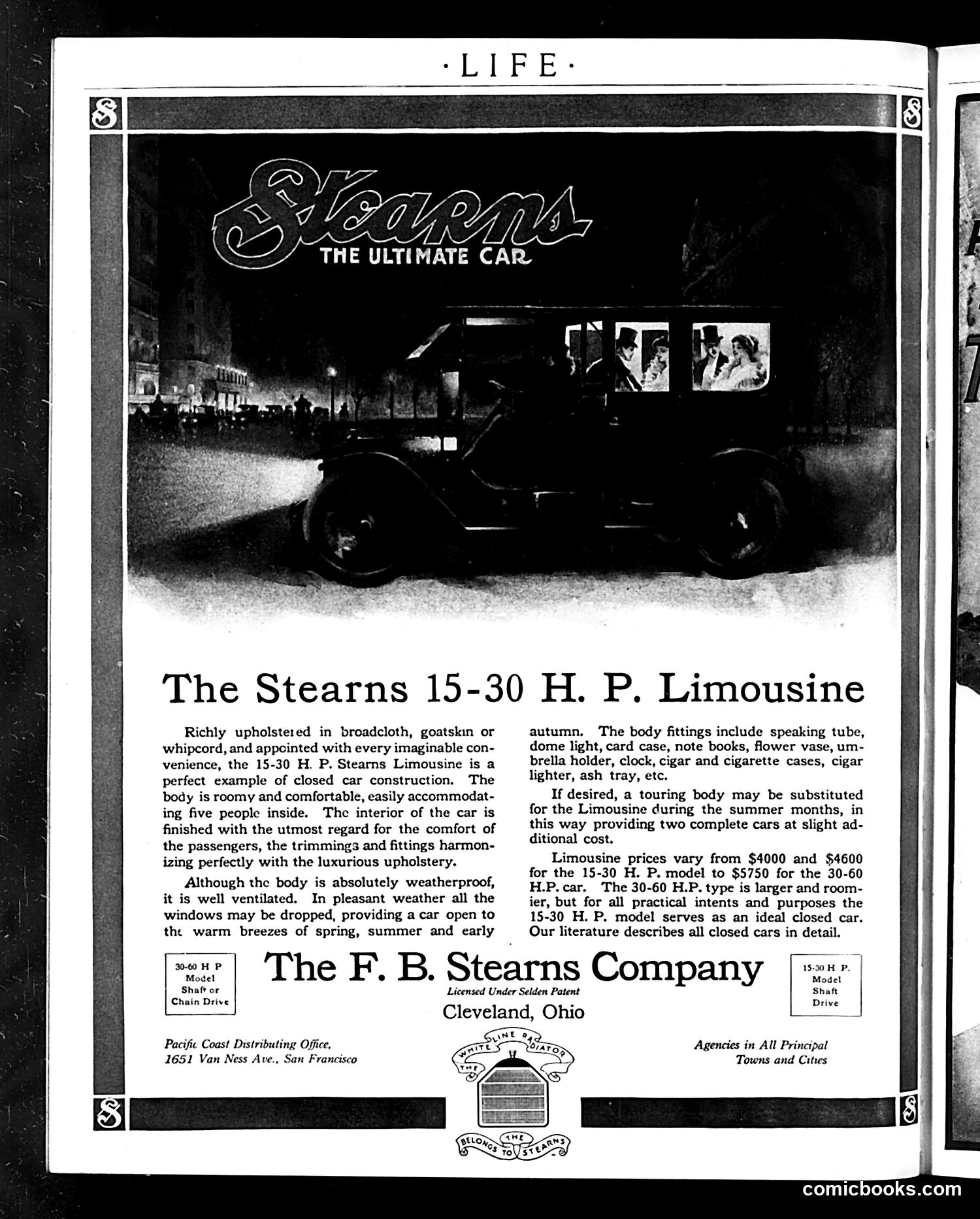
This page is **primarily an automobile advertisement**, not political satire. It promotes the F. B. Stearns Company's luxury limousines from Cleveland, Ohio. The ad emphasizes the 15-30 H.P. Limousine as "the ultimate car"—a closed, weatherproof vehicle richly upholstered with amenities like speaking tubes, dome lights, cigar cases, and ash trays. It could accommodate five people comfortably and, if desired, could be converted to a touring body for summer use. The small photographs on the vehicle show passengers enjoying the car's interior comfort and appointments. The pricing ($4,000-$5,750) indicates this was a high-end luxury product. There is **no visible political cartoon or satire** on this page—it's straightforward early 20th-century automotive marketing designed to appeal to wealthy consumers seeking luxury and convenience.
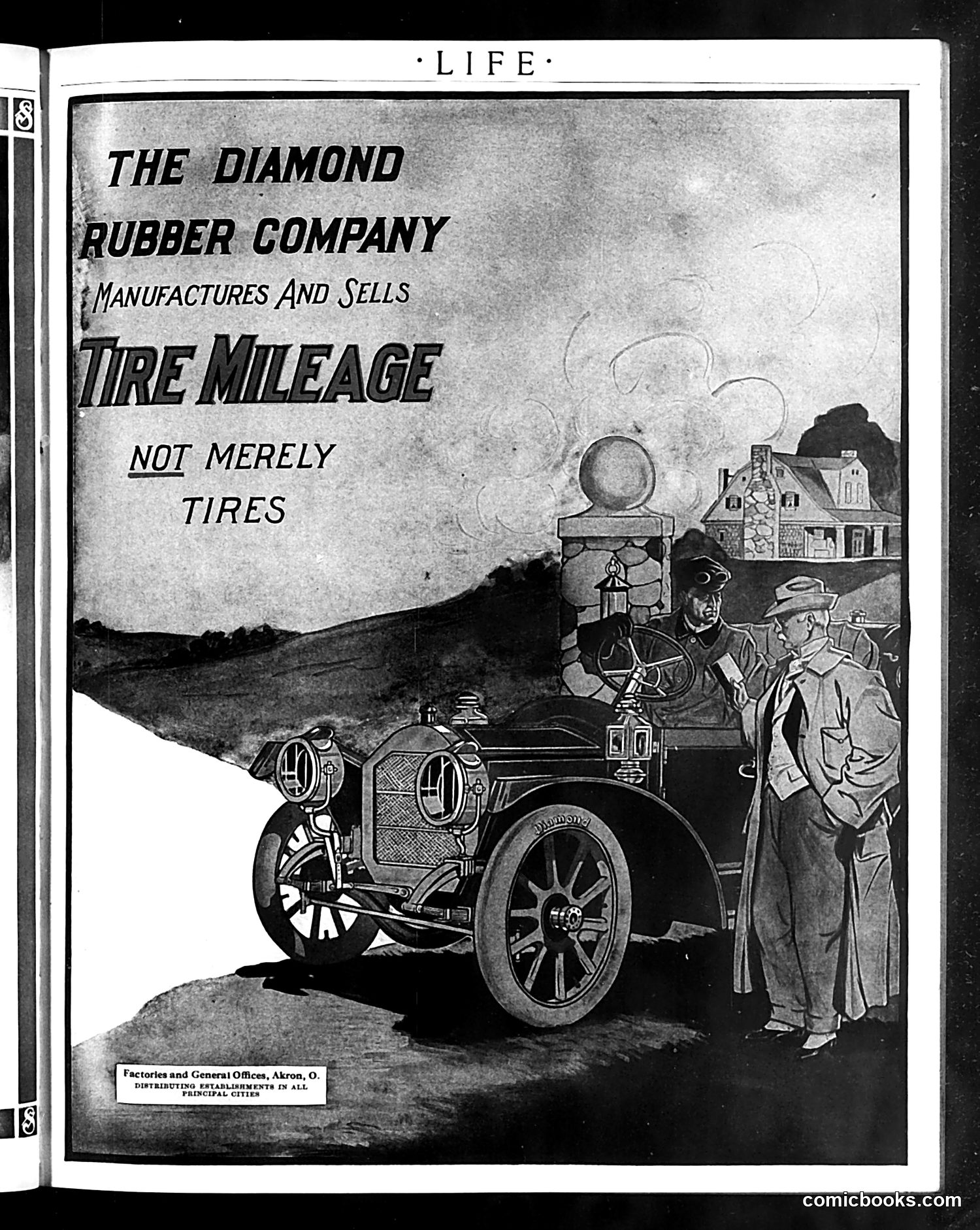
This is a **Diamond Rubber Company advertisement** for "Tire Mileage," not a political cartoon. The page promotes their tires by emphasizing durability and long-lasting performance—the key selling point being that their product offers more mileage than competitors. The illustration depicts an early automobile (appears to be from the 1910s era based on the vehicle design) with three well-dressed men examining or discussing the car. A house and rural landscape appear in the background. The advertisement's emphasis—"NOT MERELY TIRES"—suggests Diamond Rubber positioned themselves as offering superior quality and value beyond basic tire functionality. The company's factories and general offices were located in Akron, Ohio, a major tire manufacturing hub at the time.
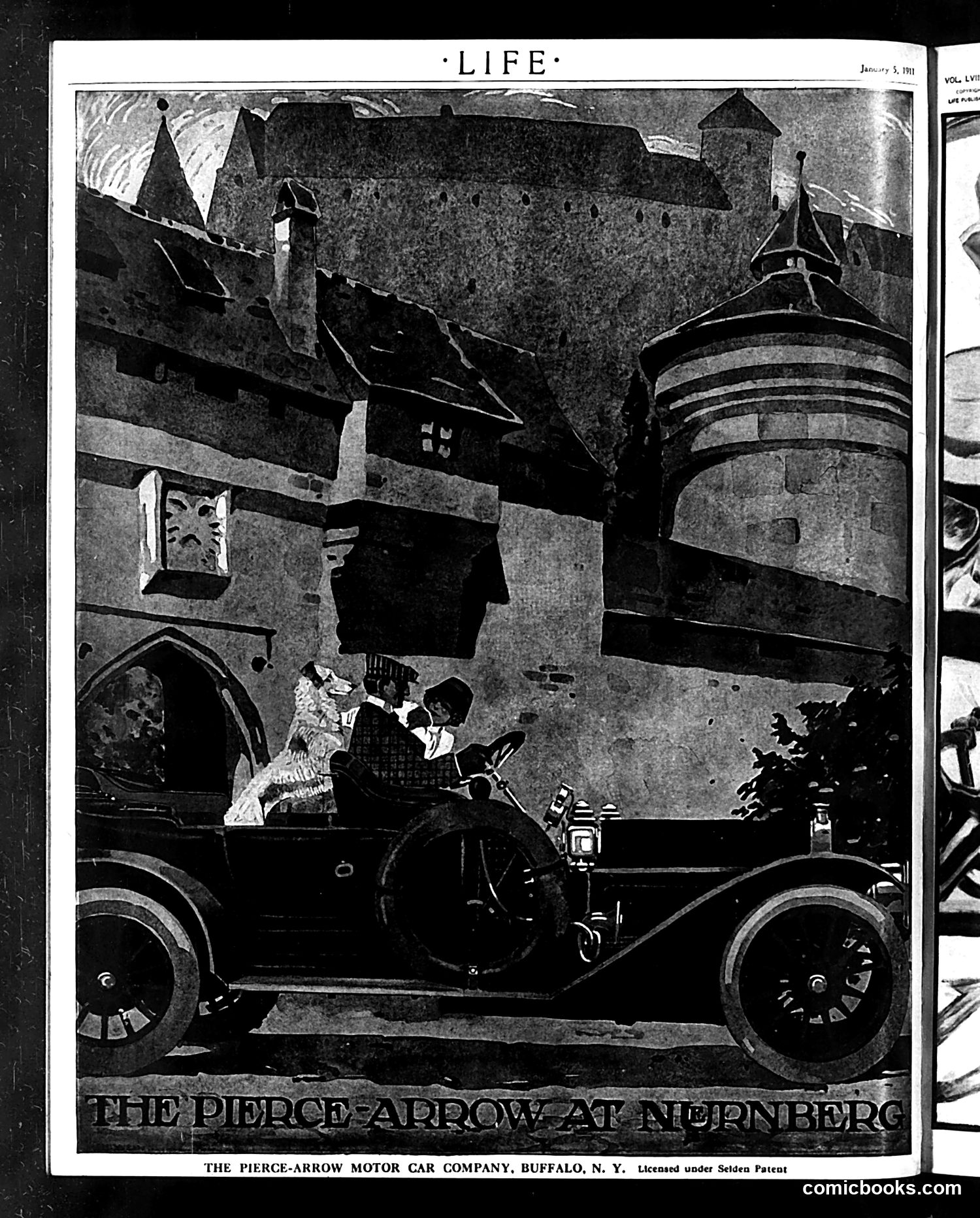
This page is primarily **an advertisement** for the Pierce-Arrow Motor Car Company of Buffalo, New York. The image depicts a romantic scene: a couple in an early automobile, dressed in formal attire, driving past a medieval European castle at night. The medieval architecture creates an atmosphere of elegance and romance. The advertisement uses this idealized imagery to associate the Pierce-Arrow vehicle with luxury, sophistication, and adventure. The "Selden Patent" reference indicates this car company licensed technology from the influential Selden Motor Vehicle Company patent. This is not political satire but rather **commercial marketing** typical of early 20th-century automobile advertising, positioning the Pierce-Arrow as a vehicle for the wealthy and cultured.