
Life, 1911-01-05 · page 28 of 104
Life — January 5, 1911 — page 28: what you’re looking at
What you’re looking at
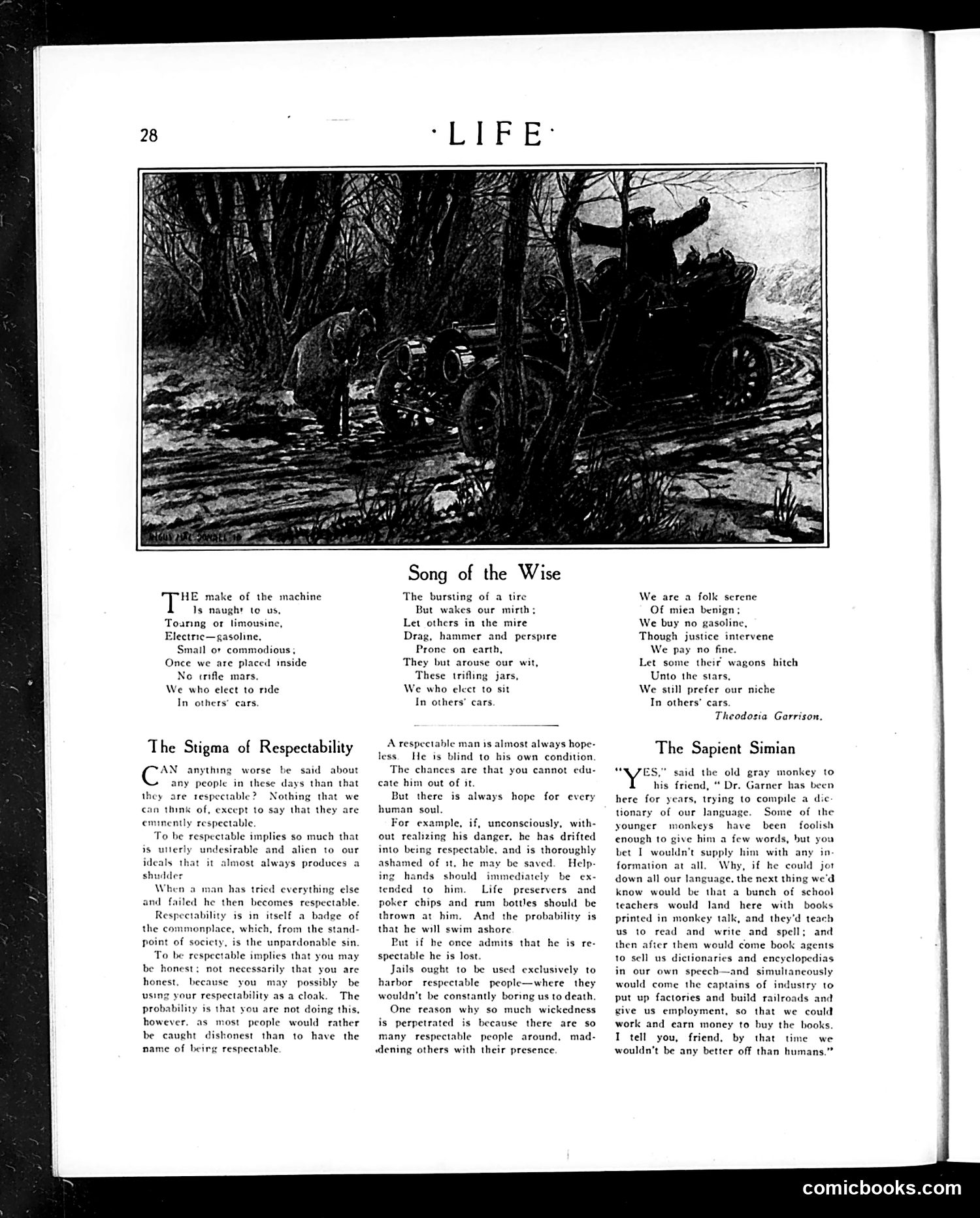
This page satirizes early automotive culture and respectability through three pieces. **"Song of the Wise"** mocks wealthy car owners who enjoy motoring while remaining detached from mechanical concerns or social responsibility. The poem's speaker boasts of sitting comfortably in cars while others struggle with repairs—a jab at class indifference and conspicuous leisure. **"The Stigma of Respectability"** argues that respectability itself is contemptible—a badge of the commonplace and conformist. The piece suggests respectable people are hopeless, blind to their condition, and tediously boring. Respectability is presented as worse than dishonesty. **"The Sapient Simian"** uses a monkey character to satirize progress. A monkey warns against teaching apes human language, fearing it would lead to schools, factories, employment, and capitalism—ultimately making monkeys "no better off than humans." This expresses skepticism about industrialization and modernization as genuine improvement. Together, these pieces critique wealth, conformity, and blind faith in progress—typical early 20th-century satirical concerns.
📄 Transcribed text from this page (OCR, searchable)
Machine-transcribed from the original scan — historical spelling and the odd misread are preserved.
HE make of the machine Is naught to us, Toaring or limousine, Electric—gasoline, Small or commodious ; Once we are placed inside No «nfle mars, We who elect to nde In others’ cars. The Stigma of Respectability ce anything worse be said abo! any people in these days than that they Nothing that we can think of, except to say that they are eminently respectable. To be respectable implies so much that undesirable and alien to our t it almost always produces a re respectable ? is utterly ideals th shudder When an and n has tried everything else iled he then becomes respectable Respectability is in itself a badge of the commonplace, which, from the stand- point of society, is the unpardonable sin. To be respectable implies that you may be honest: not necessarily that you are honest. because you possibly be vsing your respectability as a cloak. The probability is that you are not doing this, however. as most people would rather be caught dishonest than to have the name of being respectable. Song of the Wise The bursting of a tire But wakes our mirth; Let others in the mire Drag, hammer and perspire Prone on earth, They but arouse our wit, These trifling jars, We who elect to sit In others’ cars. A respectable man 1s almost always hope- less. He is blind to his own condition The chances are that you cannot edu- cate him out of it. But there is always hope for every human soul. For example, if, unconsciously, with- out realizing his danger, he has drifted into being respectable. and is thoroughly ashamed of st, he may be saved. Help- ing hands should immediately be ex- tended toh Life preservers and poker chips and rum bottles should be thrown at him. And the probability is that he will swim ashore Put if he once admits that he is re- spectable he is lost. Jails ought to be used exclusively to harbor respectable people—where they wouldn't be constantly boring us to death, One reason why so much wickedness is perpetrated is because there are so many respectable people around, mad- dlening others with their presence We are a folk serene Of miea benign We buy no gasoline, Though justice intervene We pay no fine. Let some theif wagons hitch Unto the stars, We still prefer our niche In others’ cars Theodosia Garrison. The Sapient Simian * said the old gray monkey to his friend, “ Dr. Garner has been Y here for years, trying to compile a dic tionary of our language. Some of the younger monkeys have been foolish enough to give him a few words, but you bet I wouldn't supply him with any in formation at all. Why, if he could jor down all our language, the next thing we'd know would be that a bunch of school teachers would land here with books printed in monkey talk, and they'd teach us to read and and spell; and then afier them would come book agents to sell us dictionaries and encyclopedias in our own speech—and simultancously would come the captains of industry to put up factories and build railroads and give us employment, so that we could work and earn money to buy the books. I tell you, friend, by that time we wouldn't be any better off than humans.” write comicbooks.com